Gran Sasso vs Falconeri: Cashmere, Merino Wool, and Quality Compared
Gran Sasso is the better sweater. Falconeri is the better purchase. Both of those sentences are true at once, and which one applies to you depends on a single question: will this sweater be worn forty times a year or a hundred and forty?
Here is the uncomfortable part. Falconeri’s cashmere, at its price, is genuinely good. Not good for the money. Good. Its Ultrafine cashmere crewneck costs $295 in the US, the yarn is fine, the hand is soft, and the colors are the ones people actually wear. Gran Sasso is the more sartorial knitwear house, with more developed construction and a tailoring point of view that Falconeri does not attempt, and its pure cashmere crewnecks list at roughly $500-$850. But “more sartorial” is not the same as “better for you,” and most buyers conflate the two. So let us separate them properly.
Two Different Kinds of Italian Knitwear
Gran Sasso is a knitwear specialist with seven decades behind it. Four brothers, Nello, Eraldo, Alceo and Francesco Di Stefano, founded Maglificio Gran Sasso in 1952 in Sant’Egidio alla Vibrata, in Abruzzo, and the family still owns it and still knits there. It builds its identity around the garment rather than the outfit: the yarn development, the range of gauges, the willingness to make a sweater with a proper shoulder and a collar that stands up on its own.
The house sensibility is traditional Italian tailoring translated into knit. Structured shoulders. Considered ribbing. A certain formality even in a crewneck. It is the kind of sweater that looks correct under a soft wool jacket and does not embarrass you at a dinner where everyone else is in tailoring.
Falconeri is much younger. Launched in 2000 and headquartered in Avio, in Trentino, it has belonged since 2009 to Sandro Veronesi’s Oniverse group, the company formerly known as Calzedonia Group, which also owns Calzedonia and Intimissimi. That ownership is often held against it, and it should not be. Falconeri is not a sourcing label: its cashmere is processed into yarn in Biella and knitted in its own Avio plant, which Forbes Italia reported in 2022 makes about 92% of the brand’s garments in-house, some four thousand pieces a day. It focuses tightly on cashmere, merino, silk and the understated basics that fill a wardrobe.
That matters because both brands own their knitting. When you compare Gran Sasso vs Falconeri, you are not comparing a craft workshop with an outsourcing operation. You are comparing two integrated Italian knitters with different priorities: Gran Sasso spends on construction and breadth, Falconeri on volume, a tight cashmere-led range and a lower price.
What Each Brand Is Actually Selling You
Gran Sasso sells craftsmanship-led discretion. The appeal is sartorial. You buy it because the garment has architecture, because it holds a line under a jacket, because it reads as considered rather than casual. It is a sweater for someone who has already decided what their wardrobe is and is filling a slot in it.
Falconeri sells soft, versatile, modern ease. The appeal is tactile and practical. You buy it because it feels lovely, because the color is right, because it works with denim, a skirt and the coat you already own. Its cuts lean relaxed, with dropped shoulders and raglan sleeves on many styles. It is a sweater for someone building a wardrobe rather than completing one.
Neither is a lesser motivation, but they lead to different purchases. Someone who wants Falconeri’s ease and buys Gran Sasso’s structure will find the sweater stiff and formal. Someone who wants Gran Sasso’s polish and buys Falconeri’s softness will find the sweater collapses under tailoring. Our Italian cashmere guide shows where both sit against the wider field.
What They Cost: The Price Overlap Most Buyers Miss
These are US prices at the time of writing (November 2026). Falconeri sells mainly through its own stores and website at fixed prices; Gran Sasso sells through department stores and boutiques, and much of it later reaches off-price retailers.
| Piece | Gran Sasso | Falconeri |
|---|---|---|
| Fine cashmere crewneck | About $500-$850 list | $295 (Ultrafine Cashmere Crewneck) |
| Same, bought off-price | Often $300-$350 | Seasonal sales on some colors |
| Softer, heavier cashmere crewneck | About $690 (felted cashmere) | $355-$425 (Ultrasoft Cashmere Crewneck) |
| Cashmere and silk crewneck | About $400 (wool, silk and cashmere) | $295 (Silkfine Cashmere) |
| Textured cashmere (waffle, tricot, bouclé) | Varies by season | $535-$885 |
Read the second row twice. A Gran Sasso cashmere crewneck bought off-price costs about the same as a full-price Falconeri Ultrafine. That gives you a simple decision rule: if you can find the Gran Sasso piece you want at $300-$350, in your size, with a fit you are sure of, it is the better buy for the money, because you get the more structured garment at Falconeri’s price. At Gran Sasso’s full list price of $500 or more, Falconeri wins on value unless you specifically need tailored structure.
Cashmere: Softness Is the Least Useful Measure
Here is where most comparisons go wrong. They pick up two cashmere sweaters, feel them, and declare the softer one better. Softness is the easiest quality to manufacture and the least predictive of how a sweater will age. What actually decides a cashmere sweater’s life is yarn consistency, knit density, recovery and finishing.
Knit density is how tightly the loops are packed. A dense knit resists distortion and holds its shape through wear. A loose, airy knit feels wonderful in the hand and collapses at the elbows within a season. Recovery is the fiber’s ability to spring back after stretching. Good cashmere bounces back when you pull it gently at the hem. Tired cashmere stays stretched.
Falconeri’s signature Ultrafine cashmere sits at the soft, light, easy end of that spectrum; the brand markets it as a thermoregulating, four-season knit, and its heavier Ultrasoft yarn covers colder weather. A lightweight crewneck that layers under a coat without bulk is a genuinely useful garment, and Falconeri does that well. But lightweight cashmere shows wear sooner at the friction points: under the arms, at the cuffs, where a bag strap crosses the body.
Gran Sasso’s cashmere tends to carry more body. The knits are more developed, the texture more deliberate, and the garment reads as tailored rather than languid. That extra substance is what makes it look correct under a jacket and what helps it survive regular wear. It is also why some buyers find it less immediately seductive on the hanger.
The practical tradeoff: lightweight cashmere layers beautifully and feels luxurious but asks more of you. Denser cashmere offers structure and durability but feels warmer and less effortless. If you run hot, or you want a sweater to wear indoors over a shirt, the lighter Falconeri approach may genuinely suit you better.
The hand test for cashmere
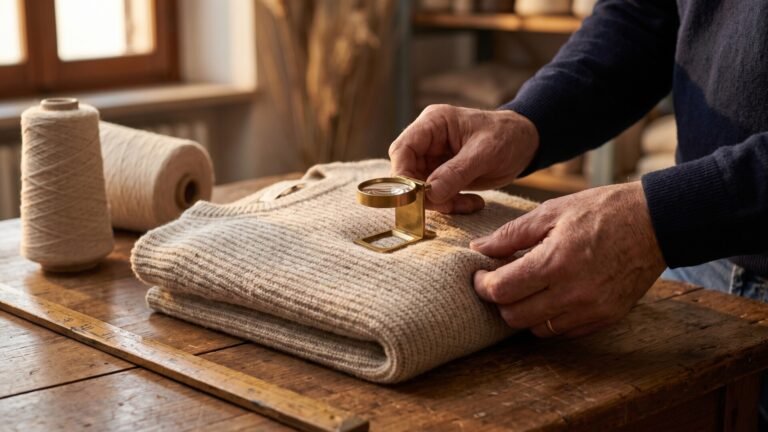
When you are holding one, gently stretch the body across the chest and let go. It should return without a memory of your hands. Turn the garment inside out and look at the seam where the sleeve meets the body: uneven stitching or a raw seam allowance means the inside was not a priority. Run your thumb along the inside edge of the collar; if it catches, it was finished in a hurry. Press the ribbing at the cuff and hem; it should feel firm and elastic, not limp. None of these tests tell you the brand. They tell you the garment, which is why the label is a starting point and not a verdict.
Merino Wool: The Rational Purchase
If I could move most readers away from cashmere and toward merino, I would. Merino wool, the fine fleece of Merino sheep spun thin enough to wear against skin without prickle, is the more rational purchase for the majority of people. It handles regular use better than delicate cashmere, regulates temperature across more seasons, travels without drama, and delivers a lower cost per wear almost every time, because you can wear it more often and wash it more confidently.
Gran Sasso’s merino is where the brand’s tailoring instincts show most clearly. The fine-gauge crewnecks, polos and refined cardigans are built for polished wardrobes: they sit cleanly under a jacket, the collars hold their shape, and the finishing is the kind you notice when you turn the garment inside out. For an office wardrobe built around tailoring, this is the natural choice.
Falconeri’s merino leans softer and simpler: base layers, easy crewnecks, casual layering pieces. Less architecture, more comfort. For someone who wants soft Italian knitwear without a formal appearance, it is the easier wear.
The gauge matters as much as the brand. Fine, lightweight merino disappears under a shirt or jacket and adds warmth without bulk. Heavier or textured merino offers more warmth and visual substance but can be too warm indoors. Buy for where you will actually wear it, not for the coldest day you can imagine.
Construction: Where the Real Difference Lives
Most buyers compare fiber content and stop. The fiber is on the label; the construction is not, and construction is where Gran Sasso’s advantage actually appears.
Look at shoulder shaping: a well-made sweater has a shoulder that follows the body’s line rather than a straight seam dropped from the neck. Look at sleeve attachment: set-in sleeves give a cleaner line under a jacket than dropped shoulders or raglans. Look at collar stability: a collar that stands up on its own after a season of wear was built with structure; one that flops was not.
Gran Sasso’s strength is in this architecture. The garment may not feel softer in the hand than a Falconeri piece, but it hangs better, moves better and looks more polished after the novelty of newness fades. Falconeri’s advantage is approachable wearability: simpler silhouettes, easy layering, soft textures, a fit language that works with casual clothes. The construction is competent, and this is not fast fashion, but it is not trying to be tailoring.
A repeatable inspection framework
Try the sweater on and move in it. Raise your arms; the body should not ride up dramatically. Check that the shoulder seam sits at the edge of your shoulder (unless the style is deliberately dropped). Examine the collar and cuffs for even ribbing and firm tension. Look along the body for a dropped stitch or a wavy panel, which shows up as a shadow line. Finally, check that the body hangs cleanly. Sizing differs too: both brands use Italian sizes, and Falconeri notes on some Ultrafine pieces that they run small and suggests sizing up.
Gran Sasso vs Falconeri Side by Side
| Feature | Gran Sasso | Falconeri |
|---|---|---|
| Founded and base | 1952, Sant’Egidio alla Vibrata (Abruzzo) | 2000, Avio (Trentino) |
| Ownership | Founding Di Stefano family | Oniverse (formerly Calzedonia Group) since 2009 |
| Overall identity | Craftsmanship-led knitwear with a refined, traditional feel | Accessible luxury focused on soft, understated staples |
| Cashmere character | More body, more tailored | Light Ultrafine and softer Ultrasoft yarns |
| Fine cashmere crewneck (US) | About $500-$850 list; $300-$350 off-price | $295 |
| Where to buy in the US | Department stores, menswear boutiques, off-price retailers | Falconeri stores and website |
| Best for | Construction, longevity, sartorial versatility | Approachable cashmere and effortless daily wear |
| Main tradeoff | Less casual; costs more at full price | Less distinctive construction in simpler styles |
Read the table as brand tendencies, not a guarantee about every garment. A dense Falconeri knit may outperform a lightweight Gran Sasso piece in a particular use case. Provisional winner by category: Gran Sasso for technical knitwear quality and refined structure; Falconeri for accessible softness, wardrobe basics and value at full price.
Three Years Later: What Actually Happens
Skip forward. It is three years from now and you are pulling the sweater out of a drawer for the fortieth time this winter. What does it look like? The answer depends far less on the brand than on how often you wore it and how you washed it. Use frequency is the main driver of cost per wear, and of wear itself. A merino sweater worn twice a week for three years will show more wear than a cashmere sweater worn twice a month, but it will also have delivered far more value per dollar.
What tends to fail first in fine knitwear, in roughly this order: pilling at friction points, stretched cuffs and hems, thinning at the elbows, and distortion from bad storage or washing. Most of that list is caused by handling, not by the fiber. A sweater ruined by a hot wash and a hanger was not a bad sweater; it was a badly kept one. And extremely soft, lightweight sweaters demand more careful rotation: you cannot wear them three days running. That is a real ownership burden, worth pricing in before you buy.
So here is the three-year framework. Choose Gran Sasso if the sweater must work with tailoring, stay visually polished, and justify its price through construction and versatility. Choose Falconeri if the sweater will be worn casually and often, especially if its $295 price lets you build a rotation of several pieces rather than overusing one. Choose merino over cashmere when durability, travel, frequent washing or daily commuting matters most. If resale is part of your thinking, our guide to whether cashmere holds its value explains why neither brand should be bought for it.
Styling and Real-World Ownership
Gran Sasso integrates with tailored trousers, wool jackets, dress shirts and refined outerwear. Put it under a soft-shouldered jacket and it looks correct. Put it with track pants and it looks like you got dressed in the dark. Falconeri integrates with denim, relaxed trousers, casual skirts, lightweight coats and simple travel wardrobes. That is not a lesser wardrobe. For most people, most days, it is the more useful one.
- Office and business-casual dressing: favor Gran Sasso’s more structured, polished knitwear.
- Travel and layering: favor Falconeri’s soft, lightweight Ultrafine pieces, but check each garment’s care label before you pack it.
- Cold-weather layering: fine merino as a base layer, cashmere as a mid-layer. Cashmere is the warmer-for-its-weight choice, not the tougher one.
- Weekend and everyday wear: favor whichever brand’s fit and price make frequent use comfortable. A sweater saved for special occasions is a sweater you overpaid for.
Care, briefly
Follow the garment label first, always. Wash infrequently: wool self-cleans better than most people assume. Use a wool-safe detergent, never a standard one. Do not hang knitwear; it stretches at the shoulders. Dry flat, reshape while damp, and store folded, away from moths. Our guide on how to care for luxury sweaters covers cashmere and merino step by step. And treat fit as a long-term value issue: a sweater too tight across the chest or too long in the sleeve will be worn less, however good the fiber.
Price, Value, and the Buying Verdict
Assess price without relying on the label: compare fiber quality, knit density, finishing, construction, versatility, expected frequency of wear and care burden. A $295 Falconeri Ultrafine crewneck worn weekly through five winters costs about $2.30 a wear; a $600 full-price Gran Sasso crewneck needs roughly twice as many wears to match it, while one bought off-price at $325 matches it at the same frequency. Do the maths for your own wardrobe.
- Best overall for craftsmanship and polished longevity: Gran Sasso.
- Best for accessible cashmere and easy everyday wear: Falconeri.
- Best value overall: Gran Sasso bought off-price, if you can get the right size and fit.
- Best material for frequent use: merino from either brand, chosen by fit and construction.
- Best first luxury sweater: Falconeri cashmere, for a softer, lower-risk entry, unless you need a structured wardrobe piece.
The One Thing to Carry Into the Shop
If you remember nothing else, remember this: the best sweater is the one whose fit, material and intended use match how often you will actually wear it. Gran Sasso builds the more serious garment, and for a polished wardrobe worn hard, it earns its price. Falconeri builds the easier one, and for a life lived casually, easy wins. Pick the sweater you will reach for on a Tuesday, not the one you admire on a hanger.
For the wider picture, read how Italian cashmere is made and our picks of the best Italian cashmere sweaters for men and for women. To see each brand against other names, try Lanificio Colombo vs Gran Sasso, Piacenza 1733 vs Falconeri and Falconeri vs Malo. If you are weighing the bigger houses, Gran Sasso vs Loro Piana, Loro Piana vs Falconeri and Gran Sasso vs Falconeri vs Brunello Cucinelli put both in context, and our guide to Italian designer clothing shows where knitwear fits in a full wardrobe.
Frequently Asked Questions About Gran Sasso Vs Falconeri
Is Gran Sasso better than Falconeri?
For knitwear construction, tailoring and traditional Italian craftsmanship, generally yes. For accessible cashmere, soft basics and casual versatility, Falconeri can be the better choice, and at full price it costs roughly half as much for a fine cashmere crewneck. Better depends on what you are asking the sweater to do, and on whether you can buy the Gran Sasso off-price.
Is Falconeri cashmere made in Italy, or is it fast fashion?
Falconeri labels its knitwear Made in Italy. Its cashmere is processed into yarn in Biella and knitted at its own plant in Avio, Trentino, which reportedly makes most of the brand’s garments in-house. It belongs to Oniverse, the group behind Calzedonia and Intimissimi, but its cashmere pricing and construction sit well above fast fashion.
What is the difference between Falconeri Ultrafine and Ultrasoft cashmere?
Ultrafine is Falconeri’s lightweight signature yarn, marketed as thermoregulating and wearable across four seasons; the US Ultrafine crewneck is $295. Ultrasoft is a softer, fuller yarn for colder weather, with crewnecks around $355-$425. Silkfine blends Ultrafine cashmere with silk for a slight sheen. Choose Ultrafine for layering and Ultrasoft for warmth on its own.
Where can I buy Gran Sasso and Falconeri in the US?
Falconeri sells mainly through its own US stores and website, so prices are consistent and sales are seasonal. Gran Sasso has no US brand store; it is sold through department stores, menswear boutiques and online multi-brand retailers, and a lot of stock later appears at off-price retailers, which is where the best value usually is.
Should I buy cashmere or merino from these brands?
Buy merino for frequent wear, travel, layering and durability, since it tolerates more washing and friction. Buy cashmere for softness, warmth for its weight and a more luxurious feel, accepting that it asks for more careful ownership. For a first purchase, a fine merino crewneck from either brand often delivers the lowest cost per wear.