Best Italian Cashmere Sweaters for Women: The Ultimate Guide to Luxury Knitwear Worth Investing In
A cashmere sweater that feels wonderful in the shop can still pill within weeks, lose its shape after a few washes, or look tired by the second winter. Softness is the easiest quality to judge by touch and the least reliable predictor of how a sweater will age. What matters more is the fibre it is spun from, how the yarn is plied, how the garment is knitted and finished, and whether the cut suits the way you actually dress.
This guide compares the Italian houses most often cited for women’s cashmere sweaters: Loro Piana, Brunello Cucinelli, Falconeri, Malo, Fedeli, Colombo, Piacenza 1733 and Gran Sasso. It explains what you pay for at each level, how crewnecks, V-necks, turtlenecks and cardigans differ, and how to look after the sweater once you own it. It is based on brand sources, retailer listings and published reporting rather than on personal wear-testing, and where we could not confirm a current price we have said so instead of guessing.
Looking for the wider picture? Start with our complete guide to Italian cashmere, part of the Italian designer clothing guide. Shopping for a partner? See the best Italian cashmere sweaters for men.
What Makes an Italian Cashmere Sweater Worth Paying For?
Fibre diameter and length
Cashmere is the soft undercoat of the cashmere goat, raised mainly in Mongolia and China’s Inner Mongolia region. Fibre diameter is measured in microns. Premium cashmere is generally around 14 to 16 microns, while cheaper cashmere often runs 18 microns or more and feels coarser against the skin. Fibre length matters just as much: longer fibres (commonly cited as over 34 to 36 millimetres) spin into stronger yarn that resists pilling, while short fibres shed and form pills quickly.
There is a real trade-off here. The very softest sweaters are often made from extremely fine fibre that is less hard-wearing, whereas a slightly thicker, longer fibre gives a firmer hand and a longer life. Neither is wrong; they suit different priorities.
Spinning, dyeing and finishing in Italy
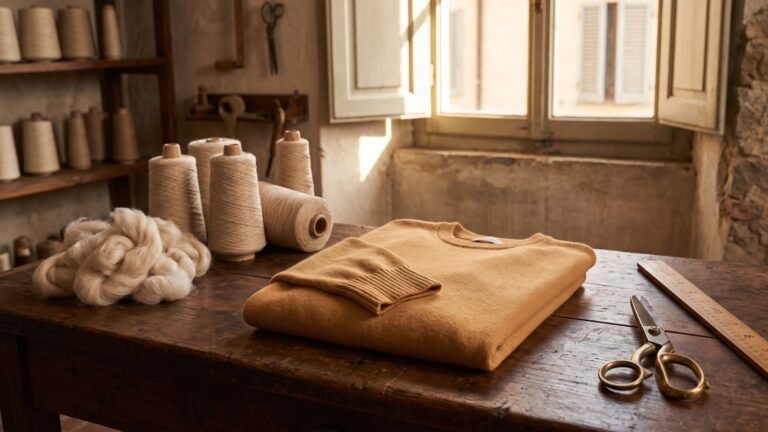
Much of Italy’s luxury cashmere spinning and weaving is concentrated in the Biella textile district in Piedmont, home to old family mills such as Fratelli Piacenza (founded in 1733) alongside the wider network of spinners and dyers that supply the big houses. Yarn spinning, dyeing and the final washing and brushing all affect how the sweater feels and how it ages. Over-aggressive brushing can raise a lovely surface at the cost of long-term durability, so a very fuzzy new sweater is not automatically a better one.
Ply, gauge and construction
Ply: Two-ply yarns (two strands twisted together) are stronger and pill less than single-ply yarns, which are lighter and drape more softly but are less durable. Many quality sweaters use two-ply yarn or heavier four-ply for winter pieces.
Gauge: Gauge describes how fine the knit is. Fine-gauge knits (for example 12 or 14 gauge) are slim enough to wear under a jacket; chunky knits are warmer but bulkier. Check the gauge or the product description if you plan to layer.
Seams and shaping: Look for neat, flat linking at the shoulders and underarms, a collar that springs back when stretched gently, and ribbing that is firm rather than loose. Fully fashioned pieces, knitted to shape rather than cut from fabric, usually hold their lines better.
Fibre content label: A garment sold as cashmere should state its fibre content. “100% cashmere” is the usual standard for this category, but blends with silk or fine merino are common and can wear well. A blend is only a problem if it is not disclosed.
Italian Cashmere in Context: Biella, Houses and Mills
Cashmere was long a prestige fibre before Italian industry industrialised its spinning and finishing. Fratelli Piacenza, based in Biella and founded in 1733, describes how Mario Piacenza travelled to the Himalayas in 1913 and learned that the soft cloth worn by local herders came from the cashmere goat’s undercoat, after which cashmere became central to the mill’s output. The Biella area remains the reference point for the wider Italian cashmere supply chain.
The houses compared below reflect different histories. Fedeli, started by the Fedeli family in Monza in 1934 as a felt-hat workshop, later moved into knitwear. Malo was founded in Florence in 1972. Colombo was founded by Luigi Colombo in 1967 in Borgosesia and began as a fabric supplier. Falconeri is part of the Calzedonia group and was built around making cashmere more accessible. Brunello Cucinelli, from Solomeo in Umbria, built its name on cashmere in muted colours. Understanding who started where helps explain why a Malo sweater and a Falconeri sweater differ in fit, finish and price.
For the long form on how the yarn is made, see how Italian cashmere is made, and for the price question see why Italian cashmere costs more than Mongolian cashmere.
Comparison Table: Italian Cashmere Houses for Women
| Brand | Best for | Price tier | Look | Origin note |
|---|---|---|---|---|
| Loro Piana | Top-tier fibre and finish | Ultra-luxury | Clean, minimal | Biella-area textile house |
| Brunello Cucinelli | Relaxed quiet luxury | Ultra-luxury | Muted tones, textured knits | Solomeo, Umbria; a sampled retailer listing says made in Italy |
| Falconeri | Entry point and value | Accessible premium | Modern, simple shapes | Calzedonia group |
| Malo | Heritage Florentine knitwear | Luxury | Classic, colourful | Founded in Florence, 1972 |
| Fedeli | Understated, long-established knitwear | Luxury | Refined, quiet | Family firm from Monza, 1934 |
| Colombo | Fabric-mill pedigree | Ultra-luxury | Plain, minimal | Borgosesia, founded 1967 |
| Piacenza 1733 | Mill heritage | Luxury | Elegant, classic | Biella, founded 1733 |
| Gran Sasso | Everyday knitwear | Premium | Versatile, classic | Italian knitwear label |
Price tiers are relative. Retail prices shift by season, size and market, so check the brand’s current listing before you buy. As one data point, a Brunello Cucinelli women’s cashmere sweater was listed at around $1,450 USD at a US retailer, while Falconeri has publicly pitched sweaters at a notably lower entry price than the luxury houses. We have not listed price ranges for brands where we could not confirm current figures.
How We Chose These Brands
We looked at fibre and yarn claims made by the brands, construction details visible in product listings, brand history, price position, and how easily each fits into a working wardrobe. The six questions we kept asking were: how fine and long is the fibre, how is it knitted, how comfortable is the cut, how versatile is the colour range, how likely is it to stay in shape, and what is the relationship between price and quality.
The Best Italian Cashmere Sweaters for Women
1. Loro Piana Cashmere Crewneck
Why it is the benchmark: Loro Piana is the name most often used as the reference point for luxury cashmere, and the house markets its finest cashmere as Baby Cashmere, taken from kid goats. Its crewnecks are cut cleanly, with minimal branding, and are available in fine-gauge and heavier knits.
Pros: very fine hand, restrained design, strong reputation for finishing.
Cons: among the most expensive options; a very soft, fine surface needs careful washing and storage.
Best for: buyers who want the benchmark fibre and are comfortable paying for it.
2. Brunello Cucinelli Cashmere Sweater
The quiet-luxury reference: Brunello Cucinelli is known for relaxed cashmere in a palette of greys, creams and earth tones, often with detailing such as ribbed hems or subtle beading on some styles. A sampled US retailer listing for a women’s cashmere sweater showed 100% cashmere, made in Italy, at around $1,450.
Pros: relaxed, wearable silhouettes; consistent palette that mixes well; strong brand identity.
Cons: premium pricing; some pieces are more decorated than a plain crewneck.
Best for: buyers who want an elevated, lived-in look. Compare directly with Loro Piana in Loro Piana vs Brunello Cucinelli.
3. Falconeri Ultrasoft Cashmere Sweater
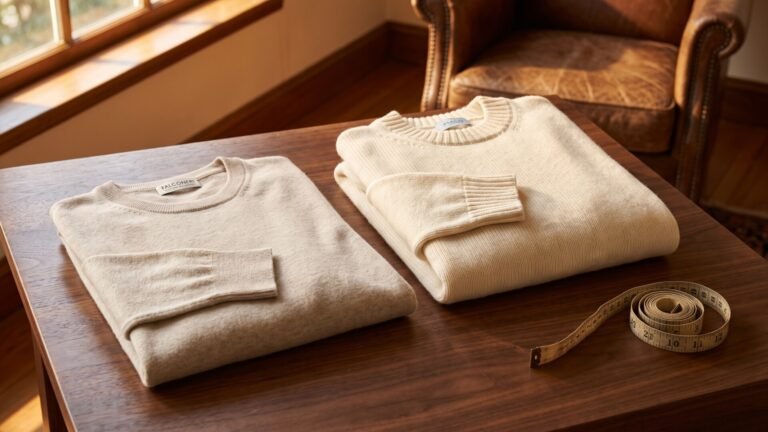
The value entry point: Falconeri, part of the Calzedonia group (which acquired the brand around 2009), positions itself as accessible cashmere, with a supply chain it describes as running from Mongolia to its stores. It is the usual starting point for readers new to cashmere.
Pros: approachable price, wide range of colours and shapes, easy to find.
Cons: a lighter, softer construction than top-tier houses may not wear in quite the same way over many seasons.
Best for: first-time buyers and anyone building a cashmere wardrobe on a budget. See Falconeri vs Malo for a closer value comparison.
4. Malo Cashmere Crewneck
Florentine knitwear specialist: Malo was founded in Florence in 1972 and works with fibres including cashmere, cashmere-silk blends and extra-fine merino. The house is known for its range of colours and for a clean, slightly fitted cut.
Pros: deep colour range, specialist knitwear focus, wearable fits.
Cons: some of its range is sold through limited channels, so availability varies.
Best for: buyers who want a dedicated knitwear house with a clear colour story.
5. Fedeli Pure Cashmere Sweater
Understated and long-established: Fedeli began in 1934 in Monza as a felt-hat workshop run by the Fedeli family and grew into a cashmere knitwear specialist, with stores in Milan and, since 2012, London. The look is quiet and polished.
Pros: restrained design, family-run heritage.
Cons: smaller retail footprint than the biggest names.
Best for: buyers who want quality without loud branding.
6. Colombo Cashmere Knit
A mill that sells garments: Luigi Colombo founded the business in 1967 in Borgosesia after developing a double-faced cashmere technique in the 1960s. Fabric is still its core business, and it sells finished sweaters and cardigans through its own channels. Published commentary on the brand rates the knitwear as its strongest category.
Pros: mill pedigree, minimal design.
Cons: high price point, narrow distribution, limited styling variety.
Best for: buyers who care about the mill behind the garment.
7. Piacenza 1733 Cashmere Sweater
Mill heritage: Lanificio Fratelli Piacenza was founded in 1733, is based in Biella with its factory in Pollone, and belongs to the Hénokiens association of long-lived family firms. Carlo Piacenza represents the thirteenth generation to lead the business, according to a profile in The Rake. Cashmere has been central to its output since the early twentieth century.
Pros: deep textile heritage, classic styling.
Cons: the ready-to-wear line is smaller and more menswear-led than the other names here.
Best for: buyers drawn to old mills and classic shapes.
8. Gran Sasso Knitwear
Everyday knitwear: Gran Sasso is better known for wool and wool-cotton knitwear than for pure cashmere, so confirm the fibre content of the specific style (some are wool-cashmere blends) before buying. It is a sensible choice for casual, hard-wearing knits.
Pros: practical, versatile styles.
Cons: not every style is pure cashmere.
Best for: casual layering where durability matters more than the softest hand.
9. Brunello Cucinelli Relaxed Cashmere Turtleneck
A cashmere turtleneck is the layering workhorse for cold months. The Cucinelli version is cut with a relaxed body and a soft, folded neck. Wear it under a coat or alone with trousers.
Best for: winter layering and travel dressing.
10. Falconeri Cashmere V-Neck
A fine-gauge V-neck is the easiest cashmere to wear under a blazer or over a collared shirt. Falconeri’s version is an inexpensive way to test whether the shape works for you before investing in a luxury house.
Best for: first purchase, office layering.
Softest Cashmere Crewnecks and Turtlenecks: What to Look For
Readers often ask which designer brands make the softest crewnecks and turtlenecks. The softest hand usually comes from the finest fibre (low micron count) and a fine-gauge, single- or two-ply knit, which is why Baby Cashmere from Loro Piana and similar fine-fibre ranges feel so smooth. The trade-off is durability: the same fineness that feels so soft can pill and snag more readily. If you want a softness-versus-wear compromise, look for two-ply yarns in a mid gauge, and use our guide to the best Italian cashmere brands to compare houses before choosing.
Crewneck, V-Neck, Turtleneck or Cardigan?
Crewneck: the most versatile shape. It works under a jacket, over a shirt collar or on its own, and suits most necklines and necklaces.
V-neck: best for layering over a shirt or under a blazer; the open neckline also elongates the neck.
Turtleneck and mock neck: the warmest option and a natural base layer under coats. A fine-gauge turtleneck is easier to wear under tailoring than a chunky one.
Cardigan: a useful third layer for offices and travel. Italian cashmere cardigans are usually sold in button-front and open-front versions; button-front versions in fine gauge double as a sweater.
For most first purchases, a crewneck in a neutral colour is the safest choice. If you mainly dress in tailoring, add a V-neck next; if you live in a cold climate, add a turtleneck.
Loro Piana vs Brunello Cucinelli for Women
Fibre: Loro Piana is generally the reference for the finest hand. Look: Loro Piana is cleaner and more minimal; Cucinelli leans relaxed, with more texture and a muted palette. Price: both sit at the top of the market. Which suits whom: choose Loro Piana for a sleek, fine knit; choose Cucinelli for a softer, lived-in look. For a longer comparison read Loro Piana vs Brunello Cucinelli.
Affordable Cashmere That Rivals the Luxury Labels
You do not need a four-figure sweater to get good cashmere. Falconeri is the most accessible Italian name in this guide, and mid-priced makers often use the same Italian mills as the luxury houses. What you give up at lower prices is usually a finer fibre, a more robust yarn ply or finishing detail. To judge a lower-priced sweater, check the fibre label, look for two-ply yarn, stretch the hem gently to see whether it recovers, and rub a small area to see how readily it fuzzes. Our guide to Falconeri vs Malo shows how value compares across two Italian names.
Italian vs Scottish Cashmere
Italian cashmere tends to be cut closer to the body and finished with soft, smooth surfaces, while Scottish cashmere has a reputation for denser, more structured knits. Both traditions produce excellent garments. Read Italian vs Scottish cashmere for a detailed breakdown.
Is It Worth the Money? A Cost-Per-Wear View
Cost per wear is a simple way to compare. A $500 sweater worn 50 times a year for five years is 250 wears, or $2 per wear. A $1,200 sweater worn 20 times a year for five years is 100 wears, or $12 per wear. A $200 sweater worn 20 times in a single season before it pills out costs $10 per wear. The point is not that cheaper is always better; it is that the sweater you reach for most often is the one that earns its price. Fit and colour decide how often that is, so buy the shape you will actually wear. See our overview of Italian cashmere for more on the value case.
How to Choose
Fit: Relaxed fits are forgiving and layer well; slim fits suit tailoring. Try your usual size and one size up in oversized styles, as sizing varies across Italian houses. Colour: Start with navy, charcoal, camel, cream or black, then add colour. Weight: Fine gauge for layering and year-round wear, mid gauge for everyday winter, chunky for cold weather. Occasion: Plain crewnecks and V-necks suit offices; turtlenecks and cardigans suit travel and casual weekends.
How to Care for a Cashmere Sweater
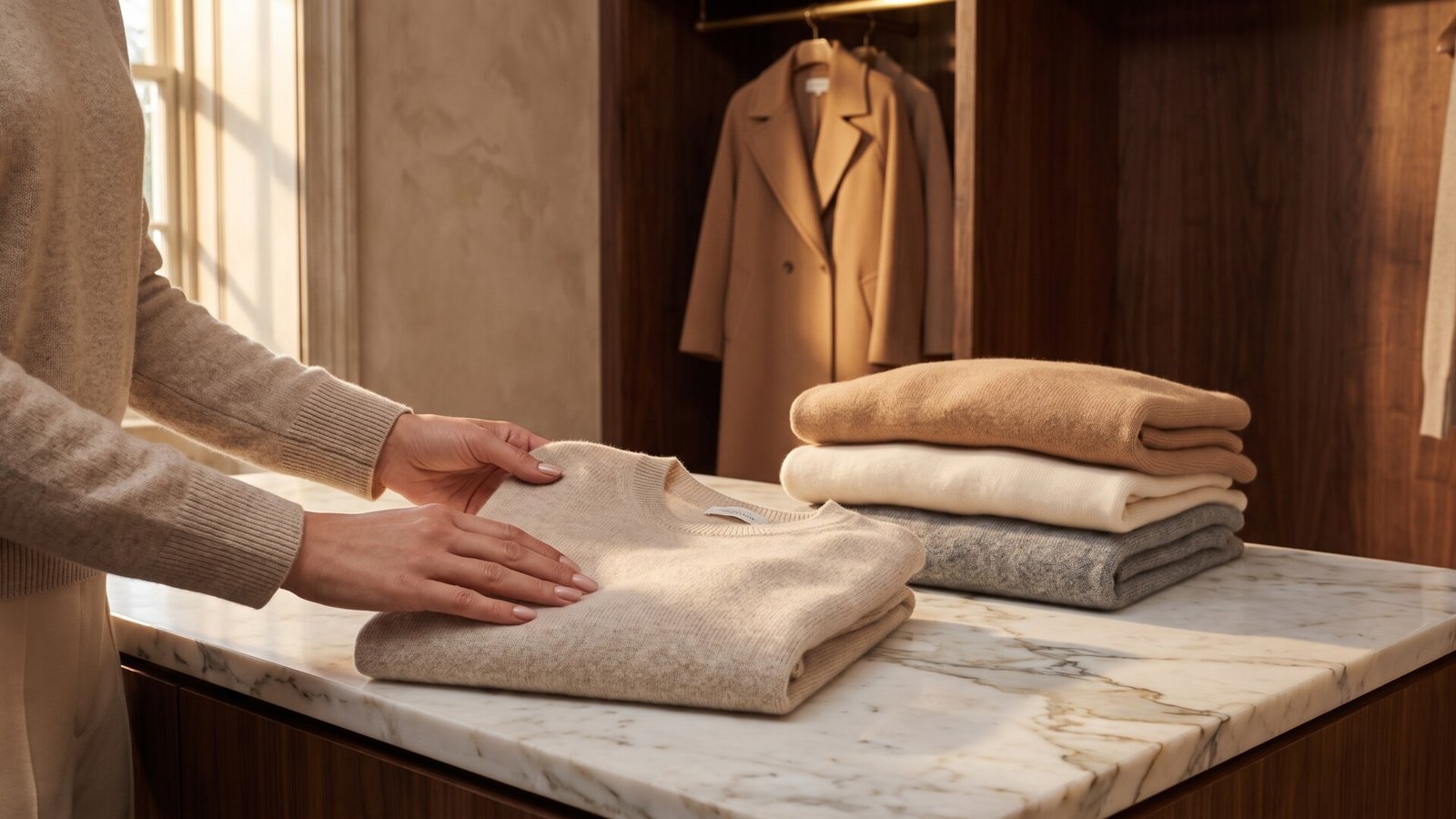
Washing: Follow the care label. Many owners hand wash in cool water with a gentle wool or cashmere detergent, press out the water without wringing, and dry flat. Dry cleaning is an option for structured or embellished pieces. Test any product on an inside seam first.
Storage: Fold rather than hang, to avoid stretched shoulders. Keep in breathable cotton bags, with cedar or lavender sachets if moths are a concern.
Pilling: Some pilling in the first weeks is normal as loose fibres work free. Remove pills with a cashmere comb or a fabric shaver used lightly, and avoid abrasion from bag straps and seatbelts.
Moths: Clean sweaters before storing them for summer, as moths are attracted to body oils and food residue.
Rotation: Resting a sweater between wears lets the fibres recover.
For a wider look at care, browse our care and maintenance section for leather and knitwear guidance.
Related Reading
- Italian Cashmere: the complete guide
- Best Italian cashmere brands
- Best Italian cashmere sweaters for men
- Best Italian cashmere scarves
- How Italian cashmere is made
- Why Italian cashmere is more expensive than Mongolian cashmere
- Italian vs Scottish cashmere
- Falconeri vs Malo
- Italian designer clothing guide
Frequently Asked Questions About Italian Cashmere Sweaters For Women
What is the best Italian cashmere sweater for women?
It depends on what you value. Loro Piana is the usual benchmark for fibre fineness and finish, Brunello Cucinelli for a relaxed quiet-luxury look, and Falconeri for an accessible first purchase.
Which designer brands offer the softest cashmere crewnecks and turtlenecks?
The softest hand generally comes from very fine fibre in a fine-gauge knit, and Loro Piana’s Baby Cashmere is the best-known example. Softer fibre can pill more readily, so a mid-gauge two-ply knit is a good compromise if you want it to last.
Is Falconeri real cashmere?
Falconeri sells cashmere knitwear and is part of the Calzedonia group. Always check the fibre content label on the specific style, because blends exist.
Are there affordable Italian cashmere sweaters that rival the luxury labels?
Falconeri is the most accessible Italian name here. Lower prices usually mean a less fine fibre or lighter construction, so check ply, fibre content and how the hem recovers when stretched.
Where can I find Italian cashmere cardigans?
Most of the houses in this guide, including Malo, Falconeri, Brunello Cucinelli and Loro Piana, make cardigans alongside their sweaters. Fine-gauge button-front styles layer most easily.
How should I wash a cashmere sweater?
Follow the care label. Many owners hand wash in cool water with a gentle detergent, press out water without wringing, and dry flat. Dry cleaning suits structured pieces.
Is Italian cashmere better than Scottish cashmere?
Neither is better in every respect. Italian cashmere is often finished smooth and close-fitting, while Scottish knits are often denser. See our Italian vs Scottish cashmere comparison for detail.
What colour cashmere sweater should I buy first?
Navy, charcoal, camel, cream or black. These neutrals work with most wardrobes and hide wear better than very pale shades.
Conclusion
Choose the fibre and construction you can afford, then buy the shape you will wear most. A single well-made crewneck in a neutral colour, looked after properly, usually delivers more than a drawer of impulse buys. Compare houses in our cashmere brands guide, and check the current listing for price and fibre content before you buy.