Italian Leather Craftsmanship: From Tannery to Timeless Luxury
Italian leather craftsmanship is a chain, not a single thing. Tanneries in Tuscany, Veneto and Campania turn raw hides into finished leather; workshops and factories cut, stitch and finish it; and houses such as Gucci, Prada, Bottega Veneta and Loro Piana decide how it is used. This hub explains each link, shows how Italian leathers behave differently, and points to our guides on how leather is made, where it is tanned, how to care for it and which brands to know.
Start with the section that matches your question: which houses set the benchmark for handcrafted leather, how to tell whether an item truly uses Italian artisan techniques, or which leather goods are the best way into luxury.
The Legacy of Italian Leather
Tanning and leatherwork have a long history on the peninsula, and Florence in particular became known for leather workshops and guilds from the Middle Ages. Today the industry combines heritage techniques with modern, regulated processes, and tanneries cluster in a few districts. According to UNIC, the Italian tanners’ association, Italy accounts for about 65% of the value and 72% of the volume of European tanning production.
Italian leather stands out for three reasons:
- Material quality – tanneries buy hides from many countries and select and grade them closely, working mostly with cowhide, calfskin, lambskin and goat, plus smaller volumes of exotic skins.
- Tanning and finishing know-how – Italy produces both vegetable-tanned and chrome-tanned leather, along with specialist finishes such as pressed and waxed Saffiano, hand-burnished dress-shoe patinas and hand-dyed vintage looks.
- Design and making – houses pair the material with details such as hand-painted edges, woven leather and hand-finished soles, which is where much of the price difference between brands comes from.
This combination of material, technique and design is why Gucci, Prada, Loro Piana and Fendi are associated with Italian leather. One honest caveat: no single process makes “Italian leather” better in every way. Chrome-tanned leather is the most common type worldwide and is chosen for softness, colour range and consistency; vegetable-tanned leather is chosen for firmness and patina. Both can be excellent, and the right choice depends on how you will use the piece.
How Italian Leather Is Made
The full process is in our guide From Tannery to Runway: How Italian Leather Is Made. In short:
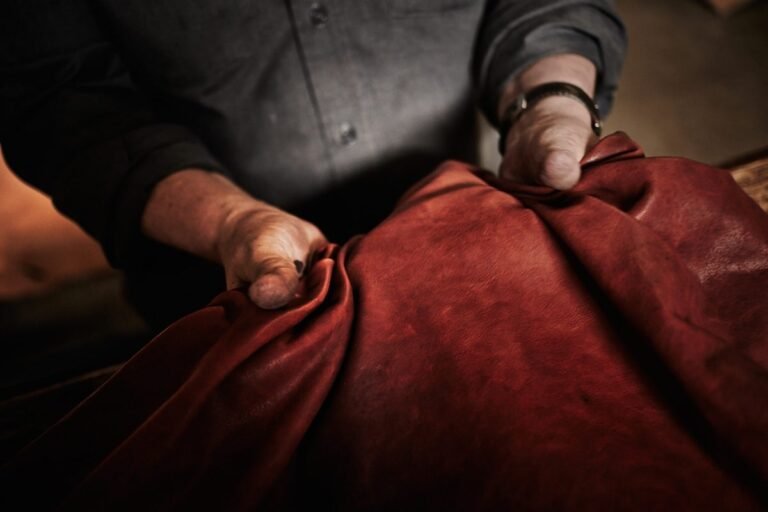
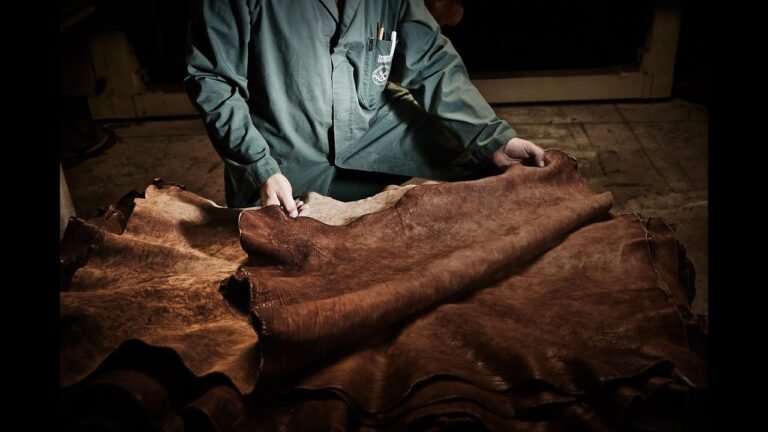
- Selection of raw hides – hides, usually a by-product of the meat industry, are graded for surface marks, thickness and uniformity. Scars, insect bites and brand marks reduce how much of a hide can be used for visible panels on a premium bag.
- Tanning – tanning stabilises the hide so it does not rot. Vegetable tanning uses plant tannins such as chestnut and mimosa and is slow and costly, producing firm leather that darkens into a patina. Chrome tanning is faster and gives softer, more colour-stable leather, used for most nappa, calfskin and Saffiano bases. Many tanneries also offer combination tannages.
- Dyeing and finishing – leather is drum-dyed or surface-dyed, then finished. Finishes range from almost none (aniline and semi-aniline, which show the natural grain) to heavy pigment coats and embossing. Hand-burnishing and hand-applied colour appear on some premium dress shoes.
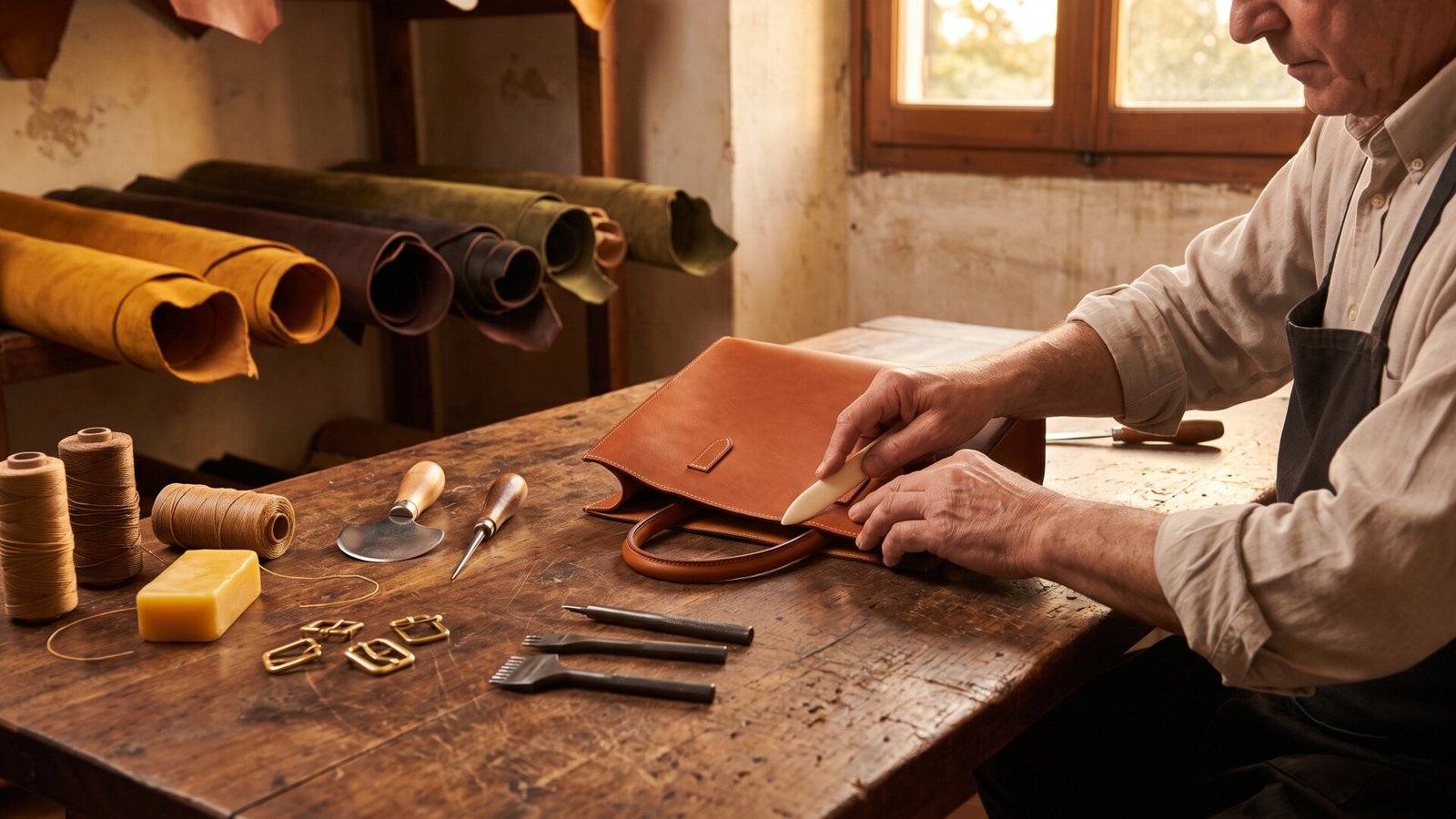
- Cutting and stitching – pieces are cut (increasingly by machine, though premium houses still hand-select panels), skived at the edges, stitched and finished. Hand-painted edges and hand-sewn details are labour-intensive and one of the clearest signs of a higher tier.
This is why many Italian goods are durable and functional and often last for many years when properly maintained. How long a piece lasts depends as much on the leather type, construction and your care as on the country of origin.
Italian Tannery Regions
Italian tanning is concentrated in a few districts, each with its own specialism. Our article The Italian Tannery Regions: Where the World’s Best Leather Comes From goes deeper. A snapshot:
| District | Region | Known for | Typical end uses |
|---|---|---|---|
| Santa Croce sull’Arno, Ponte a Egola and San Miniato | Tuscany | Tuscan vegetable-tanned leather and sole leather (“cuoio toscano”), plus chrome-tanned leather for footwear and bags; about 400 companies and 5,600 employees across the wider Tuscan district | Handbags, belts, shoe soles and linings, small leather goods |
| Arzignano (Chiampo valley) | Veneto | Italy’s largest and most productive district, focused on medium-to-large bovine hides | Furniture, automotive and footwear leather |
| Solofra | Campania | Small sheep and goat skins, nappa leather | Jackets, gloves, bags, accessories |
Tuscan vegetable-tanning tanneries are represented by the Consorzio Vera Pelle Italiana Conciata al Vegetale in Toscana, whose mark certifies the tanning method and origin and involves periodic checks by an independent certifier. Several large luxury groups own or hold stakes in tanneries in the area, so it is worth reading about sourcing before you assume a brand’s leather is “made by hand from start to finish”. A brand’s workshop (in Florence or the Marche, say) and the tannery that supplied its leather are often in different places.
Reading the chain on a label. “Made in Italy” tells you where the last step happened. A named tannery or a consortium mark tells you about the leather. A brand’s own statement about its workshop tells you about the making. A piece can be strong on one link and weak on another, so ask which link the brand is actually vouching for before you pay a premium for the word “Italian”.
Italian Leathers Compared
The leather name on a product page tells you more about how a piece will age than the brand does. This table covers the leathers you will meet most often in Italian goods.
| Leather | What it is | Strengths | Trade-offs | Example brands |
|---|---|---|---|---|
| Saffiano | Calfskin pressed with a cross-hatch pattern and finished with wax | Scratch- and water-resistant, holds its shape | Little patina; the stiff surface can crack along edges over years | Prada |
| Intrecciato nappa | Strips of soft nappa woven by hand | Supple, light, distinctive texture | Soft leather marks and sags if overloaded; avoid rain | Bottega Veneta, Valextra (different construction) |
| Vegetable-tanned cowhide | Tanned with plant tannins over weeks | Develops a deep patina, repairable, firm | Marks from water and oils; needs conditioning | Il Bisonte, The Bridge, Guidi |
| Calfskin (smooth) | Fine-grained leather from young cattle | Dressy finish, takes burnishing well | Scratches show; needs polish and shoe trees on footwear | Santoni, Ferragamo, Gucci |
| Suede and nubuck | Sanded leather with a velvety surface | Soft, casual, comfortable | Water and stains are hard to remove | Valstar, Tod’s, Brunello Cucinelli |
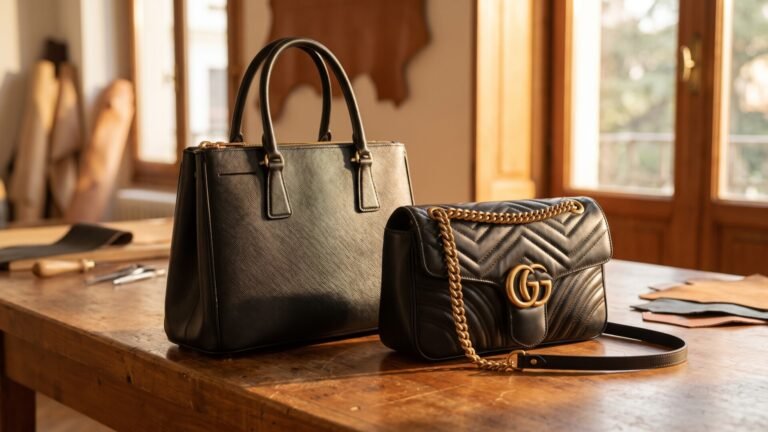
A simple decision rule: choose Saffiano if you want a bag that ignores commutes and rain; vegetable-tanned leather if you like a piece that changes with use and can be conditioned and repaired; nappa if low weight and softness matter more than shape; and suede only for dry-weather, occasional wear. Match the leather to your habits first and the brand second. For a direct comparison of two popular choices, read Prada Saffiano vs. Gucci GG Marmont: Which Leather Lasts Longer? and our guide to Vachetta vs Saffiano for daily use.
Which Houses Are Known for Leather Craftsmanship?
Readers often ask which luxury house is the “gold standard” for leather. There is no single answer, because houses excel at different things. Our full ranking is in Top Italian Leather Brands to Know; here is what each main name is best known for:
- Bottega Veneta – the hand-woven intrecciato technique, founded in Vicenza in 1966; its strongest association is logo-free leather goods.
- Prada – Saffiano, the cross-hatched wax-finished calfskin that became the house’s trademark, in the family firm founded by Mario Prada in Milan in 1913.
- Gucci – Florentine leather goods and luggage heritage (founded 1921), with the Horsebit loafer and the bamboo-handle and GG Marmont lines.
- Fendi – Roman leather and fur house (founded 1925), known for the hand-stitched Selleria line and the Baguette and Peekaboo bags.
- Loro Piana – best known for cashmere and fine wool; its bag line includes the Extra Bag and Bale, the latter inspired by raw cashmere yarn. Check each model’s product page for leather type and origin rather than assuming.
- Salvatore Ferragamo and Santoni – the footwear specialists: Ferragamo for engineered fit, Santoni for hand-finished colour.
- Valextra – Milan minimalism with hand-painted edges. Serapian’s Mosaico weave is an alternative to intrecciato (Serapian is covered in our brands guide).
For smaller artisan names, see our guide to emerging and niche Italian designers and Italian artisanal leather workshops you can buy from directly.
Italian Leather Handbags
Handbags are often the most visible and collectible Italian leather products. Our guide Best Italian Handbags for the Holidays highlights standout pieces, the Italian Designer Handbags hub covers every category from totes to travel bags, and our ranking of top Italian handbag brands shows who suits whom. When comparing bags, look at:
- Leather type – structured Saffiano holds its shape; soft nappa slouches and needs more careful handling.
- Edge finishing – painted edges should be smooth and even, with no cracking at the folds.
- Hardware and lining – check zip action, hardware weight and the interior lining as well as the exterior.
Italian Leather for Shoes and Accessories
Beyond handbags, Italian leather appears in shoes, belts, wallets, cardholders, watch straps and gloves. Our Italian designer shoes guide covers footwear construction, and the Italian designer accessories hub covers belts and small leather goods.
- Belts – a full-grain leather strap is the part to judge; the buckle is secondary.
- Wallets & cardholders – compact pieces use the same leather as bags and see more wear, so material choice matters.
- Small leather goods – key holders, coin purses and tech cases are the cheapest way to try a brand’s leather.
On a budget, see Best Affordable Italian Leather Gloves for Men.
Best Entry Points Into Luxury Leather
For a first piece, small leather goods and accessible-tier brands give you a feel for the material without the cost of a flagship bag. Price tiers on this site use the same bands throughout: accessible is most bags under about $800, premium is roughly $800–$2,500, and top luxury is signature bags from about $2,500 upwards. Prices vary by size, leather and retailer, so check the current price with the brand.
| Goal | Good starting point | Why |
|---|---|---|
| Try vegetable-tanned leather | Il Bisonte or The Bridge wallets and totes | Visible patina development at accessible-tier prices |
| Everyday polished bag | Furla or Coccinelle | Italian-designed leather bags in the accessible tier |
| Durable luxury bag | Prada Saffiano | Scratch-resistant finish suits daily use |
| Quiet luxury | Bottega Veneta or Valextra small leather goods | Logo-free design, lower entry cost than bags |
| Dress shoes | Santoni or Ferragamo | Hand-finished colour and an established fit range |
Small leather goods show craftsmanship fastest. Slim card holders and wallets from Valextra (edge-painted), Bottega Veneta (woven) and Il Bisonte (vegetable-tanned) are good examples; check the edge paint, stitch spacing and snap or zip action before you judge the brand.
How to Tell if a Piece Is Truly Italian-Made
“Made in Italy” is a legal origin claim that applies per product. Under EU origin rules it generally means the last substantial transformation took place in Italy, so some components or even the hide can come from elsewhere. Brands that tan and make everything in Italy usually say so explicitly. The practical checks:
- Look for a clear “Made in Italy” label on the product or product page, not just an Italian-sounding brand name.
- Check whether the brand names the tannery or leather, or carries a consortium mark such as the Tuscan vegetable-tanned leather mark.
- Inspect the leather: natural grain with small pores and variations is typical of aniline and semi-aniline leather, but heavily finished and embossed leather is uniform and still real leather.
- Look at the finishing: even stitching, smooth painted or burnished edges and clean lining seams.
- Buy from the brand or an authorised retailer, and keep the documentation. Visual checks alone cannot prove authenticity.
Caring for Italian Leather
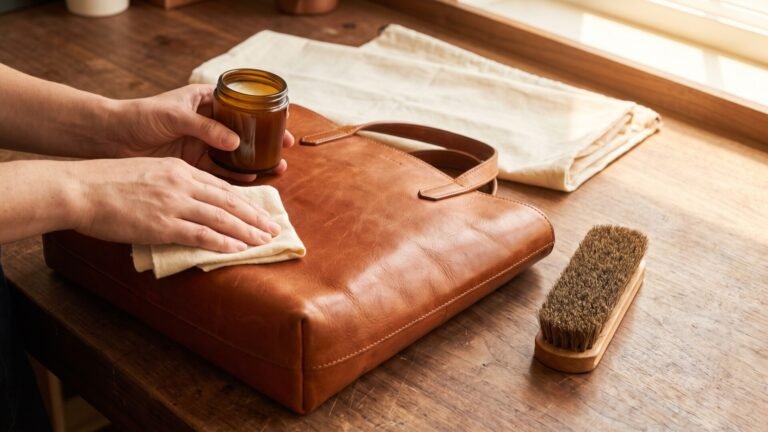
Even good leather needs maintenance. For a full guide, see How to Care for Italian Leather Goods (The Right Way), and for frequency, how often to condition high-end Italian leather. Key tips:
- Clean gently – use a soft cloth and a mild leather cleaner; test any product on an inconspicuous area first.
- Condition as needed – conditioner suits vegetable-tanned and natural leathers; coated leathers such as Saffiano need much less.
- Store properly – keep bags, shoes and jackets in dust bags or boxes, away from direct sunlight, heat and moisture.
- Protect from water – nappa, suede and untreated leathers are the most sensitive; use a professional cleaner for valuable pieces.
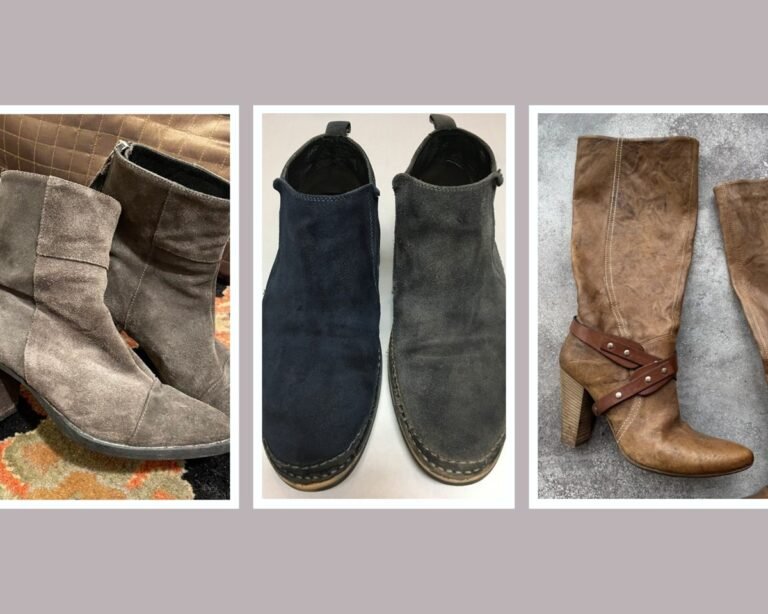
Specific problems have their own guides: removing ink from Prada Saffiano and restoring colour to faded suede boots.
Italian Leather in Fashion Design
Designers choose hides, finishes and colours to suit each collection. Prada’s Saffiano and structured totes show off firmness; Gucci’s loafers show off flexible calfskin; jackets, gloves and belts rely on thinner, softer skins that suit drape and movement. Specialists such as Stewart, Rifugio and Giorgio Brato make leather and suede jackets, and Poltrona Frau applies the same craft to furniture. See Italian designer clothing and the Italian fashion designers guide for the houses behind these choices.
Value, Resale and Collectibility
Some Italian pieces resell well, but value retention is never guaranteed and varies by model, condition and market. Continuously produced classics generally hold value better than seasonal, trend-driven pieces. Collectors look at brand and provenance, material and condition, and the model’s history. Leather type matters too: coated leathers such as Saffiano tend to look newer for longer, while soft nappa and suede show wear faster, and buyers price that in. For comparisons see is Bottega Veneta worth the price and intrecciato vs Gucci Marmont as an investment.
The Future of Italian Leather
The industry is under commercial and environmental pressure. UNIC reported at its 2026 assembly that Italian tanning production value fell about 5.8% in 2025 and exports about 5%, after a weak 2024. Trends include more traceability, certified tanning methods and shared wastewater-treatment consortia in the Santa Croce area, and a gradual increase in recycled and alternative materials alongside traditional leather. For related categories, see our guides to children’s fashion and Italian vs French fashion.
Italian Leather Craftsmanship: Frequently Asked Questions
Which luxury houses are the gold standard for leather craftsmanship?
There is no single answer. Bottega Veneta is known for hand-woven intrecciato, Prada for Saffiano, Gucci and Fendi for Florentine and Roman leather goods heritage, Valextra for minimalist edge-painted bags, and Santoni and Ferragamo for shoes. See our Top Italian Leather Brands guide.
Which fashion brands are known for artisan production in leather goods?
Bottega Veneta (woven leather), Valextra (hand-painted edges), Il Bisonte and The Bridge (vegetable-tanned Florentine leather) and Guidi (Tuscan vegetable-tanned boots) are all strongly tied to artisan methods. Large houses combine workshops with factory production, so check the specific product.
What does Made in Italy actually guarantee?
Under EU origin rules, it generally means the last substantial transformation took place in Italy. Some components or the hide itself may come from elsewhere, so check whether the brand names the tannery or leather, and buy from the brand or an authorised retailer.
Which leather goods are the best entry point into luxury?
Wallets, cardholders and small leather goods from accessible-tier brands such as Il Bisonte, The Bridge or Furla, or from houses like Bottega Veneta or Valextra, give you the leather and finishing without a flagship bag price.
Which small leather goods stand out for craftsmanship and functionality?
Slim card holders and wallets show construction quickly. Look for evenly painted edges, tight and regular stitching and a clasp or zip that closes cleanly. Valextra, Bottega Veneta and Il Bisonte are good places to start.
Final Thoughts
Italian leather is best understood as a chain of decisions: which hide, which tannage, which finish and which maker. Once you know that, brand marketing becomes easier to read and you can match a leather to how you actually live. Explore the linked guides above, and see the full Top Italian Leather Brands hub for the brand-by-brand breakdown.