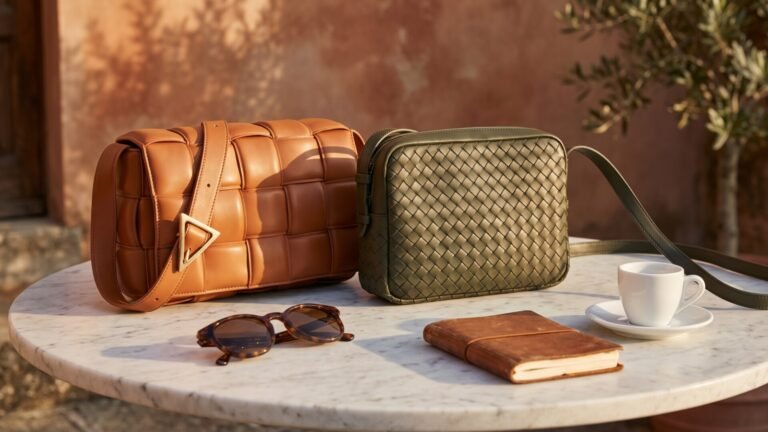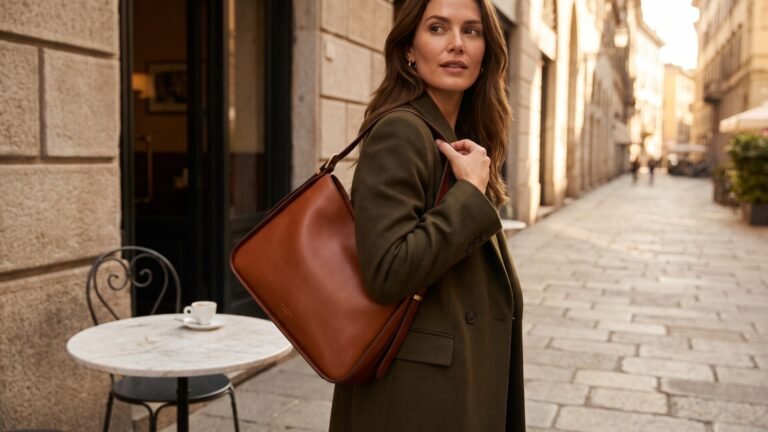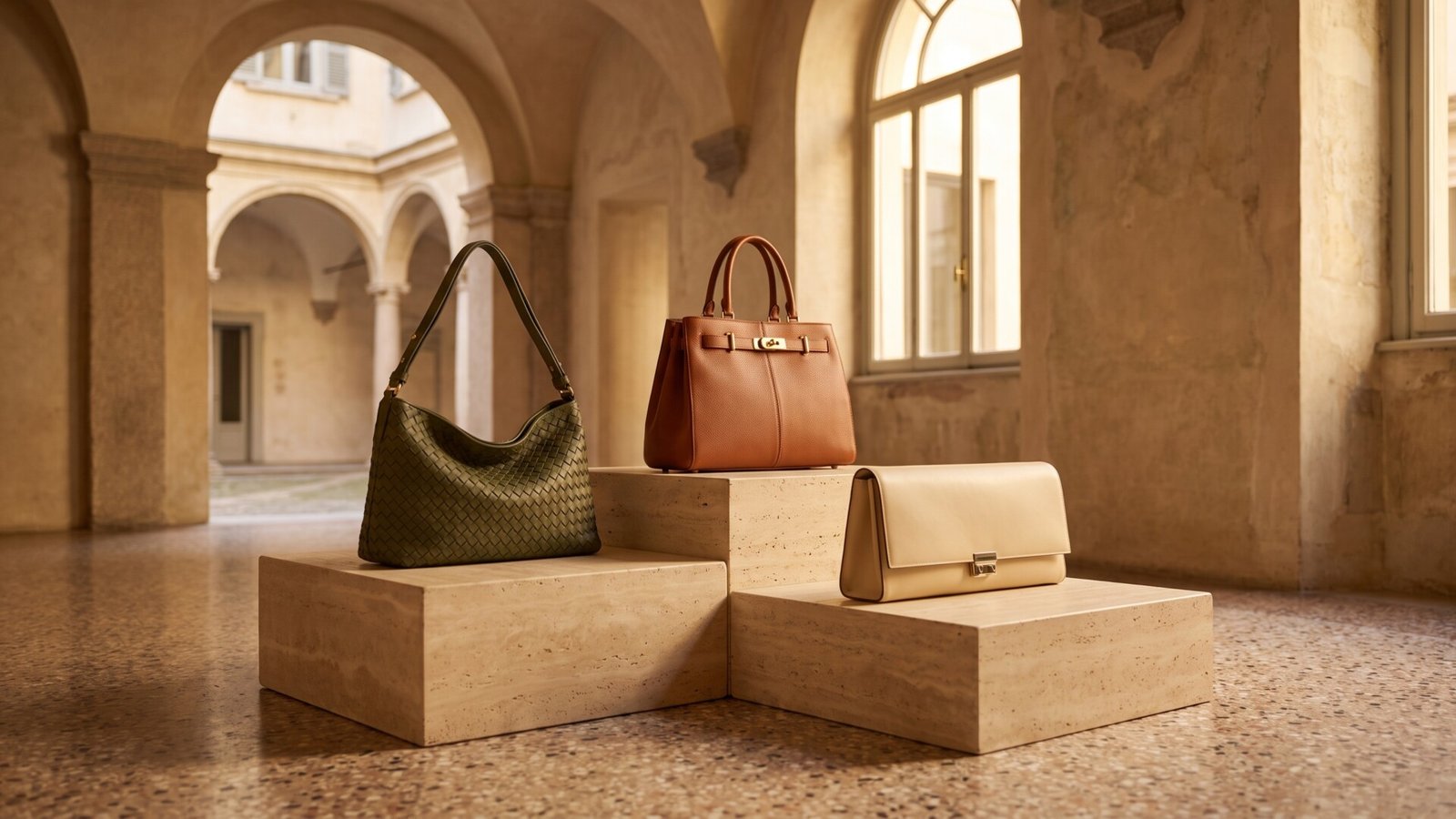
Top Italian Handbag Brands for 2027
Searching for Italian handbag brands usually returns the same dozen names. This guide covers those houses and the quieter makers that deserve a place beside them: the signature bags each one is known for, what the materials and construction actually are, and which kind of buyer each brand suits. It is not a ranking, because the right bag depends on whether you want a recognisable icon, a discreet signature, or leather that ages with you.
One theme carries into 2027: a move away from loud logos toward construction, material and understated design. That has helped both the big houses, several of which have changed creative directors since 2025, and smaller makers in Tuscany and Lombardy whose bags are recognisable only to people who know them. This is a research-based guide, not a record of hands-on testing, so where a detail comes from a brand’s own description we say so. For the wider category, start with our Italian Designer Handbags guide.
If you only have a minute, the table below sorts the brands by what they are best known for. Details, caveats and the bags themselves follow underneath, and further down you will find a side-by-side comparison of signature bags, a short explainer on the leathers involved, and notes on buying, authenticating and repairing a bag.
Italian Handbag Brands at a Glance
| Brand | Founded | Signature feature | Best for |
|---|---|---|---|
| Gucci | 1921, Florence | GG monogram, horsebit, bamboo and Web stripe | Recognisable design with a wide price spread |
| Prada | 1913, Milan | Saffiano leather and Re-Nylon | Durable everyday and work bags |
| Bottega Veneta | 1966, Vicenza | Intrecciato leather weave | Logo-free, texture-led luxury |
| Valentino | 1960, Rome | Rockstud hardware, VLogo | Structured bags with an edge |
| Fendi | 1925, Rome | Baguette, Peekaboo, FF logo | Collectors of named, recognisable silhouettes |
| Dolce & Gabbana | 1985, Milan | Sicily bag, decorative detail | Statement pieces |
| Salvatore Ferragamo | 1927, Florence | Gancini hardware, Vara bow | Understated work and travel bags |
| Versace | 1978, Milan | Medusa head, Greca pattern | Bold, glamorous accessories |
| Serapian | 1928, Milan | Hand-woven Mosaico leather (introduced 1947) | Discreet, artisan-signed pieces |
| Valextra | 1937, Milan | Minimal, logo-free leather goods with black Costa edges | Quiet-luxury buyers |
| Il Bisonte | 1970, Florence | Vegetable-tanned leather that ages visibly | Natural patina, lower price band |
| The Bridge | 1969, Scandicci, near Florence | Full-grain, vegetable-tanned Tuscan leather | Bags that look established from day one |
| Furla | 1927, Bologna | Accessible luxury pricing | First designer bag |
Gucci
Gucci remains one of the most visible Italian handbag names. The house was founded in Florence in 1921 by Guccio Gucci and has belonged to Kering since 1999. After Alessandro Michele (2015–2022) and Sabato De Sarno (from 2023 until he left in February 2025), Demna was appointed creative director in March 2025 and has led the house’s collections since. Its bags are built around recognisable codes: the interlocking GG, the horsebit, bamboo handles and the green-red-green Web stripe. For the full story of the house, see our Gucci brand guide.
Signature Bags
- Dionysus: A structured shoulder bag with a tiger-head spur closure, introduced under Alessandro Michele and presented in the house’s Fall 2015 collection.
- GG Marmont: Quilted matelassé leather with a chevron pattern and a large double-G hardware plate. We compare it directly with Prada’s best-known leather in Prada Saffiano vs Gucci GG Marmont.
- Ophidia: Coated GG canvas with the Web stripe, a style taken from the house archive.
- Jackie 1961: A slouchy hobo first launched in 1961, with a piston-lock closure, now reissued; see how the original Jackie compares with the reissued piston clasp.
- Horsebit 1955: An archive shape built around the equestrian horsebit hardware that Gucci also uses on its loafers. With the Jackie, it is one of the safer entry points into the house, since archive shapes tend to outlast any one designer’s era.
Why Gucci Stands Out
Gucci offers the widest range of any Italian house, from canvas-and-leather pieces to exotic-skin special orders, so the quality you get depends heavily on the line. Canvas Ophidia styles are lighter and more forgiving of daily wear than smooth calfskin, while matelassé leather on the Marmont shows scratches more readily. The recognisable hardware is the main thing you are paying for, and it is also why the bags are easy to find on the resale market. Read Gucci vs Prada for brand reputation and resale value before treating any bag as a store of value.
A practical way to choose within the Gucci range is to decide on the surface first. Coated canvas tolerates rain, keys and crowded commutes, and it is the lower-maintenance option. Quilted leather is softer and dressier, but the raised quilting points are where edges rub first. Structured shoulder bags with metal closures, such as the Dionysus, carry their weight in the hardware, so check how the closure feels and whether the strap attachment points are reinforced before you commit.
Prada
Prada was founded in Milan in 1913 by Mario Prada, and Miuccia Prada has shaped the label for decades (see Miuccia Prada and the house’s evolution). Its bags are the practical end of Italian luxury: coated leather and technical nylon that tolerate commuting. Saffiano is credited to Mario Prada, who patented it in 1913; some versions of the story credit Miuccia Prada, but the patent predates her involvement by decades. The full overview is in our Prada brand guide.
Signature Bags
- Galleria: A structured top-handle bag in Saffiano leather, the cross-hatch-textured, coated calf leather Prada is known for. Sizes run from micro to extra-large, and on Prada’s US site in November 2026 the small was $4,800 and the medium $5,100, with larger sizes costing more (check Prada’s site for current figures). See Prada Galleria vs Saffiano Lux for a closer comparison.
- Re-Edition nylon bags: The Re-Edition 2000 and 2005 revive 1990s and 2000s shapes in nylon. Prada’s separate Re-Nylon material is regenerated nylon made partly from recovered ocean plastic, so only styles labelled Re-Nylon should be described as recycled. At the time of writing, the Re-Nylon Re-Edition 2000 mini-bag was listed at $1,320 on Prada’s US site and the Re-Edition 2005 was $2,250 on the same site (November 2026); we set the two side by side in Prada Re-Edition 2000 vs 2005. Our verdict on the 2005 style is in whether the Re-Edition 2005 is still a good investment
- Cahier: A structured shoulder bag whose name is French for notebook; the house presents it as a nod to vintage stationery and notebooks, with a distinctive flap and studded edge.
Key Features
Saffiano’s pressed finish resists scuffs and light moisture better than untreated calf, which is why Prada totes suit office use. The trade-off is that the finish is a coating: deep cuts do not blend away the way they can on aniline leather. If you own one, our guide to removing ink stains from Prada Saffiano covers the safe first steps, and Saffiano versus smooth leather durability compares how the two surfaces age.
Bottega Veneta
Bottega Veneta was founded in Vicenza in 1966 by Michele Taddei and Renzo Zengiaro and has been part of Kering since Gucci acquired it in February 2001. Its identity rests on the Intrecciato weave, in which strips of leather are woven together by hand, and on the absence of an outward logo. Creative leadership has changed repeatedly: Tomas Maier (2001–2018), Daniel Lee (2018–2021) and Matthieu Blazy (2021–2024). Louise Trotter was announced as creative director in December 2024, taking over from Matthieu Blazy, who moved to Chanel. Her first collection for the house was shown for spring/summer 2026, and her third, for spring/summer 2027, was shown in Milan in September 2026. Read our Bottega Veneta guide and is Bottega Veneta worth the price? for context.
Signature Bags
- The Pouch: A soft, oversized clutch made from a gathered piece of leather, with no frame or lining structure to speak of.
- Cassette: A padded, intrecciato crossbody that reads as a cushion in leather.
- Jodie: A slouchy shoulder bag with a knotted handle. We compare it with the Hop in Bottega Veneta Hop vs Jodie and look at weave durability in this durability comparison.
- Andiamo: A woven tote covered in our price review of the Andiamo.
What Makes It Special
Because there is no logo, buyers are paying for leather quality and weaving labour. Woven leather is flexible and hides light scratches well, but it can snag and the structure of very soft styles can sag with heavy loads. For a comparison with the Gucci bag above, see Intrecciato vs Gucci Marmont.
The weave itself has a practical origin. Fashion press accounts of the house’s history describe the founders weaving long strips of leather because the sewing machines available locally struggled with thick hides. The weave is not identical across models: the Cassette is described as a grid of stiffer, glued strips with small gaps between them, while the Pouch uses a denser, more supple weave that bends. When you compare two Bottega bags, look at strip width and stiffness rather than assuming the same durability, and keep in mind that a finer weave generally means more visible handwork and more places for a snag to show.
Valentino
Valentino was founded in Rome in 1960 by Valentino Garavani and Giancarlo Giammetti. Its accessories are known for the pyramid-shaped Rockstud, which the house introduced in 2010. Alessandro Michele has led the house since 2024 (see his debut bags). Background is in our Valentino guide, Valentino Garavani profile and history of the Rockstud.
Signature Bags
- Rockstud tote and shoulder styles: Structured leather bags edged or trimmed with the stud.
- Locò: A compact shoulder bag with a metal chain and a signature hardware closure.
- VLogo totes: Covered in our look at the VLogo tote.
Why Consider Valentino
The studs add edge to otherwise classic shapes, and the hardware is the main recognisable element. Studs can scratch other items in a bag and each other when stored touching, so use the dust bag and keep the bag upright.
Fendi
Fendi was founded in Rome in 1925 by Adele and Edoardo Fendi as a fur and leather shop, and has been part of LVMH since 2001. It is famous for fur and leather craft and for named bags that became cultural reference points. Its creative structure changed in 2025: Silvia Venturini Fendi stepped down as artistic director in September and became honorary president, and Maria Grazia Chiuri was appointed Chief Creative Officer in October. Her first Fendi collection was shown for autumn/winter 2026–2027 (see our look at Chiuri’s Fendi debut). See the Fendi brand guide and our Fendi handbags page.
Signature Bags
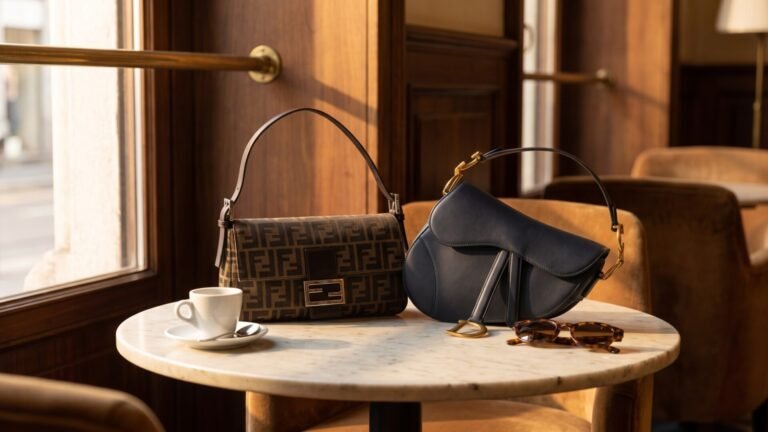
- Baguette: Designed by Silvia Venturini Fendi and launched in 1997, a small shoulder bag carried under the arm. Read about the reissue in Fendi Baguette 1997 Re-Edition. On Fendi’s US site (checked October 2026, with some items sold out), Baguette prices ran from about $3,100 to $6,300 depending on material. For its closest Paris rival, see Fendi Baguette vs Dior Saddle.
- Peekaboo: A structured bag with a two-sided opening that reveals a second compartment. Silvia Venturini Fendi designed it; it first appeared on the runway in September 2008 and reached stores for spring 2009, according to fashion press accounts.
- Kan I: A compact bag with an F-shaped clasp.
- Croissant: A recent, softly curved shoulder bag. In the same October 2026 check of Fendi’s US site, it ranged from about $1,900 to $3,750 depending on material.
Key Features
Fendi mixes smooth leather, jacquard fabric and its FF monogram. The house also describes its Selleria line as hand-stitched using a technique derived from saddle-making, which is the line to look at if construction matters more to you than the logo. The Baguette’s popularity has made it one of the most-imitated shapes, so buying from the brand or a documented reseller matters more here than on most bags. Our guide on spotting authentic Italian designer pieces explains where to buy and what paperwork to look for.
Dolce & Gabbana
Dolce & Gabbana was founded in Milan in 1985 by Domenico Dolce and Stefano Gabbana, and its bags often draw on Sicilian imagery. See the Dolce & Gabbana brand guide.
Signature Bags
- Sicily Bag: A structured top-handle bag named after the designers’ Sicilian roots, produced in many leathers and prints. Our article asks whether the hand-painted series is worth about $5,000.
- Devotion: A quilted leather bag with an ornate closure.
- DG Millennials: A compact, structured style aimed at younger buyers.
What Sets It Apart
Floral, baroque and Sicilian-inspired prints and trims make these bags statement pieces. If you want a bag that works with most outfits, choose plain leather versions; printed ones date their outfit more quickly.
Salvatore Ferragamo
Salvatore Ferragamo opened his Florence business in 1927 and the house is known first for shoes, then for the bags that grew from that leather expertise. See the Ferragamo brand guide.
Signature Bags
- Vara Bow bag: Leather with a grosgrain bow echoing the house’s Vara pump, which dates to 1978.
- Studio Bag: A contemporary structured style with a geometric handle.
- Hug: A newer sculpted bag, covered in our Ferragamo Hug piece. The Gancini hook appears across the range as hardware.
Highlights
Ferragamo bags are generally understated and work well with business clothes. If you care about the footwear side of the house, see why Ferragamo loafers are still handmade in Italy.
Versace
Gianni Versace founded the house in Milan in 1978 (Gianni Versace profile). Prada Group announced the completion of its acquisition of Versace from Capri Holdings on 2 December 2025, according to press reports, so the house now sits in the same group as Prada and Miu Miu; check current ownership before quoting it, since corporate structures change. Dario Vitale succeeded Donatella Versace as creative director in 2025 but left in December 2025 after a single season, two days after the Prada acquisition closed. Pieter Mulier, previously creative director of Alaïa, joined as Chief Creative Officer on 1 July 2026, and his first Versace show is scheduled for Paris Couture Week in January 2027. Expect the bag line to shift once his collections reach stores. See the Versace brand guide.
Signature Bags
- La Medusa: A structured bag with a Medusa head plate. See La Medusa vs Greca Goddess.
- Greca Goddess: Built around the Greek-key (Greca) motif.
- Palazzo Empire: A larger top-handle style with heavy hardware.
- Pivot: Introduced on the spring 2026 runway, a leather bag worn on the shoulder or carried by its top handle, lined in lambskin, in two sizes. Its leather patch carries a Medusa cameo that the house links to the door of its original Milan atelier.
Who It Suits
Versace bags are dramatic yet wearable if you want gold-toned hardware and a clear logo. If you prefer subtle luxury, Valextra or Bottega Veneta fit better.
Serapian
Serapian is one of the oldest names in this guide that many buyers have not met. It was founded in Milan in 1928 by Stefano Serapian, an Armenian-born craftsman who arrived in Italy in the early 1920s and, by the brand’s account, first sold leather goods by bicycle. The house is based at Villa Mozart in Milan and is listed among Richemont’s maisons.
Signature Bags
- Mosaico pieces: Bags and small leather goods in Mosaico, a hand-woven weave of lamb nappa leather strips that Stefano Serapian introduced in 1947. Each Mosaico piece carries an inner tag signed by the artisan who made it.
- Bespoke: A made-to-order service led by Giovanni Nodari Serapian, a third-generation family member.
What Makes It Special
Like Bottega Veneta, Serapian sells woven leather without an outward logo, but the weave is built from lamb nappa, a soft, fine leather, rather than calf. The signed tag puts a named maker behind each piece, which is unusual at any price. The brand’s own site says its pieces are made entirely in Italy. It suits buyers who want quiet construction-led luxury from a house few people will recognise across a room.
Valextra
Valextra was founded in Milan in 1937 by Giovanni Fontana; the name combines “valigia” (suitcase) and “extra”. Its design language is deliberately logo-free, and it is the house most often named when buyers ask for quiet luxury in Italian leather. Background is in our Valextra guide.
Signature Bags
- Brera: An everyday bag dating to the 1950s.
- Tric Trac: A patented 1967 design inspired by camera cases.
- Iside: A structured bag launched in 2011.
- Serie S: Launched in 1961 and relaunched in 2019.
- 24 Ore: The bag that won a Compasso d’Oro at the award’s first edition in 1954.
Key Features
Valextra bags are made mainly in calfskin and finished with hand-applied black Costa lacquered edges, which are the most recognisable detail in place of a logo. Each bag carries an embossed serial number and the artisan’s number inside, and the brand offers lifetime cleaning and repair. That service matters more than it sounds: painted edges are one of the first places a structured bag shows wear, so a maker that will refinish them changes the long-term cost of ownership.
Il Bisonte
Il Bisonte was founded in Florence in 1970 by master craftsman Wanny Di Filippo and his wife Nadia. The name means “the bison”, an animal Wanny admired for combining gentleness with strength. The brand has used vegetable-tanned, full-grain leather since the 1980s, and it says all production stays within a 30 km radius of Florence. See our Il Bisonte guide.
Signature Bags
- Nina crossbody: A small crossbody in the house’s natural leather.
- Classic Crossbody: The brand’s long-running everyday crossbody.
- Unlined leather tote: A simple tote that shows the leather on both sides.
- Soft Hobo: A slouchy shoulder bag.
Who It Suits
These are not polished-looking bags when new; the appeal is in how they age, as the leather darkens and softens with use. That makes Il Bisonte a good fit for buyers who want a natural patina at a lower price than the major houses, and a poor fit for anyone who wants a bag to look the same in five years. For care, see restoring the patina on natural Italian leather bags; for budget options in the same leather, vegetable-tanned purses under $500.
The Bridge
The Bridge began in 1969 as Il Ponte Pelletteria and took its current name in 1975; manufacturing moved to Scandicci’s industrial district, near Florence, in 1987. See our The Bridge guide.
What Sets It Apart
The Bridge works with full-grain, vegetable-tanned Italian leather from Tuscany and describes its look as “Anglo-Tuscan”, an English-inflected aesthetic, with hardware chosen to develop its own patina over time. Where Il Bisonte starts plain and earns its character, The Bridge is a good pick if you want a bag that looks established from day one, at a price well below the major houses.
Lieta Milano and Its Alternatives
Lieta Milano is a small direct-to-consumer label that describes itself as a Milanese house but says its bags are cut and stitched in the Florence leather district, around Scandicci, the same area where many luxury houses have their bags made. It does not publish a founding date or the names of its founders, and the details below come from the brand’s own site rather than independent verification.
Signature Bags
The range is small: the Abbraccio, the Lungo, the Mercato and the Piazza, which the brand says began as a concept in its online “Vault” before joining the collection. In November 2026 the site listed the Lungo at €255, the Mercato at €275 and the Abbraccio at €295, with the brand putting its whole range at €255 to €295.
Key Features
The brand says its main leather is Walpier Buttero, a full-grain, vegetable-tanned calf dyed through the hide, with brass hardware plated in Arezzo. It is unusually specific about construction: hand saddle-stitching at load-bearing points such as handle attachments, and machine stitching on long seams. That mix is common across the industry, so the candour is more useful than the method itself. It sells only online, with no boutiques or seasonal collections, in small drops of about 20 to 30 pieces per colour that go to a waitlist first. The trade-off is availability and track record: a newer label with limited runs cannot offer the store network, repair service or resale history of an established house.
Alternatives to Lieta Milano
If what appeals is vegetable-tanned Tuscan leather without major-house pricing, the established makers in this guide cover the same ground:
- Il Bisonte: The closest match on leather: vegetable-tanned, full-grain and left to darken, from a Florentine house operating since 1970.
- The Bridge: Also made in Scandicci in full-grain, vegetable-tanned Tuscan leather, with a more finished, English-inflected look.
- Campomaggi: A more rugged, fashion-led take on Italian leather at a mid-range price.
- Furla and Coccinelle: Smoother, more polished leather and wide availability in department stores, if you would rather see a bag before buying.
To buy directly from smaller makers, see three Italian artisanal leather workshops; for more options in this leather, vegetable-tanned purses under $500.
Signature Bags Compared: Materials, Hardware and Trade-offs
Dimensions and weights differ by size and season, and houses revise them, so the table below compares the character of each bag rather than quoting centimetres. Take exact measurements, empty weight and strap drop from the brand’s product page for the model you are considering.
| Bag | Main material | Shape and construction | Hardware | Best for | Trade-off |
|---|---|---|---|---|---|
| Prada Galleria | Saffiano, a pressed and coated calf leather | Structured top-handle bag that holds its shape | Metal lettering and fittings | Office and daily carrying | Coating means deep cuts are hard to disguise |
| Gucci GG Marmont | Quilted matelassé leather | Soft chevron quilting with a flap | Large double-G plate | Dressier everyday wear with recognisable branding | Raised quilting shows scuffs earlier |
| Gucci Ophidia | Coated GG canvas with leather trim | Lighter bag with Web stripe detail | GG and stripe details | Low-maintenance daily use | Canvas ages differently from leather and cannot be conditioned like it |
| Bottega Veneta Cassette | Intrecciato leather | Padded, woven crossbody with a cushioned look | No outward logo | Logo-free, texture-led style | Woven surface can snag |
| Bottega Veneta Jodie | Soft intrecciato leather | Slouchy, unstructured shoulder bag with a knotted handle | Minimal | Comfortable shoulder carrying | Soft structure can sag under heavy loads |
| Fendi Baguette | Leather, jacquard or other fabrics | Small bag worn under the arm | Magnetic or clasp closure varies by version | Collectors of an established silhouette | Small capacity and widely imitated shape |
| Valentino Locò | Leather | Compact shoulder bag with a metal chain | Metal chain and signature closure | Evening and light daytime use | Metal fittings can scratch other items |
| Ferragamo Vara Bow bag | Leather | Understated shape finished with a grosgrain bow | Bow and Gancini details vary by model | Business clothing and quiet branding | Less instantly recognisable than logo-led bags |
Read the table by trade-off rather than by price. A structured bag in coated leather asks little of its owner but will not develop character. A soft woven or quilted bag feels more luxurious in the hand and demands more careful storage. Hardware-led bags give you brand recognition, yet each metal element is a potential scratch, a plating wear point and a repair question later.
More Italian Handbag Brands Worth Knowing
The big houses and the specialists above are not the whole story. These smaller or more accessible makers are covered in their own guides, and our underrated Italian handbag brands list goes further:
- Furla: founded in Bologna in 1927, the usual first-step brand for buyers moving into designer leather.
- Tod’s: known for the Gommino driving shoe, with a bag range led by the D-Bag; see Tod’s Di Bag vs The Row Margaux.
- Campomaggi, Coccinelle and Sara Battaglia: mid-priced options with their own character.
- Gianni Chiarini: a Florentine label that positions itself around “refined simplicity” for modern women.
- Loro Piana, Brunello Cucinelli and Moschino: houses better known for clothing that also make bags.
For emerging names, see 10 up-and-coming Italian designers to watch. For a workshop-level view of makers you can buy from directly, see three Italian artisanal leather workshops, and for a wider survey of leather-led labels, top Italian leather brands. If you are also weighing Paris against Milan, our sister site covers the best French handbag brands.
Budget Tiers: Where Each Brand Sits
Prices change by market, season and size, and almost every house sells across a wide range, so these tiers describe where a brand’s core bags usually sit rather than quoting figures. Check the brand’s own site for current prices in your market.
- Accessible entry point: Furla, Coccinelle, The Bridge and Il Bisonte. These are the brands to consider if you want Italian leather and a recognisable name without the premium attached to a major house. Il Bisonte is the one to pick for vegetable-tanned leather; Furla is easier to find in department stores and airports. Lieta Milano, a newer online-only label, also sits here, with bags under €300.
- Mid-range Italian makers: Campomaggi, Sara Battaglia and Tod’s sit above the entry tier. They suit buyers who want a distinct design voice or, in Tod’s case, a long-established leather-goods house, without paying for a monogram.
- Major designer houses: Gucci, Prada, Fendi, Valentino, Dolce & Gabbana, Versace and Ferragamo. A large share of what you pay here is the name and the hardware, and the range inside each house is wide, so a canvas or nylon bag and a hand-finished leather bag from the same label are very different purchases.
- Top-end and logo-free: Bottega Veneta, Valextra, Serapian and Loro Piana. Here the argument is material and labour rather than brand recognition, which is also why the bags look less obviously expensive.
If budget is the main constraint, our guides to vegetable-tanned purses under $500 and travel bags by price range narrow the choice by spend, and 10 best Italian designer handbags to invest in covers the upper end.
What You Are Paying For
Price gaps between Italian bags come from a handful of things: leather grade and finishing, how many hand operations go into the bag, the hardware, and the brand itself. Woven Bottega Veneta bags and some Fendi lines involve visible hand work. A Prada Saffiano tote pays for a durable coated leather that machines handle well. Furla and Il Bisonte keep prices down through simpler construction and more efficient production. A useful test: open the bag. Edge paint should be even, stitching should be straight and dense, and the lining should be neatly attached. Our piece on why Italian leather bags last goes deeper, as does handmade vs mass-produced Italian fashion. A “Made in Italy” label is applied per product, so check the label on the exact bag.
What to Check, Regardless of Name
Brands are promises; bags are objects. Once you hold one, these points tell you more than the label:
- Stitching at stress points: Look for even, tight stitching where handles attach and at the corners. Hand-stitching is a plus where a brand documents it, but good machine stitching is not a flaw.
- Hardware: Solid metal is generally more durable than thin plating, which can wear through over time. Ask the brand what it uses and whether parts can be replaced.
- Weight: A bag should not feel heavy when empty. If it does, the materials may be too thick or the structure too rigid for everyday use.
- Smell and finish: Good leather has a natural scent; a strong chemical smell can indicate heavy coatings. This is a rough guide, not proof of quality or authenticity.
Leather Types and Construction Explained
The same shape can behave very differently depending on the surface. These are the materials and techniques you will meet most often in this guide, and what each means in daily use. For the wider background, see how Italian leather is made and our Italian leather craftsmanship hub.
- Saffiano: Calfskin that is hot-pressed into a fine crisscross pattern and finished with a wax coating, a process Prada associates with its founder, who is reported to have patented it in 1913. The result is stiff, scratch-resistant and easy to wipe, which is why it is chosen for totes and briefcase-style bags. Other brands sell their own versions, so the print and quality differ between labels.
- Intrecciato: Not a tannage but a construction method: strips of leather woven over and under each other. The look depends on the strip width and on how stiff the leather is. Woven leather is flexible and conceals light marks, but loose threads and snags are harder to repair than a scratch on smooth calf.
- Matelassé: A French term for quilting. On a bag, it means the leather is padded and stitched into a pattern such as the Marmont’s chevron. The padding makes the bag soft and dressy, and the raised points are where abrasion shows first.
- Vegetable-tanned leather: Hide tanned with plant-based tannins, the traditional method that Il Bisonte is known for. It is usually left with a natural surface, so it darkens with sun and handling and shows water spots. Some buyers want exactly that patina; others find it too unpredictable. Our guide to restoring the patina on natural Italian leather bags shows what ageing looks like and how to manage it.
- Chrome-tanned leather: Leather tanned with chromium salts looks more uniform and stays consistent for longer than vegetable-tanned leather. Neither is better; they suit different tastes, and which one you prefer narrows the brand list quickly. See where each comes from in our guide to Italian tannery regions.
- Technical nylon: A woven fabric rather than a leather, light and weather-tolerant, used by Prada on its Re-Edition and Re-Nylon bags. It is comfortable for travel and rain, but the trim, usually leather or metal, is where wear shows.
Beyond the leather itself, three construction details show quality. Check the edges, which can be painted or turned under, with turned edges generally a sign of more handwork. Look at where handles and straps join the body, since that is where bags fail under load. And check the lining: a neatly stitched lining with a securely attached zip pocket is a sign of care, and a loose one is what you will be repairing in a few years.
How to Choose the Right Italian Handbag
- Material: Smooth calf, Saffiano, matelassé, woven leather, vegetable-tanned leather or nylon each wear differently.
- Function: Check dimensions, weight empty, strap drop and whether it holds a laptop or tablet.
- Style: Logo-forward or understated; classic or trend-led.
- Resale: Iconic bags in neutral colours tend to resell better than seasonal styles, but nothing guarantees value; prices vary by condition and market.
- Repairability: Ask whether the brand or an independent repairer can replace handles, edges and zips. Our guide to repairing a ripped lining shows what is realistic.
Matching to use: for work, see best Italian designer work bags; for trips, best Italian handbags for travel; for small bags, micro bags and what fits; and for category pages, tote bags and crossbody bags.
Which Italian Bag Brand Should You Choose?
- You want a recognisable icon: Gucci, Prada, Fendi.
- You want a discreet, logo-free bag: Bottega Veneta, Valextra, Serapian.
- You want leather that ages, on a more modest budget: Il Bisonte, The Bridge; see also Italian leather shoulder bags under $1,000.
- You need a hard-wearing work or travel bag: Prada for coated leather and nylon, Ferragamo or Valextra for understated structure; for a backpack, see affordable Italian leather backpacks for business travel.
- You are buying to invest: no bag guarantees resale value; start with the investment and resale guides linked under Budget Tiers and in the Gucci section.
Italian Handbag Trends for 2027
The bags shown at Milan Fashion Week in September 2026 for spring/summer 2027 point to the directions below, based on runway reports from the shows. Runway pieces usually reach stores months later, and not every look goes into production, so treat these as directions rather than a shopping list.
- Oversized totes: Large carry-all shapes ran through several shows, including Bottega Veneta’s XL totes in leather and woven raffia and big soft bags at Max Mara, Gucci and Tod’s. They are practical, but check the empty weight before buying, since a large leather tote gets heavy quickly.
- Strong colour: After several seasons of neutrals, colour came back: Prada showed elongated bags in green, red and purple, Gucci used deep fuchsia, and Fendi put colour on the Baguette. Red appeared at Dolce & Gabbana, Tod’s, Ferragamo and Bottega Veneta. A coloured bag dates faster than a neutral one, so it is a better fit for a second bag than a first.
- East-west shapes: Prada’s horizontally elongated, flattened bags with long handles were one of the clearest silhouettes of the season.
- Soft, slouchy bags: Unstructured pouches and gathered shapes appeared at Max Mara, Marni and Etro. These are comfortable to carry but, like the Bottega Veneta Jodie above, can lose their shape under heavy loads.
- Fringe and tactile detail: Fendi showed fringed versions of the Peekaboo and the Baguette, Etro used fringe and embellishment, and Bottega Veneta added oversized tassels. Fringe snags and tangles, so it suits occasional use more than a daily bag.
- Raffia and woven textures: Bottega Veneta scaled its intrecciato up into raffia, and Dolce & Gabbana showed woven baskets and crochet. See our designer straw bags guide for how to judge weave quality.
- Polished, structured leather: As a counterpoint to the slouchy shapes, Gucci, Prada and Ferragamo showed defined top-handle bags in smooth leather. This is the trend most likely to stay wearable beyond one season.
For the current cold-weather season, see our five Italian suede bags, and for the materials side of the industry, how Italian designers are embracing sustainability.
Caring for Italian Handbags
- Smooth leather: Store in a dust bag, away from damp and direct sun. Test any conditioner on an inconspicuous area first. See how to care for Italian leather goods and the best leather conditioner.
- Saffiano: Wipe with a barely damp cloth and avoid prolonged strong sun.
- Vegetable-tanned leather: Expect darkening; read restoring the patina on natural Italian leather bags.
- Hardware: Wipe gently with a soft dry cloth; avoid polishing plated finishes aggressively.
- Valuable pieces: Use a professional leather specialist for stains and repairs.
Storage matters as much as cleaning. Stuff the bag lightly with acid-free paper or a soft cloth so it keeps its shape, keep it upright rather than stacked, and let it rest between uses so the leather and lining can dry out after exposure to damp. If mould or a persistent smell appears, see dealing with mould on stored designer leather goods rather than improvising with household cleaners.
Where to Shop, Authenticity and Repairs
- Official boutiques and brand websites: Authenticity guaranteed and current collections.
- Department stores: Such as Harrods, Saks and Selfridges.
- Consignment platforms: Useful for discontinued styles; choose sellers that offer authentication and returns.
Keep dust bags, receipts and care cards, which help at resale and when requesting repairs.
No checklist can prove a bag is genuine from photographs, and counterfeiters copy details such as stitching and date codes. The safest protection is the source: buy new from the brand or an authorised retailer, and for pre-owned bags use a platform that authenticates each item and has a clear return policy. Be cautious when a price is far below the market for that model, when the seller will not provide close photographs of the interior, hardware and labels, or when a story replaces documentation. Our guide to spotting authentic Italian designer pieces covers the general principles, and an independent authentication service is worth the fee for a high-value purchase.
Repairs are part of the ownership cost. Brand boutiques commonly offer repair or refurbishment services, though availability, turnaround and cost vary by house and by model, so ask before you buy. Independent leather specialists can often restitch seams, replace zips and recolour edges on conventional leather. Woven, quilted and heavily hardware-led bags are harder to work on, and plated hardware generally cannot be refinished at home. A bag with simple construction and standard parts is usually the easiest to keep in service, which is one reason a plain structured tote often outlasts a trend-led design.
Related Reading
Craftsmanship drives long-term value, so read Why Italian Leather Bags Last a Lifetime for the leather quality, tanning and construction behind it. For gifts, see Best Italian Handbags for the Holidays. Also see Italian travel bags by price range, must-have Italian accessories and how to style Italian handbags; for a broad wardrobe view, luxury Italian designer bags every wardrobe needs. For an overview of the category, our Italian leather handbags page is the best starting point.
Frequently Asked Questions About Italian Handbag Brands
Which Italian handbag brand is best for everyday use?
Prada’s Saffiano leather and nylon bags are among the most practical because the finish resists scuffs and light moisture. Furla and Il Bisonte offer lower-priced everyday options.
Which Italian brand makes the most understated handbags?
Bottega Veneta, which avoids outward logos, and Valextra, known for minimalist leather goods, are the usual choices for a quiet look.
Are Italian handbags a good investment?
Some iconic styles hold resale value better than others, but there is no guarantee. Condition, colour, model and market demand all affect resale, so buy a bag you will use rather than expecting a return.
Are all bags from Italian brands made in Italy?
Not necessarily. A Made in Italy label applies to a specific product, so check the label and the brand’s product page for the exact bag. Serapian, for example, states its pieces are made entirely in Italy, while Prada’s US page for the Re-Edition 2000 lists it only as Imported.
What is Saffiano leather?
Saffiano is a cross-hatch-textured, coated calf leather associated with Prada. The pressed finish is scratch- and water-resistant compared with untreated leather.
Where is the safest place to buy a designer handbag?
Brand boutiques and websites or established department stores. For pre-owned bags, use sellers that authenticate items and offer returns.
What is the difference between Saffiano and smooth leather on a handbag?
Saffiano is pressed into a fine cross-hatch and coated, so it resists scratches and light moisture and keeps its shape. Smooth calf feels softer and can look more refined, but it marks more easily and needs more careful storage and conditioning.
Which Italian handbag brands are the most affordable?
Furla, Coccinelle, The Bridge and Il Bisonte are usually the most accessible Italian names, while Campomaggi, Sara Battaglia and Tod’s sit a step above. Prices vary by market and model, so check each brand’s own site for current figures.
Can a designer handbag be repaired?
Often, yes. Many houses offer repair services, and independent leather specialists can restitch seams, replace zips and recolour edges on conventional leather. Woven, quilted and heavily hardware-led bags are harder to repair, so ask about repairability before you buy.
Does vegetable-tanned leather suit a rainy climate?
It can be used, but it is sensitive to water spotting and darkens with exposure, so it suits buyers who accept a changing surface. Coated leathers such as Saffiano or technical nylon are more forgiving of rain.
What are the best Italian handbag brands?
The best known are Gucci, Prada, Bottega Veneta and Fendi. For quieter craftsmanship, look at Valextra, Serapian, Il Bisonte and The Bridge.
Which Italian bag brands are the most luxurious?
The major houses (Bottega Veneta, Fendi, Gucci, Prada) and specialists such as Valextra and Serapian sit at the luxury end. Luxury is partly price and partly construction and service: Valextra, for instance, offers lifetime cleaning and repair.
Who owns Gucci, Bottega Veneta and Fendi?
Kering owns Gucci and Bottega Veneta, and LVMH owns Fendi. Prada Group is independent and, since completing its acquisition in December 2025, also owns Versace. Serapian is listed among Richemont’s maisons. Ownership can change, so check recent news.
What is a good Italian bag brand for a first luxury purchase?
A Prada Saffiano or nylon bag for durability, or a Bottega Veneta or Valextra piece for a discreet classic. Il Bisonte and The Bridge are more affordable ways into Italian leather.
What are good alternatives to Lieta Milano?
For vegetable-tanned Tuscan leather at a moderate price, Il Bisonte is the closest match, and The Bridge is also made in Scandicci. Campomaggi offers a more rugged look, while Furla and Coccinelle are more polished and easier to see in stores before buying.
Final Thoughts
Italian handbag design in 2027 is not about which brand is biggest. It is about construction, material and what suits how you live. Choose the leather first, then the name, and verify the details before you spend.