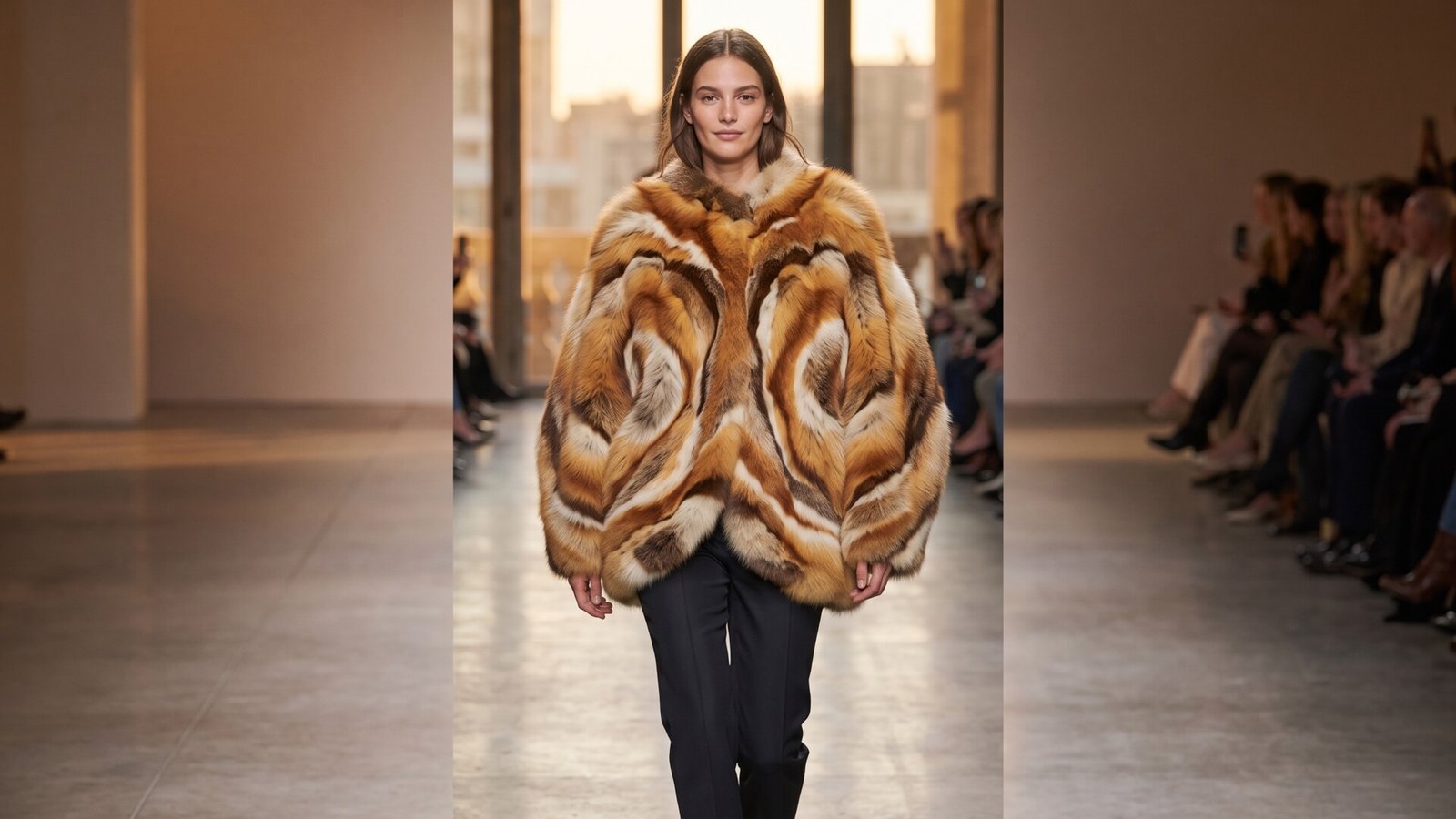
Maria Grazia Chiuri‘s Fendi Debut: A Review of the ‘Echo of Love’ Circular Fur
For years, I had grown weary of creative director debuts. The drumroll, the hype, the breathless industry anticipation—only for the collection to arrive and feel like a familiar echo of the designer’s previous work. When Maria Grazia Chiuri, who had spent nearly a decade redefining femininity at Dior through feminist slogan T‑shirts, architectural tailoring and a deeply romantic couture vision, was announced as Fendi’s new chief creative officer in 2024, my reaction was measured. Would she bring the same medieval‑inspired, brocade‑and‑T‑shirt language to the Roman house? Or would she honour Fendi’s century‑old DNA of fur, leather craftsmanship and quiet, powerful luxury?
Chiuri wasn’t a stranger to Fendi. She had worked there from 1989 to 1999, part of the accessories team that helped develop the iconic Baguette bag. This was a homecoming, not an invasion. Still, the pressure was immense. Fendi had spent decades under the creative stewardship of Karl Lagerfeld, followed by the transitional leadership of Silvia Venturini Fendi and then Kim Jones. The house needed a reset.
On a rainy February day in Milan, Chiuri finally presented her Fall/Winter 2026–27 collection. The runway was stencilled with her guiding motto: “Less I, More Us.” And then the clothes came out. Among them, the most talked‑about piece of the season: the “Echo of Love” circular fur.
This article reviews Chiuri’s debut, dissects the conceptual and material significance of the circular fur, and asks the critical question every collector, investor and luxury enthusiast is debating: Is this merely runway theatre, or could the Echo of Love project become one of the most important Fendi archive pieces of the decade? We will explore the design, the philosophy of “emotional durability,” the investment potential, and the risks—because in 2026, luxury fashion is no longer just about what you wear. It is about what you collect.
Why Maria Grazia Chiuri‘s Move to Fendi Matters
Creative director transitions are never just artistic events. They are financial events. A debut collection can redefine a brand’s trajectory, attract a new generation of collectors and—if it resonates—send the value of certain pieces soaring on the secondary market.
From Dior to Fendi: A Designer’s Evolution
Chiuri’s tenure at Dior was transformative. When she became the house’s first female creative director in 2016, she brought with her a lexicon of feminist symbolism, romantic lace and streetwear‑adjacent tailoring. The “We Should All Be Feminists” T‑shirt, the mythological gowns, the athleisure‑inspired sneakers—these pieces defined an era.
Yet as her decade at Dior unfolded, critics began to note a certain predictability. The medieval revival silhouettes, the careful layering of sheer and opaque, the reliance on slogan messaging. Many wondered: could she adapt to Fendi, a house built on fur, structure and a less obviously “theatrical” form of glamour?
The answer, unexpectedly, was yes. And the key was something no one predicted: she leaned into fur, Fendi’s oldest and most controversial métier, but she did so on her own terms—through what she called “emotional durability.”
Fendi’s Current Position in Luxury
Fendi occupies a unique tier. It is not as logo‑driven as Gucci nor as intellectually minimalist as Prada. It is Roman, opulent, grounded in family tradition. The brand was founded in 1925 by Edoardo and Adele Fendi as a fur and leather goods workshop in Rome. Under Karl Lagerfeld, whose partnership with the house spanned over fifty years, fur was transformed from heavy, traditional outerwear into lightweight, wearable art. Lagerfeld’s double “F” logo, introduced in 1965, stood for “Fun Furs.”
By the time Chiuri arrived, Fendi was in a phase of transition. Silvia Venturini Fendi had led a centenary celebration, and Kim Jones had brought a London‑inflected, streetwear‑adjacent energy. The brand needed a leader who could honour its Roman roots while charting a course for the next generation.
First Collections as Collector Moments
In luxury fashion, debut collections occupy a special place in the collector‘s psyche. They are raw, unfiltered, untainted by the commercial pressures that inevitably shape subsequent seasons. Historical examples abound: Alessandro Michele’s first Gucci collection became a grail for maximalist enthusiasts; Hedi Slimane’s debut at Saint Laurent reset the silhouette for an entire decade; Pierpaolo Piccioli’s initial Valentino couture shows established a new romantic language that influenced the entire industry.
Debut‑season pieces from a new creative director are often produced in limited quantities. They capture the first flowering of a new vision, before the designer’s vocabulary becomes familiar and, perhaps, diluted. For collectors, these pieces offer a unique combination: historical significance and relative rarity.
The Echo of Love circular fur belongs squarely in that category. Whether it will appreciate to the level of a Michele‑era Gucci jacket or a Slimane‑era Saint Laurent tuxedo remains to be seen. But it has already attracted the attention of editors, stylists and the kind of deep‑pocketed buyers who view fashion as an asset class.
What Is the ‘Echo of Love‘ Circular Fur?
Let me describe the piece that has become the visual anchor of Chiuri‘s debut.
Design Breakdown
The circular fur is not a coat in any traditional sense. It is a sculptural, almost radial construction—a garment that wraps around the body in a continuous, flowing loop, made from scraps of pre‑existing fur stitched together into a kind of woodland camouflage or abstract patchwork.
On the runway, the circular fur appeared on a woman‑worn jacket, where “scraps of fur were stitched into a woodland camouflage.” This was not the heavy, matronly fur of the 1980s. It was lightweight, almost ethereal, designed to move with the body rather than weigh it down.
The silhouette was deliberately fluid. Chiuri had said before the show that she wanted to define “the silhouette of the coat” for Fendi, and the circular fur was her most radical answer to that brief. The garment had no traditional lapels, no structured shoulders, no obvious front or back. It was, as the name implies, a circle—a continuous loop of fur that could be worn in multiple ways, adapting to the wearer’s body and intentions.
Materials and Craftsmanship
The circular fur was produced in Fendi’s fur atelier, which has operated since the house’s founding. Fendi is one of the few luxury houses that maintains an in‑house fur workshop, employing artisans whose families have worked with the brand for generations. The atelier is known for techniques such as the “Astuccio” cape (designed by Lagerfeld in 1971), “Featherlike” creations that are incredibly light, and intricate inlay workmanship, where pieces of different shapes, colours and lengths are assembled to create 3D effects.
For the Echo of Love project, however, Chiuri did not simply commission new fur. She introduced a new atelier service: clients can bring their own vintage or inherited furs to the Fendi workshop, where artisans will “unpick and reassemble outdated garments into contemporary volumes.” The collection treated fur as “an archive of memories rather than a disposable commodity.” This shift toward “emotional durability” was a quiet act of resistance against the industry’s cycle of overconsumption.
Why It Became the Collection’s Signature Piece
Several factors contributed to the circular fur‘s instant status as a talking point.
First, its visual distinctiveness. In a season dominated by quiet luxury and beige cashmere, the circular fur was bold, unmistakable and photographically compelling. It was impossible to scroll past.
Second, the controversy. Fur remains a charged material. Many luxury conglomerates, including Kering (which owns Gucci, Balenciaga and Saint Laurent), have banned fur entirely. Fendi, as an LVMH brand, has continued to use fur, certifying its supply chains through the Furmark® label. Chiuri’s decision to not only use fur but to place it at the centre of her debut was seen by some as a provocation and by others as a brave defence of Fendi’s core heritage.
Third, the conceptual depth. The “Echo of Love“ name, the idea of “emotional durability”, the collaboration with clients to remake their own inherited furs—these were not merely aesthetic choices. They were philosophical statements. And in an era where luxury consumers increasingly demand meaning from their purchases, that philosophical depth matters.
The Symbolism Behind ‘Echo of Love’
Fashion, at its best, is not just about clothes. It is about stories.
Circular Design Meaning
The circle is one of the most ancient and potent symbols in human culture. It represents continuity, eternity, the cyclical nature of life, death and rebirth. By choosing a circular silhouette for her signature fur piece, Chiuri was making a deliberate statement about Fendi‘s past, present and future.
The collection treated fur as “an archive of memories rather than a disposable commodity.” The circular shape evokes the idea of something that has no beginning and no end—a fitting metaphor for a brand that has been in continuous operation for over a century. It also speaks to the circular economy: taking existing materials (vintage furs) and transforming them into something new, rather than extracting fresh resources.
Chiuri’s Signature Narrative Approach
At Dior, Chiuri became known for storytelling. The “We Should All Be Feminists” T‑shirt, the collaboration with artists like Judy Chicago, the catwalk that spelt out “Consent” in lights—her work always carried a message.
At Fendi, the message is more subtle but no less present. The “Echo of Love” project is about family, memory and intergenerational transmission. “I have pieces that for me are very important because they give me some emotion, and remind me of some moment in my life,” Chiuri explained. “I think the link with the object is very personal.”
This is a powerful argument for why luxury goods can be investments—not just in financial terms, but in emotional terms. A bag or a coat that carries the memory of a grandmother, refashioned into something new and wearable, acquires a value that no stock market index can measure.
Fendi Heritage Reinterpreted
Fendi‘s identity is inseparable from its five sisters: Paola, Anna, Franca, Carla and Alda, who ran the company after their parents. Chiuri’s collection was full of tributes to them. The “5 SISTERS” scarf, the football scarves declaring a tribal affinity with the sisters, the emphasis on collective creativity—all of this honoured Fendi‘s unique family history.
The circular fur, though not explicitly labelled as such, fits into this narrative of sisterhood and continuity. It is a garment that can be passed down, remade, reinterpreted. It is not a disposable commodity; it is a family heirloom in waiting.
Runway Review: Success or Overstatement?
The critical response to Chiuri‘s debut was mixed but largely positive.
Strengths of the Piece
The collection opened with 17 black looks. For a brand known for bold colour and playful textures, this was a noticeable shift. But as Chiuri explained, the point was not the absence of colour but an “emphasis on shape.” There were sharply cut black suits, fluid skirts, lace dresses, detached collars. The black itself came in textures—matte wool, glossy leather, sheer lace—giving depth without disrupting the mood.
The circular fur, when it appeared, provided a welcome eruption of texture and contrast. It was the most expressive piece in a deliberately restrained collection. Critically, it “breathed—a collection designed to traverse the city rather than remain trapped in an image.”
Editors praised Chiuri for not trying to be someone else. This was not Lagerfeld’s Fendi, nor was it Jones’s. It was Chiuri‘s Fendi: romantic, but grounded; feminine, but not fragile; respectful of heritage, but not imprisoned by it.
Criticisms and Debate
Not everyone was convinced. Some critics felt that the collection lacked a strong, linear narrative. After a disciplined opening, the show took “an abrupt change of direction—a kind of boho‑chic turn, with fur gilets, shearling coats, cargo trousers, muddy tones and a range of animal prints.”
Others questioned the return to fur. In a decade where many luxury brands have banned fur, Fendi’s continued use of the material seemed to some observers like a step backward. However, Chiuri‘s “Echo of Love” project, which focuses on repurposing existing furs rather than producing new ones, at least attempted to address those ethical concerns.
Editorial vs Commercial Luxury
Some pieces are designed to sell. Others are designed to sell an idea. The Echo of Love circular fur belongs firmly to the second category. It is unlikely to become a top seller in terms of volume—few collectors will have the resources or the occasion to wear a sculptural, avant‑garde fur piece.
But that is not its purpose. Statement runway pieces drive brand heat. They create editorial coverage, social media virality and the kind of intangible buzz that elevates the entire collection. The circular fur is Fendi’s halo product for the season—the piece that justifies the price of the T‑shirts and the baguettes.
Investment Potential: Could It Become a Collector Piece?
Now we arrive at the central question for anyone reading this guide: should you consider buying the Echo of Love circular fur as an investment?
What Makes Fashion Pieces Investable
Certain garments appreciate in value over time. The formula includes:
- Limited production – The piece is not mass‑produced.
- Historical significance – It marks a creative director‘s debut or a major brand transition.
- Archive desirability – The design is distinctive, recognisable and emblematic of a specific era.
- Condition – Pristine, unworn examples with original packaging command premiums.
The Echo of Love circular fur checks the first three boxes decisively. It is a debut‑season piece. It is historically significant. It is visually distinctive.
Fendi’s Collector Market
Fendi has a dedicated collector base, particularly for vintage fur pieces and iconic bags like the Baguette. The brand’s fur atelier has been operating for a century, and pieces from the Lagerfeld era are highly sought after. However, fur as a material category is more niche than leather handbags. The potential pool of buyers is smaller.
Why ‘Echo of Love’ Has Potential
The circular fur’s strongest asset is its conceptual framework. “Emotional durability” and “sartorial regeneration” are not just marketing phrases; they articulate a value proposition that resonates with contemporary collectors who care about sustainability, storytelling and provenance.
Moreover, debut pieces from major creative directors have a strong track record. Chiuri‘s own early Dior pieces—particularly the “We Should All Be Feminists” T‑shirts and the first J’Adior bags—have performed well on the secondary market.
Risks to Investment Value
The risks are equally real.
First, the fur market is sensitive. Public attitudes toward fur continue to evolve, and while vintage and repurposed fur may be more acceptable than new fur, the category remains controversial.
Second, wearability concerns. The circular fur is a dramatic piece. It is not an everyday bag or a classic coat. The market for such items is limited, and liquidity (the ability to sell quickly) may be low.
Third, archive value takes time to mature. A piece from 2026 may not become a collector’s grail until 2036. This is a long‑term hold, not a quick flip.
Comparing It to Other Debut Collector Pieces
To understand the potential trajectory of the Echo of Love circular fur, it helps to look at historical analogues.
Alessandro Michele at Gucci
Michele‘s first Gucci collection, Fall/Winter 2015, introduced the world to a new maximalist language: embroidered bees, floral prints, velvet slippers, the Dionysus bag. Early pieces from that collection are now highly collectible. A Gucci velvet bee jacket from the debut season, in pristine condition, can command several times its original retail price on the secondary market.
Chiuri’s Fendi debut is less overtly “Instagrammable” than Michele‘s Gucci, but it shares the same authenticity. It is unmistakably hers.
Hedi Slimane at Saint Laurent
Slimane’s debut at Saint Laurent (then still called Yves Saint Laurent) in 2012 was met with fierce resistance. He changed the name, the logo, the silhouette. He brought a rock‑and‑roll, skinny‑legged, leather‑jacketed aesthetic that alienated many traditional clients. Yet those early Slimane pieces are now coveted. A 2013 Saint Laurent leather jacket, with the original “Yves” branding, has become a uniform for a certain kind of fashion insider.
The Echo of Love circular fur could follow a similar trajectory. Initially divisive, it may become, in time, a shorthand for a particular moment in Fendi’s history.
Chiuri at Valentino
Chiuri’s early work at Valentino (before she moved to Dior) is also instructive. Her debut collection for the house, created alongside Pierpaolo Piccioli, helped establish the romantic, ethereal aesthetic that defined Valentino for a decade. Early Valentino Rockstud pieces from that era have held their value remarkably well, as they capture the transitional moment between the house’s older identity and its newer one.
Why Fendi‘s Case Is Different
Fendi’s fur heritage creates a unique archive value that other houses cannot replicate. No other brand has the same depth of craftsmanship, the same century‑long relationship with a single material. For collectors who specialise in fur as a medium, the Echo of Love circular fur is already a landmark.
Who Should Consider Buying Pieces from This Collection?
The Echo of Love circular fur is not for everyone. But it may be right for specific types of buyers.
Fashion Collectors
For collectors who view fashion as a form of art, the circular fur is a compelling acquisition. It represents a turning point in Fendi’s history. It is rare, conceptually rich and produced with the highest level of craftsmanship.
Luxury Investors
Investors with a long time horizon (ten years or more) and a tolerance for illiquidity may find the circular fur an interesting addition to a diversified luxury asset portfolio. However, I would recommend that such buyers focus on the leather and bag categories as primary investment vehicles, with statement fur pieces as secondary, passion‑driven acquisitions.
Editorial and Couture Clients
For clients who buy fashion for its artistic value and who have the occasion—and the wardrobe—to wear dramatic pieces, the Echo of Love circular fur is a purchase that will give pleasure regardless of its future resale value.
Who Should Probably Avoid It
Buyers seeking everyday wearable investment pieces should look elsewhere. The circular fur is not a neutral tote bag or a classic pump. It will not be your most‑used garment. It will also not be the easiest item to resell quickly.
Final Verdict: Fashion Moment or Future Icon?
After reviewing the collection, analysing the craftsmanship and weighing the investment risks, where do I land?
Strong Case for Future Archive Status
The Echo of Love circular fur has several factors in its favour: it is a debut‑season piece; it is conceptually strong; it is visually distinctive; it represents a major creative director‘s first statement on Fendi’s core métier; and it is produced by an atelier whose techniques are unique in the luxury world.
The Limitations
The fur category is narrower than leather handbags. The buyer pool is smaller. And the ethical debate around fur continues to evolve. A future shift in consumer sentiment could affect the desirability of all fur items, regardless of their provenance or sustainable credentials.
Overall Review
Is the Echo of Love circular fur a guaranteed investment in the way that a Hermès Birkin or a Chanel Classic Flap is? No. It is far too niche for that.
But is it one of the most important symbolic Fendi pieces of 2026? Absolutely. And for the right collector—someone who cares about fashion history, craftsmanship and emotional durability—it is a piece worth serious consideration.
Chiuri’s Fendi debut will be remembered as the moment when fur returned to the centre of the Roman house’s identity, not as a nostalgia act, but as a reimagined, sustainable, emotionally resonant craft.
Conclusion
In an industry obsessed with speed and seasonality, Maria Grazia Chiuri did something unusual. She slowed down. Her “Less I, More Us” motto was not a marketing slogan; it was a creative strategy. By focusing on silhouette, on collective creativity and on the emotional resonance of inherited objects, she produced a debut that feels less like a debut and more like a conversation—with Fendi‘s past, with its artisans, with its clients.
The Echo of Love circular fur is the physical manifestation of that conversation. It is a garment that asks questions: Where did this material come from? Who owned it before? What memories does it carry? In answering those questions through craft, Chiuri has created something rare: a runway piece that is simultaneously forward‑looking and deeply rooted.
Whether it becomes a financial asset or merely a beautiful object, the circular fur has already achieved something more important. It has given Fendi a new story to tell—and in luxury, the story is everything.
[Explore the Fall/Winter 2026–27 Fendi collection at the official Fendi website and through select luxury retailers via the links throughout this guide.]
*[Shop Fendi Fall/Winter 2026 Collection]*
[Explore Fendi Fur Atelier]
[View Maria Grazia Chiuri’s Fendi Debut]
[Browse Collector Investment Pieces]