Brunello Cucinelli: The Complete Guide to Italy’s King of Quiet Luxury (2026 Edition)
Brunello Cucinelli sells cashmere sweaters for well over a thousand dollars and almost nothing with a visible logo. That combination prompts the questions people type into search: why is Brunello Cucinelli so expensive, is it a good brand, and is it worth it? This guide answers them with what can be checked: the company’s own published figures, retailer listings and independent reporting, with the house’s own claims labelled as the house’s own claims.
It is the complete resource for Brunello Cucinelli on ItalianDesignerVault.com: the history, the philosophy of humanistic capitalism, where the clothes are actually made, the main product categories, realistic price ranges, how it compares with other Italian quiet luxury names, care, and where to buy. Everything here is based on research rather than wear-testing, and prices are dated because they move.
[Shop the most timeless Brunello Cucinelli pieces]
Brunello Cucinelli at a Glance
| Fact | Detail (as of November 2026) |
|---|---|
| Founded | 1978, by Brunello Cucinelli, initially selling colored cashmere sweaters |
| Founder | Born 23 September 1953 in Castel Rigone, near Perugia, Umbria |
| Headquarters | Solomeo, a hilltop hamlet in Umbria; the company moved there in 1982 and the founder bought the village castle in 1985 |
| Stock market | Listed on Borsa Italiana (Milan) in 2012 |
| Leadership | Brunello Cucinelli is Executive Chairman and Creative Director; Riccardo Stefanelli is among the co-CEOs |
| Ownership | Controlled by the founder’s family through a holding company, which holds roughly half of the share capital; the rest trades publicly |
| 2025 revenue | About 1.41 billion euros (roughly $1.6 billion), up 11.5% at constant exchange rates, according to the company’s January 2026 results |
| Main categories | Knitwear, soft tailoring, casualwear, outerwear, shoes, bags, accessories, home |
Brand History & Origins
Founder Story
Brunello Cucinelli was born in 1953 in Castel Rigone, a village near Lake Trasimeno in Umbria. In 1978 he founded his own company, starting with cashmere sweaters in colors that were unusual for knitwear at the time. The company’s own telling presents this as a bet that cashmere did not have to be limited to a few traditional shades, and the colored-cashmere idea is what the brand grew from.
In 1982 the business moved to Solomeo, then a small and partly dilapidated village. Three years later, in 1985, Cucinelli bought the village’s castle. Those two moves, a workshop in Solomeo and a castle to restore, set the pattern for what the brand has become: a company whose identity is tied to one place in Umbria rather than to a Milan or Paris address.
Solomeo: The Heart of the Brand
Over the following decades Cucinelli funded the restoration of buildings in Solomeo, and the village now includes the company headquarters, a library, a theatre of roughly 240 seats and a school of crafts that teaches trades such as tailoring and masonry. The house describes Solomeo as the spiritual home of the brand. It is also a commercial headquarters of a listed company, and both descriptions are true at once.
Growth into Global Luxury
From a knitwear start, the house expanded into men’s and women’s clothing, shoes, bags, accessories and home goods. In 2012 it listed on Borsa Italiana, and it has since reported steady growth: roughly 1.41 billion euros of revenue for 2025, with retail growing faster than wholesale and the strongest regional growth in Asia, according to the company’s results as reported by FashionUnited. Cucinelli also sells through wholesale partners and department stores, which is why many pieces can be found outside its own boutiques.
Philosophy: Humanistic Capitalism & Ethical Luxury
What the House Says It Stands For
Humanistic capitalism is the term Cucinelli uses for his approach to running a business: profit should be pursued without sacrificing the dignity of the people who produce it. In practice, reporting from the Kiel Institute for the World Economy (which honored Cucinelli with its Global Economy Prize in 2017) and from Monocle describes several concrete features:
- Above-market pay – staff in Solomeo are reported to earn roughly 20 percent above the median wage. This is the company’s figure as relayed by the Kiel Institute, not an independently audited number.
- Limited working hours – a working day of 8:00 to 17:30 including a 90-minute lunch break.
- Craft training – the School of Crafts in Solomeo exists to pass manufacturing skills to a new generation.
- Cultural investment – restored buildings, a library and a theatre open to the local community.
How to Read These Claims
These points are part of how the brand presents itself, and they are a real part of why buyers choose it. They are not a guarantee about any single garment. A sweater’s quality depends on its yarn, knit and finishing, and its price reflects brand positioning as well as labor and materials. A sensible way to treat the philosophy is as a reason to be comfortable with the company, not as proof that a particular price is fair.
Where Brunello Cucinelli Is Made
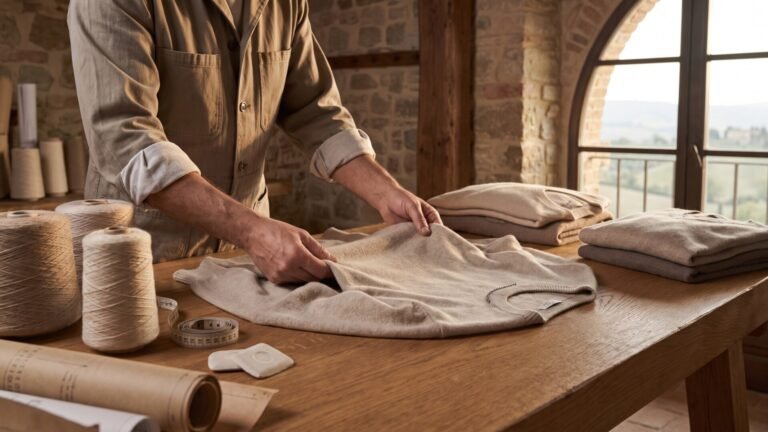
It is often repeated that everything is made by hand in Solomeo. The company’s investor pages give a more precise picture. The house says its products are made in Italy, with production carried out by about 400 artisan workshops that it selects for their skills in specific stages of manufacturing. Roughly 70 percent of those workshops are in Umbria, which the company calls a district of excellence for knitwear, and the others are in industrial districts elsewhere in Italy. Manual work is described as accounting for about 60 percent of the collections.
Two practical points follow. First, Solomeo is the headquarters and a training and design center, but most manufacturing is done by partner workshops, not by one factory. Second, the company has been bringing some production closer: in 2024 it acquired the Sartoria Eugubina sewing workshop in Gubbio, Umbria. As with any brand, “Made in Italy” is a labelling claim that applies product by product, so the label on the garment you are holding is the thing to read.
Design DNA: What Defines Brunello Cucinelli Style
Aesthetic
Brunello Cucinelli’s look is defined by:
- Neutral tones – Beige, cream, taupe, dove grey, navy, olive, and the occasional dusty rose or powder blue
- Relaxed tailoring – Soft shoulders, unstructured blazers, trousers that drape rather than cling
- Understated polish – Clothes designed to look settled rather than newly bought
- Layering – Cashmere over linen, wool over cotton, textures that build on each other
Signature Elements
| Element | Description |
|---|---|
| Cashmere knitwear | The foundation of the brand and the category it started with in 1978 |
| Soft tailoring | Blazers and jackets with minimal structure, designed to be worn like cardigans |
| Minimal branding | Few or no visible logos on most clothing |
| Monili | A bead-chain trim used on bags, shoes and knitwear, and one of the few recognizable decorative signatures |
| Natural materials | Cashmere, wool, linen, cotton, silk and leather or suede for shoes and bags |
Brunello Cucinelli Clothing
Cashmere Knitwear (The Brand’s Core)
Cashmere is what the company started with and still what it is best known for. For background on fibre grades, spinning and how Italian knitters differ from one another, see our guide to Italian cashmere. The brand does not publish a single micron figure for all of its knitwear, so it is better to compare specific garments: gauge (how fine the knit is), ply, fibre blend and finishing.
The core knitwear pieces:
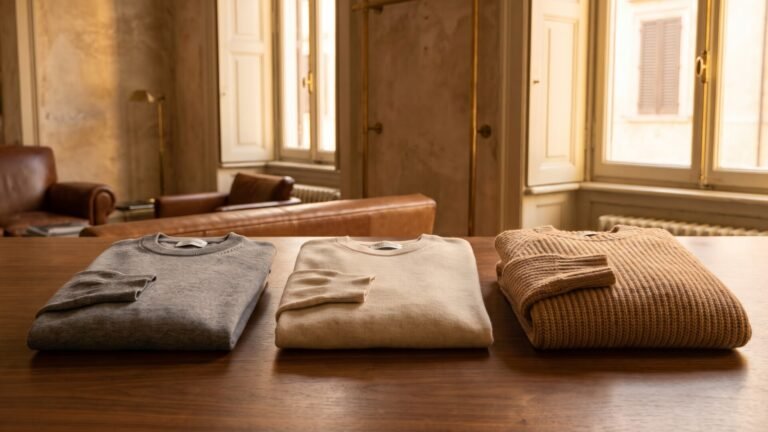
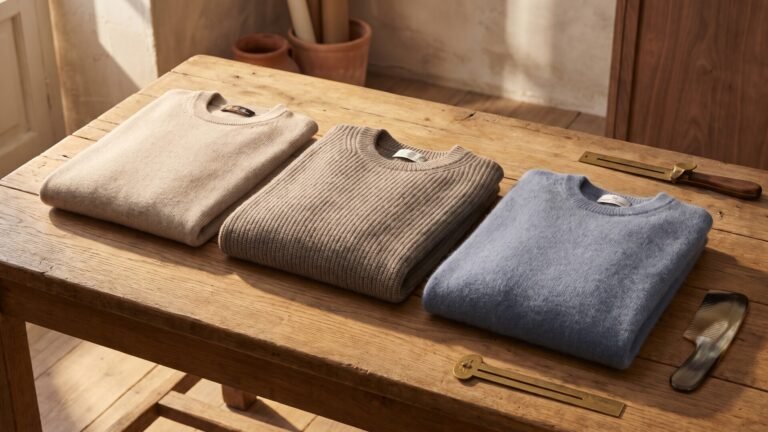
Cashmere crewneck – The usual first purchase. Lightweight enough to layer under a blazer and available in the brand’s neutral palette. Retailer listings seen in 2026 included a women’s 100% cashmere sweater at $1,450 and a men’s ribbed cashmere crewneck with a retail tag of $2,195.
Half-zip and quarter-zip sweaters – A more casual option; a men’s 100% cashmere half-zip was listed with a retail value of $1,350.
Cardigans, turtlenecks and hoodies – The house also makes these in cashmere and blends. Prices vary a lot with gauge, trims and embellishment, so compare current listings rather than relying on a single figure.
Rough guide: plain cashmere sweaters tend to start in the neighborhood of $1,350 and run to about $2,200 and beyond for heavier or embellished versions. Treat that as a snapshot, not a price list.
Tailoring & Smart Casual
Brunello Cucinelli’s tailoring is soft and deliberately unstructured, closer in spirit to a cardigan than to a stiff business suit. For how that compares with traditional Italian tailoring, see our Italian suits guide, and for harder-edged Neapolitan and Roman tailoring, the guides to Kiton and Brioni.
Soft blazers – Made in wool, linen, cashmere and blends. Price depends heavily on fabric: a Prince of Wales check 100% cashmere blazer was listed at Mytheresa at $11,000, a reminder that the top of the range sits far above the entry level.
Trousers – Relaxed fits with a soft drape, usually in wool, cotton or linen blends in neutral colors.
Linen jackets and field-style jackets – Lightweight summer layers and outerwear that borrow from military and hunting jackets in more refined fabrics.
Casualwear & Essentials
Even the most casual categories are priced as luxury: cotton T-shirts, polos, jersey and cashmere joggers and travel pieces. These are the lowest-priced clothing categories, which makes them the usual way to try the house’s cut and fabric before spending on cashmere or tailoring. Exact prices change by season, so check current retailer listings.
Brunello Cucinelli Bags & Leather Goods
Bags are a smaller part of the business than clothing, and they follow the same logic: restrained shapes, soft leathers and suede, and very little hardware. The most recognizable decorative detail is Monili, the bead-chain trim that shows up on many totes and shoulder bags.
What’s on Offer
Leather and suede totes – Medium and large totes in leather or suede, some reversible. At a major European retailer in late 2026, the tote range ran from about 1,765 euros for a raffia-effect tote with leather trim to about 3,865 euros for a large reversible leather tote. That is roughly $2,000 to $4,500, depending on exchange rate.
Suede shoulder bags – Soft, slouchy shapes. The same retailer listed medium suede shoulder bags between about 2,940 and 3,280 euros, roughly $3,300 to $3,800.
Crossbody, travel and weekend bags – The house makes smaller crossbody styles and travel bags as well; check the current catalogue for sizes, since offerings rotate season to season.
For comparison within Italy, see the guides to Bottega Veneta, Valextra and Il Bisonte, which approach understated leather goods from different price points.
Brunello Cucinelli Shoes
Sneakers
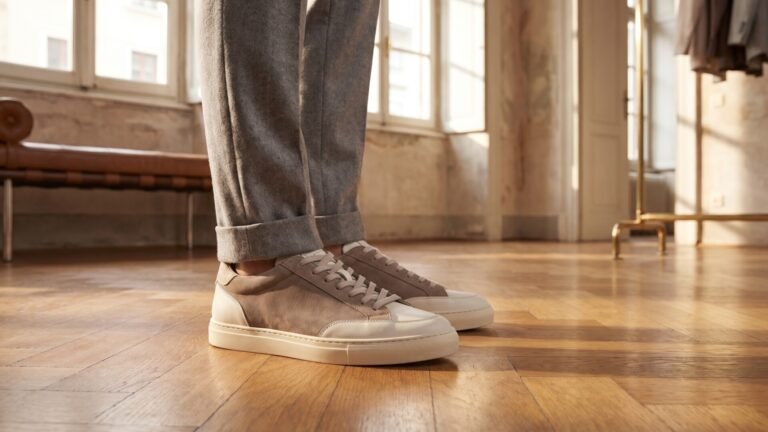
Sneakers are the most accessible shoe category: low-profile leather and suede designs, plus slip-on and loafer-sneaker hybrids, in the house’s neutral palette. New low-top suede pairs have been listed around $1,100, and multi-brand retailers show some styles slightly below that. For fit, comfort, materials and whether they are worth the money, read our dedicated guide: Brunello Cucinelli Sneakers: Quality, Comfort and Value.
Loafers & Formal Shoes
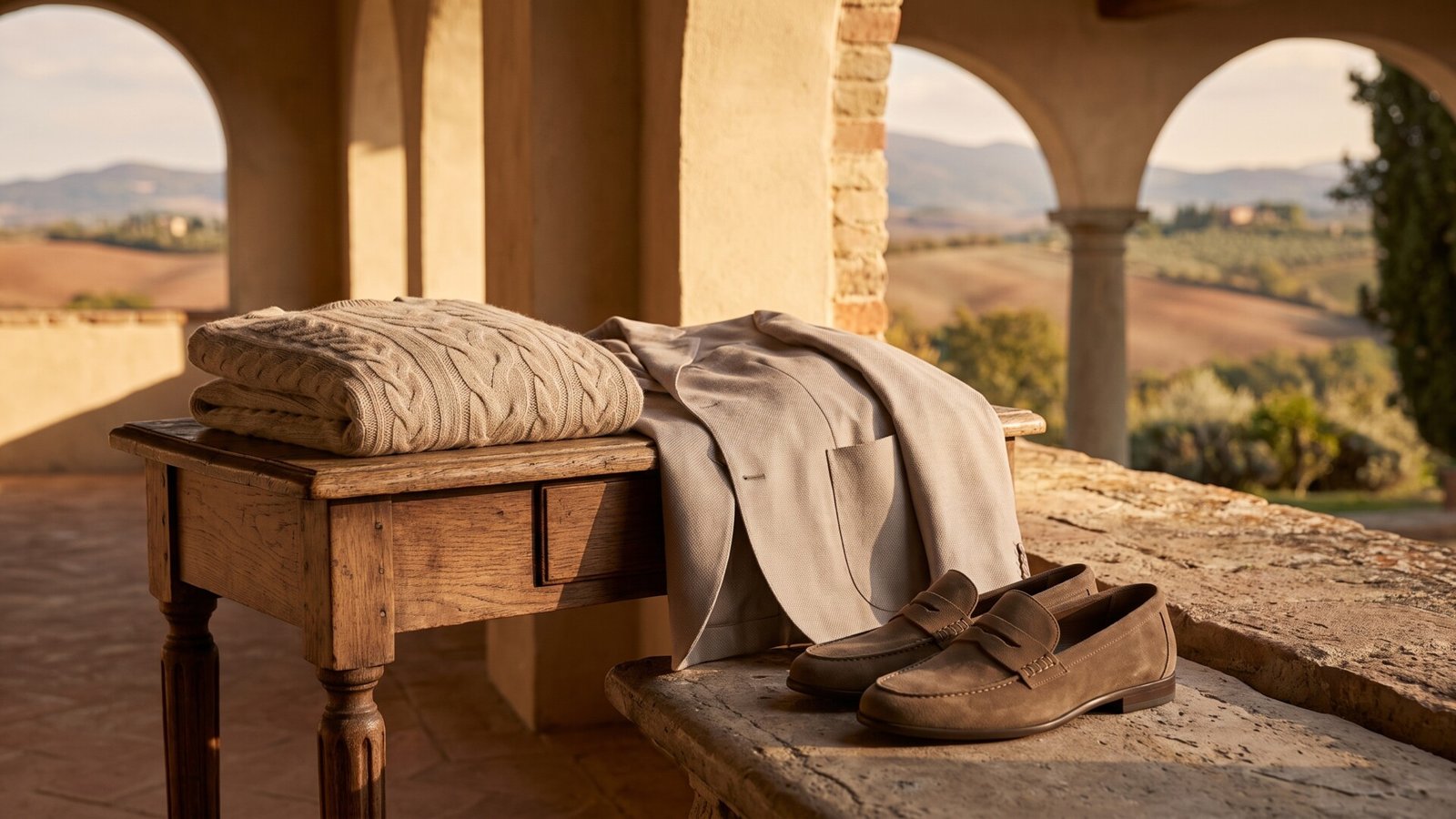
The house makes suede and leather loafers, derbys and other dress shoes, plus Monili-trimmed styles for women. For serious dress-shoe construction (Goodyear welting, hand finishing), compare against specialists such as Santoni and Tod’s.
Boots
Chelsea and lace-up boots appear in the autumn and winter collections. One European retailer listed a Chelsea boot at about 1,100 euros and a lined lace-up boot at about 1,600 euros, so roughly $1,300 to $1,900.
Pricing & Value Analysis (2026)
Typical Price Ranges (USD, Late 2026)
| Category | Approximate range | Basis |
|---|---|---|
| Cashmere sweaters | $1,350 to about $2,200+ | Retailer listings and retail tags seen in 2026 |
| Cashmere tailoring | Can reach $11,000 | One cashmere blazer at Mytheresa; wool and linen jackets cost less |
| Totes and shoulder bags | Roughly $2,000 to $4,500 | Converted from euro listings at one European retailer |
| Sneakers | About $900 to $1,100 | Retail and multi-brand listings |
| Boots | Roughly $1,300 to $1,900 | Converted from euro listings |
Prices change by season, market and exchange rate, so confirm on the retailer or brand site before buying.
Why Is Brunello Cucinelli So Expensive?
Materials and construction – Cashmere, fine wool, linen and leather at the top of the quality range, and a high share of manual work (about 60 percent of the collections, by the company’s own figure).
Italian production – Manufacturing is done by about 400 Italian workshops, mostly in Umbria, which costs more than producing in lower-wage countries.
Wages and training – The company reports paying roughly 20 percent above median wages and runs its own craft school, both of which raise costs.
Positioning and distribution – A large share of sales goes through its own boutiques, with real estate on premium shopping streets. A portion of any luxury price pays for brand, retail experience and margin, not only for the garment.
Is Brunello Cucinelli Cheaper in Italy?
Often the sticker price differs between countries because of exchange rates, import duties and sales tax. Italy’s VAT is 22 percent, and visitors from outside the EU can usually claim a refund on eligible purchases, so the net price can be lower than in some other markets. The gap changes constantly and we have not verified current price differences, so compare the same item at the same retailer in your currency, after tax refunds and any customs on the way home.
Cost-Per-Wear
Cost-per-wear is simple arithmetic. A $2,000 sweater worn 50 times a year for 10 years works out to $4 per wear; a $200 sweater worn 20 times works out to $10. The calculation depends on how often you actually wear it and how long it lasts, which varies with care and with the specific knit. It is a way to think about the purchase, not a promise about durability or resale value.
Brunello Cucinelli vs Other Quiet Luxury Brands
| Brand | Aesthetic | Price Position | Best For |
|---|---|---|---|
| Brunello Cucinelli | Relaxed, soft, neutral | Ultra-high-end | Head-to-toe wardrobe, knitwear, soft tailoring |
| Loro Piana | Fabric-led, technical, discreet | Ultra-high-end | Buyers who prioritize fibres and outerwear |
| Zegna | Modern, more structured | High-end | Workwear and tailoring |
| Max Mara | Polished, feminine | Premium | Women’s coats and outerwear |
| The Row | Minimalist, architectural (American) | Ultra-high-end | Silhouette purists |
| Luca Faloni and Falconeri | Simple, knit-focused | Considerably lower | Cashmere basics without the premium |
Positioning: Brunello Cucinelli sells a complete, coordinated wardrobe built around a philosophy. Loro Piana leans on fabric and Zegna leans on tailoring, while Cucinelli is the brand most associated with soft, layered, neutral dressing. If the price is the obstacle and you simply want a similar look, our guides to Luca Faloni and Falconeri cover Italian cashmere at lower prices, though the cut, yarn and finishing are not the same, so compare gauge and fibre before assuming equivalence.
Is Brunello Cucinelli a Quiet Luxury Brand?
Yes, and it is one of the names most often cited when quiet luxury is discussed. Muted colors, no prominent logos, soft tailoring and a premium on fabric are all part of its identity. Our broader guide to Italian designer brands places it alongside the other houses that share this approach.
Who Should Buy Brunello Cucinelli?
Ideal Buyer
- High-income professionals who value comfort, quality, and understatement
- Quiet luxury enthusiasts who have moved beyond logos and trends
- Capsule wardrobe builders who want pieces that work together for years
- Buyers drawn to the company’s approach to wages, craft training and local investment
- Frequent travelers who want a small set of soft, neutral pieces that mix easily
Who Should Skip
- Trend-driven buyers – The house is not built around seasonal “It” pieces
- Logo-focused shoppers – Few garments carry visible branding
- Budget-conscious buyers – This is ultra-high-end pricing
- Those who prefer bold colors or prints – The palette is intentionally neutral
Which Brunello Cucinelli Pieces Are Worth Buying?
Searches for essential Brunello Cucinelli pieces usually mean one thing: where to start. The sensible answer depends on the budget and what you already own. No luxury garment is guaranteed to hold its value, so the practical test is whether you will wear it often.
Top Picks by Category
| Need | Suggested piece | Why |
|---|---|---|
| The signature product | Cashmere crewneck | The category the company was founded on, and the easiest piece to wear often |
| Soft tailoring | Unstructured blazer in wool or linen | The clearest expression of the house style; cheaper than cashmere versions |
| Everyday casual | Cashmere half-zip or cotton T-shirt | Easier to wear regularly than dressier pieces |
| Shoes | Minimal leather or suede sneakers | Quiet, versatile; see our sneakers guide |
| Bag | Leather or suede tote | Understated shape, no loud logo |
| Lowest-cost entry | T-shirt or polo | Lets you assess fit and fabric before a larger purchase |
[Shop the most timeless Brunello Cucinelli pieces]
Where to Buy Brunello Cucinelli
Official Channels
Brunello Cucinelli boutiques – The company operates its own stores in major luxury cities; use the store locator on the brand website to find the nearest one and current opening details.
Brunello Cucinelli official website – The full current range, with regional price lists.
Luxury Retailers
Net-a-Porter and Mytheresa carry selected collections, as do luxury department stores in many markets. Selection, shipping terms and return policies differ by retailer, so check them before ordering.
Pre-Owned
The RealReal and Vestiaire Collective list pre-owned Brunello Cucinelli pieces, which can lower the entry price. Buy only where the platform authenticates items, check measurements and fibre content against the label photos, and treat resale prices as variable rather than a guarantee of what a piece will fetch later.
Care Guide: Maintaining Luxury Fabrics
Always follow the care label on the garment first. The notes below are general practice for the materials involved; when in doubt, use a professional cleaner experienced with cashmere and suede.
Cashmere Care
- Wash gently – cold water and a wool or cashmere detergent by hand, or dry clean if the label says so
- Do not hang – fold and store flat to prevent stretching
- Use a cashmere comb to remove pills (some pilling on soft knits is normal and does not by itself mean poor quality)
- Store in a breathable cotton bag – not plastic, which can trap moisture, and keep clean garments away from moths in off-season storage
Leather & Suede Care
- Protect from moisture – a suede protector spray, tested first on a hidden area
- Use a suede brush to lift the nap and remove surface dirt
- Condition smooth leather occasionally with a product suited to the leather
- Store in a dust bag away from direct sunlight and heat
Is Brunello Cucinelli Worth It?
Pros
Material focus – Cashmere, fine wools and soft leathers are the center of the offer.
Italian production – Made through a network of about 400 Italian workshops, mostly in Umbria, according to the company.
Coherent design – Pieces are designed to work together in a neutral palette, so a small wardrobe can go a long way.
Labor practices – Above-median pay and craft training, as reported by the company and the Kiel Institute.
Cons
Very high price point – Basic knitwear starts above $1,300 and tailoring can climb far higher, and part of that price pays for brand and retail.
Limited bold designs – If you want bright colors or dramatic silhouettes, this is not the brand.
Few logos – For some buyers, this is a feature. For others, it is a drawback.
Less affordable alternatives exist – Several Italian knitwear makers offer similar-looking cashmere for far less, with different construction.
Verdict
Brunello Cucinelli is a good brand if what you want is a coherent, understated wardrobe built around soft materials and you can afford the premium. It is a poor fit if you want value per dollar, visible status, or fashion novelty. A single cashmere piece, tried on in person and compared against a lower-priced alternative, is the least risky way to find out whether it suits you.
Frequently Asked Questions About Brunello Cucinelli
Why is Brunello Cucinelli so expensive?
The price reflects high-grade materials, a production network of about 400 Italian workshops (mostly in Umbria), a large share of manual work, wages the company says are about 20 percent above the median, its own craft school and boutique network, plus brand positioning. Part of any luxury price pays for brand and retail rather than for the garment alone.
Is Brunello Cucinelli a luxury brand?
Yes. It is a publicly listed Italian luxury house, trading on Borsa Italiana since 2012, with roughly 1.41 billion euros of revenue in 2025. Its prices place it in the ultra-high-end tier alongside Loro Piana.
Is Brunello Cucinelli quiet luxury?
Yes. It is one of the names most often associated with quiet luxury: neutral colors, soft tailoring and few visible logos. The house was working in this style well before the term became popular.
Where is Brunello Cucinelli made?
The company says its products are made in Italy by about 400 artisan workshops it selects for specific skills, roughly 70 percent of them in Umbria. Solomeo is the headquarters and training center, but most production is not done in a single factory. Check the label on each item, since origin is a product-level claim.
Who owns Brunello Cucinelli?
The company is listed on Borsa Italiana and controlled by the founder’s family through a holding company that holds roughly half of the share capital. Brunello Cucinelli is Executive Chairman and Creative Director, and Riccardo Stefanelli is among the co-CEOs (as of November 2026).
Is Brunello Cucinelli worth it?
It depends on how often you would wear the piece and whether you value soft, neutral dressing. Cost-per-wear can be low for a sweater worn often, but no luxury garment is guaranteed to keep its resale value. Trying one piece in person is the lowest-risk start.
Is Brunello Cucinelli cheaper in Italy?
It can be, because of exchange rates, taxes and the VAT refund available to many non-EU visitors, but the gap changes. Compare the same item in your currency after refunds and customs before assuming savings.
What is Brunello Cucinelli best known for?
It is best known for cashmere knitwear, soft unstructured tailoring, a neutral palette with minimal branding, and its humanistic capitalism approach centered on the restored village of Solomeo.
Keep Exploring
- Italian Designer Brands: A Complete Guide to Italy’s Most Influential Fashion Houses – the full directory of houses
- Brunello Cucinelli Sneakers: Quality, Comfort and Value
- Loro Piana vs Brunello Cucinelli: Which Italian Cashmere Brand Is Better?
- Piacenza 1733 vs Brunello Cucinelli – a Biella mill’s cashmere against the Solomeo premium
- Gran Sasso vs Brunello Cucinelli – an Abruzzo knitwear specialist at a fraction of the price; for Falconeri added to the comparison, see Gran Sasso vs Falconeri vs Brunello Cucinelli
- Lanificio Colombo vs Brunello Cucinelli – a Valsesia mill’s no-logo cashmere against Cucinelli at similar full prices
- Loro Piana: Mastering Quiet Luxury and Ermenegildo Zegna
- Luca Faloni and Falconeri – Italian cashmere at lower prices; see Brunello Cucinelli vs Falconeri for the price gap in cost-per-wear terms
- Italian Cashmere and Italian Suits
[Shop Brunello Cucinelli Cashmere]
[Shop Brunello Cucinelli Shoes]
[Shop Brunello Cucinelli Bags]
[Shop Brunello Cucinelli Men’s Collection]