Piacenza 1733 vs Brunello Cucinelli: Cashmere Quality, Style, and Price Compared
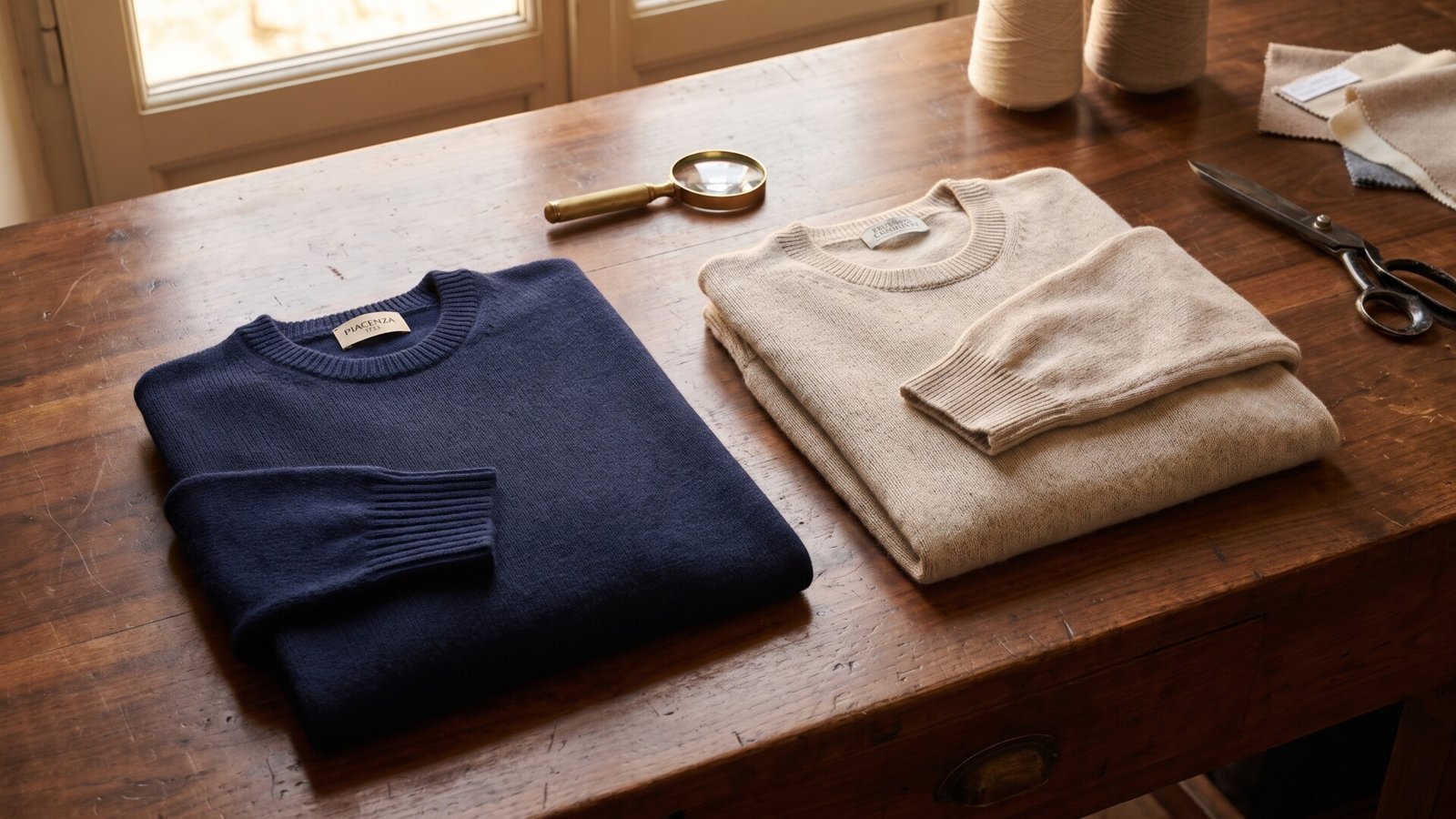
Two winters in, the difference between a good cashmere sweater and a great one stops being about the label and starts being about the elbows. That is the honest way into a Piacenza 1733 vs Brunello Cucinelli comparison, because both houses sell you cashmere that feels extraordinary on the first touch, and only one of them is built around the fiber itself rather than around the world it can be sold inside. Piacenza 1733, the textile mill turned knitwear label, puts its money into yarn and finishing. Brunello Cucinelli puts its money into a complete aesthetic: the relaxed shoulder, the precise neutral, the styling that makes a whole wardrobe cohere. In US stores in late 2026 that difference costs real money: about $600-$850 for a Piacenza 1733 cashmere crewneck against about $1,250-$1,400 for a plain Cucinelli one. Both are legitimate purchases. They are not the same purchase.
How the Two Brands Approach Cashmere Differently
Piacenza 1733 began as a wool mill founded in 1733 by Pietro Francesco Piacenza in Pollone, in the Biella district of Piedmont, the northern Italian textile region that has supplied cloth to tailoring houses for generations. Despite the name, it has no link to the city of Piacenza; it is the family surname, and the family still runs it. A mill thinks in yarn lots, fiber microns and finishing before it thinks in silhouettes, and press coverage of the company describes a process that runs in-house in Biella from raw Mongolian fiber through spinning and finishing. When a mill starts making finished garments, the material stays the protagonist. You feel it in the hand: a certain density, a lack of surface fuzz, an edge that holds its line.
Brunello Cucinelli is a different animal. Cucinelli founded the company in 1978 with a small collection of colored cashmere sweaters for women, and moved it to the restored hamlet of Solomeo, near Perugia in Umbria, where it is still headquartered; it has been listed on the Milan stock exchange since 2012. It is a fashion and lifestyle house built on cashmere as a signature, but its authority comes from design: the way a cardigan sits, the exact shade of oatmeal, the ease of a garment that looks expensive without shouting. Its knitwear is made in Italy through Umbrian workshops, and it buys its yarn from specialist spinners rather than spinning fiber itself. The brand’s “humanistic capitalism” and the Solomeo story are genuine, but they are also a story, and stories cost money to tell.
Comparing the two means separating three kinds of value that get tangled together in luxury knitwear:
- Textile value: the quality of the fiber, the spin, the knit density, the finishing.
- Garment-design value: the cut, the proportions, the styling, the details that make a sweater look considered.
- Brand and status value: what the label communicates, and what that communication is worth to you.
Here is the clearest way to see where each brand puts its weight: ask who made the yarn. Piacenza 1733 spins its own, so a large share of its price sits in the first category. Cucinelli designs and knits garments from yarn bought in, so its price sits mostly in the second and third. Neither is wrong, but it tells you what you are paying for before you touch a single sweater. And because fiber grade, construction and pricing vary item by item within both houses, the only fair comparison is like-for-like: a crewneck against a crewneck, a heavy cardigan against a heavy cardigan.
Cashmere Quality and Construction
Fiber, softness, and warmth
Softness is the worst possible measure of cashmere quality, and it is the one almost everyone uses in the shop. A garment can be softened mechanically or washed into a cloud-like hand that feels magnificent for a season and pills into a mess by the second winter. What you actually want is fiber fineness (measured in microns: the lower the number, the finer the hair), staple length (longer fibers spin into stronger, less pilly yarn), and enough knit density that the fabric resists abrasion.
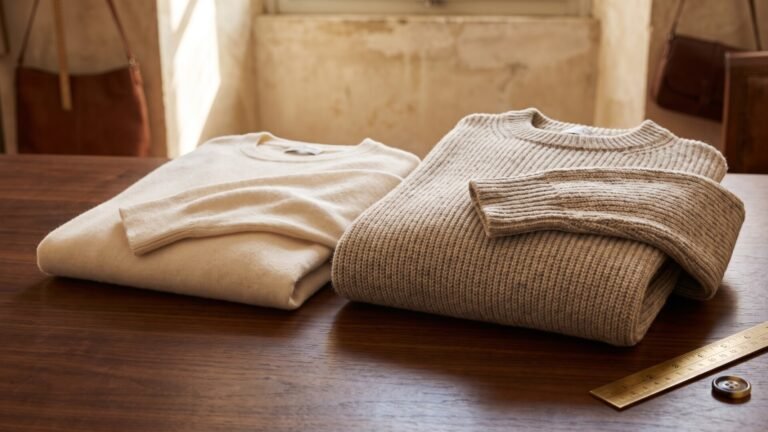
Piacenza 1733’s textile background shows here. The yarns tend to have a slightly drier, more substantial hand than the plushest fashion cashmere: less immediately seductive, more evidently built. Warmth-to-weight is strong because the knit is dense rather than loose. Brunello Cucinelli’s cashmere is generally excellent too, but the house’s priority is the finished garment’s feel and drape, and some of its lighter weights are deliberately soft and airy. That is a design choice, not a flaw, but a very soft, very light knit is more vulnerable to pilling and abrasion than a denser one. If you want a sweater to survive a decade of winters, the slightly less cloud-like option is often the smarter buy.
Knitting, finishing, and garment structure
Construction decides more of a sweater’s fate than a small difference in advertised fiber grade. The details that matter:
- Rib recovery: does the cuff and hem snap back after stretching, or stay baggy?
- Collar stability: does the neckline hold its shape, or gape and stretch?
- Seam neatness: are the seams flat and secure, or bulky and prone to pulling?
- Knit density: hold it to the light. If you can read a newspaper through it, it will wear thin fast.
- Shoulder construction: set-in shoulders hold structure; dropped and raglan shoulders are softer but can sag.
Piacenza 1733, coming from a mill, tends to finish with a textile-maker’s discipline: clean edges, even tension, a fabric that keeps its body. Brunello Cucinelli’s finishing is refined and its proportions are deliberate: the relaxed shoulder and easy body are engineered to drape a particular way, and they do. A small difference in cashmere grade rarely outweighs a large difference in how the garment is put together and how it fits you.
What most buyers get wrong about luxury cashmere
The assumption that the more expensive sweater must contain dramatically better cashmere is the costliest mistake in this category. Price in luxury knitwear is a stack: raw material, labor, design development, finishing, retail environment, marketing and brand positioning. Cucinelli’s premium buys you all of it. Some of that stack is fiber. A great deal of it is everything around the fiber.
Here is the hand test to run in the shop. Press the fabric between thumb and forefinger and release: it should spring back, not stay creased. Hold it up to the light to judge density. Run your thumb along the inside seam; if it catches, it was finished in a hurry. Look at the underarm and side seams for early fuzzing. And give it several minutes against your skin before deciding: the first touch is marketing, the fifth minute is information.
Style, Fit, and Everyday Wearability
Piacenza 1733
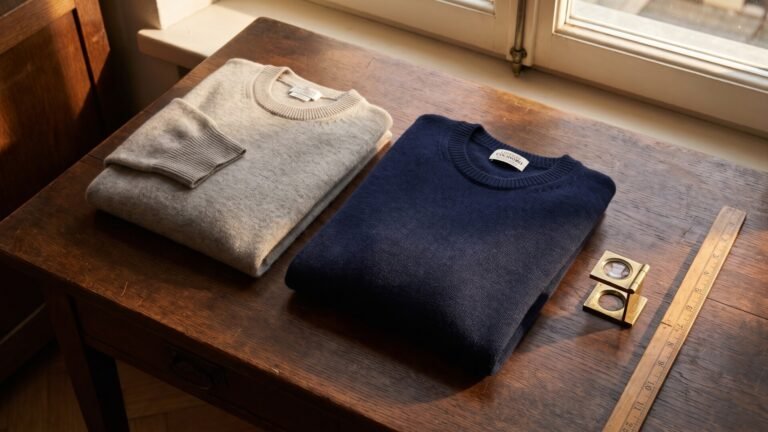
Piacenza 1733 suits the buyer who wants restrained, textile-led luxury: classic proportions, subtle or absent branding, colors that slot into an existing wardrobe without a fight. A navy crewneck or a charcoal cardigan from this house does not announce itself; it simply looks correct under a jacket, over a shirt, at a desk, on a plane. The limitation is real: if you want a sweater that reads as a statement, or looks styled the moment you put it on, Piacenza will feel understated to the point of plain. Its ready-to-wear is also concentrated in menswear basics, so the range is narrower than Cucinelli’s.
Brunello Cucinelli
Cucinelli’s signature is the balance of relaxed tailoring, neutral palettes, soft layering and elevated casualwear. The proportions are the product: a raglan or slightly dropped shoulder, a generous body, a neckline shaped to sit just so. Details like ribbing width, cuff tension and layering compatibility make the garment feel more luxurious even when the fiber is comparable. This is design value, and it is genuine.
The trade-off is versatility in the opposite direction. A piece with a strong design identity is harder to wear anonymously: it wants to be the Cucinelli sweater, styled the Cucinelli way. If you want a simple, invisible cashmere staple, the design signature can become a constraint rather than a pleasure.
Which brand works better in real wardrobes?
Match the brand to the use case. For office layering under tailoring, a classic Piacenza crewneck or fine turtleneck earns its keep because it disappears under a jacket and reappears over a shirt. For travel, a denser mid-weight knit from either house beats a delicate lightweight one. For weekend wear and cold-weather dressing, Cucinelli’s relaxed overshirts and heavier layers are hard to beat on feel. For quiet formal occasions, restraint wins, and that usually means Piacenza. Either way, a classic piece worn three times a week will beat a distinctive piece worn twice a season, every time, on pure economics.
Piacenza 1733 vs Brunello Cucinelli: Price and Value Compared
These are US retail prices at the time of writing (November 2026). Both brands change prices by season and fiber, and Cucinelli in particular has a very wide range, so treat these as ranges rather than quotes.
| Piece | Piacenza 1733 | Brunello Cucinelli |
|---|---|---|
| Plain cashmere crewneck | About $600-$850 (Mr Porter: $630) | About $1,250-$1,400 (Neiman Marcus: $1,250) |
| Wool-cashmere crewneck | About $250 for a 12-gauge wool-cashmere knit | About $1,295 |
| Cashmere and silk crewneck | About $800-$850 | About $1,650-$1,800 |
| Rib or textured cashmere | Limited range | Up to about $3,200 (English rib crewneck) |
For a plain cashmere crewneck, Cucinelli costs roughly 1.5 to 2 times as much as Piacenza 1733, and the gap widens sharply in textured and blended pieces. That premium is not arbitrary: it funds design development, the Solomeo workshops, luxury retail and the recognition that makes the label mean something. But it does not translate into proportionally better fiber. Piacenza 1733 usually offers stronger material-led value: more of your money goes into yarn and construction, less into lifestyle branding.
Handle sale pricing with care. Cucinelli knitwear does reach department-store and online markdowns at the end of a season, but a discounted piece is a good buy only if the design is timeless and the fit is right. Buy the garment, not the discount.
The cost-per-wear framework is where this comparison actually resolves:
- Estimate use across several winters, not the purchase moment. A $1,250 Cucinelli crewneck worn 100 times costs $12.50 a wear; a $630 Piacenza 1733 crewneck worn 100 times costs $6.30, and the Cucinelli only matches it if you wear it about twice as often.
- Factor in care: professional cleaning or careful hand-washing, a cashmere comb, storage, occasional repair.
- Weigh replacement risk: a thin, pale, loosely knit piece may need replacing before a denser, darker one.
- Count layering utility: a sweater that works under a coat and over a shirt gets worn more than one that only works alone.
Neither brand is a financial investment. The relevant returns are durability, wardrobe utility, satisfaction and some resale demand, not appreciation. Our guide to Cucinelli as an investment works through resale in more detail.
Comparison Table: Piacenza 1733 vs Brunello Cucinelli
| Feature | Piacenza 1733 | Brunello Cucinelli |
|---|---|---|
| Founded | 1733, Pollone (Biella), Piedmont | 1978; Solomeo (Perugia), Umbria |
| Ownership | Founding Piacenza family | Listed in Milan since 2012; founder’s family holds the largest stake |
| Who makes the yarn | Spun in-house | Bought from specialist spinners |
| Main strength | Material expertise and understated quality | Refined design, styling and luxury positioning |
| Design language | Classic, discreet, fabric-led | Relaxed, polished, recognizably luxurious |
| Cashmere crewneck (US) | About $600-$850 | About $1,250-$1,400 |
| Range | Mostly menswear basics, scarves, cloth | Full men’s and women’s wardrobe |
| Main trade-off | May feel less distinctive | Higher price may not equal proportionally better fiber |
Read the table as a map, not a scorecard. The specific garment in front of you, its density, fit and finishing, decides more than the label on the collar.
What Happens After Six Months of Ownership?
Six months in, cashmere tells you the truth. The first signs of wear appear at the underarms and along the sides, where friction from seat belts, shoulder bags, coats and desk edges does more damage than any wash cycle. You will see pilling at those friction points first, then flattening at the cuffs, then a softening of the collar. Surface fuzzing is normal; how fast it appears tells you about fiber length and knit density.
Both brands will show these signs if worn hard; the difference is the rate and the recovery. A denser, well-spun knit from either house sheds pills and holds shape longer than a loose, ultra-soft one. Friction, not washing, is the real enemy. So care matters: follow the care label, wash as little as possible, rest knitwear a day between wears, dry flat, and store folded rather than hanging. Our step-by-step cashmere cleaning guide applies to both brands.
Apply a three-year test before you buy:
- Will the color still work with the wardrobe you actually own?
- Will the shape still be useful, or will the silhouette have dated?
- Can the piece be repaired or refreshed: re-knit at a worn elbow, de-pilled, re-blocked?
- Would you choose it again at today’s price?
If the answer to all four is yes, the price is defensible.
Which Brand Still Makes Sense in Three Years?
Choose Piacenza 1733 if you want a discreet cashmere staple rather than a status purchase, if you buy on textile heritage and material-first reasoning, if you want control over cost per wear, and if you want classic pieces that sit under tailoring or slot into a capsule wardrobe. [Affiliate: Explore the Piacenza 1733 cashmere collection] with an eye on crewnecks, cardigans and classic neutrals rather than statement pieces.
Choose Brunello Cucinelli if you want a complete luxury wardrobe aesthetic rather than an isolated sweater, if the relaxed proportions and refined finishing genuinely suit you, if you want a garment that communicates quiet luxury through design and association, and if that satisfaction justifies the premium. [Affiliate: Browse the Brunello Cucinelli knitwear collection] for timeless sweaters and layering pieces built for long-term use.
Skip both if you want hard-wearing everyday knitwear for heavy friction, if you will not follow cashmere care instructions, or if you are buying primarily for resale. The resolution is clean: Piacenza 1733 is the stronger rational buy for cashmere-focused value. Brunello Cucinelli is the stronger luxury-fashion buy when design identity and brand experience matter as much as material performance.
Buying Advice: How to Choose the Right Garment
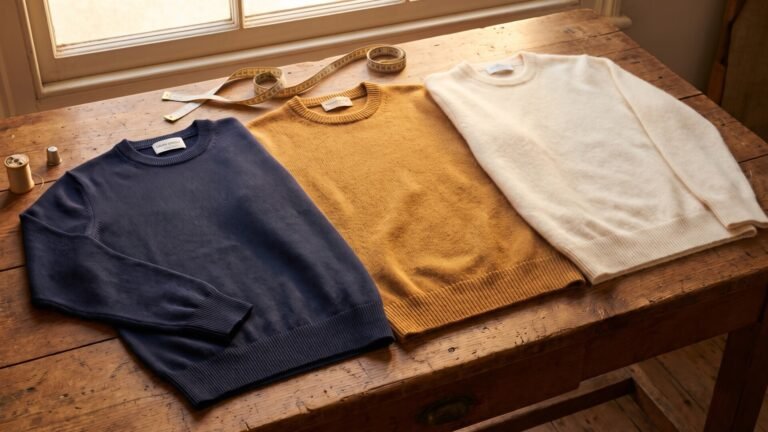
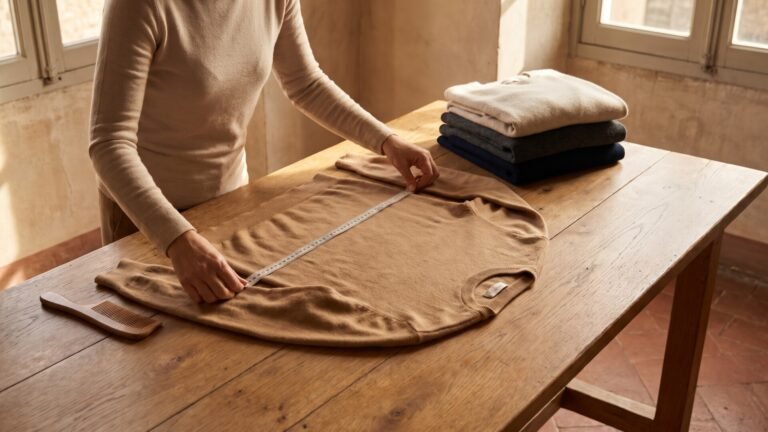
Start with use case, not brand. A daily office layer wants a fine-gauge crewneck or turtleneck in a dark neutral. A travel sweater wants mid-weight density and a color that hides a spilled espresso. A weekend knit can be softer and more relaxed. An occasional luxury piece can afford to be more distinctive. Prioritize versatile colors (navy, charcoal, camel, cream, dark brown), then assess fit: shoulder seam at the shoulder bone (or deliberately dropped, if that is the design), sleeves ending at the wrist bone, enough body ease to layer without pulling, and a neckline that holds its shape when you move. Both brands size in Italian sizes, so check the conversion chart.
- Compare equivalent weights and constructions, not just labels.
- Inspect the high-friction zones (underarms, sides, cuffs) for density and finish.
- Check the care label and decide honestly whether you will follow it.
- Review the return policy before committing to a premium price.
The caveat worth carrying out of the shop: this verdict holds only if you buy the right garment. The moment you find yourself paying the Cucinelli premium for a sweater you will wear twice a season, the rational case collapses, and you are buying a feeling rather than a garment. For how fiber, spinning and knitting decide what a sweater is worth, read how Italian cashmere is made, and compare the wider field in our best Italian cashmere brands roundup and the Italian cashmere guide. For other Cucinelli match-ups, see Lanificio Colombo vs Brunello Cucinelli, Gran Sasso vs Brunello Cucinelli, Brunello Cucinelli vs Falconeri and the three-way Gran Sasso vs Falconeri vs Brunello Cucinelli; if Loro Piana is also on your list, read Piacenza 1733 vs Loro Piana.
Frequently Asked Questions About Piacenza 1733 Vs Brunello Cucinelli
Is Piacenza 1733 cashmere better than Brunello Cucinelli cashmere?
There is no universal winner across every garment. Piacenza 1733 has the stronger textile-specialist argument: it spins its own yarn, knits dense, and charges roughly half the Cucinelli price for a plain crewneck. Brunello Cucinelli adds more design, styling and brand value. Judge the specific sweater on density, seams and fit rather than the label.
Where is Brunello Cucinelli made, and who owns it?
Brunello Cucinelli is headquartered in Solomeo, near Perugia in Umbria, and its knitwear is made in Italy through its own and partner Umbrian workshops. Brunello Cucinelli founded it in 1978, and it has been listed on the Milan stock exchange since 2012, with the founder’s family company remaining the largest shareholder.
Is Piacenza 1733 from the city of Piacenza?
No. Piacenza is the founding family’s surname. The mill was founded in 1733 in Pollone, in the Biella wool district of Piedmont, and it is still run by the Piacenza family. You may also see the knitwear sold as Piacenza Cashmere 1733. The city of Piacenza, in Emilia-Romagna, has no connection to the company.
Does Brunello Cucinelli knitwear go on sale?
Yes, through department stores and online retailers at the end of a season, typically on seasonal colors and less classic shapes rather than core neutrals. Discounts can take a $1,250 crewneck under $900. Brunello Cucinelli’s own boutiques discount far less. A markdown makes sense only for a timeless design in your exact size, since sale items may be final.
Does Brunello Cucinelli cashmere hold its value?
Better than most knitwear, thanks to strong brand recognition, but do not count on appreciation. Used sweaters typically sell for a fraction of retail, and condition, color, size and how classic the design is matter more than the original price. Piacenza 1733 resells less easily, so treat both as clothes to wear rather than assets to hold.