Lanificio Colombo: The Italian Cashmere and Luxury Knitwear Guide
Most people who want a Lanificio Colombo sweater will never see the brand in an airport. There is no monogram on the chest, no glossy campaign, no queue outside a store. That is the tradeoff in one sentence: you pay top-tier Italian cashmere prices for a garment that signals its quality to the person next to you on the train and to almost nobody else. If that sounds like a limitation, it is. If it sounds like the point, this is one of the quietest ways into serious Italian cashmere. Judge it as a wardrobe piece, not as a label.
This guide sits within our Italian designer brands guide and our wider Italian cashmere guide. It covers what the mill is, what its knitwear actually costs, what to inspect in the hand, and how it compares with Loro Piana, Piacenza 1733, Brunello Cucinelli and the more accessible Italian names.
What Lanificio Colombo Is and Why It Matters
Lanificio Luigi Colombo is a textile mill that also makes finished clothing. That order of operations matters more than any campaign. The word lanificio means wool mill: a place where fiber is sorted, blended, spun, woven or knitted and finished, not a label attached to a garment someone else produced.
| Detail | What to know |
|---|---|
| Full name | Lanificio Luigi Colombo; finished garments are sold under the Colombo label |
| Founded | 1967, in Borgosesia (Vercelli), by Luigi Colombo |
| Production | Two plants in Piedmont’s Valsesia: Borgosesia and Ghemme |
| Ownership | Family-run; Roberto Colombo built its international reputation from the 1990s, and the founder’s grandson joined the business recently |
| Fibers | Cashmere, kid cashmere, vicuña, guanaco, camel hair and superfine wool |
| Main business | Cloth and yarn for international luxury houses; knitwear, outerwear and accessories under its own name |
| Typical price (Nov 2026) | About $1,300-$1,900 for a full-price cashmere crewneck at Farfetch and Harrods |
Italian business press (Milano Finanza, December 2025) puts turnover at around €100 million and annual fiber output above 500,000 kg. A retailer profile describes a vertically integrated process of 94 production steps; treat that figure as the company’s own account. The point for a buyer is simpler: most of Colombo’s output ends up as cloth inside other brands’ coats and jackets, so the knitwear you buy under the Colombo name comes from a supplier, not a client, of the luxury trade.
Why does that matter in cashmere specifically? Because cashmere is not one material. It is a range. The duvet, the fine undercoat a cashmere goat grows beneath its coarse outer hair, varies enormously in fiber diameter, staple length and color. Fine, long fibers spin into a yarn that is smooth, strong and slow to pill. Short, coarse fibers can feel soft on the shelf and collapse within a season. A mill’s reputation rests on knowing the difference and refusing the cheap end of the range. Our guide to how Italian cashmere is made follows that process step by step.
Where does Colombo sit? Alongside Piacenza 1733 and Loro Piana as a house with genuine textile roots, though with far less retail visibility than Loro Piana. It belongs to the same Piedmont mill tradition that produced Zegna, which began as a wool mill in Trivero. It is closer in spirit to Gran Sasso, another construction-first name, than to Brunello Cucinelli, where design language leads. For the full map, see our best Italian cashmere brands guide.
Price Check: Colombo Is a No-Logo Alternative, Not a Budget One
Many buyers assume a less famous mill must be much cheaper than Loro Piana. At full price, that is not what the shelves show. In November 2026 a Colombo 100% cashmere crewneck listed at about $1,850 on Farfetch, and a kid cashmere crewneck at £990 (about $1,300) at Harrods. Loro Piana’s own US site listed its Baby Cashmere Classic Crewneck at $1,900. Falconeri’s Ultrasoft cashmere crewneck sold for around $285 when last reviewed in late 2023.
So the decision rule is straightforward:
- Choose Colombo if you want mill-level fiber and no visible branding, and you are prepared to pay close to Loro Piana money for it. The best value comes in end-of-season sales, where Colombo pieces are often marked down heavily.
- Choose Loro Piana if, at a similar price, you would rather have the wider range, easier returns and stronger recognition.
- Choose Falconeri or Gran Sasso if the budget is a few hundred dollars and frequent wear matters more than the last degree of refinement.
For a head-to-head on fibers, prices and retail access, read our Lanificio Colombo vs Loro Piana comparison.
Materials and Craftsmanship
Italian wool and cashmere production clusters in a few places: Biella and the Valsesia in Piedmont for spinning and fine cloth, the area around Carpi in Emilia-Romagna for knitwear, and mills in Tuscany and the Marche. Colombo’s plants sit on the Sesia river, and the company and its retailers point to the river’s soft water as an advantage for washing and dyeing fine fibers.
Across Colombo knitwear you will meet the standard luxury set, cashmere and kid cashmere, plus silk blends and occasionally rarer fibers such as vicuña. Always read the fiber content and care label on the specific garment. A house with mill credentials still produces blends, and a cashmere-silk knit is a different object from 100% cashmere: softer drape, less warmth per gram, different pilling behavior.
Yarn quality drives four things at once: softness, drape, pilling resistance and warmth-to-weight. Softness is the one everyone tests in the shop and the one that tells you least. A long-fiber yarn can feel reserved at first and soften over months of wear; a short-fiber yarn can feel like a cloud on the hanger and shed pills by February. Softness is a finishing effect as much as a fiber property. What a mill cannot fake is how the garment behaves after twenty wears.
Here is what to check when you are holding one:
- Stitch density. Hold the knit up to a light. A lot of daylight through a fine-gauge sweater means it will distort at the elbows and under the arms.
- Rib recovery. Stretch the cuff and hem and let go. Good ribbing snaps back; ribbing that stays stretched loses shape at the wrists and waist first.
- Seams and joins. Turn the sweater inside out. Where the sleeves meet the body, a good join is flat and neatly finished. If your thumb catches on the inside edge, it was finished in a hurry.
- Linked cuffs and collars. On better knitwear the rib is joined to the body by linking, loop by loop, rather than with an overlock seam. Linking is slower, and it avoids the hard ridge an overlock seam leaves where it rubs.
- Shoulder shaping. The shoulder seam should sit where your shoulder ends, and shaping should be knitted in (fully fashioned), not cut and sewn.
- Collar structure. A crewneck or polo collar should stand on its own without a visible stiffener. A floppy collar is the first thing to look tired.
What Most Buyers Get Wrong About Luxury Cashmere
The most expensive sweater is not automatically the best value, and the most famous name is not automatically the best cashmere. You pay for fiber, but also for retail real estate, campaigns and the premium attached to recognition. Some of that buys a better garment; some of it buys the feeling of owning one.
The softer-is-better assumption causes real damage. Ultra-soft cashmere is often lightly spun and loosely knitted, which is lovely against the skin and vulnerable to abrasion. Cashmere wears out first at the underarm seams, the cuffs, and wherever a bag strap crosses the front. A delicate single-ply knit will fuzz and thin at those points long before a denser, firmer knit gives up. The sweater that feels most luxurious in the shop can be the one that looks tired soonest.
"Pure cashmere" sounds like a guarantee and isn’t. It means the fiber content is 100% cashmere; it says nothing about fiber length, diameter or spinning. "Ultra-soft" is a finishing claim, not a quality claim. Neither phrase tells you whether the knit will hold its shape.
A practical framework:
- Buy Colombo when material refinement is the main thing you want, you prefer no visible branding, and you will wear the garment often enough to justify the price.
- Look elsewhere when logo recognition matters, you need easy try-on and returns, or another house gives you a fit that flatters you better. Fit beats fiber: a superb yarn in the wrong silhouette is money wasted.
- Compare the garment, not the brand. A Colombo cardigan and a Piacenza 1733 cardigan at similar prices should be judged on the same points: handle, stitch density, rib recovery, seam finish and fit.
Lanificio Colombo Knitwear: What to Buy and What to Inspect
Everyday sweaters and knit layers
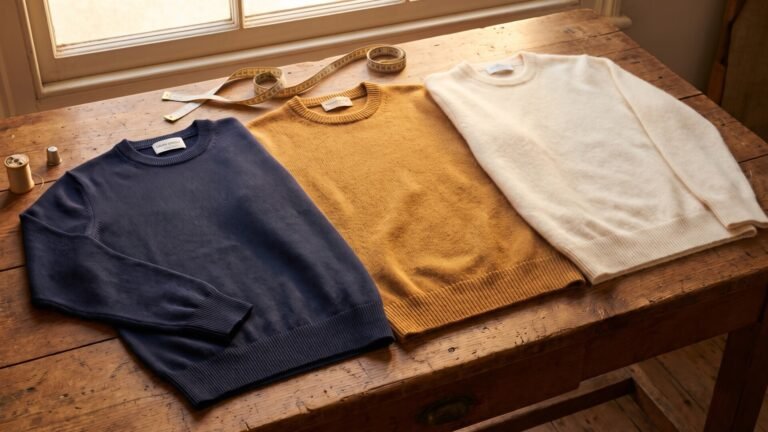
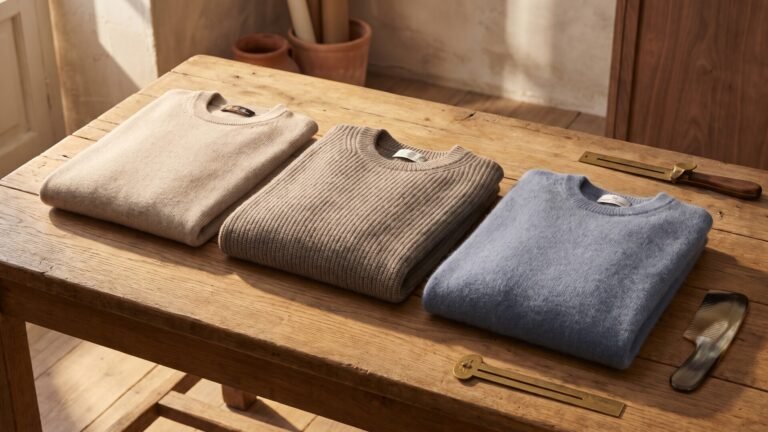
The most practical entry points are the plain ones: a cashmere or kid cashmere crewneck, a V-neck, a cardigan, a fine-gauge rollneck. These earn their price because they go into rotation. A neutral crewneck in a medium weight, heavy enough to hold shape and light enough to layer under a jacket, is the best first purchase from any mill-led house. Our guide to the best Italian cashmere sweaters for men compares crewnecks across brands.
Fit matters more than most buyers expect. The shoulder seam should land at the edge of your shoulder unless the piece is designed oversized. With your arms at your sides, the cuff should reach the base of your thumb. A hem that grips too tightly rides up; one that gapes looks sloppy. A fine-gauge piece cut close shows every layer underneath, while a medium-gauge piece cut generously reads as outerwear.
Seasonal and statement pieces
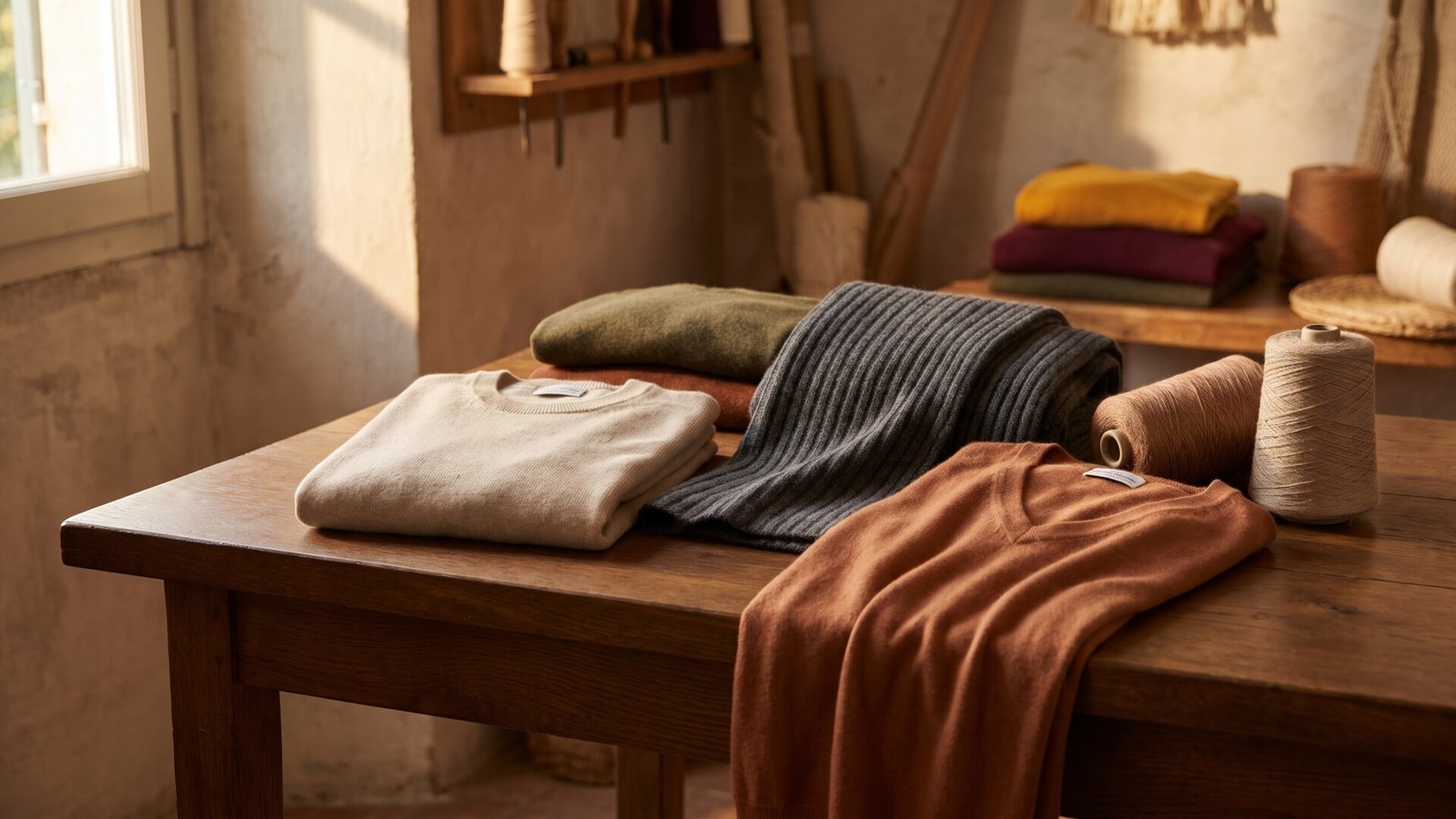
Heavier knits, cable and textured constructions, and cashmere outerwear are where a mill-led house shows what it can do with a heavier yarn. These often deliver better long-term value than delicate ultra-light pieces because they withstand more wear per outing. The trade-off is versatility: a bold texture in a fashion shade may be the piece you wear four times. Buy it only when you can picture at least five outfits it completes.
Accessories and gifting
Scarves, hats and gloves are the lower-commitment way into the brand, and a good cashmere scarf is one of the highest cost-per-wear items in a cold-climate wardrobe. Check the fiber content, because accessories are where blends hide; check the edge finishing; and check weight and dimensions, because a narrow, thin scarf gives far less warmth. Dark cashmere can transfer onto a light coat collar, so navy or charcoal is a safer gift than saturated red. See our round-up of the best Italian cashmere scarves for alternatives.
Lanificio Colombo Compared With Other Italian Cashmere Brands
Colombo does not exist in a vacuum. The differences between serious Italian houses are mostly about what each one optimizes for.
Lanificio Colombo vs Piacenza 1733. The closest comparison in spirit. Both are family mills that sell cloth to other houses and knitwear under their own name. Piacenza, founded in 1733 in Pollone near Biella, carries the longer heritage and a slightly more traditional design language; Colombo reads a touch more contemporary in its restraint. Neither is universally better: compare the specific garment’s handle, density, fit and price.
Lanificio Colombo vs Loro Piana. Loro Piana is the global benchmark, with exceptional materials and enormous category breadth, from knitwear to shoes and bags. Owned by LVMH since 2013, it also has a far larger store network. At full price the two are closer than most buyers expect, so the choice is mostly about range, retail access and whether you want recognition.
Lanificio Colombo vs Brunello Cucinelli. A difference of intent. Cucinelli is design-led luxury: the styling, the softly tailored silhouette, the elevated-casual identity. You pay for design and brand as much as for fiber. If you want a complete look, that is worth it; if you want the best yarn for the money, a mill-led house usually wins.
The practical tier. Gran Sasso offers broad Italian knitwear expertise and dependable construction at a lower price. Malo, the Florence cashmere house founded in 1972, brings more expressive design and is being relaunched under new ownership. Falconeri is the accessible entry point. Fedeli is the specialist for refined knitwear and resort dressing.
| Brand | Best known for | Design character | Best buyer | Value consideration |
|---|---|---|---|---|
| Lanificio Colombo | Mill-made cashmere, kid cashmere and rare fibers | Quiet, material-focused | Buyer prioritizing fabric and discretion | Full price close to Loro Piana; best value on sale |
| Piacenza 1733 | Textile heritage since 1733 | Understated, traditional | Buyer seeking heritage and low-logo luxury | Compare fabric, fit and retailer pricing |
| Loro Piana | Global prestige and exceptional materials | Minimal, polished | Buyer wanting prestige and broad category coverage | Crewnecks around $1,900 in 2026 |
| Brunello Cucinelli | Design-led elevated casualwear | Softly tailored, modern | Buyer wanting cashmere within a complete look | Price reflects design and brand |
| Gran Sasso | Italian knitwear breadth | Classic, practical | Buyer wanting dependable everyday knitwear | Often strong on cost per wear |
| Malo | Cashmere heritage, expressive knitwear | Rich, tactile | Buyer wanting heritage with personality | Brand in relaunch; check current collections |
| Falconeri | Accessible Italian cashmere | Clean, contemporary | Buyer entering premium cashmere | Lowest entry price here |
| Fedeli | Refined knitwear and resort dressing | Elegant, discreet | Buyer building a polished leisure wardrobe | Best when its aesthetic fits your life |
Which Option Still Makes Sense in Three Years?
A Colombo knit in a neutral color, worn weekly and cared for properly, should still look like a good sweater in year three. Dense stitches resist distortion, good ribbing recovers, and a well-finished seam does not fray. Color longevity depends on dye quality and on how you wash and store the garment. Repairability is the quiet advantage of a well-made knit: a specialist rimagliatore, a knitwear mender, can reknit a small hole or replace a cuff.
Cost per wear is the only honest measure. Divide the purchase price by realistic annual wears, then add cleaning, storage and repairs. A $1,500 sweater worn forty times a year for five years costs about $7.50 per wear before care; a $300 sweater worn five times a year for two years costs $30 per outing. The math rewards frequency, which rewards neutral colors and classic shapes. It also shows why Colombo only makes sense for a garment you will actually reach for every week.
Styling, Ownership, and Care
A mill-led sweater rewards a simple wardrobe. A navy or charcoal crewneck sits under a blazer for work, over a shirt for smart-casual, and alone with trousers at the weekend. A camel or cream fine-gauge rollneck is a travel staple. A restrained cardigan is the most versatile layering piece you can own. Prioritize navy, charcoal, camel, cream, gray and muted earth tones; a seasonal shade is worth the risk only when you can name the outfits it completes.
Ownership practices that materially extend lifespan:
- Fold, do not hang. Hanging stretches lightweight cashmere at the shoulders.
- Rotate. A day of rest between wears lets the fibers recover their loft.
- Store breathably. Use a cotton or canvas bag, not vacuum-sealed plastic, and store only clean garments, since moths are drawn to soiled fiber.
- Address pilling gently. A cashmere comb or a lightly used fabric shaver removes pills without pulling new fibers.
- Follow the care label. Some cashmere is hand-washable in cool water with a pH-neutral wash; some is dry-clean only. Our Italian knitwear guide covers the full routine.
Buying Verdict: Who Should Buy Lanificio Colombo?
Buy Colombo if you value Italian textile expertise, prefer low-visibility luxury, and want garments that stay in rotation for years. It is the right house for the buyer who would rather explain the yarn than the logo, and who is comfortable paying close to Loro Piana prices for it, or patient enough to buy in the sales.
Look at Piacenza 1733 or Loro Piana if you want a stronger heritage story or a larger retail network. Look at Gran Sasso, Falconeri or selected Malo pieces if budget, everyday practicality or easy access matters more than exclusivity. Look at Brunello Cucinelli or Fedeli if you want cashmere inside a complete-look identity. Skip Colombo if the purchase is driven by logo recognition, resale or the softest possible hand feel: those are the three things this house is least designed to deliver.
Most readers do not need to spend Colombo money to own excellent cashmere. A Gran Sasso crewneck or a Falconeri knit will serve a weekly rotation well. The buyer who genuinely benefits from spending more is the one who will wear the garment often and keep it for a decade.
Frequently Asked Questions About Lanificio Colombo
Is Lanificio Colombo a luxury cashmere brand?
Yes. It is a family-run Piedmont mill founded in 1967 that supplies cashmere and rare-fiber cloth to international luxury houses and sells knitwear, outerwear and accessories under the Colombo label. Its positioning rests on fiber and construction rather than visible branding.
Where is Lanificio Colombo made?
The mill’s two plants are in Borgosesia and Ghemme, in Piedmont’s Valsesia. Colombo garments sold at major retailers are labelled Made in Italy, but check the label of the specific piece, since origin is stated per product.
Where can I buy Colombo knitwear in the US?
Colombo knitwear is sold mainly through multi-brand luxury retailers and online marketplaces such as Farfetch, plus department stores like Harrods abroad, rather than a large network of US boutiques. Availability changes by season, so check current stockists before planning a try-on.
Does Lanificio Colombo cashmere pill?
Any cashmere can pill, especially lightweight knits and high-friction areas like cuffs, underarms and where a bag strap crosses. Fiber length, knit density, wear and care all affect how much. Good yarn pills less and recovers better; a cashmere comb manages what appears.
Which Colombo item is the best first purchase?
A medium-weight crewneck or cardigan in navy, charcoal, camel or gray, provided the fit works with your wardrobe. These pieces earn their price through frequent wear. A scarf is the lower-cost way to judge the yarn before committing to a sweater.
Does Colombo knitwear hold its resale value?
Most luxury knitwear is bought to wear, not to resell. Neutral colors and excellent condition help, but cashmere does not have the resale dynamics of scarce handbags or watches, and Colombo’s low recognition limits demand further. Treat it as clothing, not an investment.