Premiata Sneakers Review: Italian Design Meets Everyday Wear
If you want a sneaker that disappears into an outfit – a plain white court shoe you can wear with everything and think about never – Premiata is the wrong brand, and you should stop reading here. Premiata sneakers are built to be noticed. Layered uppers, mixed panels, graphic soles, a logo that announces itself. That is the whole proposition, and it is also the whole risk.
The question worth answering is not whether they look good in a product photo. It is whether that layered, textured design still earns its place in your wardrobe after a year of wear, whether the comfort holds up to how you actually move through a day, and whether the premium over a plainer Italian sneaker buys you something real or just something louder. This review is about ownership, not novelty.
What Premiata Is Actually Selling
Premiata sits in a specific and slightly awkward place in the Italian footwear landscape. It is not a dress-shoe house that added a sneaker line, and it is not a performance brand that hired a designer. It is a sneaker brand with genuine Italian design authorship, and the product reflects that.
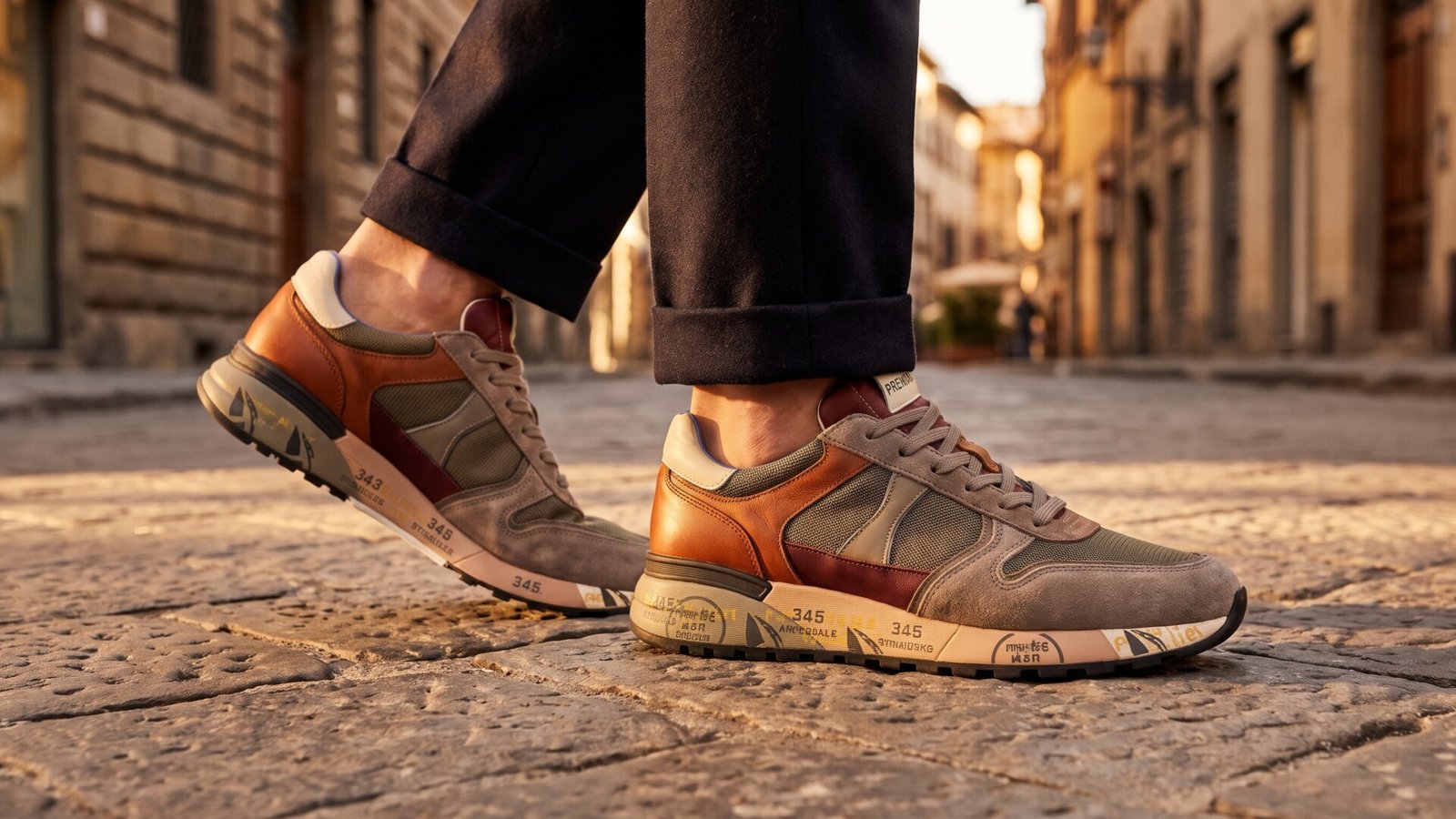
Walk into a stockist and the first thing you notice is that the shoes are busy. Not chaotic – there is a system to it – but busy. Suede panels against smooth leather. Mesh inserts. Contrast stitching. A sole unit that has been shaped and textured rather than left as a flat slab of rubber. This is a brand that treats the sneaker as a canvas, and the design language is consistent across the range even when the individual models differ.
The positioning is easier to understand against its neighbors. It is less formal and more playful than Santoni’s sneaker line, which leans toward hand-finished leather and a more conservative silhouette. It is far less minimalist than Common Projects, whose Achilles Low is essentially a leather shell with almost no visual information. And it is more visually expressive than Zegna’s Triple Stitch, which has become the default smart-casual sneaker for people who want to look considered without looking fashionable.
What you are paying for, then, is not only leather and rubber. You are paying for proportion, texture, sole treatment, and the styling flexibility that comes from a shoe with actual visual content. That is a legitimate thing to pay for. It is also a thing that can go wrong if the design does not match how you dress.
One caution before you buy anything. Materials, construction, and country-of-origin labeling can vary by model, and Premiata’s range is broad enough that you cannot assume a single standard across it. Check the product page for the specific pair you are considering. [Internal: See our Italian Designer Sneakers guide] for the wider category context.
Design, Materials, and Construction
Why the layered design matters
The mixed-material upper is Premiata’s signature, and it is worth understanding as a system rather than a checklist of features.
A typical Premiata sneaker combines suede, smooth leather, and a textile – mesh or nylon – across the upper, often with contrast panels and a textured or sculpted sole. Each material does a job. Suede adds depth and a matte surface that catches light differently from leather. Smooth leather gives structure and wipes clean. Mesh or nylon adds breathability and a technical note that keeps the shoe from feeling too precious.
The practical benefit is visual. A single-material white sneaker reads as one flat shape from across a room. A layered upper reads as several shapes, which gives the shoe more presence and makes it easier to pair with textured clothing – heavy denim, brushed cotton, knitwear, suede jackets. The shoe has something to answer back to.
The practical cost is maintenance. Every additional material is another surface to protect, another thing that can stain, and another cleaning method you need to know. Suede wants a brush and a protector. Mesh traps dust and does not respond well to cream. Metallic finishes can flake or dull. You are signing up for more care than a plain leather sneaker demands.
The sole deserves its own note. Premiata’s oversized and graphic sole units give visual lift – they make the shoe look more substantial and can add a little height – and they create an impression of cushioning. That impression is not always accurate. A thick, sculpted sole can be stiff, and visual bulk does not guarantee underfoot comfort. Judge the sole by how it flexes, not by how it looks.
The signature models
Three models come up again and again, and they represent genuinely different purchases.
Premiata Lucy. The Lucy is the model most people picture when they think of the brand – a low-profile sneaker with a layered upper and enough detail to carry a casual outfit on its own. It is the most versatile entry point in the range, particularly in a restrained colorway. If you want one Premiata and you are not sure where to start, this is where to start. [Affiliate: Browse the Premiata Lucy collection]
Premiata Mase. The Mase is a more substantial shoe – chunkier silhouette, stronger streetwear influence, more presence. It suits buyers who already dress with some volume and want a sneaker that holds its own against wide trousers and heavier outerwear. It is harder to wear with slim tailoring, and it will look out of place in a conservative office. [Affiliate: Browse the Premiata Mase collection]
Premiata Moerun. The Moerun leans sportier – more technical-looking proportions, a running-influenced shape, a sole that reads as performance-adjacent. It is the right choice for someone who wants a sneaker that looks active without committing to actual athletic footwear. The trade-off is refinement: in a smart-casual setting, the Moerun can look a little too casual next to a structured jacket. [Affiliate: Browse the Premiata Moerun collection]
Compare them by silhouette and use case rather than by colorway. The model you choose determines what the shoe can do. The color determines how often you reach for it. Both matter, but the silhouette decision comes first.
What to inspect before ordering
Here is what to check when the box arrives, or when you are holding a pair in a shop.
Run your thumb along the edge of each panel where the upper meets the sole. If it catches or feels rough, the edge was finished quickly. A clean, sealed, or neatly burnished edge is a good sign.
Press the leather on the side panels. It should give slightly and spring back. Leather that feels stiff and papery will crease sharply and look tired within months.
Turn the shoe over and look at how the sole is bonded to the upper. You are looking for an even line of adhesive with no gaps, no overflow, and no lifting at the toe. This is the single most common failure point on any sneaker, at any price.
Check the heel structure. Squeeze the heel counter – the stiffened panel at the back – between your thumb and fingers. It should hold its shape firmly. A soft heel counter collapses over time and lets your foot roll inward.
Look at the stitching. Even spacing, no loose threads, no skipped sections. Machine stitching is normal and fine on a sneaker; sloppy machine stitching is not.
Feel the insole. If it is thin and glued in place with no cushioning, plan to replace it or add a thin insert.
One honest caveat. A well-finished upper does not mean the shoe is built for long walks or wet weather. Most designer sneakers, Premiata included, use factory-based construction – the upper is assembled and then bonded or stitched to a rubber sole unit. This is not hand-welted shoemaking, and it is not meant to be. Visual craftsmanship and hidden construction are different things, and you should judge each on its own terms. [Internal: See The Art of Italian Shoe Making] for what those distinctions actually mean.
Comfort, Fit, and Everyday Wear
Comfort is where a single brand-wide claim falls apart. Premiata’s range includes low-profile shoes and chunky shoes, soft uppers and structured ones, and the experience differs accordingly. The Lucy and the Mase do not feel the same on foot.
On fit: most Premiata models are generally reported to run close to true to size, but the toe box and heel hold vary by silhouette. A chunkier model with a roomier interior will feel different from a low-profile one. Thick socks change the equation entirely – a shoe that fits perfectly in a thin sock can feel tight in a wool sock, and vice versa. Check the specific model’s sizing guidance on the retailer’s page rather than assuming.
The break-in question matters too. Leather-and-suede uppers generally soften over the first few weeks. A stiff new pair is not necessarily the wrong size – it may just need time. But if the heel slips when you walk, that is a fit problem, not a break-in problem, and sizing up to create length will make it worse.
Realistic use cases, honestly assessed:
- Short urban walks and daily errands. Premiata handles this comfortably. The shoes are built for city wear, and a few thousand steps a day is well within their range.
- Casual office wear and travel days with moderate walking. Fine, provided you chose a model with a supportive sole and a secure heel. The Lucy in particular works well here.
- Long sightseeing days. This is where you should be skeptical. Support, weight, breathability, and outsole grip matter more than branding when you are on your feet for eight hours. Some Premiata models will cope; others will not. If a long walking day is the primary use, a dedicated walking shoe is the smarter purchase, and no designer sneaker replaces that.
If comfort is your first priority, our guide to [Internal: Top 7 Italian Luxury Sneakers That Are Actually Comfortable] treats this question properly, with Premiata as a design-led case study rather than a performance recommendation.
For online orders, a short checklist:
- Measure both feet – they are rarely identical – and use the longer measurement.
- Compare that measurement against the retailer’s specific size chart for the model you are buying.
- Read the return terms before you order. Free returns make an uncertain size a low-risk experiment.
- Do not size up to create extra length if the heel already slips. Choose a different model instead.
What Most Buyers Get Wrong
The most common mistake is assuming that a technical-looking sole means a comfortable shoe. It does not. Appearance, cushioning, stability, and fit are four separate qualities, and a sculpted rubber sole tells you almost nothing about any of them. Judge comfort by trying the shoe, or by reading accounts from people with your foot shape, not by looking at the sole unit.
The second mistake is buying the loudest colorway first. The heavily paneled, high-contrast version is the one that photographs best and the one you will wear least. A restrained combination – white, gray, taupe, navy, black – delivers a far lower cost per wear because it works with more of what you already own. Buy the wearable pair first. Treat the statement pair as a second purchase, once you know the brand fits you.
The third mistake is conflating Italian design with artisanal construction. Premiata offers genuine design authorship and quality materials. It is not equivalent to a hand-finished dress shoe, and it does not claim to be. Understanding that distinction protects you from disappointment.
The fourth is underestimating maintenance. A mixed upper is not a single cleaning job. Suede needs a brush and a protector. Mesh needs gentle surface cleaning. Metallic details need care. Contrasting rubber can scuff and mark. If you are not willing to do that work, choose a model with fewer materials.
And a note on the logo. Recognition is part of why people buy Premiata, and there is nothing wrong with that. But the long-term value of the shoe depends far more on silhouette, condition, and whether the colorway works with your wardrobe than on the badge. A well-kept restrained pair will look better in three years than a scuffed loud one.
Which Premiata Sneaker Makes Sense for Your Wardrobe?
| Buyer priority | Best direction | Why it works | Main compromise |
|---|---|---|---|
| Versatile casual wear | Premiata Lucy in a restrained colorway | Layered design without overwhelming most outfits | Less minimal than Common Projects |
| Chunkier fashion silhouette | Premiata Mase | Stronger presence with contemporary proportions | Harder to style with formal tailoring |
| Sportier everyday look | Premiata Moerun | Technical visual language and casual versatility | May feel less refined in conservative settings |
| Quiet luxury styling | A low-contrast Premiata model | Texture and construction provide interest without loud color | Branding and sole details may still be visible |
| Frequent travel and walking | The lightest, most supportive model available | Lower bulk and easier movement | Designer styling may not replace performance footwear |
Four buyer archetypes, four different answers.
The design-led casual dresser – someone who wears good denim, knitwear, and unstructured jackets, and wants a sneaker with enough character to finish the outfit. The Lucy in a low-contrast colorway is the obvious choice.
The executive wanting a relaxed alternative to dress shoes – someone who wears chinos and soft tailoring to work and wants a sneaker that reads as considered rather than casual. A restrained Lucy or a low-contrast model works, but check that the sole and branding are discreet enough for your office. The Mase is probably too much.
The traveler – someone building a capsule for trips who needs one pair to do a lot. Choose the lightest, most supportive model you can find, in a color that works with everything you pack. Accept that it will not replace a walking shoe on the hardest days.
The minimalist – someone who wants a plain, clean, invisible sneaker. Premiata is not for you. Look at Common Projects or a low-key Zegna instead.
The buy this if / skip this if framework is simple. Buy if distinctive Italian styling, mixed textures, and casual versatility matter to you, and you will wear the pair several times a week. Skip if your priority is an invisible plain white sneaker, maximum athletic support, or a shoe you can clean without thinking.
For how these shoes slot into a wider wardrobe, see [Internal: How to Style Italian Shoes for Every Occasion] and [Internal: How to Style Italian Shoes for Fall].
Premiata Compared With Other Luxury Italian Sneakers
Premiata does not compete in a vacuum, and the alternatives are genuinely different purchases rather than interchangeable options at different prices.
Zegna Triple Stitch. More understated, more tailored, and the safer choice for a business-casual wardrobe. If you wear a blazer most days, the Zegna will serve you better. [Internal: See our Zegna Triple Stitch Sneaker Review] for the full model analysis.
Golden Goose Super-Star. Deliberately distressed and highly recognizable. Premiata offers a cleaner starting point and a different kind of visual identity – layered rather than worn-in. If you want the distressed look specifically, Golden Goose is the answer; if you want texture without the pre-aged effect, Premiata is. [Internal: See our Golden Goose Super-Star coverage]
Brunello Cucinelli sneakers. More restrained, more refined, and firmly quiet-luxury. A better fit for buyers who prioritize subtle materials and low-key branding, at a higher price. [Internal: See our upcoming Brunello Cucinelli Sneakers guide]
Common Projects Achilles Low. Cleaner and more minimalist, with almost no visual complexity. Less design risk, less personality. [Internal: See our Zegna Triple Stitch vs. Common Projects Achilles Low comparison]
Comparison table
| Option | Design character | Everyday versatility | Walking comfort focus | Best for | Value consideration |
|---|---|---|---|---|---|
| Premiata sneakers | Layered, textured, fashion-led | High for casual wardrobes | Model-dependent | Buyers who want distinctive Italian design | Strongest when worn frequently across casual outfits |
| Zegna Triple Stitch | Refined and understated | High for smart-casual dressing | Comfortable for moderate walking | Tailored and professional wardrobes | Pays off through office and travel versatility |
| Golden Goose Super-Star | Distressed, recognizable, fashion-forward | Medium to high | Model and foot shape dependent | Buyers who want an intentionally worn-in look | Style is highly specific, so colorway choice matters |
| Brunello Cucinelli sneakers | Quiet, polished, understated | High in refined wardrobes | Model-dependent | Quiet-luxury buyers | Higher price requires strong material and wardrobe alignment |
| Common Projects Achilles Low | Minimal and clean | Very high with simple outfits | Moderate, not performance-focused | Minimalists wanting a plain everyday sneaker | Lower design risk but less visual personality |
The resolution is by wardrobe, not by ranking. Premiata is the strongest choice for expressive everyday styling. Zegna or Common Projects suit minimalists and tailored wardrobes. Golden Goose suits buyers who specifically want a distressed signature look. Brunello Cucinelli suits quiet-luxury buyers with a larger budget.
There is no universal winner here, and any review that declares one is selling you something. [Internal: See our Italian Sneakers hub] for the full category, and [Internal: Best Italian designer sneakers made with recycled materials] if material sourcing is part of your decision.
The Hidden Cost of Choosing the Wrong Premiata Model
Cost per wear is the only number that matters, and it is not the number on the price tag.
A $500 sneaker worn four times a week for two years costs less per wear than a $200 sneaker worn twice a month for the same period. The math is not close. This is why buying the wearable Premiata – the restrained colorway you will actually reach for – is almost always the better financial decision than buying the dramatic one that lives in the box.
The hidden costs are real, though, and they show up later.
Cleaning. Suede and mixed materials need professional care for anything beyond surface dirt. A specialist clean runs a meaningful fraction of what a basic leather sneaker costs to maintain, and it is not optional if you want the shoe to last.
Replacement parts. Branded insoles and unusual sole units are hard to replace. If the insole wears through, you may not find an exact match, and an odd sole shape limits your repair options.
Versatility loss. An extreme color combination reduces the number of outfits it works with, which raises cost per wear even if the shoe itself is excellent.
Weather damage. Premature creasing and staining happen fast if you wear mixed uppers in wet conditions. Suede and water are not friends.
Return friction. If you are uncertain about sizing, an awkward return process can leave you with a pair you cannot wear.
Resale is secondary. Worn designer sneakers generally sell on condition, box and accessories, current demand, and a broadly wearable colorway – not on brand prestige alone. Do not buy Premiata expecting appreciation. Buy it expecting to wear it.
Long-term relevance follows the same logic. A restrained Premiata colorway will stay useful for years. A highly seasonal combination will not. But be honest with yourself: the layered look will never be as timeless as a plain leather court sneaker. That is the trade you are making when you choose personality over anonymity.
For care, use material-specific treatment – a suede brush and protector for the nap, gentle cleaner for smooth leather, and professional help for anything set in. [Internal: See How to Care for Italian Leather Shoes] for the full method. [Affiliate: Browse sneaker care essentials]
Are Premiata Sneakers Worth It?
For the right buyer, yes. Premiata sneakers are worth the price if you will wear their design personality regularly and you value Italian styling over anonymous minimalism. The materials are good, the design is genuinely authored, and the shoes do something that a plain white sneaker cannot.
The purchase is less convincing in four situations. You need serious all-day walking support. You want one sneaker to work with suits, formal trousers, denim, and travel. The colorway you have chosen is difficult to combine with what you already own. Or you expect hand-crafted dress-shoe construction and investment-grade resale – neither of which a designer sneaker delivers.
Run four tests before you commit.
Wear frequency. Can you wear this pair at least several times a week? If not, the cost per wear is working against you.
Wardrobe reach. Does it work with at least three categories of outfit you already own?
Maintenance tolerance. Are you willing to protect and clean mixed materials properly?
Design longevity. Will you still like the silhouette when the current sneaker trend moves on?
If all four come back yes, buy with confidence. If two or more come back no, look at a different model or a different brand.
Best for: design-conscious casual dressers, smart-casual professionals, and buyers who find minimalist luxury sneakers too plain. Consider alternatives: frequent long-distance walkers, strict minimalists, and buyers primarily seeking quiet luxury. Best purchase strategy: choose a restrained, wearable colorway first, and treat louder versions as second-pair purchases.
The Verdict
Most people do not need to spend Premiata money to get a good sneaker. A well-made plain leather court shoe at half the price will cover more outfits, clean more easily, and stay in style longer. If that is what you want, buy that, and you will not be missing much.
But there is a smaller group for whom the modest option genuinely is not enough – the people who dress with texture and color and want a sneaker that participates rather than recedes. For them, a restrained Premiata Lucy or a low-contrast Mase earns its keep, because it does something no plain white shoe can do. Buy the wearable colorway, wear it hard, and let the cost per wear settle the argument.
For the wider category, start with [Internal: Italian Designer Sneakers: The Complete Guide to Luxury Casual Footwear] and [Internal: Italian Designer Shoes: The Complete Guide to Luxury Footwear Craftsmanship]. If comfort is your deciding factor, [Internal: Top 7 Italian Luxury Sneakers That Are Actually Comfortable] answers that question directly.
Frequently Asked Questions About Premiata Sneakers
Are Premiata sneakers worth the money?
Value depends on wear frequency, not brand name. If you will wear them several times a week across casual outfits, the cost per wear compares well with cheaper shoes you rarely reach for. If they will sit in the box, they are expensive at any price. Judge them on materials, design, comfort for your foot, and how often they will leave the house.
Are Premiata sneakers comfortable for walking?
Comfort varies by model and foot shape. They handle short urban walks, errands, and moderate travel days well. For long sightseeing days, support, weight, breathability, and grip matter more than branding, and a dedicated walking shoe is the better tool. Try the specific model rather than assuming brand-wide comfort.
Do Premiata sneakers run true to size?
Most models are generally reported to run close to true to size, but toe box and heel hold vary by silhouette. Check the retailer’s model-specific size chart, measure both feet, and account for sock thickness. Do not size up to create length if the heel already slips.
Are Premiata sneakers made in Italy?
Country of origin and construction details can vary by model. Check the product page and the shoe’s labeling before purchase rather than assuming the whole range is made in Italy. Italian design authorship and Italian manufacturing are related but not identical claims.
How do Premiata sneakers compare with Golden Goose?
Premiata uses layered, mixed-material design with a cleaner starting point. Golden Goose uses deliberate distressing as its signature. If you want the worn-in look specifically, choose Golden Goose. If you want texture and visual depth without the pre-aged effect, Premiata is the better fit.
Can Premiata sneakers be worn with business-casual clothing?
Restrained models and low-contrast colorways work well with chinos, unstructured tailoring, knitwear, and dark trousers. Watch the sole and branding – a chunky graphic sole or a loud logo pushes the shoe too casual for conservative offices. The Lucy in a quiet color is the safest choice here.
How should Premiata sneakers be cleaned?
Use material-specific care. Brush and protect suede before wear, wipe smooth leather with a gentle cleaner, and keep mesh dry. For set-in stains on suede or mixed uppers, use a professional. Protect the shoe before the first wear rather than after the first mark.