Bulgari Serpenti Collection: Is It a Good Investment?
When a piece of jewelry costs as much as a car, it is reasonable to ask whether it is an investment or a beautiful expense. The Bulgari Serpenti, the coiled-snake design the Roman house has been refining since the late 1940s, is one of the few jewelry icons where that question comes up constantly. The honest answer is nuanced: Serpenti is a well-made, highly recognizable piece that tends to keep a meaningful share of its value, but it is not a reliable way to make money, and the details of which piece you buy matter far more than the name.
This guide covers the history of Serpenti, how the pieces are made, what the main lines cost today, what drives resale value, how Serpenti compares with Cartier Love and Van Cleef & Arpels Alhambra, and how to decide whether it makes sense for you. It is part of our coverage of Italian designer brands.
The Short Answer
- As a store of value: reasonable for precious-metal and gem-set pieces, because the gold and stones carry real intrinsic value.
- As an appreciating asset: only for rare, vintage or exceptional pieces. Current retail pieces usually sell for less than their boutique price on the second-hand market.
- As something to wear: where Serpenti makes the strongest case. Cost per wear drops quickly if it becomes a daily piece.
The Serpenti Story
Bulgari (also written Bvlgari) was founded in Rome in 1884 by the Greek silversmith Sotirios Voulgaris, and has been part of the LVMH group since 2011. The snake is an ancient symbol of rebirth, protection and wisdom, and Bulgari first used it in 1948 for a gold Tubogas bracelet-watch with a coiled body and a square dial hidden in the serpent’s head. According to Sotheby’s history of the collection, it was designed in that year and has been reinvented ever since.
The 1960s gave Serpenti its celebrity moment. Elizabeth Taylor bought a Serpenti watch in Rome while filming Cleopatra at Cinecittà, and her attention helped carry the brand beyond Italy. Over the decades the motif has grown from a single watch into a family: Tubogas watches and bracelets, the sculptural Viper line, Serpenti Forever handbags, and high-jewelry necklaces and bangles set with diamonds, enamel and colored stones such as emeralds, rubies and sapphires.
The Anatomy of a Serpenti
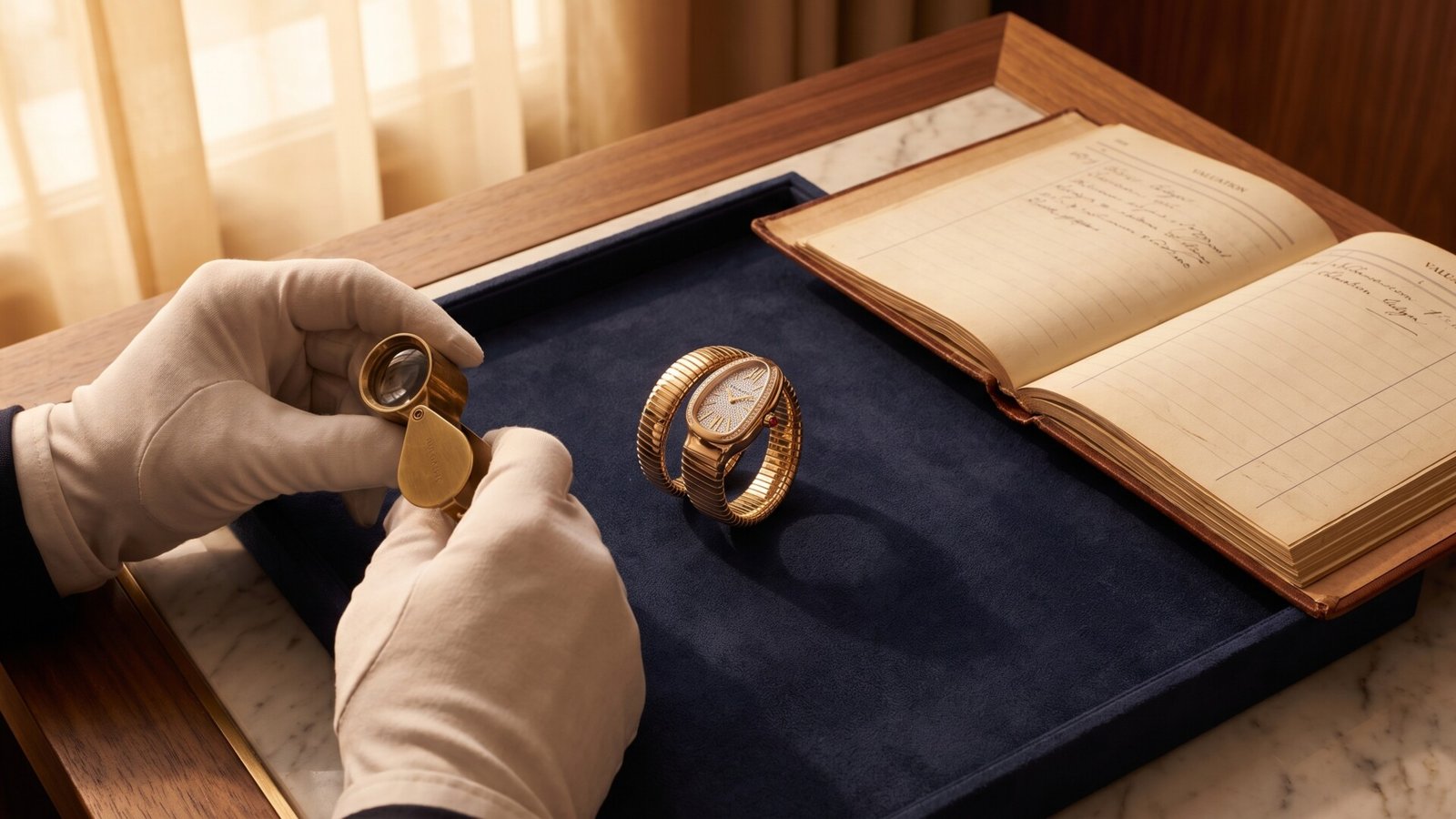
Tubogas. The technique that defines the classic Serpenti. A strip of gold is wound into a flexible, coiled tube without solder, giving the bracelet a fluid, scale-like movement. The name refers to its resemblance to flexible gas piping, and it became a Bulgari signature in the 1940s. It is demanding to execute well, which is part of why vintage Tubogas pieces are prized.
The head and eyes. The head is where the personality sits. On gem-set models the eyes are often cabochon stones, meaning polished into a smooth dome rather than faceted. A cabochon pink tourmaline or pink sapphire on the crown of a Tubogas watch is a typical example.
Scales and enamel. Scales may be gold, pavé-set diamonds or enamel. Enamel is glass fused to metal at high temperature and typically needs several firings, so flawless enamel indicates skilled work, but it can chip if the piece is knocked hard.
Viper. A more modern, geometric reading of the snake with a clean, architectural look. It is the lighter-feeling, easier-to-style side of the family.
What Serpenti Costs Today
Prices vary enormously by metal, stones and size, so be wary of any single figure. As examples from Bulgari’s own US website at the time of writing, 35 mm Serpenti Tubogas watches in 18 kt rose gold with diamond-pavé dials are listed in the region of $80,000 to $107,000 depending on the bracelet and stones, and a 35 mm version set with pink sapphires is listed at around $87,000. Gem-set high-jewelry pieces climb well beyond that. Serpenti Viper jewelry in 18 kt gold with diamonds can also sit in the six-figure range on Bulgari’s sites.
Lower-priced entry points exist, including smaller jewelry and leather goods, but prices change often and differ by market, so check Bulgari’s current listings before budgeting. [Affiliate: Explore the Bulgari Serpenti Collection]
Craftsmanship and Materials
Serpenti fine-jewelry watches and bracelets are made in 18 kt gold, which balances purity with durability (24 kt is too soft for pieces worn on the wrist every day). Gem-set versions use brilliant-cut diamonds and colored stones; one US-listed 35 mm watch, for example, carries 262 diamonds and 156 pink sapphires on the dial, case and bracelet. Quartz movements are common in the women’s jewelry watches, which keeps them thin and flexible but means value is driven by the gold and stones, not the movement.
Quality shows in flexibility, secure settings and clasps that close cleanly. These are the things to check on any pre-owned example. A well-made piece that has been looked after will keep selling; one that is dented, has loose stones or has been polished repeatedly will not.
The Investment Question, Honestly
Retail jewelry carries a boutique markup that covers design, craftsmanship, brand and the shopping experience. When you resell a piece, buyers pay for the gold, stones and desirability, not for the markup, so a newly bought piece usually fetches less than you paid. How much less depends on the piece, its condition, whether you have the box and papers, and the market on the day. Treat any specific resale percentage you read online with caution, including from sellers who have a stake in the answer.
Where Serpenti can genuinely appreciate is at the top and in the past. Vintage Tubogas watches from the mid-twentieth century and important high-jewelry pieces regularly appear at major auction houses. Sotheby’s cited sales in May 2025 where a Serpenti diamond bangle and a diamond necklace each made well into six figures (in Swiss francs). Those are exceptional pieces with rarity and provenance, not the same as a current-season retail item.
The pieces most likely to hold or gain value are:
- Vintage Tubogas pieces in good, unpolished condition, particularly 1960s and 1970s watches and bracelets with gem or enamel detailing.
- High-jewelry and gem-set models where rare stones and complex work add intrinsic value.
- Limited editions clearly marked as such by Bulgari, with full documentation.
If you want to understand how other categories behave, our article on Italian designer handbags to invest in looks at the same question for leather goods.
Serpenti vs. Cartier Love vs. Van Cleef & Arpels Alhambra
The three most-discussed icons in luxury jewelry occupy different niches. Cartier Love, introduced in the 1970s, is a screw-motif bracelet that is understated and worn daily by many people. Van Cleef & Arpels Alhambra is built around a four-leaf clover motif, delicate and often layered. Serpenti is the boldest of the three, a sculptural animal that changes how a wrist looks.
| Feature | Bulgari Serpenti | Cartier Love | Van Cleef & Arpels Alhambra |
|---|---|---|---|
| Design | Coiled serpent, Tubogas, enamel and gems | Screw-motif bangle | Four-leaf clover motif |
| Personality | Bold, sculptural, statement-making | Understated, everyday | Delicate, feminine, layerable |
| Resale audience | Smaller but passionate | Very broad | Broad and loyal |
| Best for | Those who want a signature piece | Those who want everyday luxury | Those who like subtle elegance |
Broadly, designs with a wide pool of buyers are easier to resell quickly. Serpenti’s distinctiveness narrows that pool, but the buyers who want it tend to be committed. If liquidity matters most to you, a more universally recognized design may be easier to sell; if distinctiveness matters most, Serpenti is hard to beat. We recommend checking current pre-owned listings for the exact model you are considering rather than relying on brand reputation alone.
Durability, Care and Servicing
You are buying something to wear, so care directly affects value. Gold is soft, enamel can chip, and sand or grit can work into flexible Tubogas links. Salt water and chlorine are best avoided.
- Store separately in a soft pouch or lined box to prevent scratches.
- Wipe gently with a soft, lint-free cloth after wearing.
- Put it on last after perfume, lotion and hairspray, which can dull the finish.
- Remove it for the beach, pool, gym and heavy housework.
- Have it inspected periodically by the brand or a qualified jeweler, who can check clasps, settings and hinges.
Keep original boxes, certificates and receipts. They are important for insurance and make a visible difference when you sell. Fine jewelry of this value should also be insured under a policy that covers its full replacement cost.
Buying New vs. Pre-Owned
Buying pre-owned can bypass much of the initial markup, which makes the numbers friendlier if you care about eventual resale. The trade-off is authenticity and condition risk. Buy from established dealers, auction houses or platforms that authenticate, ask for the serial number, hallmarks and any service history, and request clear photos of the clasp, hinges, scales and stones. Be cautious of heavily polished pieces, where metal has been removed and crisp details softened, and of any piece with no documentation at a price that seems too good to be true.
Styling the Serpenti
Formal events. A gem-set Serpenti watch or bangle pairs well with an evening dress and little else. Let the serpent be the focal point.
Work. A Viper necklace or slim Tubogas bracelet adds quiet authority to tailoring. One statement piece is enough.
Every day. Flexible Tubogas bracelets sit comfortably and do not snag on knitwear, which makes them easier to wear often than a rigid bangle. If you add leather goods from the same family, such as a Serpenti Forever bag, keep the rest of the outfit simple.
Layering. Pair a Serpenti with simple diamond studs rather than other bold jewelry. For more ideas on building an Italian wardrobe around signature pieces, see iconic Italian handbags you must own.
The Cost-Per-Wear Reality
Cost per wear is price divided by number of wears, ideally adjusted for what you could sell the piece for later. As a purely illustrative example, if you paid $20,000 for a piece, wore it 250 times a year for five years (about 1,250 wears) and then sold it for $10,000, your net cost would be $10,000, or about $8 per wear. If it stayed in a drawer and you wore it ten times, the same purchase would cost far more per wear. The numbers are hypothetical, but the lesson is real: the more you wear it, the better the value, and a piece that sits unworn is the worst kind of investment.
Will Serpenti Stay Relevant?
Serpenti has been in production, in one form or another, for more than 75 years, which is a strong track record. The snake motif is timeless rather than seasonal, and Bulgari keeps the line current with new interpretations such as Viper and Serpenti Forever. Increasing interest in pieces with heritage and longevity, as opposed to disposable fashion, works in its favor. That said, no brand is guaranteed to stay fashionable, and past performance at auction does not guarantee future resale prices.
The Buying Verdict
Buy it if you:
- Want a distinctive piece that expresses personal style.
- Appreciate Italian craftsmanship and design heritage.
- Plan to wear it regularly and look after it.
- Treat any resale value as a bonus rather than the goal.
Skip it if you:
- Need a financial investment with predictable returns.
- Prefer understated, minimal jewelry.
- Cannot comfortably afford insurance and periodic servicing.
Final Word
Treated as an object you will love and wear, the Bulgari Serpenti is an easy piece to justify. Treated as a financial instrument, it is a gamble that only really pays off for rare, vintage or exceptional examples. Buy the piece that you will reach for again and again, keep the paperwork, and consider any later resale value a welcome extra. Compare it with its rivals using the table above, and continue exploring Italy’s leading houses in our complete guide to Italian designer brands.
Frequently Asked Questions About Bulgari Serpenti Collection
Is the Bulgari Serpenti collection worth the investment?
It can be worth it as something you wear and enjoy, and gold and gem-set pieces retain intrinsic value. It is not a reliable way to make money: most current retail pieces resell for less than the boutique price, and appreciation is mainly seen in rare, vintage or high-jewelry examples.
How much does a Bulgari Serpenti watch cost?
Prices vary widely. On Bulgari’s US website, 35 mm Serpenti Tubogas watches in 18 kt rose gold with diamond or sapphire settings are listed from roughly $80,000 to $107,000. Check Bulgari’s current listings for the model you want.
How does Serpenti compare with Cartier Love and Van Cleef & Arpels Alhambra?
Cartier Love is understated and worn daily by many people, Alhambra is delicate and layerable, and Serpenti is the boldest and most sculptural. Serpenti’s distinctiveness means a narrower pool of buyers, though a committed one.
What are the most collectible Serpenti pieces?
Vintage Tubogas watches and bracelets from the mid-twentieth century in unpolished condition, high-jewelry pieces with rare stones, and documented limited editions are the most collectible.
How do I care for Bulgari Serpenti jewelry?
Store it separately, wipe it with a soft cloth, apply perfume and lotion before putting it on, remove it for swimming and heavy activity, and have it inspected periodically by Bulgari or a qualified jeweler.
Can I wear Serpenti jewelry every day?
Yes, many people do. Flexible Tubogas bracelets are comfortable for daily wear. Delicate enamel and heavily gem-set pieces need more care and may be best reserved for special occasions.
Is it better to buy a Serpenti new or pre-owned?
Pre-owned can avoid much of the initial markup, but you should buy from reputable, authenticating sellers and check condition, hallmarks and documentation carefully.