Proper storage for silk Italian scarves (to prevent creasing)
A silk scarf that spends a season folded into a tight square under a pile of knitwear usually comes out with sharp creases and a dull line along every fold. Silk is a protein fibre, and repeated hard folding in the same place stresses it at that line. Once a crease has set, steaming only softens it, and ironing silk carries its own risk of water marks and shine.
This guide explains how to store silk Italian scarves so they stay smooth and keep their colour. It covers hanging, folding and rolling, the right temperature and light, breathable storage, seasonal and travel storage, and how to relax a crease safely. It sits inside our Italian designer accessories collection, alongside buying guides such as our best Italian leather laptop bags for remote work.
The Short Answer: How to Store Silk Scarves Without Creases
- Best for crease prevention: hang the scarf from a smooth-slotted scarf hanger or a padded, rounded hanger so there is no hard fold line.
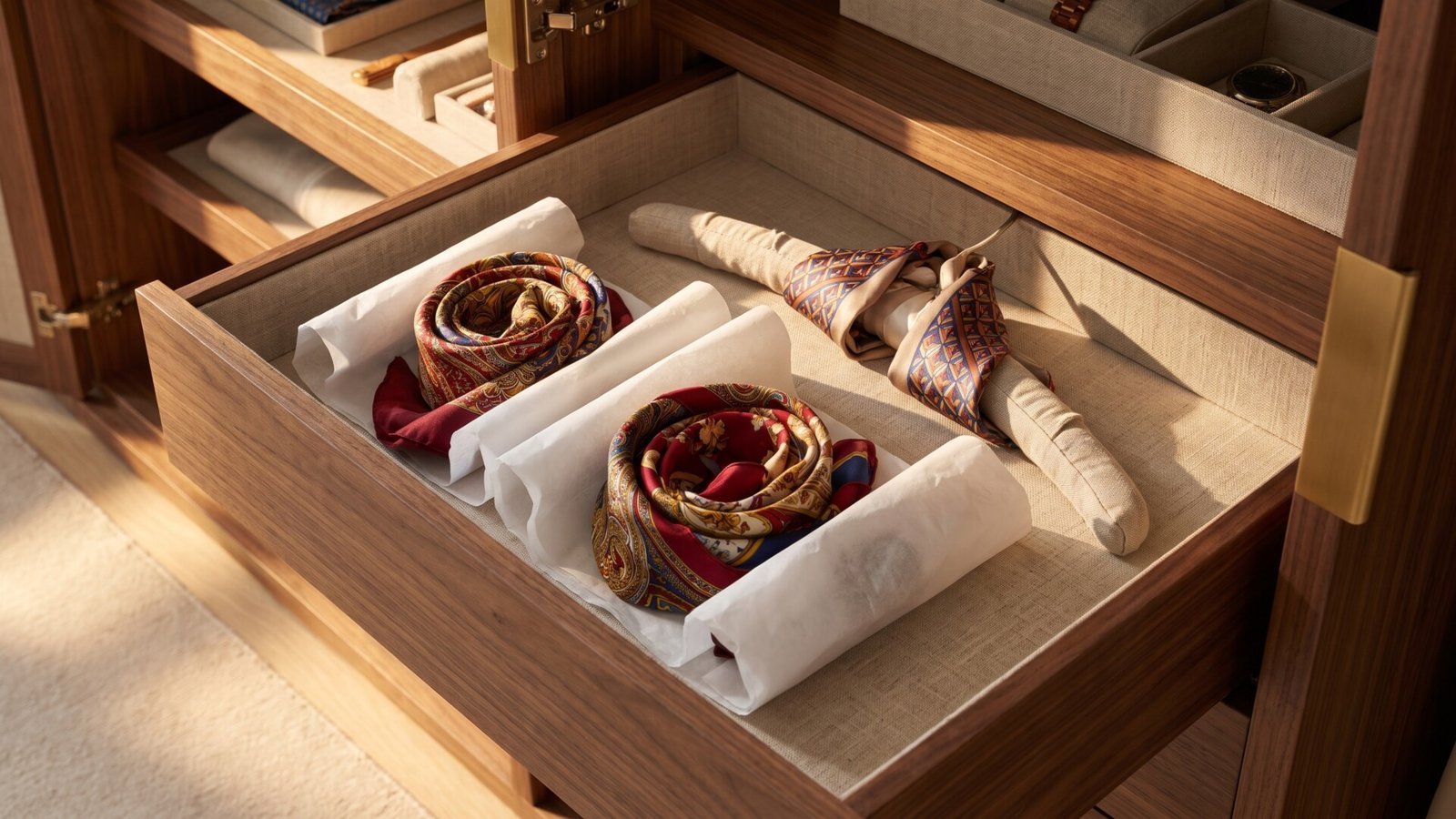
- Best for drawers: fold the scarf once or twice, then roll it loosely around a tube of unbuffered acid-free tissue, and keep it in its own compartment.
- Best environment: cool, dark, dry and stable, in a bedroom closet rather than an attic, basement or sunny shelf.
- Avoid: airtight plastic, tight multi-fold squares, heavy stacks on top, and direct sunlight.
Italian Silk Scarves and Why They Need Careful Storage
Lake Como, in Lombardy, is the best-known centre of Italian silk weaving, printing and finishing, and many luxury scarves sold under Italian and international names are printed there. Italian houses that sell silk scarves include Salvatore Ferragamo, Gucci, Fendi, Valentino, Prada and Etro, and the format ranges from large silk twill squares (commonly around 90 cm, about 35 in, a side) to smaller neckerchiefs, long stoles and narrow ribbons. Check the label or product page for the exact fabric, size and country of manufacture, because “Made in Italy” is a per-product claim.
Printed silk is delicate in three ways. The fibre creases and marks, the dyes can fade in light, and the fabric reacts to moisture. Each of these is controlled mainly by how and where the scarf is stored. Hand-rolled hems on twill squares also snag easily, so a smooth surface matters as much as a gentle fold.
Understanding the Nature of Silk
Silk is a natural protein fibre. It is built from fibroin, the structural protein, and in raw silk the fibre is coated in sericin, a gum that is mostly removed during processing. Silk is strong for its weight but sensitive: it takes up and releases moisture from the air, it is weakened by prolonged light exposure, and it is damaged by alkaline or enzyme-based detergents, which are designed to attack proteins in stains.
Creasing is the most visible result. A tight fold concentrates pressure on a narrow line of fibres. If the scarf stays under weight for months, the crease sets, and fabric that has been creased repeatedly in the same spot can develop a worn, slightly dulled line. This is why the goal of every storage method below is the same: fewer folds, gentler curves, and no weight on top.
The Storage Mistakes That Ruin Silk
The Creasing Catastrophe
Folding a scarf in half, then half again, then again, produces a dense square with sharp edges that sits under pressure. Those folds are where creases set. Ironing them out is risky, because heat and pressure can leave a shiny mark or a water stain on silk.
The Fading Enemy
Ultraviolet light breaks down dyes and weakens protein fibres. A scarf left on a shelf by a window can fade unevenly, with the exposed side paler than the side facing the wall. Fading is not reversible, so keep scarves in the dark whenever they are not being worn.
The Environmental Assault
Damp air encourages mould and mildew, which leave stains and a musty smell that are hard to remove. Very dry air can make fibres brittle. A stable, moderate environment is the goal, and the same reasoning applies to leather accessories stored nearby; see our guide to dealing with mould on stored designer leather goods if your storage space has had a humidity problem.
Storage Methods Compared
| Method | Crease risk | Space needed | Best for | Watch out for |
|---|---|---|---|---|
| Hanging on a scarf hanger | Lowest | Closet rail | Frequently worn scarves, small to medium collections | Dust and light exposure; snagging on rough hooks |
| Rolling around tissue | Low | One drawer compartment | Larger collections and delicate prints | Rolling too tightly; stacking weight on top |
| Loose flat fold in tissue | Moderate | Shallow drawer or box | Long-term and seasonal storage | Re-fold along different lines every few months |
| Tight multi-fold square | Highest | Minimal | Not recommended | Sharp, set creases |
The Right Way to Store Your Silk Scarves
Hanging Silk Scarves
Hanging removes sharp folds almost entirely. Avoid draping a scarf over a thin wire or edged plastic hanger, where it slips and picks up a dent along the bar. A scarf hanger with smooth, slotted or ringed arms lets you pass the scarf through without hard pressure points.
- Household Essentials Scarf Hanger: a multi-arm scarf hanger with smooth slots. Fold the scarf in half, lay the fold over a slot and pull the ends through so it hangs without a knot or sharp edge. [Affiliate: Check the price for the Household Essentials Scarf Hanger on Amazon]
Keep hung scarves clear of the floor and away from rough garments such as zips, beaded knitwear or Velcro that could snag the weave. Heavy stoles are better rolled than hung, because their weight can stretch the fabric over time.
The Art of Folding
If you keep scarves in a drawer, fold as few times as possible and never leave other items on top. This method works well for a 90 cm square:
- Lay the scarf flat: use a clean, smooth surface and smooth it out with dry hands.
- Fold once into a rectangle: match the edges and corners so the fold is clean.
- Fold again only if needed: a second fold gives a long strip that fits most drawers.
- Roll rather than fold again: wind the strip loosely around a tube of acid-free tissue, so the final shape has a soft curve instead of a hard edge.
- Store separately: place the roll in its own drawer or compartment where nothing presses on it.
The Rolling Alternative
Rolling is also the most space-efficient option. Rolled scarves can stand on end in a divided drawer like files in a cabinet, so you can see each print without lifting the others. For long stoles or shawls, fold once lengthwise and roll from one end to the other, keeping the roll loose enough to slide a finger into the centre.
Creating the Ideal Storage Environment
Temperature, Humidity and Light
Textile conservators generally recommend a cool, stable room with moderate humidity and little light. For a home wardrobe that means an interior bedroom closet or a drawer away from radiators, exterior walls and windows. Avoid attics, garages and basements, where temperature and humidity swing widely.
If your climate is humid, a closet dehumidifier or silica gel packets can help, but keep gel packets from touching the silk. In very dry climates, stable room humidity matters more than any special accessory. Lining a drawer with undyed cotton or acid-free tissue also helps keep the silk away from raw wood, which can release acids and discolour fabric over time.
Breathable Storage
Plastic dry-cleaner bags and sealed plastic boxes trap moisture and can encourage mildew and yellowing, so they are a poor choice for long-term silk storage. Better options are:
- Cotton or muslin bags: they let air move while keeping off dust and light. Wash new fabric bags first so finishing chemicals do not transfer to the silk.
- Acid-free tissue and boxes: use these for scarves that you wear rarely or want to keep long term.
- Gaylord Archival Unbuffered Acid-Free Tissue: archival tissue that the maker sells specifically for protein-based materials such as silk, wool and leather. For silk, choose unbuffered tissue: conservation suppliers advise against buffered tissue, which contains an alkaline reserve such as calcium carbonate, for animal fibres. Use it to cushion folds, as the core you roll a scarf around, or to line a drawer or box; a buffered archival box is fine as long as the scarf is wrapped in an unbuffered layer first. Gaylord sells it on its own site and through an official Amazon store. [Affiliate: Check the price for Gaylord Archival Unbuffered Acid-Free Tissue on Amazon]
Seasonal, Long-Term and Travel Storage
For scarves you will not wear for months, clean them first, because body oils, perfume and food residue attract pests and can stain over time. Wrap each in acid-free tissue, store flat in a box or loosely rolled, and check them once or twice a year. When you re-wrap, change the fold lines so no single line carries the same stress year after year.
For travel, roll the scarf loosely around a tissue tube or inside a clean cotton pouch and keep it in a hand-luggage pocket rather than at the bottom of a case. Unpack it as soon as you arrive and hang it in a bathroom during a hot shower, not in the spray, to let the fibres relax.
How to Remove a Crease from a Silk Scarf Safely
Start with the gentlest method. Hang the scarf in a steamy bathroom for ten to fifteen minutes, then smooth it by hand and let it dry fully before storing. For a stubborn crease, check the care label first, then use the lowest iron setting on the reverse side with a clean, dry pressing cloth between the iron and the silk, and test a hidden corner. Never use a hot iron directly on silk, and never use steam if the print is bleeding or the label says dry-clean only. Valuable or vintage pieces are best taken to a specialist dry cleaner.
Complementary Care: Cleaning and Light
Silk scarves should be cleaned sparingly. Many designer scarves carry a dry-clean-only label, and you should follow it. For pieces labelled hand-washable, use a detergent made for delicates rather than a standard enzyme detergent.
- The Laundress Delicate Wash: a delicates detergent sold for hand-washing silk and other fine fabrics. Test for colour bleeding on a hidden corner first. [Affiliate: Check the price for The Laundress Delicate Wash on Amazon]
Wash in cool water, press out water without wringing or twisting, roll the scarf in a clean towel to remove moisture, then dry it flat in the shade. Never dry silk in direct sunlight or in a tumble dryer.
The Cost of Poor Storage
Prices for designer silk scarves vary widely by house, size and print, so check the current price on the brand’s own site. The point about cost per wear holds at any price: as an illustration, a scarf that cost $400 and is worn 80 times costs $5 per wear, while the same scarf retired after 20 wears because of creases or fading costs $20 per wear. Storage accessories are small by comparison, which makes them cheap protection for something you intend to keep.
Condition also affects what a scarf can fetch on the secondhand market, although resale prices vary by brand, print and demand and are never guaranteed. A scarf with fading, water marks or snags will be priced below an unmarked one.
A Practical Storage Routine
A scarf that is easy to reach and uncreased is a scarf you will actually wear, whether tied at the neck, worn as a headband or knotted on a handbag. A simple routine keeps that true: air the scarf for a few hours after wearing, let any dampness dry in the shade, return it to its hanger or roll, and review the collection at the change of each season. Our Italian designer accessories page gathers more guides on the pieces you may be storing alongside your scarves, and our care articles on restoring the patina on natural Italian leather bags and DIY vs professional cobbler for designer Italian shoes cover the rest of a luxury wardrobe.
Shop Scarf Storage Solutions | Explore More Silk Care Tips
Frequently Asked Questions About Silk Italian Scarves Storage
How often should I clean my silk scarves?
Clean them sparingly, typically at the end of a season before long-term storage, and follow the care label. If a scarf is only lightly worn, airing it for a few hours is often enough before you put it away.
Can I store my silk scarves in a humid environment?
It is not recommended. High humidity encourages mould and mildew. If you live in a humid climate, use a dehumidifier in the storage area, keep scarves in cotton or muslin bags, and avoid airtight plastic.
What should I do if my silk scarf gets creased?
Hang it in a steamy bathroom for ten to fifteen minutes, then smooth it by hand. For stubborn creases, check the care label, use the lowest iron setting on the reverse side with a dry pressing cloth, and test a hidden corner first. Take valuable pieces to a specialist cleaner.
Is it safe to use a clothes dryer for silk scarves?
No. Heat and tumbling can roughen the fibres, set creases and cause shrinkage. Air dry silk flat in the shade.
How do I choose the right storage bag for my scarves?
Choose breathable materials such as cotton or muslin, plus unbuffered acid-free tissue, which is the type conservators recommend for silk. Avoid airtight plastic bags and boxes, which trap moisture.
Are there special hangers designed specifically for silk scarves?
Yes. Scarf hangers with smooth slotted or ringed arms, such as the Household Essentials Scarf Hanger, hold the scarf without sharp pressure points. They are a better choice than draping a scarf over a standard hanger.
Is it better to hang or roll a silk scarf?
Both avoid sharp creases. Hanging suits scarves you wear often, while rolling around acid-free tissue suits larger collections, heavy stoles and long-term storage.
How should I pack a silk scarf for travel?
Roll it loosely around a tissue tube or place it in a clean cotton pouch, keep it in hand luggage, and hang it up as soon as you arrive.