The right way to clean patent leather Italian heels
Patent leather looks tough, and many owners treat it that way: tossed into a tote without a dust bag, wiped with a baby wipe, worn in the rain. The usual results are a dull, cloudy film across the toes and fine cracks near the flex point. Patent is one of the more high-maintenance finishes in footwear, and Italian heels from houses such as Valentino, Gianvito Rossi, Prada and Ferragamo, which can cost several hundred dollars to well over $1,000 new, deserve a careful routine.
The good news is that cleaning patent leather is not complicated, but it does need a specific, gentle approach. This guide covers what patent leather actually is, the tools to use, a step-by-step routine, the mistakes that ruin finishes, and when to hand a pair to a professional. It is part of our Italian designer shoes guide, and it pairs with our wider guide on how to care for Italian leather shoes.
Understanding Patent Leather
Before we talk about cleaning, we need to talk about what patent leather actually is. This is where most people misunderstand the material—and it’s the root of most damage.
Patent leather is not a type of animal hide. It’s a finishing process. The leather base is coated with a high-gloss lacquer or plastic resin, which creates that mirror-like surface. Historically, the finish was a linseed oil-based lacquer: British patents from the 1790s and early 1800s (including Edmund Prior’s in 1799) covered related coating work, and Seth Boyden of Newark, New Jersey is credited with introducing and popularising the process in the United States from 1818, with commercial manufacture beginning in 1819. The result is a material that is water-resistant, shiny, and visually striking, but also non-porous and prone to scuffing.
Here’s the critical difference: because the surface is sealed, patent leather does not absorb moisture or oils the way full-grain or nubuck leather does. That sounds like a benefit, and in many ways it is. It’s why patent leather can handle a light rain better than suede. But it also means that the finish is the entire aesthetic. Once that lacquer is scratched, clouded, or cracked, you cannot simply condition it back to health. The damage is to the coating, not the hide beneath.
Italian footwear makers love patent leather because it allows for impeccable color saturation and a formal, reflective quality that pairs beautifully with the architectural silhouettes of Italian design. Brands such as Prada, Valentino, Salvatore Ferragamo and Gianvito Rossi use patent leather in pumps and other dress shoes; for example, Net-a-Porter listed the Gianvito Rossi 85 patent pump at a full price of $795 and the Valentino Garavani Rockstud 100 two-tone patent pump at $1,190 (checked November 2026; prices change). The craftsmanship is in the cutting, the lasting, and the finishing—but the material itself demands a different kind of care than traditional leather.
Preparing for Cleaning
You don’t need a drawer full of products. Four things do the work, and each has a specific job.
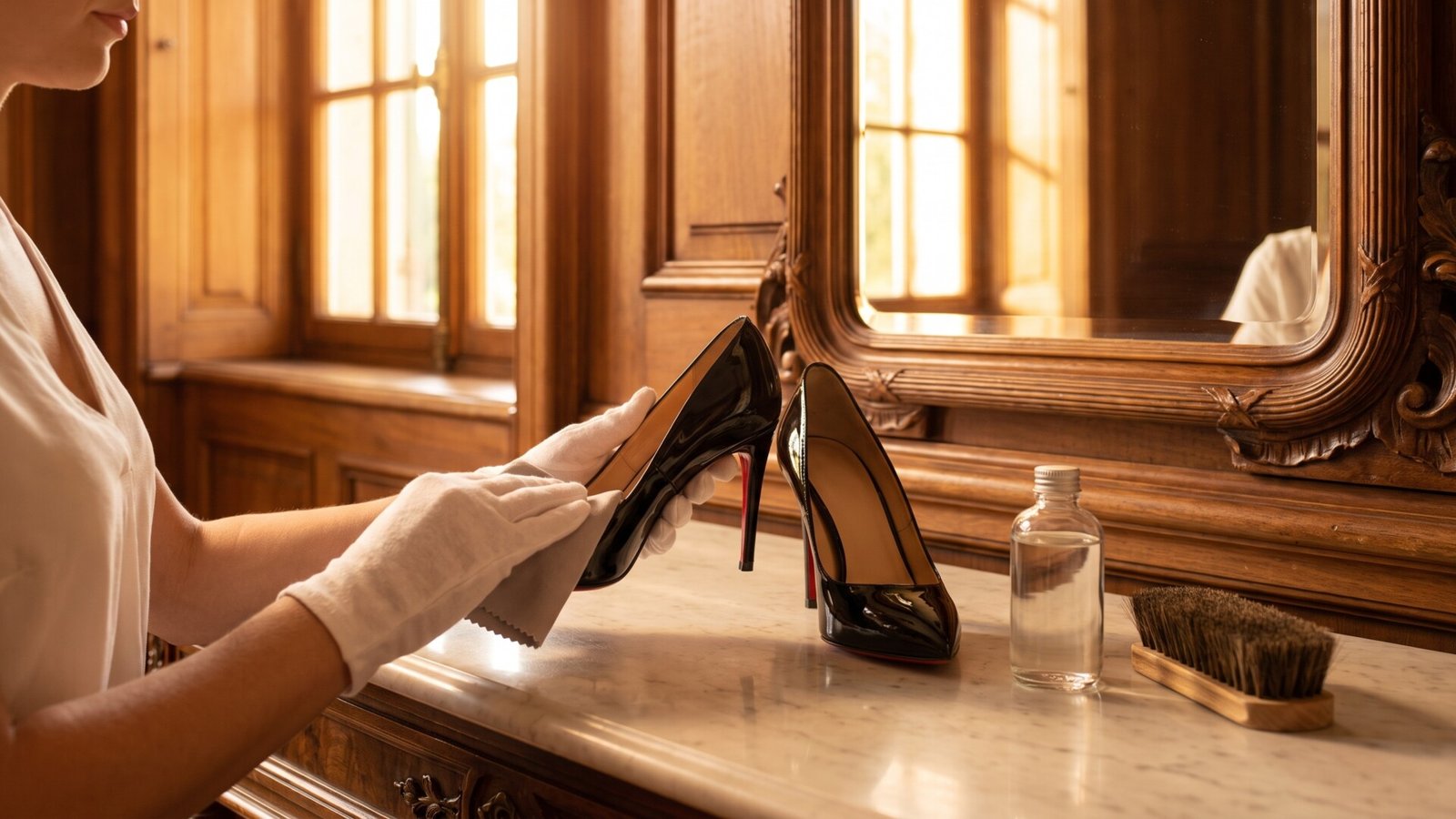
Soft microfiber cloths — These are your primary tool. They lift dust and products without scratching the surface. A pack of microfiber cloths (MagicFiber is one widely sold brand) is worth buying because you will go through them. Use one for dusting, one for applying cleaner, and one for buffing. Do not use paper towels. The fibers are too rough and will leave micro-scratches on the lacquer.
Patent leather cleaner — You want a product specifically formulated for patent leather or a very gentle shoe cleaner. Jason Markk Premium Shoe Cleaner is a widely sold option, but it is marketed mainly for sneakers, so confirm on the label that the product is safe for coated or patent leather and test it on an inconspicuous spot first. Whatever you choose, it should not leave a residue.
Soft-bristled toothbrush — For stubborn stains or dirt trapped in the seams, a soft-bristled toothbrush is invaluable. The key word is soft. A hard-bristled brush will scratch the finish instantly. A new, extra-soft manual toothbrush with angled bristles reaches into seams without scratching.
Leather conditioner — This is the controversial one. Many people say you should never condition patent leather because the surface is sealed. That’s partially true. But a very light application of a mild leather conditioner, applied only to the edges, seams, and the uncoated lining and underside of the shoe (never over the glossy surface, and tested first on a hidden spot), can help maintain the suppleness of the leather base and prevent cracking where the material flexes.
Before you start, assess the condition of your heels. Are we dealing with light dust, a scuff, or a stubborn stain? Run your finger over the surface. If it feels gritty, you have dirt embedded in the finish. If it feels sticky, you have a residue problem. If you see cracks, that’s a deeper structural issue—cleaning will help, but it won’t reverse the damage. Know what you’re dealing with before you begin.
Step-by-Step Cleaning Process
Here is a gentle, systematic routine. Always test any product on an inconspicuous area first, and check the brand’s care card.
Step one: Dust and debris removal. Take a dry microfiber cloth and wipe down the entire surface of the shoe. This removes loose dirt and grit that would otherwise act like sandpaper when you apply liquid cleaner. Pay attention to the seams and the area where the upper meets the sole. Dirt loves to hide there.
Step two: Spot cleaning. If you see a scuff or a stain, dampen a corner of your microfiber cloth with your patent leather cleaner. Do not saturate the shoe. Gently rub the affected area in small, circular motions. Let the cleaner do the work—don’t press hard. For scuff marks, you may need to repeat this a few times. Scuffs on patent leather are often just surface-level marks on the lacquer, and they can frequently be lifted with gentle friction.
Step three: Deep cleaning. For the entire shoe, dampen a fresh microfiber cloth with a small amount of cleaner—just enough to create a light foam. Wipe down the entire surface, working in sections. Use the soft-bristled toothbrush, dipped in the cleaner, to gently work into the seams and any textured areas. Be extremely cautious around embellishments, buckles, or any metallic hardware. The cleaner can dull the finish on metal, so use a cotton swab for those areas instead.
Step four: Drying. This is where most people make their second mistake. They set the shoes near a radiator or in direct sunlight to speed up drying. Don’t. Heat will cause the lacquer to soften, crack, or cloud. Instead, let the shoes air dry naturally at room temperature, away from sunlight and heat sources. This can take a few hours. Patience here is not optional—it’s essential.
Once dry, buff the surface with a clean, dry microfiber cloth. This restores the shine and removes any residual cleaner that could dull the finish.
Troubleshooting Common Patent Leather Problems
| Problem | Likely cause | What to do |
|---|---|---|
| Cloudy or dull film | Residue from the wrong cleaner or dried-on dirt | Re-wipe with a damp microfiber cloth, then buff dry |
| Light scuffs | Surface marks on the coating | Gentle circular rub with a suitable patent cleaner |
| Colour transfer | Dye migrating from darker items stored nearby | Stop contact; ask a cobbler before trying removers |
| Fine cracks at the flex point | Coating wear or heat/dry-air damage | Cleaning will not reverse it; see a cobbler |
| Sticky surface | Heat, solvent or product residue | Stop, avoid more products, and consult a professional |
When to See a Cobbler
Take the pair to a cobbler or the brand’s repair service if the coating is peeling, cracked through to the leather, or sticky, or if the heel tip or sole is worn. Resoling and heel-tip replacement are routine repairs for Italian pumps, and resoling choices are covered in our guide to leather versus rubber soles. Ask about cost up front, as repair prices vary by region and shop.
Maintaining Shine and Longevity
Cleaning is a reactive measure. Maintenance is the proactive practice that keeps your patent leather heels looking new for years. Here is how the two differ.
Conditioning, done right. The glossy surface does not need conditioner, but the leather edges and the interior of the shoe can benefit from it. The seams, the heel counter, and the lining are all uncoated leather that can dry out and crack. A light application of a mild leather conditioner on these areas every few months can keep the leather supple; if the brand’s care card says otherwise, follow the brand.
Avoiding sunlight and heat. Patent leather is sensitive to ultraviolet light and extreme temperatures. Prolonged exposure to direct sunlight will cause the color to fade and the lacquer to become brittle. A hot car is one of the fastest ways to damage the finish. Store them in a cool, dark place, ideally in their original dust bags.
Proper storage. Storage is where many pairs get damaged. Patent leather heels should be stored upright, never stacked on top of each other. If you stack them, the weight of the upper shoe can leave permanent indentations on the lacquer of the shoe below. Use shoe trees—cedar is ideal because it absorbs moisture and helps maintain the shape. If you don’t have shoe trees, stuff the toes with acid-free tissue paper to prevent creasing.
What Most Buyers Get Wrong
These are the misconceptions that most often cost people their heels.
Mistake one: Using harsh chemicals. Nail polish remover, rubbing alcohol and bleach are sometimes suggested online for patent leather stains. Avoid them. Solvents can dissolve or cloud the coating, and that damage is usually permanent because the finish is the material.
Mistake two: Using regular leather cleaners. Standard leather cleaners are formulated for porous leather. They often contain oils and conditioners that are meant to penetrate the hide. On patent leather, these products leave a greasy residue that attracts dust and dulls the shine. You need a cleaner specifically designed for coated or patent leather.
Mistake three: Ignoring manufacturer guidelines. Here’s the thing—every brand has its own specific finish. A pair of Prada patent leather heels may have a slightly different lacquer composition than a pair from Ferragamo. The care instructions that come with the shoes are not just marketing fluff. They are the result of the manufacturer’s testing. Read them. Follow them. A product that suits one finish can cloud another, which is why the test spot matters.
Mistake four: Over-cleaning. You don’t need to clean your patent leather heels every time you wear them. Over-cleaning can strip the finish over time. Spot-clean when necessary, and do a full clean only when the shoes are visibly dirty or have been worn several times.
Practical Application: Real-World Ownership
So how often should you clean and maintain patent leather heels? A practical schedule looks like this.
After every wear, wipe down the shoes with a dry microfiber cloth to remove dust and surface dirt. This takes thirty seconds and prevents buildup.
If you’ve worn them in wet conditions or they’ve been exposed to significant dirt, do a spot clean immediately. Don’t wait. Stains set in faster on patent leather than you’d think.
Once a month, or every ten to fifteen wears, do a full clean following the step-by-step process above. This keeps the finish bright and prevents the buildup of grime that can cloud the surface.
Every three to four months, condition the uncoated leather areas—the seams, the interior, the edges. This is the maintenance that prevents cracking.
A consistent routine helps protect both appearance and resale condition. Lifespan depends on wear, storage and the specific coating, so no pair is guaranteed to last for decades.
On the styling side, patent leather heels are remarkably versatile. The reflective quality adds a polished touch to everything from tailored trousers to cocktail dresses. They work with cropped jeans or silk midi skirts alike; let the shoes be the statement and keep the rest of the outfit simple. For more ideas, see how to style Italian shoes for every occasion.
Investment Value
Let’s talk about money, because these shoes aren’t cheap, and neither is the care.
As a guide, full-price examples listed by Net-a-Porter in November 2026 were about $795 for the Gianvito Rossi 85 patent pump and about $1,190 for the Valentino Garavani Rockstud 100 patent pump, so expect roughly $800 to $1,200 for many luxury Italian patent heels. Cost per wear is a useful frame: a $1,000 pair worn 100 times is $10 a wear, while a $200 pair worn five times is $40 a wear. The comparison only holds if the shoes stay wearable, which is where maintenance comes in.
Condition also matters on the secondhand market, where listings for luxury footwear are priced and graded by condition. Resale values vary widely by brand, model and platform, so we do not quote a percentage; a clean, unscuffed finish simply gives you a stronger listing.
Collectors and resale platforms like The RealReal and Vestiaire Collective pay close attention to the condition of patent leather. Buyers on these platforms look closely at gloss, scuffs and cracking.
Patent coatings resist water and many stains, but they eventually lose gloss and can crack at flex points. Treat any pair as a long-lasting purchase, not a guaranteed lifetime one.
Conclusion
Patent leather rewards a light, regular routine far more than occasional heavy cleaning.
Start with a dry wipe after each wear, a soft damp cloth and a suitable cleaner when needed, and cool, dark storage in a dust bag.
Patent leather’s appearance depends entirely on the integrity of its coating, so gentle cleaning and careful storage are what protect it.
Keep light-coloured patent away from coloured items, since dye can transfer; store pale pairs in a white dust bag.
If you’re looking for more guidance on caring for your luxury footwear, explore our guide to caring for Italian leather shoes, read about leather versus rubber soles, and see how Italian designer shoes should fit. When you’re ready for your next pair, see whether luxury Italian shoes are worth the money, the Italian designer shoes guide, Sergio Rossi, Aquazzura and Gianvito Rossi.
Frequently Asked Questions About Cleaning Leather Italian Heels
What products are safe for cleaning patent leather?
Use a gentle cleaner whose label says it is safe for coated or patent leather, and test it on a hidden spot first. A damp cloth with a drop of mild soap can work for light marks; avoid solvents, alcohol and oil-based products.
How can I remove scuff marks from patent leather?
Scuffs are often just surface marks on the lacquer. Try a gentle circular rub with a damp microfiber cloth and a small amount of patent leather cleaner. For stubborn scuffs, a soft-bristled toothbrush can help. Avoid abrasive pads or harsh chemicals.
How often should I clean my patent leather heels?
Wipe them down after every wear. Do a full clean once a month or every ten to fifteen wears. Spot clean immediately after any exposure to dirt or moisture.
Can I use regular leather cleaners on patent leather?
No. Regular leather cleaners contain oils and conditioners designed for porous leather. On patent leather, they leave a greasy residue that dulls the shine and attracts dirt.
Is it safe to use water on patent leather?
Yes, water is safe on patent leather—the coating resists light rain and a damp cloth. Still, dry the shoes promptly, avoid soaking them, and keep them away from heaters.
How can I maintain the shine on my patent leather heels?
Buff them with a dry microfiber cloth after cleaning. Store them away from sunlight and heat. Avoid stacking them. Condition the uncoated leather areas regularly to prevent cracking.