Leather Soles vs. Rubber Soles: Which Is Better for Luxury Shoes?
Most people ask which sole is more luxurious. The actual question is which sole you will still be wearing in five years, and that depends almost entirely on where you walk. Leather soles win on elegance, breathability and the way a well-made pair conforms to your foot over time. Rubber soles win on wet pavement, cobblestones, airports and the simple fact that you will reach for them without checking the sky. Neither material is the deciding factor on its own. The upper, the welt, the thickness of the sole, the compound, and whether anyone can repair the thing in three years matter more than the label under your foot. Pick the sole that reduces compromise in your actual routine, not the one that photographs better.
What the Sole Material Changes in Real Ownership
Hold a leather-soled Oxford in one hand and a rubber-soled version of the same last in the other, and the difference registers before you look down. The leather sole is thin, almost architectural, and it lets the shoe taper to a clean edge. The rubber version sits a few millimetres taller and reads slightly heavier, even when the maker has done a good job of keeping it discreet.
That first impression is real, but it is not the whole story. A luxury leather upper does not automatically make a shoe formal. You can put a beautiful full-grain tomaia (the upper – the part that covers the foot) on a chunky lugged sole and get a shoe that belongs with denim, not tailoring. Equally, a rubber sole does not automatically signal lower quality. Some of the most expensive shoes in Italy sit on moulded rubber.
The criteria that actually decide the purchase are these: traction, weather tolerance, comfort, break-in, durability, maintenance burden, repairability, formality, versatility, and cost per wear. Every one of them interacts with the others. A leather sole scores high on formality and low on traction. A rubber sole scores high on traction and, if it is thick, low on formality. You are not choosing a material. You are choosing which trade-offs you can live with.
Construction matters more than branding alone, and this is where buyers get caught. A well-made rubber-soled shoe with a stitched sole unit will outlast a poorly made leather-soled shoe with a cemented sole every time. Conversely, a replaceable leather sole on a Goodyear-welted shoe can be renewed two or three times over a decade, which changes the economics entirely. The material is the visible choice. The construction is the one that decides whether the shoe survives.
Leather Soles: Where They Excel and Where They Frustrate
The case for leather soles
A slim leather sole gives a dress shoe, a loafer, a formal pump or a refined boot a profile that nothing else quite matches. It is the difference between a shoe that disappears under a trouser hem and one that announces itself. With tailoring, that restraint is the point.
Leather also breathes. A dense sole leather lets moisture move out of the shoe in a way that a solid rubber sheet does not, which matters if you wear the same pair through a long day indoors. And it flexes – not immediately, but over weeks. A good leather sole develops a slight curve at the ball of the foot that matches your gait, and the leather darkens and burnishes where it meets the ground.
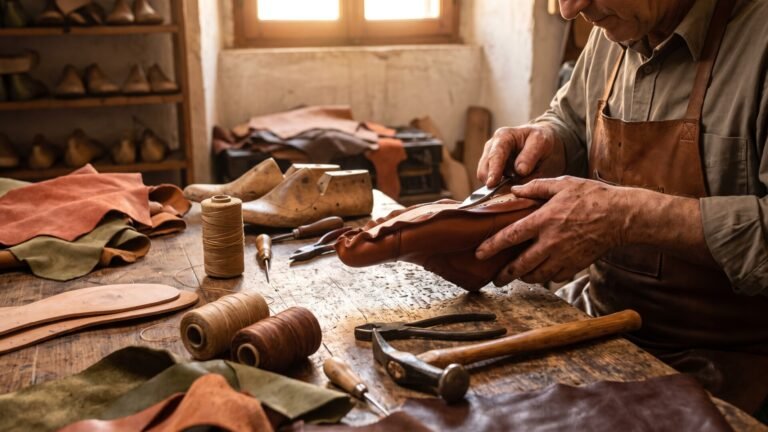
Do not expect instant comfort, though. Dense sole leather – usually oak-bark tanned or vegetable tanned and compressed under rollers – starts stiff. The break-in is real, and it is part of the ownership experience. [Internal: The Art of Italian Shoe Making] explains how sole leather is selected and finished, and why the quality of that hide determines how the sole ages. [Internal: Handmade Italian Shoes Explained] covers what “artisan” actually means in construction terms, which is worth reading before you assume a high price guarantees a hand-finished sole.
The drawbacks buyers notice later
The first wet pavement is where leather soles lose their shine, literally and figuratively. On rain-soaked sidewalks, smooth stone, painted floors and winter surfaces, a leather sole offers very little grip. The concern is not only slipping. Prolonged water exposure softens the leather, accelerates wear at the toe and heel, and can wick moisture up into the welt.
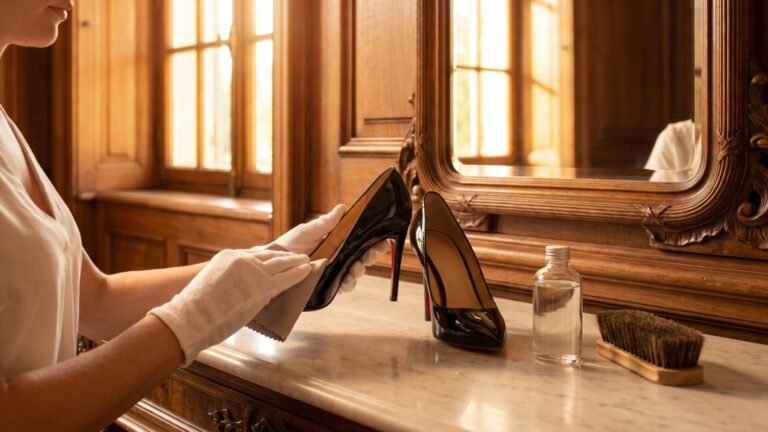
Leather soles also demand rotation. Wear the same pair two days running in damp conditions and you will shorten its life. They need drying away from direct heat, occasional conditioning where appropriate, and protective measures if you walk hard. Toe plates – thin metal or plastic plates nailed to the toe – protect the most vulnerable area. A thin rubber topper, fitted by a cobbler, adds grip without changing the silhouette much, though it does alter the feel slightly and some purists dislike it.
Leather soles are not automatically less durable. Their lifespan depends on leather density, walking surface, gait, frequency of wear, weather, and whether the shoe is repaired before the sole is worn through. A well-made leather sole worn indoors and rotated can last years. The buyer most likely to regret leather is the one who wants a single luxury pair for daily commuting in a wet city, or who has no intention of maintaining and rotating shoes. If that is you, read the rubber section carefully.
Rubber Soles: The Practical Advantage With Trade-Offs
Why rubber works for everyday luxury footwear
Rubber gives you traction, weather resistance, shock absorption and immediate usability. You put the shoe on and walk out the door. For commuting, travel, city walking and mixed indoor-outdoor wear, that is not a small thing. It is the difference between a shoe that gets worn and one that stays in the box.
The category is broader than most buyers realise. There are thin dress rubber soles, moulded to look almost like leather from the side. There are leather-look rubber soles, where a rubber base is finished to mimic the appearance of a traditional sole. There are crepe soles, soft and grippy but prone to picking up grit. There are lugged soles, with deep treads for serious weather. And there are proprietary compound soles, developed in-house by brands that want a signature feel.
Each changes the shoe. A thin dress rubber sole can sit under a formal derby without ruining the line. A lugged sole turns the same derby into something you wear with a field jacket. Rubber soles are now common on luxury loafers, casual derbies, Chelsea boots, sneakers and hybrid dress shoes, and they are no longer confined to workwear.
Consider the examples. The Tod’s Gommino, with its pebbled rubber sole and rubber nubs, is the canonical flexible casual driving shoe – [Internal: Why is Tod’s Gommino So Popular?] explains why that sole design became iconic. The Zegna Triple Stitch is a lightweight luxury sneaker built around a flexible rubber unit, and [Internal: Zegna Triple Stitch Sneaker Review: Why Every CEO Owns a Pair] covers how it wears. Italian designer boots increasingly favour rubber for traction and weather tolerance, which is exactly the right call when the alternative is a paper-thin sole on a wet cobblestone.
The compromises
Rubber can add weight, stiffness, heat and bulk, particularly when the sole is thick or heavily lugged. A chunky rubber unit on a formal shoe looks wrong, and it feels wrong too – less flex at the ball, more heat underfoot, a heavier step.
Some rubber compounds wear unevenly. They can collect debris in the tread, become less flexible with age, and cannot always be repaired as invisibly as a traditional leather sole. A leather sole can be rebuilt by a cobbler with a knife and a hammer. A complex moulded rubber unit may need to be replaced as a whole, and replacement parts are not always available.
Here is the contrarian point worth holding onto: a premium rubber sole is not automatically the more durable choice. Durability comes from the quality of the compound and, more importantly, from the construction and replaceability of the shoe. A cheap rubber sole on a cemented shoe will fail sooner than a good leather sole on a welted one. Rubber solves weather and traction. It does not solve construction.
And it does not solve fit. Cushioning and grip do not compensate for heel slip, toe compression or an incorrectly sized shoe. If the last is wrong for your foot, no sole material will rescue it.
Leather Soles vs. Rubber Soles: Side-by-Side Buying Comparison
| Feature | Leather soles | Rubber soles |
|---|---|---|
| Best environment | Dry indoor settings, offices, formal events | Wet streets, commuting, travel, mixed surfaces |
| Formality | Usually the most refined and traditional | Ranges from discreet dress rubber to distinctly casual |
| Traction | Limited on wet or smooth surfaces | Generally stronger, depending on compound and tread |
| Break-in | Often requires more break-in | Frequently more comfortable immediately |
| Weather resistance | Lower without added protection | Usually higher |
| Breathability and flexibility | Often excellent once broken in | Varies widely by thickness and compound |
| Repair and longevity | Often highly resoleable when well constructed | Varies; some can be resoled, others require sole-unit replacement |
| Best buyer | Traditional dresser who maintains and rotates shoes | Practical buyer prioritizing comfort and all-weather use |
Treat that table as a starting framework, not a quality ranking. It tells you which way each material leans. It does not tell you which shoe to buy.
Put it into practice. Compare a slim leather-soled Oxford with a discreet rubber-soled Oxford on the same last: the leather version is more elegant, the rubber version more wearable in November. Compare a leather-soled loafer with a rubber-soled loafer: the leather one dresses up, the rubber one handles a commute. Compare a rubber-soled boot with a traditional leather-soled boot: the rubber boot is the one you take on a trip, the leather boot is the one you wear to a dinner in town.
The same brand can offer materially different ownership experiences across models. One house might make a beautifully welted leather-soled derby and a cemented rubber-soled sneaker under the same label. Assess the specific sole unit, not the reputation of the name above the door. [Internal: Italian Dress Shoes: The Complete Guide to Luxury Formal Footwear] covers formal construction in more depth, and [Internal: Italian Loafers: The Complete Guide to Timeless Luxury Footwear] does the same for the loafer category.
What Most Buyers Get Wrong About Luxury Shoe Soles
The first mistake is believing leather soles are always more luxurious. Luxury is better judged through materials, construction, finishing, fit, repairability and design coherence. A beautifully made rubber-soled shoe with a full-grain upper, a stitched sole unit and a comfortable last is a more luxurious object than a leather-soled shoe with corrected-grain leather and a glued sole. The sole material is one signal among many, and it is not the loudest one.
The second mistake is believing rubber soles are maintenance-free. They resist water better, but the uppers still need conditioning, drying, cleaning and careful storage. A rubber sole protects the bottom of the shoe. It does nothing for the leather above it, which is the part that actually determines how the shoe looks in three years. [Internal: How to Care for Italian Leather Shoes] covers the upper-side routine properly.
The third mistake is treating “more comfortable” as a sole-only judgment. Last shape, footbed, heel height, lining, flex point and the fit around the instep often matter more than the sole material. A well-fitting leather-soled shoe can be more comfortable than a poorly fitting rubber-soled one. Rubber helps at the margins. Fit decides the outcome.
The fourth mistake is buying a delicate leather sole for symbolic reasons when the lifestyle demands a discreet rubber sole. This is the most common error I see. Someone buys a beautiful leather-soled pair for a rainy city commute, wears them twice, and then leaves them in the wardrobe because the walk from the station is slick. The more sensible choice is often the shoe that gets worn frequently and maintained properly. A rubber sole you actually wear beats a leather sole you are afraid of.
Choosing the Right Sole for Your Wardrobe and Routine
Match the sole to the use case
Office and formal business wear. Leather soles suit dry, mostly indoor environments and traditional tailoring. If your commute is a short walk on dry pavement, leather is the right call. If it is a long walk in a rainy climate, consider a discreet rubber sole – the kind that looks almost like leather from the side – and keep the formal leather pair for the office itself.
Loafers and classic casual footwear. A leather-soled penny loafer is the more elegant object. A rubber-soled version is the more flexible one, and for driving, commuting and travel it is often the better buy. [Internal: Best Italian Penny Loafers for Men] and [Internal: Best Italian Designer Loafers for Women] will cover the model-level detail when they publish.
Travel and city walking. Favour rubber or hybrid soles when the itinerary includes wet pavement, airports, cobblestones and long periods on foot. This is not a compromise. It is the correct choice for the use case.
Boots and outdoor ceremonies. Rubber soles generally offer the safer practical choice for rain, grass, stone and uneven ground. If you are attending an outdoor wedding, [Internal: Italian Designer Wedding Shoes for the Outdoor Ceremony] covers the specific considerations.
Match the sole to the buyer
The traditional luxury buyer values silhouette, patina, formal dress and regular shoe rotation. Leather soles suit them, and they will do the maintenance that keeps those soles alive.
The one-pair buyer is often better served by a discreet rubber sole as a first purchase. It handles more surfaces and more weather, which means it gets worn, which means the money was well spent.
The collector or wardrobe builder should own both. Leather for formal dry days, rubber for travel, rain and high-mileage wear. The rotation is more useful than either material alone.
The comfort-sensitive buyer should focus on fit and construction first, then choose rubber where shock absorption and traction address a genuine need. Rubber is not a universal comfort solution. It is a targeted one.
The Hidden Cost of Choosing the Wrong Sole
Compare cost per wear rather than retail price. A less expensive or less traditional sole can offer better value if it allows the shoe to be worn regularly without weather anxiety or discomfort. A $900 leather-soled pair worn twelve times a year costs more per wear than a $700 rubber-soled pair worn eighty times.
The hidden costs are real and they add up. Sole protectors and toe plates cost money to fit. Premature repairs cost more. Damp storage damages leather. Professional cleaning, replacement insoles and the opportunity cost of leaving an expensive pair unworn all erode the value of the purchase. The most expensive shoe in your wardrobe is the one you never wear.
Repairability is the variable most buyers ignore until it is too late. Ask whether the shoe is Goodyear welted (stitched through a welt so the sole can be cut away and replaced), Blake stitched (stitched directly through the sole and upper, thinner and more flexible but harder to resole repeatedly), Blake rapid (a combination with a stitched midsole), cemented (glued, and generally not worth resoling), or built with a proprietary sole unit. Then ask whether the manufacturer or a reputable cobbler can service it.
Resoling is not always economically sensible. A high-quality upper and repairable construction can justify the expense. A complex rubber unit or fashion-focused construction may make replacement difficult or costly, at which point the shoe becomes disposable despite its price. That is the quiet scandal of some expensive footwear, and it is worth knowing before you pay.
Which Option Still Makes Sense in Three Years?
Classic leather soles remain strong for formal shoes and traditional wardrobes. Understated rubber soles are likely to remain important as luxury footwear becomes more travel-oriented and lifestyle-driven. Neither is going out of style. The direction of travel favours rubber for everyday wear, but the formal leather sole is not going anywhere.
Durability is best judged by ownership pattern rather than fixed lifespan. A leather sole used carefully in dry conditions may last well. A rubber sole used daily on abrasive pavement may also wear quickly. The surface you walk on matters more than the material under your foot.
Resale implications are worth a mention, without promising appreciation. Original construction, condition, recognisable design and service history generally matter more than whether the sole is leather or rubber. Visibly worn or heavily modified soles can affect buyer confidence, so keep the original components and service records if resale is on your mind.
The three-year framework is simple. Choose leather if the shoe has a specific formal role and will be rotated. Choose rubber if the shoe must handle commuting, travel and uncertain weather. Choose both if you are building a serious luxury footwear wardrobe rather than a single all-purpose pair. [Internal: Are Luxury Italian Shoes Worth the Money?] covers the value question in more depth, and the [Internal: Italian Luxury Footwear hub] is the place to start if you are mapping out a wardrobe.
Buying Checklist: What to Inspect Before Paying
Inspect the sole-to-upper relationship first. Look for consistent stitching, clean edge finishing, a properly attached heel, no visible glue squeeze-out, and a welt that runs evenly around the shoe. Check that the sole looks proportionate to the last – a thick sole on a delicate last looks wrong and usually is.
Ask about construction and future service. Can the shoe be resoled? Where are repairs performed? Are replacement parts available? A good salesperson will know. A vague answer is information too.
Assess the upper and lining before you get distracted by the sole. A beautiful sole cannot compensate for corrected-grain leather of disappointing quality, a poor lining, a weak heel structure or an uncomfortable last. Run your thumb along the inside edge of the topline – if it catches, it was finished in a hurry. Press the upper near the toe; it should flex and spring back, not crease sharply.
Test fit under realistic conditions. Wear the socks you intend to wear with the shoe. Check toe room and heel security. Walk on a hard floor, not carpet. Do not assume a rubber sole will fix a poor fit.
For Italian brands, compare the specific model rather than assuming every shoe from the same house uses the same construction or materials. [Internal: Santoni Shoes Review: Quality, Comfort and Value] and [Internal: Ferragamo Shoes Guide: Signature Styles and Sizing] will cover the brand-level detail when they publish.
Buying Verdict: Which Sole Should You Choose?
Best overall for formal luxury footwear: leather soles, provided you have a dry climate, rotate your shoes and value a traditional silhouette. This is the material that gives tailoring its cleanest line.
Best overall for daily wear and travel: rubber soles, particularly a slim or discreet compound that preserves a refined profile. This is the material that gets worn.
Best for a first luxury shoe: a well-constructed rubber-soled loafer, derby or versatile dress shoe if you expect frequent walking and variable weather. Buy the shoe you will actually wear.
Best for a mature wardrobe: both materials in complementary roles. There is no universal winner here, and anyone who tells you otherwise is selling something.
Buy leather if formal appearance, patina and traditional construction are your priorities. Skip leather if daily exposure to rain and rough pavement would leave the shoes unworn. Buy rubber if traction, versatility and low weather anxiety matter most. Skip thick or aggressively lugged rubber if your wardrobe is primarily formal and lightweight tailoring.
Frequently Asked Questions About Leather Soles Vs. Rubber Soles
Are leather soles better than rubber soles for luxury shoes?
Neither is inherently better. Leather generally offers the most traditional appearance and a refined feel underfoot. Rubber is usually more practical for weather, traction and frequent walking. The right answer depends on where the shoe will spend its life.
Do leather soles last longer than rubber soles?
Lifespan depends on sole quality, construction, walking surfaces, frequency of wear and repair. A well-made leather sole can be resoled, which extends its life considerably. Some rubber soles wear very well, while others require replacement of the complete sole unit. Construction decides more than material.
Are rubber soles more comfortable than leather soles?
Rubber often feels more forgiving and grippy immediately. But comfort depends heavily on the last, fit, footbed, lining, heel and sole design. A well-fitting leather-soled shoe can be more comfortable than a poorly fitting rubber-soled one.
Can leather-soled shoes be worn in the rain?
Occasional light exposure can be managed with proper drying and care. Repeated soaking is undesirable and will shorten the sole’s life. If you live in a wet climate, consider rubber soles or have a cobbler fit a protective sole.
Do rubber soles make luxury shoes look less formal?
Thick lugged rubber usually reads as casual. Thin, moulded or leather-look rubber soles can remain discreet enough for business casual and some business wardrobes. Look at the profile from the side, not just the tread from below.
Which sole is best for Italian loafers?
Leather works well for traditional penny and dress loafers in dry conditions. Rubber is often better for driving, commuting, travel and daily casual use. [Internal: Tod’s Gommino vs. City Gommino: What’s the Difference?] will cover the model-level distinction when it publishes.
Can luxury shoes with rubber soles be resoled?
It depends on the construction and sole design. Welted or stitched shoes are generally more serviceable than cemented shoes with proprietary moulded units. Confirm with the brand or a qualified cobbler before you buy.
The honest caveat is this: the sole material matters less than the shoe it is attached to. A leather sole on a well-welted shoe with a good upper will serve you for years, and so will a rubber sole on a well-built one. The material you should avoid is the wrong one for your routine – the delicate leather sole you are afraid to wear, or the thick lugged rubber sole that ruins the line of your tailoring.
Get the construction and the fit right, choose the sole that matches where you actually walk, and let the shoe do the rest. [Internal: Italian Designer Shoes: The Complete Guide to Luxury Footwear Craftsmanship] is the place to go next.