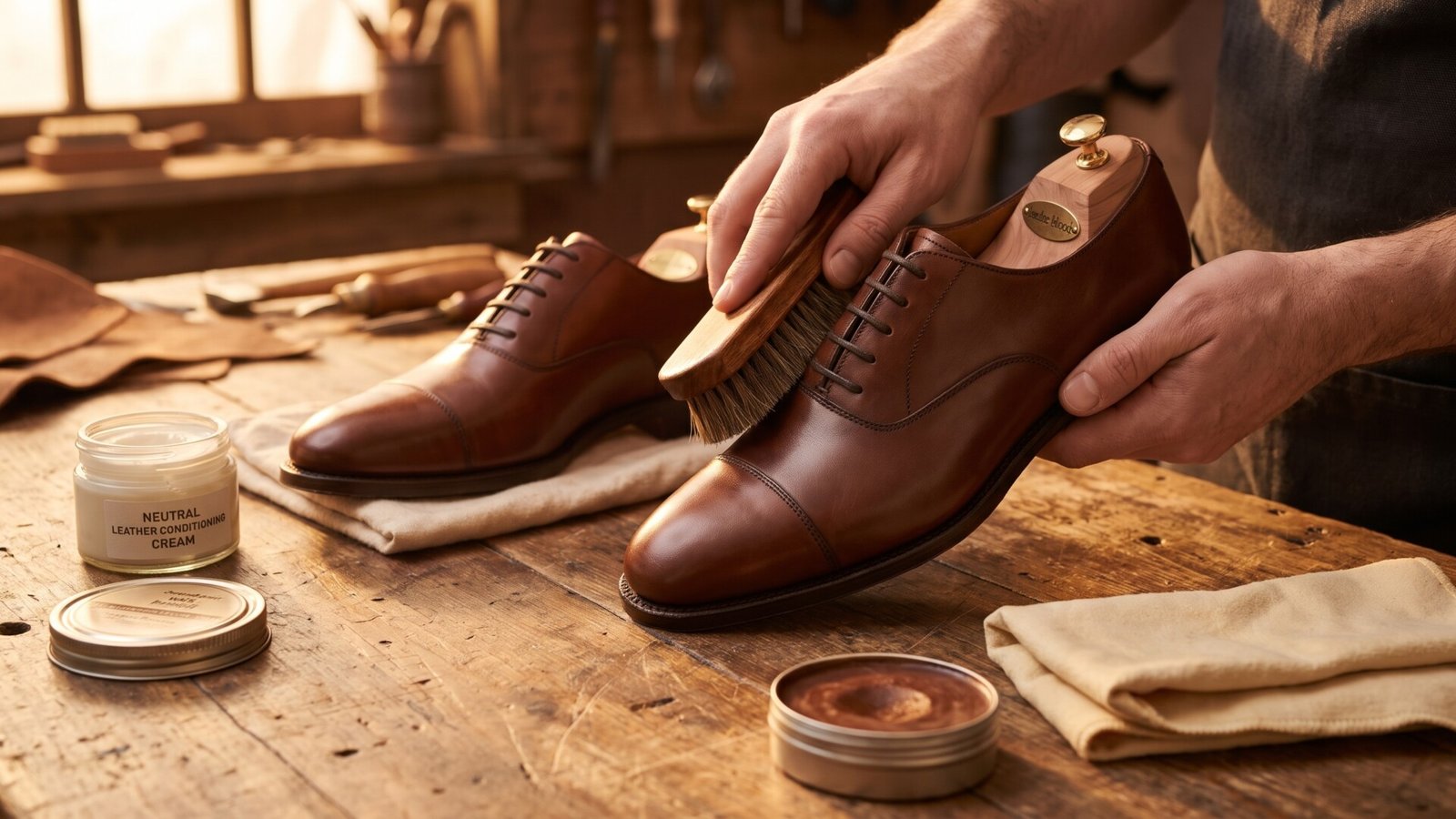
How to Care for Italian Leather Shoes
The whole tradeoff comes down to this: the shoes that cost the most usually need the least done to them, and the owners who spend the most on care products are often the ones doing the most damage. A pair of calfskin loafers given several coats of conditioner in a couple of weeks can go floppy at the vamp and dark at the toe, and brushing will not bring the structure back. What those shoes needed was a horsehair brush, a pair of cedar trees, and time to rest.
Italian leather shoes care is mostly a discipline of restraint. Brush them, dry them slowly, condition them rarely, polish them only where polish belongs, and keep them off your feet every other day. Do that and a good pair will hold its shape and its color for a decade or more. Do more than that and you shorten its life.
The routine changes with the leather, not the price tag. Smooth calfskin, suede, patent, grained leather, and leather-lined shoes each want something different, and the same cream that rescues a scuffed derby will ruin a suede loafer. Before you buy a single product, you need to know what you are holding.
Why Italian Leather Shoes Need a Different Care Approach
A $900 Italian shoe is not a $200 shoe with a better logo. The leather is often more supple, the color is frequently applied by hand, the finish may be deliberately thin, and the sole is often leather rather than rubber. Every one of those qualities is a pleasure to wear and a liability under heavy-handed care.
Supple leather flexes beautifully at the vamp and molds to your foot. It also absorbs moisture faster and marks more readily than a stiff, heavily corrected hide. Hand-applied color gives depth and patina that a sprayed finish cannot match, but it sits closer to the surface and dislikes solvents. A thin finish looks refined; it also means a harsh cleaner can strip it in one pass.
The construction matters too. A leather sole is a living thing in a way a rubber sole is not – it breathes, it flexes, and it drinks water if you let it. Many Italian dress shoes are made with a Blake stitch or a Bologna construction, both of which keep the shoe light and flexible. That flexibility is the point. It is also why you do not want to soak the shoe or bake it dry.
Appearance is not the same as quality
A mirror shine tells you nothing about the leather underneath. Some shoes are finished with a heavy glaze to hide a mediocre hide; others with a whisper of wax over something extraordinary. You cannot judge care needs by how glossy a shoe looks on the shelf.
What you can judge is the grain. Look closely at the surface. If you see a natural, slightly irregular pore pattern, you are probably looking at full-grain or top-grain leather that will age well and take conditioner kindly. If the surface looks uniform and plasticky, it may be corrected grain or a coated finish, which needs less conditioning and more caution.
What care can and cannot do
Care preserves flexibility, color depth, edge finishing, shape, and comfort. It slows the rate at which creases deepen and scuffs accumulate. It keeps the leather from drying to the point of cracking.
It cannot make a shoe last forever, and it cannot reverse structural damage. A cracked finish, a separated sole, or a deep cut is a repair job, not a maintenance one. Think of care as slowing the clock, not stopping it.
The decision framework
Before you touch a shoe, run through four questions in order. Identify the leather. Identify the problem – is it dust, dryness, a scuff, a stain, or water? Choose the mildest treatment that could plausibly solve it. Then test that treatment somewhere no one will see.
That order matters. Most damage comes from skipping straight to the strongest product in the cupboard because the owner was in a hurry. A soft brush solves most of what people reach for a cleaner to fix.
Identify the Leather Before Applying Anything
You cannot care for a leather you have not identified. This is the single most useful habit in Italian leather shoe care, and it takes about ten seconds once you know what to look for.
Smooth leather and calfskin
Smooth calfskin is the easiest category to live with and the one most Italian dress shoes and loafers use. It takes cream, it takes wax, it develops a patina, and it forgives a light scuff.
It is also the leather most often over-conditioned. Supple calfskin, the kind found on many premium Italian loafers and dress shoes, is already soft. Feed it too often and it softens further, loses structure at the vamp, and darkens unevenly. Calfskin also shows pressure marks and fine scratches more than heavily grained leather does, which tempts owners into aggressive polishing. Resist.
Use a cream polish for nourishment and color, and reserve hard wax for controlled shine on the toe and heel. When you are unsure of the exact shade, a neutral product is safer than a colored one. A neutral cream will not deepen the color or leave a tide mark if your application is uneven.
Suede, nubuck, patent, and specialty finishes
Suede and nubuck – the latter is suede’s smoother cousin, buffed on the grain side rather than the flesh side – want brushing and spot treatment, never cream or wax. A suede brush lifts the nap; a suede eraser lifts dry marks. That is the whole routine for most suede shoes.
Patent leather is a coated finish with a mirror surface, and it should never be treated like smooth calfskin. Cream will sit on top and smear; wax will dull it. Patent wants a damp cloth and, for scuffs, a method suited to the coating. Our guide to cleaning patent leather Italian heels covers that properly, and our guide to removing scuff marks from high-shine Prada loafers walks through the high-shine case in detail.
Metallic finishes, printed leather, coated leather, and hand-painted shoes are their own categories. Treat them as brand-specific: check the maker’s guidance before you apply anything, and when in doubt, do nothing and ask a cobbler.
The rule that saves the most shoes: a product marketed for "leather" is not automatically suitable for every leather finish. Read the label for the finish it is designed for, not just the material.
Leather soles and leather linings
The upper and the sole have different needs, and the lining is a third thing again.
Leather soles should be kept away from prolonged saturation and allowed to dry naturally, away from heat. They will darken and soften with water, and repeated soaking breaks down the fibers and can separate the sole from the upper. A light application of a dedicated sole oil or wax, if the maker recommends it, helps; a puddle does not. For the buying side of this question, our comparison of leather soles vs. rubber soles for luxury shoes lays out the trade-offs.
The lining is where comfort lives. Wear socks or thin liners with closed shoes, give the shoe time to dry between wears, and brush the inside lightly now and then. Avoid heavy oils inside the shoe – they can transfer color to your socks and soften the lining until it loses its shape.
The Basic Italian Leather Shoe Care Routine
A good routine is short, repeatable, and boring. That is the point. You want a sequence you will actually do on a Sunday evening, not a ritual you abandon after a month.
The tools worth owning
You need less than the internet suggests. A practical core kit looks like this:
- A horsehair shoe brush for removing dust. Horsehair is soft enough not to scratch and stiff enough to lift grit.
- Soft cotton cloths for applying and buffing products.
- Shoe trees sized correctly for the shoe.
- A leather conditioner or shoe cream suited to the leather.
- A neutral cream polish.
- Optional hard wax for a restrained toe and heel shine.
- A suede brush and suede eraser, only if you own suede or nubuck.
A small, well-chosen kit beats a cupboard of aggressive cleaners and shine products every time. Products you do not need are products that tempt you into over-treating.
If you want named starting points, these are the ones worth knowing. Saphir Renovateur is a conditioning cream for suitable smooth leather, used sparingly. Saphir Pommadier Cream Shoe Polish handles color renewal and light nourishment. Saphir Mirror Gloss is for a controlled high shine on toe and heel. Collonil 1909 Leather Cream is a solid alternative for conditioning smooth leather. For orientation, 75 ml jars of these Saphir products were listed by a major US shoe-care retailer in November 2026 at roughly $29-$32 for Renovateur, $27-$30 for Pommadier cream and $36-$40 for Mirror Gloss; prices vary by retailer and color, so check before you buy. We could not confirm a current US price for the Collonil cream, so none is quoted here. Treat all four as examples, not requirements – compatibility with your leather matters more than the name on the tin. [Affiliate: Check current prices on Saphir shoe care] and [Affiliate: Browse Collonil leather care] if you want to compare.
The maintenance sequence
The order is fixed, and it is the same every time.
- Remove the laces where appropriate, so you can reach the tongue and the eyelet area.
- Brush away dust with the horsehair brush. Work in short strokes, and pay attention to the welt – the stitched strip where upper meets sole – where grit collects.
- Wipe lightly with a barely damp cloth if the shoe is dirty, then let it dry before going further.
- Apply a small amount of cream or conditioner to a cloth, not to the shoe. Work it in thin layers.
- Let it absorb for a few minutes, then brush off the excess.
- Polish only if the shoe needs color renewal or shine.
Thin layers are the whole game. Excess product clogs the surface, attracts dust, darkens leather unevenly, softens structure, and creates a patchy shine that looks worse than no shine at all. Two thin coats always beat one thick one.
Apply product to the cloth rather than pouring it onto the shoe. It gives you control, it avoids puddles in the creases, and it keeps the product out of the stitching.
And test first. The patch-test rule applies to every product you have not used on that shoe before. Test inside the heel area, on the tongue edge, or another concealed section, and wait a few minutes to see how the leather responds.
How often to maintain them
Forget the calendar. Care intervals depend on climate, how often you walk, whether you are on salted winter streets, whether it rains, and what the leather finish is.
- Brush after wear, or whenever the shoe looks dusty.
- Condition when the leather looks dry or starts to lose flexibility – not automatically at every cleaning.
- Polish when the shoe needs color renewal or shine.
- Deep clean only when brushing and light wiping are not enough.
A pair of formal shoes worn twice a month may need conditioning a few times a year. A pair of loafers worn four days a week through a wet winter will need more attention, and more drying time, than any schedule can capture.
What Most Owners Get Wrong
The most common mistake in Italian leather shoes care is over-conditioning. It is especially common on soft calfskin and on shoes that are worn infrequently, because owners treat a rare outing as an excuse for a full treatment. The leather does not need it, and the structure suffers.
The second mistake is wearing the same pair on consecutive days. This has nothing to do with luxury branding and everything to do with moisture. Your feet sweat, the lining absorbs it, and the upper needs time to dry and recover its shape. Twenty-four hours between wears is the working minimum; forty-eight is better. Rotation matters even more with a new pair; see how to break in Italian leather shoes for the first weeks of wear.
Shoe trees belong in the shoe after it has cooled briefly, not while it is still warm and damp from your foot. And the tree must fit. Forcing an oversized tree into a narrow shoe stretches the upper and can distort the topline – the curved edge around the ankle opening – in a way that never fully recovers.
Cleaning errors that cost real money
- Scrubbing a scuff before identifying it. Dirt, dye transfer, and actual abrasion each need a different response, and scrubbing makes two of the three worse.
- Reaching for household soap, alcohol, baby wipes, olive oil, or anything from the kitchen. These strip finishes, dry leather, or leave residue that attracts dirt.
- Applying dark polish to hide damage instead of treating the damaged finish. It works for a week and looks like a cover-up forever.
- Drying wet shoes against a radiator, in front of a hair dryer, or in direct sun. Heat shrinks, cracks, and hardens leather, and it can soften the adhesives holding the sole and lining in place.
Here is the contrarian point worth taking seriously. A moderate patina and a few small signs of wear are often safer than repeatedly trying to restore a factory-new finish with strong products. Every aggressive restoration removes a little of the finish that protects the leather. A shoe that looks lived-in but is structurally sound will outlast one that has been scrubbed back to brightness three times.
Rain, Salt, Scuffs, and Other Real-World Problems
Real life does not respect a maintenance schedule. You will get caught in rain, you will step in salt, and you will scuff a toe on a train platform. What matters is the response.
Wet shoes and water exposure
When a shoe gets wet, act in this order. Remove the insoles if they come out, remove the laces, and blot the surface rather than rubbing it. Stuff the shoe with absorbent paper or insert correctly sized trees, and let it dry at room temperature, away from any heat source.
Heat is the enemy. It shrinks leather, cracks finishes, hardens the upper, and can damage adhesives and edge finishing. A radiator will do in an afternoon what a season of wear could not.
Seek professional help after full saturation, dye transfer, sole separation, or severe distortion. Those are not home-care problems.
Salt, grit, and winter residue
Road salt leaves a pale residue and draws moisture out of leather, which is why winter is hard on shoes. Remove it promptly with a lightly damp cloth, let the shoe dry completely, and only then apply a suitable conditioner or cream.
Salt damage recurs if the shoe keeps going back onto treated streets without rotation or weather-appropriate footwear. The fix is partly behavioral: rotate pairs, and accept that a leather-soled dress shoe is not a winter commuting shoe.
Scuffs and scratches
Separate surface transfer marks from cuts that have removed the finish. A transfer mark – dye from another surface, a bit of rubber from a chair leg – often lifts with a light wipe or a touch of cream. A cut that has gone through the finish and exposed fibers is a different problem.
Cream polish can reduce the visibility of light scuffs. Deep scratches, exposed fibers, and gouges need a cobbler or a restoration specialist. The Prada loafer scuff guide linked above covers the high-shine case, but note that patent leather needs a different method entirely.
When to stop treating the shoe at home
Put the products down and call a professional when you see cracking, peeling finish, severe staining, dye bleed, deep cuts, loose stitching, sole separation, or water damage that has reached the lining.
For hand-finished or delicate shoes, find a cobbler who knows luxury footwear rather than a generic quick-clean service. The wrong hands can do more damage in an hour than a year of wear.
Caring for Different Italian Shoe Categories
The leather decides the routine, but the shoe category decides the wear pattern and the failure points. A driving shoe and a pair of Oxfords do not fail in the same places.
| Shoe type | Main wear points | Care priority | Watch out for |
|---|---|---|---|
| Loafers and Gommini | Heel counter, toe, flexible vamp | Frequent brushing, light cream, trees | Heel contact wear, light-color staining |
| Formal dress shoes | Toe, sole edge, heel top piece | Polish control, sole care, trees | Over-polishing, sole saturation |
| Luxury sneakers | Toe box, midsole join, lining | Gentle surface cleaning, spot treatment | Machine washing, soaking glued parts |
| Heels, flats, sandals | Toe box creasing, exposed edges | Storage, edge care, delicate finishes | Crushing in storage, sun fading |
Loafers and Gommini
Loafers take more heel contact than any other dress shoe, because you slip them on and off and often drive in them. Flexible construction and light-colored leather change the routine: brush more often, condition lightly, and watch the heel counter for wear. Tod’s Gommino owners should read why the Tod’s Gommino is so popular and how the Gommino differs from a standard driving shoe for the construction context, and our guide to the best Italian driving shoes covers the category in depth.
Formal dress shoes
Formal shoes reward polish control. Keep the shine restrained and concentrated on the toe and heel, keep the leather sole dry, and replace the heel top piece – the replaceable tip at the bottom of the heel – before the heel structure is damaged. Shoe trees matter most here. See our guide to Italian dress shoes and our picks for the best Italian dress shoes for the buying side.
Luxury sneakers
Leather sneakers combine leather uppers with rubber soles, textile linings, foam, and glued components. Soaking or machine washing can cause more damage than on a traditional dress shoe, because water gets into places you cannot dry. Clean the surface gently, treat leather panels separately from textile and suede sections, and follow the maker’s instructions. Our comparison of Italian leather vs. suede sneakers covers how each material wears and what it needs. Our guide to Italian designer sneakers and our roundup of Italian luxury sneakers that are actually comfortable cover the category.
Heels, flats, and sandals
Toe-box creasing, delicate finishes, leather soles, and exposed edges are the concerns here. Storage matters as much as cleaning – heels and flats crush easily and fade in sunlight. See our guides to Italian designer flats, Italian designer heels, and best Italian leather sandals.
How Construction Changes the Care Routine
Two pairs in the same calfskin can need different handling because of how the sole is attached. Construction decides how much water the shoe tolerates, how it dries, and what a cobbler can do when the sole wears through.
| Construction | How the sole is attached | Care implication | Resoling |
|---|---|---|---|
| Goodyear welt | Upper and insole stitched to a welt, which is stitched to the outsole | Sturdier against moisture, but the cork filler between insole and outsole is slow to dry; allow at least 48 hours after a soaking | Can usually be resoled several times by a competent cobbler |
| Blake stitch | Upper stitched directly through insole to outsole | Lighter and more flexible, with the sole closer to the foot; avoid soaking, since water can wick through the stitching channel | Needs a cobbler with a Blake machine; ask before assuming it is routine |
| Bologna (sacchetto) | Upper sewn into a sock-like lining, then stitched to the sole | Very soft and flexible with little built-in structure, so correctly sized shoe trees and gentle handling matter most | Depends on the maker; confirm with a specialist before the sole wears through |
| Cemented (glued) | Sole bonded with adhesive | Common on sneakers and some casual loafers; avoid heat and prolonged soaking, which weaken the bond | Often limited; check with the maker or a specialist |
Check the brand’s product page or care card for the construction of your specific pair, because makers use more than one method across their ranges. Our guide to Italian shoe making explains the methods in more depth.
Care Questions That Depend on the Shoe You Own
Care advice works best when it follows the shoe. These guides on the site cover the questions that most often sit next to maintenance:
- Owners of men’s loafers can read our picks for the best Italian penny loafers for men, which note how each style wears at the heel and vamp; women’s equivalents are in the best Italian designer loafers for women.
- Formal shoes with leather soles are covered in the best Italian Oxford shoes for men and the best Italian designer shoes for business casual outfits.
- Velvet is a textile, not leather, so smooth-leather cream and wax do not apply. Brush gently with a soft brush and spot-clean carefully; our roundup of Italian velvet loafers for the holiday season covers the style.
- Shoes for outdoor events take more punishment from grass and uneven ground; see Italian designer wedding shoes for the outdoor ceremony.
- If a pair stretches or pinches after you start caring for it, check Italian designer shoes for wide feet and Italian shoe sizes vs US and UK sizes before assuming the leather is at fault.
- Comparing makers before you buy? See Italian vs. French luxury shoe brands and our guide to styling Italian shoes for every occasion.
Care products and cobbler prices vary by market and change often, so use the figures in this guide as a starting point and confirm current costs locally.
Storage, Rotation, and Repair: The Hidden Cost of Choosing Wrong
Storage is where most shoe budgets quietly leak. Shoe trees, breathable bags, adequate ventilation, and protection from sunlight preserve shape and finish more effectively than any product. Structured dress shoes want firm trees and a dust bag. Flexible loafers want correctly sized trees that fill the shoe without stretching it. Sneakers want air and a wipe-down before storage. Suede wants a brush and a dry environment. Embellished footwear wants individual protection so nothing catches or scratches. Boots need their shafts supported with boot trees or rolled paper so they do not slump and crease; our guides to the best Italian leather ankle boots and Italian designer boots for women cover the styles themselves.
Rotation is a cost-per-wear issue. Owning fewer pairs and wearing each continuously increases drying time, odor, creasing, and repair costs. Three pairs rotated will outlast four pairs worn hard, and the repair bills will be lower.
The repair timeline
- Replace worn heel tips before the heel structure is damaged. This is the cheapest repair you will ever make, and skipping it is the most expensive.
- Consider sole protectors or resoling based on construction and intended use. A thin rubber sole protector can extend the life of a leather sole in wet climates; on a shoe designed to be resoled, plan for it.
- Avoid adding a heavy rubber sole if it materially changes flexibility, balance, or the original design. You can ruin the thing you loved about the shoe.
Care connects directly to construction quality. Our pieces on the art of Italian shoe making and handmade Italian shoes, along with our Italian designer shoes hub, explain what you are maintaining and why some shoes are worth the effort.
Which Care Routine Still Makes Sense in Three Years?
Three buyer profiles, three sensible routines.
The occasional formal-shoe owner. Neutral cream, a horsehair brush, shoe trees, and a professional inspection before major events. That is enough. Do not buy a cabinet of products for shoes you wear six times a year.
The frequent office and travel wearer. Rotation, a compact brush and cloth kit, weather awareness, and planned heel or sole maintenance. This is the profile that benefits most from spending on quality care products, because the shoes are working hard. If you are still choosing pairs for long days on foot, our guide to the best Italian shoes for walking all day focuses on comfort and construction.
The luxury sneaker and casual-shoe owner. Gentle surface cleaning, no machine washing unless the maker explicitly permits it, and extra attention to glued components and mixed materials.
The best routine balances preservation against over-maintenance. More products do not automatically mean better care.
The simple decision framework
- If the leather is dusty, brush.
- If it is dry, condition sparingly.
- If the color is dull, use a matching cream.
- If the surface is damaged, stop experimenting and seek repair.
- If the shoe is wet, dry slowly before applying anything.
Consistent care improves wearability and presentation. It cannot turn a poor fit or unsuitable construction into a good purchase. If the shoe pinches, no amount of conditioner will fix it – see our guide to how Italian designer shoes should fit for that conversation.
Care Products Worth Buying
| Product or tool | Best use | Buyer who benefits most | Important caution |
|---|---|---|---|
| Saphir Renovateur | Occasional conditioning for suitable smooth leather | Owners of supple calfskin and premium dress shoes | Use sparingly and patch-test first |
| Saphir Pommadier Cream Shoe Polish | Color renewal and light nourishment | Owners of smooth leather loafers and dress shoes | Match color carefully; neutral is safer when uncertain |
| Saphir Mirror Gloss | Controlled high shine on toe and heel | Formal-shoe owners who want a polished finish | Not necessary for casual shoes; avoid thick layers |
| Collonil 1909 Leather Cream | Conditioning and finish maintenance for smooth leather | Buyers seeking an alternative premium cream | Confirm compatibility with the specific finish |
| Horsehair brush and cotton cloths | Routine dust removal and product application | Every Italian leather shoe owner | Keep brushes dedicated to light and dark products |
| Cedar or correctly sized shoe trees | Shape retention and drying support | Frequent wearers of structured shoes | Avoid forcing an oversized tree into the shoe |
| Suede brush and suede eraser | Dry cleaning of suede and nubuck | Owners of suede loafers, sneakers, or boots | Never use smooth-leather cream or wax |
A reputable cobbler and properly sized shoe trees will often provide more long-term value than a cabinet of specialized products. And be wary of universal sprays, silicone-heavy shine products, household cleaners, and unverified waterproofing treatments. Compatibility beats brand prestige every time.
Buying Verdict: The Routine That Protects the Investment
The minimum sensible system is brush, shoe trees, a suitable cream, cloths, and rotation. Add hard wax only for formal shoes, and a suede kit only if your wardrobe includes suede.
Use professional care for hand-finished shoes, expensive leather soles, unusual finishes, severe stains, or significant water damage. Avoid complex home restoration entirely if you are dealing with peeling finishes, deep scratches, color changes, or construction damage.
The best care purchase is not the most expensive product. It is the smallest compatible kit, used consistently. And care ties back to fit and purchase quality: proper maintenance preserves a well-fitting, suitable shoe, and it cannot compensate for buying one that is too narrow, too delicate for your lifestyle, or wrong for your weather. See whether luxury Italian shoes are worth the money, and the shoes hub linked above, for the buying decisions that come before the care routine.
In short, Italian leather shoe care is a small kit used well and a habit of leaving the shoes alone: a horsehair brush, correctly sized trees, one compatible cream, and a rotation that gives each pair a day off. Brush when dusty, condition when dry, dry slowly when wet, and see a cobbler before small problems become structural ones.
Frequently Asked Questions About Italian Leather Shoes Care
How often should Italian leather shoes be conditioned?
Condition when the leather looks dry or loses flexibility, not on a fixed schedule. Climate, wear frequency, and the finish matter more than the calendar. Over-conditioning softens and darkens leather, so less is usually more.
Can I use ordinary shoe polish on Italian leather shoes?
Only if the product matches the leather finish. Smooth-leather cream may suit some shoes, but suede, patent, metallic, coated, and hand-finished leather need different products. Check the maker’s guidance and patch-test first.
Should I waterproof Italian leather shoes?
Some smooth leather benefits from a compatible protective treatment, but waterproofing sprays are not universally safe. Check the maker’s care guidance and test in a concealed area before applying anything.
Can Italian leather shoes be worn in the rain?
Occasional light rain is manageable if you dry the shoes promptly and properly. Prolonged saturation can damage leather, lining, soles, adhesives, and shape. Rotate pairs and choose weather-appropriate footwear.
Are shoe trees necessary for expensive Italian shoes?
They are particularly useful for structured leather shoes. Use correctly sized, breathable trees. They support shape and drying, but they do not replace brushing or repair.
How do I care for Italian leather sneakers?
Mixed materials and glued construction make soaking and machine washing risky. Clean the surface gently, follow the manufacturer’s instructions, and treat leather panels separately from textile and suede sections.
When should I take Italian leather shoes to a cobbler?
Take them in for deep scratches, cracking, peeling, severe stains, sole separation, worn heels, and serious water damage. Those are repair jobs, not maintenance.
Can Italian leather shoes be resoled?
Often yes, but it depends on construction. Goodyear-welted shoes can usually be resoled several times, Blake-stitched shoes need a cobbler with the right machine, and cemented soles may be limited. Ask a specialist before the sole wears through.
Should I use cream or wax on Italian leather shoes?
Cream nourishes and renews color; wax adds shine and a thin layer of protection. Most owners need cream occasionally and wax only on the toe and heel of formal shoes. Apply either in thin layers and patch-test first.
How long should I leave Italian leather shoes between wears?
Allow at least 24 hours, and ideally 48, so the lining and upper can dry and recover shape. Insert correctly sized shoe trees once the shoes have cooled.
How do I clean suede Italian loafers?
Use a suede brush to lift the nap and a suede eraser for dry marks. Do not use cream or wax, and let any dampness dry naturally away from heat. Take stubborn stains to a specialist.