Removing smells from vintage leather jackets (product links)
Few things are more frustrating than finding the perfect vintage leather jacket—the cut, the patina, the way the zipper pulls—and then catching the smell: decades of smoke, damp basements and old perfume baked into the lining. The good news is that most odors can be reduced or removed, as long as you work gently and in the right order.
This guide explains why vintage leather holds on to smells, the methods that work, the ones to avoid, the products worth your money, and how to protect the investment you have made. It is part of our wider guide to Italian leather jackets, within the broader Italian designer clothing collection.
Quick Answer: What Works Best?
Start with the gentlest option: air the jacket in the shade for several days, then use odor absorbers (baking soda in open containers or activated charcoal) in an enclosed space for a few days, without letting loose powder sit on the leather. Treat the lining separately. If a strong smell remains after two rounds, take the jacket to a professional leather cleaner rather than escalating to harsher home treatments.
Understanding Leather Odors
Vintage leather jackets are not like modern synthetic fabrics. They are tanned animal hide, which means they are porous, fibrous and reactive.
Why Leather Holds Onto Smells
Leather is a natural material built from a web of collagen fibers stabilized through tanning. The same porous structure that makes leather breathable also lets it absorb volatile compounds. Smoke, sweat, mildew, cooking odors and old perfume can penetrate deeply and bond with the leather’s natural oils over the years. That is why a musty jacket often does not just smell on the surface; the odor sits inside the material and the lining.
Identify the Source of the Smell
| Smell | Likely cause | Where to start |
|---|---|---|
| Musty, damp | Mildew from humid storage | Dry airing, activated charcoal; see mold guide below |
| Stale smoke | Years of smoking environments | Airing, absorbers, then professional cleaning |
| Sweat, body odor | Lining and underarm areas | Treat lining; replace or professionally clean it |
| Sharp chemical | Old dyes, finishes or cleaning solvents | Extended airing; professional advice |
| Perfume, mothballs | Storage with fragrance or moth repellent | Long airing, charcoal |
If you can see white or green fuzzy growth, the problem is mold, not just odor. Read our guide to dealing with mold on stored designer leather goods before you do anything else.
The Value of a Fresh-Smelling Jacket
A vintage jacket with a bad smell is not just unpleasant to wear; it is a financial liability. In the resale market, condition is everything, and a lingering odor signals poor storage. Addressing odors is preservation, not vanity: it protects both the leather and the value of the piece.
What Not to Do
- Do not spray perfume or heavy fragrance. It layers a new smell over the old one and can stain the leather.
- Do not use a washing machine, steam or a hairdryer. Water and heat shrink and stiffen leather.
- Do not use bleach, ammonia or multi-surface sprays. They strip oils and can permanently damage the finish.
- Do not dry in direct sun or near a radiator. Sunlight fades dye and heat cracks the hide.
- Do not store in plastic. Trapped moisture encourages mildew.
Core Methods for Removing Smells
There are two main approaches: natural remedies and commercial products. The best results often come from combining them, starting with the gentlest.
Step 1: Air It Out
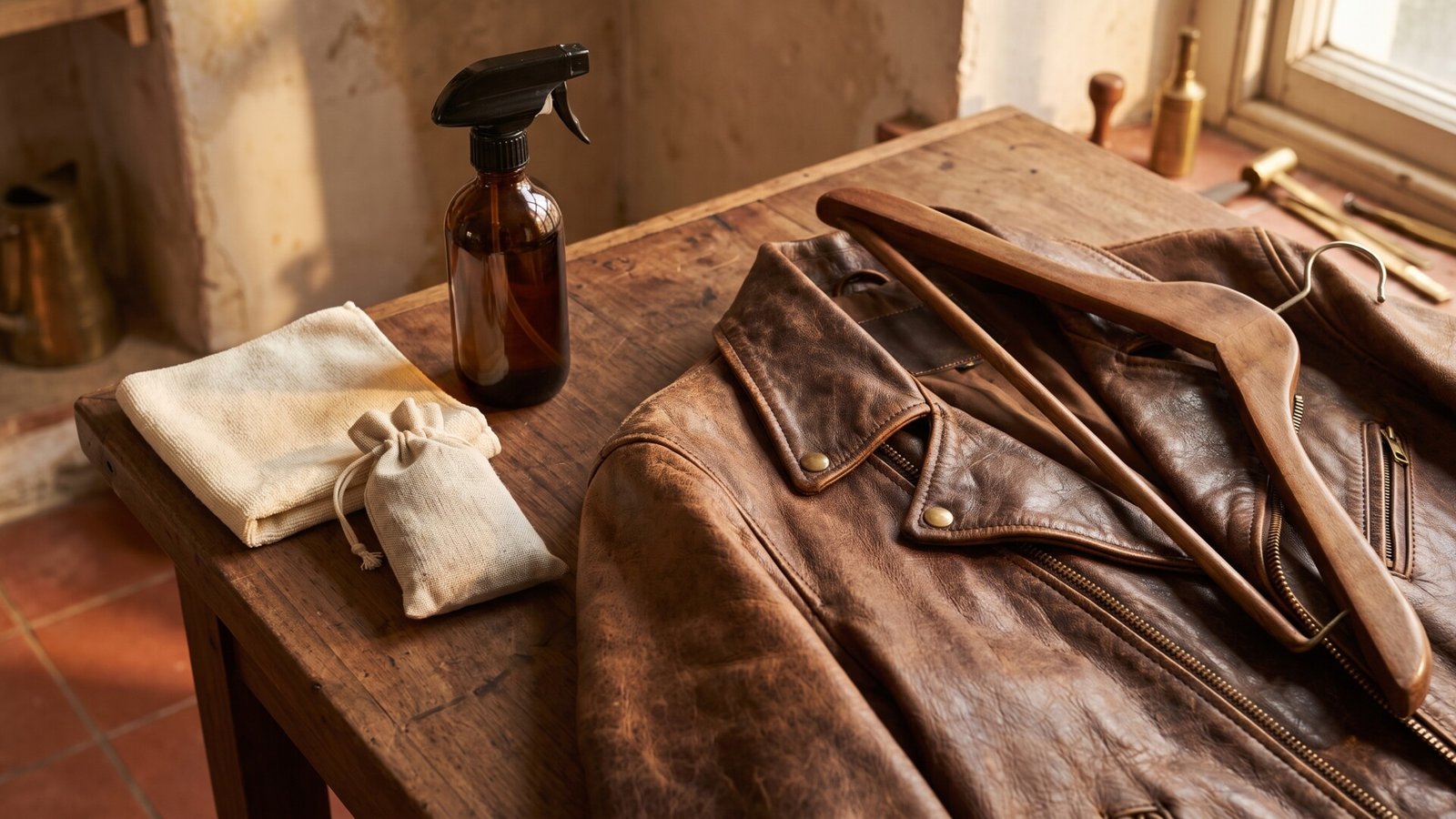
Hang the jacket on a wide, padded hanger in a shaded, well-ventilated spot for several days, such as a covered porch or a room with an open window. Avoid direct sun and damp, humid air. Turn pockets out and open the lining as far as possible. Many light odors fade with airing alone.
Natural Remedies
Baking Soda
Baking soda is a classic odor absorber. Odor molecules stick to its particles and are trapped. The safest approach for leather is to keep the powder off the hide:
- Place the jacket in a large cloth garment bag or a clean, dry plastic bin with a lid, for a short period only.
- Add several open containers or breathable cloth sachets filled with baking soda so the powder does not touch the leather.
- Close the container and leave it for 48 hours. For heavy odors, repeat with fresh baking soda for up to a week, checking the jacket daily for moisture.
- Remove the jacket and air it again in the shade.
Some people sprinkle baking soda directly on the lining. If you do, use it only on the fabric lining, never on exposed leather, and brush or vacuum every trace off afterward, because leftover powder can dry the leather out.
Diluted Vinegar (Lining Only)
White vinegar can neutralize some sweat and mildew odors, but it is acidic and can alter leather finishes. Use a one-to-one mix of white vinegar and distilled water, mist the fabric lining lightly (not the leather), and let it dry fully in a ventilated spot. Test first on a hidden area. If your jacket is aniline or suede, skip vinegar entirely.
Activated Charcoal
Activated charcoal has a massive surface area that traps odor molecules, making it particularly useful for musty smells from long-term storage. Place one or two charcoal bags in the pockets and hang the jacket in a breathable garment bag with more bags for several days. Charcoal bags can be refreshed by leaving them in sunlight for a few hours every month.
Other Natural Aids
Unscented cedar blocks help absorb moisture and keep moths away, and fresh, unused coffee grounds in an open dish can mask lingering smells in a closed storage space. Neither replaces proper cleaning, and they should not touch the leather.
Commercial Products
For stubborn odors, products formulated for leather can help, but be realistic: most leather care products condition or clean rather than eliminate deep odor.
Leather Conditioner
Leather Honey Leather Conditioner is a widely used non-toxic conditioner, available in an 8 oz bottle for roughly $13 to $25 depending on the retailer. It is a conditioner first, not a dedicated odor remover, but replacing lost oils keeps leather supple and less absorbent to new smells. Apply sparingly to the leather, never the lining, and test on a hidden spot.
Fabric Refresher for the Lining
A fabric refresher such as Febreze can be used sparingly on the interior lining only. Keep it off the leather, since chemicals and moisture can affect the finish, and let the lining dry completely before wearing or storing the jacket.
Leather Cleaning Wipes
Leather-specific wipes are useful for quick touch-ups because surface grime and body oils can hold odors. Always choose a product intended for your type of leather (finished, aniline, suede or shearling) and patch test it first.
Professional Cleaning Services
If natural remedies and commercial products have not worked, the odor is deeply embedded. Professional leather cleaners have specialist solvents and equipment, and some use ozone treatment to neutralize odors. Prices vary by region, jacket and the service, so ask for a quote first. For a jacket worth several hundred dollars or more, a professional clean is often a sensible investment.
[Affiliate: Shop the leather care collection]
Different Leathers, Different Rules
Not all vintage jackets respond the same way. Finished (pigmented) cowhide and lambskin are the most forgiving. Aniline and semi-aniline leather absorb liquids easily, so avoid sprays on the surface. Suede and nubuck should not be treated with liquids at all; use a suede brush and dry absorbers only. Shearling-lined jackets need professional cleaning because moisture ruins the wool. If you are unsure what your jacket is made of, treat it as delicate and check with a specialist.
Practical Application: How to Apply the Methods
The Patch Test
Before you apply any method, test it on a small, inconspicuous area such as the inside of the cuff or the bottom hem. Apply a tiny amount, wait 24 hours, and check for discoloration, stiffness or damage.
Frequency and Maintenance
- Air the jacket after each wear.
- Condition every few months if the leather feels dry, rather than on a fixed calendar.
- Do a deeper clean and odor session whenever you acquire a new vintage piece, and check stored jackets seasonally.
The Importance of Proper Storage
You can do everything right and then undo it with bad storage. Leather needs to breathe. Use a breathable cloth garment bag, a padded hanger and a cool, dry spot, and add a desiccant packet in humid climates. Never use plastic.
Buying Vintage: Check for Odor Before You Pay
If you are shopping for a vintage jacket, ask the seller directly about smell and storage, and smell the lining and underarms in person if you can. When buying online, check whether returns are accepted. A jacket with only a light stale smell is usually fixable; one with strong smoke or visible mold is a risk. To compare what a sound jacket looks like, see our guide to Italian leather jacket brands known for durability.
Value and Investment Perspective
The Long-Term Value of Maintenance
A vintage leather jacket is not disposable. With care it can last decades. Basic upkeep—a conditioner, a proper garment bag and an occasional professional clean—costs a small fraction of replacing a good jacket. A used vintage leather jacket can cost several hundred dollars, and designer pieces considerably more, so maintenance is closer to a savings plan than an expense.
Resale Value
The resale market for vintage leather is active, and well-made jackets from established makers and designer houses tend to hold interest. Condition is the biggest factor: a jacket with a clean interior, supple leather and no lingering odor will usually sell for noticeably more than a musty one.
The Cost of Neglect
If you ignore a musty smell it does not go away; it usually gets worse. The moisture that causes mildew also breaks down leather fibers, leaving the jacket stiff, cracked and eventually unwearable. A problem that could be handled with simple supplies and some patience can become a total loss.
Care Tips for Vintage Leather Jackets
Regular Conditioning
Leather needs moisture. A good conditioner replenishes natural oils, keeps the leather supple, and makes it less absorbent to future odors. Use a small amount and buff off the excess.
Cleaning and Handling Scratches
For surface dirt, a soft, slightly damp cloth is usually enough; for stubborn marks use a leather-specific cleaner. Scratches are part of a vintage jacket’s character, but a color-matched leather balm can help blend them.
Dealing with Fading
Sunlight fades dye and dries out the hide. You can embrace faded areas as part of the vintage patina, or use a color restorer. Restoring color is an advanced technique, so practice on a less valuable piece or hand it to a professional.
Conclusion
Removing smells from vintage leather is about patience and gentleness: air first, absorb next, treat the lining separately, test everything, and call a professional when the odor will not budge. A jacket that has survived fifty years deserves to be preserved, not discarded. Once the smell is gone, protect it with good storage and light conditioning, and it will keep going for decades.
Continue reading: Italian Leather Jackets guide | Dealing with mold on stored designer leather goods | Italian leather jacket brands known for durability | Italian Designer Clothing
Frequently Asked Questions About Removing Smells From Vintage Leather Jackets
What is the best way to remove odors from leather jackets?
Start with airing in the shade, then use baking soda or activated charcoal in an enclosed space without letting powder sit on the leather. For stubborn smells, a professional cleaning is the most reliable solution.
Can I use regular household cleaners on my leather jacket?
No. Bleach, ammonia and multi-surface sprays are too harsh. They can strip the leather’s natural oils and damage the finish permanently.
How often should I clean my vintage leather jacket?
Wipe off surface dirt as needed, condition when the leather feels dry, and arrange a professional clean when odors or heavy soiling build up, typically no more than once a year.
Is it safe to use vinegar on leather?
Use it with caution. A diluted vinegar solution can help on a fabric lining, but it is acidic and can alter leather finishes, so test first and avoid it on aniline, suede or nubuck.
Does putting a leather jacket in the freezer remove smell?
Results are mixed and it does not remove embedded odors. Condensation when it thaws can also add moisture, so we do not recommend it for vintage leather.
How can I prevent smells from returning after cleaning?
Store the jacket in a cloth garment bag on a padded hanger, avoid plastic, keep it in a cool, dry place, and add desiccant packets in humid climates.
How do I get cigarette smoke out of a vintage leather jacket?
Air it in the shade for several days, use charcoal or baking soda sachets in a closed garment bag, treat the lining, and if the smell persists, have it professionally cleaned.
What should I do if the odor persists after trying these methods?
See a leather cleaner that specializes in vintage or high-end garments. They have the tools and expertise to handle deeply embedded odors.