Best Italian Dress Shoes: The Definitive Guide to Formal Italian Luxury Footwear
A formal shoe does not have to be stiff to be correct. The Italian approach to the dress shoe, as most makers present it, is a clean line on a last that holds the foot comfortably, a leather upper finished to a good depth of colour, and a sole that can be maintained. This guide compares the main Italian names for men’s dress shoes, explains what the construction terms actually mean, gives current US price bands where we could verify them, and helps you decide which pair suits your dress code. It sits inside our wider Italian designer shoes coverage and complements the broader guide to Italian dress shoes.
Prices below were checked against brand or retailer pages in November 2026 and are given in US dollars. They change often and vary by market, so treat them as bands rather than quotes. Where we could not confirm a figure, we say so instead of guessing.
Quick Answer: Which Italian Dress Shoe Brand Should You Choose?
- Closest to a pure dress-shoe specialist: Santoni, a Marche-based maker whose US lace-ups ranged from about $850 to $2,350 in November 2026, with a handmade Uniqua line at $4,500.
- Heritage and a signature construction: Ferragamo and its Tramezza method.
- Tailoring-led business footwear: Zegna, whose leather Derby was listed at $1,150 at Mr Porter’s US store in November 2026.
- Understated, logo-free styling: Brunello Cucinelli.
- Fashion-led formal looks: Gucci.
- Softer, smart-casual lace-ups: Tod’s.
What Defines a True Italian Dress Shoe?
1. Construction: Goodyear, Blake and Bologna
Goodyear welt: A strip of leather (the welt) is stitched around the bottom of the upper, and the outsole is stitched to that welt. Because the outsole is attached separately from the upper, a cobbler can replace it, and well-made Goodyear-welted shoes are often resoled several times. Santoni’s own product page for a polished Oxford lists Goodyear construction, a leather sole with a half-rubber heel, and the ability to be resoled.
Blake stitch: The upper is lasted over the insole and a single seam passes through the outsole, upper and insole. The result is a slimmer, more flexible sole with a closer cut, which is why it appears on many dressier Italian shoes. The trade-off is that resoling is possible but usually needs a cobbler with the right machine, and the seam can let water in more readily than a welt.
Bologna (sacchetto) construction: The upper is stitched into a sock-like pouch before being attached to the sole, which gives a very soft, flexible shoe. It is usually associated with softer Italian styles rather than strict business Oxfords. Ask the maker which method a specific model uses, because brands often mix several across a range.
Tramezza: Ferragamo’s house method places a layer of soft leather between the insole and the sole. The name means “something in between”, and the house says Salvatore Ferragamo introduced and patented the technique in the 1920s and that the shoe involves more than 160 artisanal steps. That is Ferragamo’s own description, not an independent measure.
2. Lacing: Oxford, Derby and Monk Strap
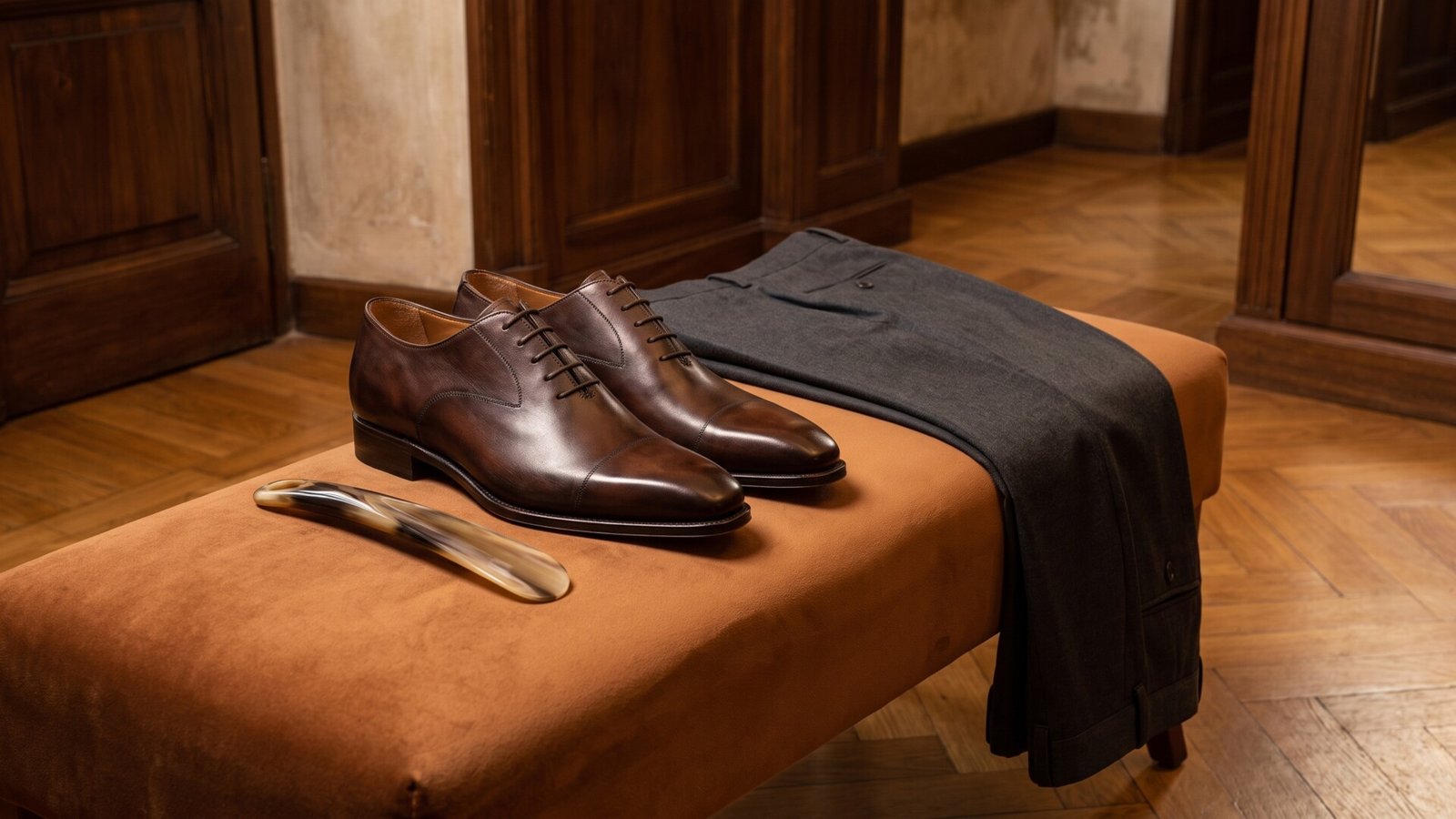
Oxfords have closed lacing, where the eyelet tabs are stitched under the vamp. This gives the cleanest line and is the standard for suits, interviews and ceremonies. Derbies have open lacing, with the eyelet tabs sewn on top, which accommodates a higher instep and reads slightly more relaxed. Monk straps replace laces with one or two buckled straps and sit between the two in formality, depending on the leather and toe shape.
3. Materials and Finish
Calfskin is the usual upper material for formal shoes. Smooth calf takes a polish well and holds a crisp shape. Brands describe finishes in their own vocabulary: Santoni describes hand-applied patinas it calls “velatura”, built up by layering colour, and sells polished and “dark brown” versions of the same Oxford shape at different prices. Hand-burnishing and patina are finishing choices rather than guarantees of grade, so look at the shade variation across the toe cap and heel in photographs and ask how the finish is applied.
Do not assume that every Italian dress shoe is full-grain, vegetable-tanned or handmade. Those are specific claims that a brand should state for a specific model. Santoni, for example, says its lace-ups are entirely handmade by its master craftsmen, but a retail listing that only says “leather” does not tell you the grade of hide.
4. Last, Fit and Toe Shape
The last, the wooden or plastic form the shoe is built around, sets the fit and the silhouette more than any other single factor. Almond toes are the most common in Italian formalwear, chisel toes read sharper and more fashion-led, and rounder toes look more traditional. A slimmer last may feel narrow if you have broad feet, so read our guide to Italian dress shoes for men with wide feet before buying, and our explainer on how Italian designer shoes should fit.
Why Italy Is a Serious Source of Dress Shoes
Italian shoemaking is clustered in districts. The Marche region is home to a large concentration of footwear makers, including Santoni in Corridonia, which was founded in 1975 by Andrea Santoni. Moreschi, founded by Mario Moreschi in 1946, is associated with the Vigevano district in Lombardy. Tuscany is known for tanning and leather expertise, and the Riviera del Brenta in Veneto is known for fashion-led shoemaking, much of it women’s. For a deeper look at what “handmade” does and does not mean in these workshops, see our guide to handmade Italian shoes explained.
“Made in Italy” is a labelling claim that applies to a product, not automatically to every item a brand sells or every component in it. Check the label or product page for the model you are buying. Our listings of Santoni, Ferragamo and Zegna product pages showed Italy as the place of manufacture for the specific shoes we looked at, but that is a statement about those pairs, not a blanket guarantee for each brand.
Comparison Table: Best Italian Dress Shoe Brands
| Brand | What it is known for | Construction (as stated by brand or retailer) | US price band | Best for |
|---|---|---|---|---|
| Santoni | Dress shoes; hand-applied patina finishes | Goodyear on the Oxford we checked; handmade Uniqua line | About $850 to $2,350 for lace-ups; Uniqua about $4,500 | Business and formal dress codes |
| Ferragamo | Heritage; Gancini emblem; Tramezza method | Tramezza on wholecut Oxfords | About $895 to $1,750 for Oxfords and Derbies; Angiolo Tramezza wholecut $1,590 | Traditional dress codes |
| Zegna | Tailoring-led footwear | Not specified on the listings checked | About $1,150 for a leather Derby | Business suits |
| Brunello Cucinelli | Quiet, logo-free styling | Not confirmed | About $1,300 (suede Derby) to $1,500 (leather Oxford) | Minimal luxury wardrobes |
| Gucci | Fashion-led formal looks; horsebit | Not confirmed | About $1,190 to $1,270 for leather Oxfords and Derbies; Horsebit 1953 loafer $1,090 | Fashion-forward formal looks |
| Tod’s | Soft, comfort-led lace-ups | Not confirmed | About $925 for a plain-toe Derby | Smart casual and relaxed business |
Price note: all figures are full US retail prices checked in November 2026. Santoni prices are from its US site; Ferragamo and Gucci from Neiman Marcus (Gucci’s Horsebit loafer also from Mytheresa US); Zegna from Mr Porter’s US store; Brunello Cucinelli from its US site and Mytheresa US; Tod’s from Nordstrom. Prices change by season and leather, so check the listing for the exact model before you buy.
Santoni Dress Shoes: A Specialist for Formal Shoes
Santoni was founded in 1975 by Andrea Santoni in Corridonia, in the Marche region. Its shoe range covers Oxfords, Derbies, monk straps, loafers and boots, and it is the most formal-leaning of the names in this guide.
Finish and Patina
Santoni describes its finishes as hand-applied patinas it calls “velatura”, where colour is built up in layers. Some retailers write that this takes many steps; we could not find a step count on Santoni’s own pages, so we do not repeat one. The practical point for a buyer is that two pairs of the same model can look different in depth and shading, and that the finish is a reason a polished Oxford costs more than a plain one.
Construction and Handmade Claims
The polished Oxford we checked on Santoni’s US site was Goodyear welted, with a leather sole and half-rubber heel, and the brand says the shoe is made entirely by hand, in Italy. Its lace-up category page offers filters for Goodyear, Blake and reverse Goodyear, but does not say which model uses which method, so confirm the construction of the exact model on the product page.
Price Bands and the Uniqua Line
In November 2026 Santoni’s US lace-up listings ranged from about $850 for its “Easy” lace-ups to $1,350 to $1,590 for polished Oxfords, up to $2,350 for the Meraviglia Oxford. The Uniqua line, which Santoni describes as made entirely by hand from a single piece of leather with no stitching on the upper, and taking up to 100 hours per pair, was listed at $4,500. Santoni’s own page therefore supports the claim that some styles exceed $4,000, but only the Uniqua tier does.
For a head-to-head with the softer-soled alternative, see our comparison of Tod’s vs Santoni.
Ferragamo Dress Shoes: Heritage and the Tramezza
Ferragamo was founded by Salvatore Ferragamo, who opened his Florence business in 1927 after working in the United States. Its men’s dress shoes are the best place to see the Tramezza method described above, and the house sells wholecut Oxfords, where the upper is cut from a single piece of leather, made in Italy. A wholecut has no vamp seam across the front, which gives a very clean line but needs a large, flawless piece of hide.
The Gancini hook is the house’s emblem and appears on hardware and trims, mostly on loafers and more casual shoes rather than on strict Oxfords. A retailer note on one Ferragamo wholecut suggested the shoe runs wide and recommended sizing down; fit varies by model, so read the sizing advice in our Ferragamo shoes guide before ordering.
Zegna Dress Shoes: Tailoring-Led Footwear
Zegna began as a fabric business in Trivero founded by Ermenegildo Zegna in 1910 and now makes ready-to-wear and footwear. The Derby shoes we checked on a luxury retailer, including the Siena Flex and a burgundy leather Derby, were listed as made in Italy with leather linings and almond toes. Those listings were in euros; in the US, Mr Porter listed a Zegna leather Derby at $1,150 in November 2026.
One of those listings contradicted itself about whether the sole was leather or rubber, which is a reminder to read the materials list, not only the headline. If you wear a Zegna suit, the shoes are a safe, quiet match, but we could not verify construction method or last details for them, so we do not make claims about either.
Brunello Cucinelli Dress Shoes: Quiet Luxury
Brunello Cucinelli is based in Solomeo in Umbria and is the brand most readers associate with logo-free, neutral-palette dressing. Its site describes its men’s lace-ups as classic leather Derby and Oxford models. In November 2026 its US site listed a suede Derby at $1,300, and Mytheresa US listed a leather Oxford at $1,500. We could not retrieve construction details, so we cannot compare it to Santoni or Ferragamo on make. Choose it if the rest of your wardrobe is already in that muted register; the shoes will not stand apart from the clothes.
Gucci Dress Shoes: Fashion-Led Formal
Gucci uses the horsebit, a hardware motif the house associates with a loafer introduced in 1953, across its footwear. Gucci’s dress shoes are more likely to carry a recognisable detail than the other names here, which suits a creative workplace or evening event but may read as too loud in a conservative office. In November 2026 Neiman Marcus listed Gucci’s leather Oxfords and Derbies at $1,190 to $1,270 and the Horsebit 1953 loafer at $1,090. We could not confirm construction on pages available to us.
Tod’s Dress Shoes: The Softer End of Formal
Tod’s is best known for the Gommino driving shoe with its rubber pebble sole, and its lace-ups lean towards smart-casual rather than ceremony. If you need a shoe that you can wear to an office with a relaxed dress code, it is a reasonable fit, but a flexible sole and softer structure are different from the firm line of an Oxford and we could not verify the construction of its lace-ups. Nordstrom listed a Tod’s plain-toe Derby at $925 in November 2026. See our Tod’s shoes guide for its signature styles.
Other Italian Names Worth Knowing
Moreschi: Founded in 1946 by Mario Moreschi and associated with Vigevano, it states that each shoe involves more than 250 manual steps. We did not confirm current US prices or construction for its dress shoes, so verify these before buying.
A note on Berluti: Berluti is often grouped with Italian makers because its founder, Alessandro Berluti, was Italian-born, but the house was founded in Paris and is owned by LVMH. It is a French maison; our comparison of Italian and French luxury shoe brands and Italian shoes vs French shoes articles explain the differences.
For a broader brand list that includes women’s and casual makers, see best Italian luxury shoe brands, and for slip-on formal alternatives see best Italian loafers.
European Style Dress Shoes: What the Term Usually Means
Readers often search for “European style dress shoes” or “Italian style dress shoes”. The phrase is not a technical standard, but in practice it usually points to a slimmer last, an almond or chisel toe, a closer-cut sole edge, and a polished or patina finish, compared with the rounder, chunkier profile common in some traditional American and British shoes. Italian makers tend to be at the sleeker end of that range, and the French and Spanish houses overlap with them. If you are trying to choose between countries rather than brands, our Italian vs French luxury shoe brands piece compares them directly.
What Details Define Luxury Evening Shoes?
For black tie and evening events, the shoe usually shrinks to its simplest form: black, plain-toe or patent, with minimal stitching. Look for these details:
- Patent or highly polished black calf: Santoni lists a black patent leather Oxford at about $1,040 in its US store.
- A plain toe or a very restrained toe cap: brogue perforations belong to daytime, not evening, in most dress-code guidance.
- Closed lacing: an Oxford is the standard choice, with opera pumps as the traditional alternative.
- A slim, closely trimmed sole edge: a Blake-stitched or similarly sleek sole gives the clean outline many evening shoes aim for.
- Thin, matching laces: flat waxed or silk laces in black look cleaner than thick round ones.
Best Italian Dress Shoes by Category
These are our editorial picks, based on the verified information above rather than on wear-testing. They are not rankings, and the right pair depends on your last, budget and dress code.
- Best for formal and business dress codes: Santoni. Documented Goodyear construction on the Oxford we checked, a resoleable sole, and a wide price range.
- Best for heritage and a distinctive construction: Ferragamo, because the Tramezza is a house method.
- Best to pair with a tailored suit: Zegna, at a price close to Santoni’s polished Oxfords.
- Best for logo-free minimalism: Brunello Cucinelli.
- Best for a statement: Gucci.
- Best for a relaxed workplace: Tod’s.
Oxford vs Derby vs Monk Strap: Choosing the Right Formal Shoe
Oxford Shoes
Oxfords are the standard for suits, interviews and ceremonies. The closed lacing makes the shoe look slimmer, but it also fits tighter across a high instep. Our shortlist of Italian Oxford shoes for men compares specific models.
Derby Shoes
Derbies are slightly less formal and more adjustable. They suit business wear, broader feet and thicker socks, and they pair well with tailored trousers and a blazer.
Monk Strap Shoes
Monk straps use one or two buckles instead of laces. They are a modern alternative to the Oxford and work well for a polished office look, though some conservative dress codes still prefer lace-ups.
Materials and Finishes in Italian Dress Shoes
Box calf and smooth calf: Fine-grained calfskin with a smooth surface that takes a polish.
Patent leather: A coated, high-gloss leather used for evening wear. It is not for every day and can crack with age.
Patina and hand-applied finishes: Layers of colour built up by hand, as Santoni describes for velatura, which give depth and variation.
Polished vs matte: A glossy finish reads more formal. Matte, suede or grained leathers read more relaxed.
Soles: Leather soles look slim and formal but wear faster in rain; rubber or half-rubber soles trade some elegance for grip. Our guide to leather vs rubber soles for luxury shoes explains the choice.
How to Style Italian Dress Shoes
Business formal: Black or dark brown Oxfords with a charcoal or navy suit.
Weddings and ceremonies: Black Oxfords or plain monk straps, with patent leather reserved for black tie.
Smart casual: Derbies in mid-brown with tailored trousers and a blazer.
Seasonal pairing: Darker leathers and heavier textures for winter; lighter browns and tans for summer.
Price vs Value: Are Italian Dress Shoes Worth It?
What the price covers: Mainly leather grade, construction method, finishing time and the brand itself. A Goodyear-welted pair that can be resoled generally gives you more years of use than a cemented shoe, but the brand premium is not tied to construction. For a fuller discussion, see are luxury Italian shoes worth the money.
Cost per wear: As an illustration only, a $1,350 pair worn 40 times a year for 10 years comes to about $3.40 a wear, before resoling and care costs. Your numbers will differ, and we make no claim that a pair holds resale value.
Price bands: In November 2026 Santoni’s entry lace-ups started around $850, its polished Oxfords sat at $1,350 to $1,590, and the handmade Uniqua line was $4,500. Ferragamo’s Oxfords and Derbies ran $895 to $1,750, Gucci’s $1,190 to $1,270, Brunello Cucinelli’s $1,300 to $1,500, a Zegna leather Derby was $1,150 and a Tod’s plain-toe Derby $925.
Care: Shoe trees, rotating pairs and regular cleaning do more for longevity than any marketing claim. See how to care for Italian leather shoes.
How to Identify High-Quality Dress Shoes
- Leather: It should look even, feel supple and flex without cracking or looking plastic.
- Stitching: Even, tight and clean at the welt or the sole seam.
- Sole: Securely attached, cleanly trimmed, with a visible stitched seam if the shoe is welted.
- Last and symmetry: The pair should sit evenly on a flat surface with no leaning.
- Red flags: “Handmade” with no construction details, unexplained “genuine leather” wording, and inconsistent finishing between the two shoes.
No checklist can prove authenticity or quality. Buy from authorised retailers, keep documentation, and use a reputable authentication service if you buy pre-owned.
Who Should Buy Italian Dress Shoes?
Good fit: People who wear formal shoes regularly, attend weddings and events, or want a small number of well-made pairs to maintain and resole.
Who Should NOT Buy Italian Dress Shoes?
Casual dressers: If you rarely wear formal shoes, the cost is hard to justify.
Sneaker-first wardrobes: A softer loafer or a driving shoe may suit your life better.
Very wide or very narrow feet: Many Italian lasts run slim, so try them on first, and if your feet are broad, read our wide-feet fit guide to Italian brands.
Frequently Asked Questions About Best Italian Dress Shoes
What are the best Italian dress shoe brands?
Santoni, Ferragamo, Zegna, Brunello Cucinelli, Gucci and Tod’s are the main names covered in this guide. Santoni is the most formal-leaning, Ferragamo is known for its Tramezza construction, and Tod’s sits at the softer end.
Are Santoni shoes good for formal wear?
Santoni makes Oxfords, Derbies and monk straps. The polished Oxford we checked on its US site was Goodyear welted with a leather sole, and US lace-ups ranged from about $850 to $2,350 in November 2026, with the Uniqua line at $4,500.
What is the most comfortable Italian dress shoe?
Comfort depends mainly on fit and last, not just brand. Softer constructions such as Bologna or Blake-stitched shoes are more flexible, and Tod’s is known for soft, casual-leaning shoes, but we could not verify the construction of its lace-ups. Check the sizing advice for each model.
What is the difference between Oxford and Derby shoes?
Oxfords have closed lacing and look sleeker and more formal. Derbies have open lacing, which adjusts more easily for higher insteps and reads slightly more relaxed.
Are Italian dress shoes worth it?
It depends on how often you wear them. A Goodyear-welted pair can be resoled, which extends its life, but a higher price does not guarantee better construction and we make no claim about resale value.
How much do Italian dress shoes cost in USD?
In November 2026, Santoni’s US lace-ups ranged from about $850 to $2,350, with the handmade Uniqua line at $4,500. Ferragamo Oxfords and Derbies were about $895 to $1,750, Gucci’s about $1,190 to $1,270, Brunello Cucinelli’s about $1,300 to $1,500, a Zegna leather Derby $1,150 and a Tod’s plain-toe Derby $925. Prices change often.
Which Italian brand is best for business shoes?
Santoni and Zegna are both geared to business dress codes, and Ferragamo suits traditional ones. Choose an Oxford or Derby in black or dark brown calfskin.
What does Made in Italy mean on dress shoes?
It is a product labelling claim, so check the label or product page for the specific model rather than assuming it for every item a brand sells.
What are European style dress shoes?
The phrase usually means a slimmer last, an almond or chisel toe and a closer-cut sole than traditional American or British shoes. It is a style description, not a technical standard.
How long do Italian dress shoes last?
Lifespan depends on construction, care and wear. Goodyear-welted shoes can be resoled several times, and using shoe trees and rotating pairs helps, but no brand can guarantee a fixed number of years.
Can dress shoes be worn casually?
Yes. Derbies and monk straps in mid-brown or tan work with smart-casual outfits, and loafers are often an easier choice for relaxed settings.
Final Verdict: The Best Italian Dress Shoes by Use Case
- Formal and business: Santoni for documented Goodyear construction and the widest range.
- Heritage classic: Ferragamo for the Tramezza method.
- Tailored suit pairing: Zegna.
- Quiet luxury: Brunello Cucinelli.
- Fashion-led: Gucci.
- Relaxed formal: Tod’s.
Conclusion
An Italian dress shoe is worth buying when you understand what you are paying for: leather grade, construction method, finish and brand. Choose a construction you can maintain, check the specific model rather than the brand, and verify “made in Italy” and “handmade” claims on the product page. If you have broader feet, start with our guide to Italian dress shoes for men with wide feet.
Explore more Italian luxury: Italian designer shoes | Italian dress shoes | Santoni Brand Guide | Tod’s Shoes Guide | Handmade Italian Shoes Explained | Italian Shoes vs French Shoes | Best Italian Loafers | Best Italian Luxury Shoe Brands