Italian vs. French Luxury Shoe Brands: Key Differences
Italian luxury shoes usually win on flexibility, immediate comfort, and versatility across a modern wardrobe. French luxury shoes usually win on structure, formal polish, and the strength of a house’s design identity. That is the tradeoff in one line, and it holds for most buyers most of the time.
What it does not tell you is whether the pair in front of you is any good. Country of origin is a weak proxy for quality. A soft, thinly constructed Italian loafer and a hand-welted French derby are not comparable objects just because of the flags on their boxes. Construction, last shape, leather selection, and repairability decide far more than the national tradition does. Still, the traditions are real, and they shape what each country’s brands tend to make. Knowing which one you are actually buying is the whole game.
Why Italian and French Luxury Shoes Feel So Different
Compare how the two traditions describe their own work and the difference shows quickly. French houses tend to talk about the last – the wooden or plastic form the shoe is built over – and about line, proportion, and silhouette. Italian makers more often start with the leather itself: the tannery, the dyeing, the hand-coloring, and how the upper will soften with wear.
That difference has roots. Italy’s shoemaking grew out of regional craft districts – the Marche (home to Tod’s and Santoni), Tuscany (Ferragamo in Florence), and the Riviera del Brenta near Venice – where networks of workshops supplied flexible leather shoes to a broad market. France’s luxury footwear identity has two different sources: Paris couture, where Roger Vivier designed shoes for Dior in the 1950s, and provincial factories built for durability, such as J.M. Weston in Limoges (founded 1891) and Paraboot in the French Alps (founded 1908). You can still see both influences in what French brands sell today.
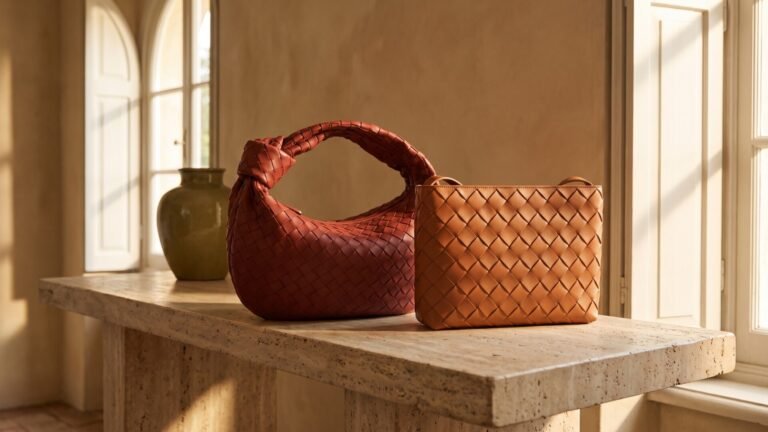
Italian footwear often leans toward softer construction, sculpted lines, color, ornament, and a relaxed idea of luxury. French footwear more often favors controlled proportions, polished surfaces, sharper formality, and understated elegance carried by the house name rather than by decoration.
The shortcut fails at the edges. A fashion-led Italian sneaker made in a large factory shares almost nothing with a hand-finished Italian dress shoe from a small workshop. A French luxury loafer from a couture house is a different animal from a Paraboot boot built for wet cobblestones. For the broader craft context behind these distinctions, the art of Italian shoe making covers the techniques in detail, and our complete guide to Italian designer shoes maps the brands. For the French side, French Designer Vault’s guide to French shoes covers houses this article only touches, such as Robert Clergerie and Carel.
Craftsmanship, Materials, and Construction
Italian construction and materials
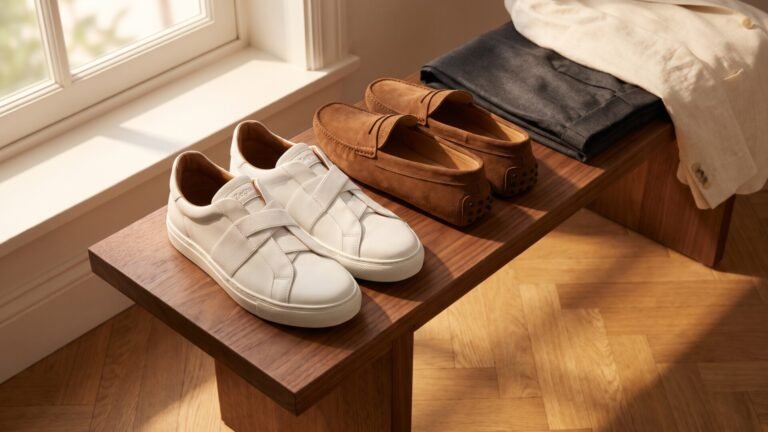
The qualities buyers associate with Italian shoes are real, and they come from specific choices. Supple calfskin. Suede. Soft unstructured uppers. Flexible soles. Hand-finishing at the edges. A preference for shoes that feel comfortable within a week rather than a month.
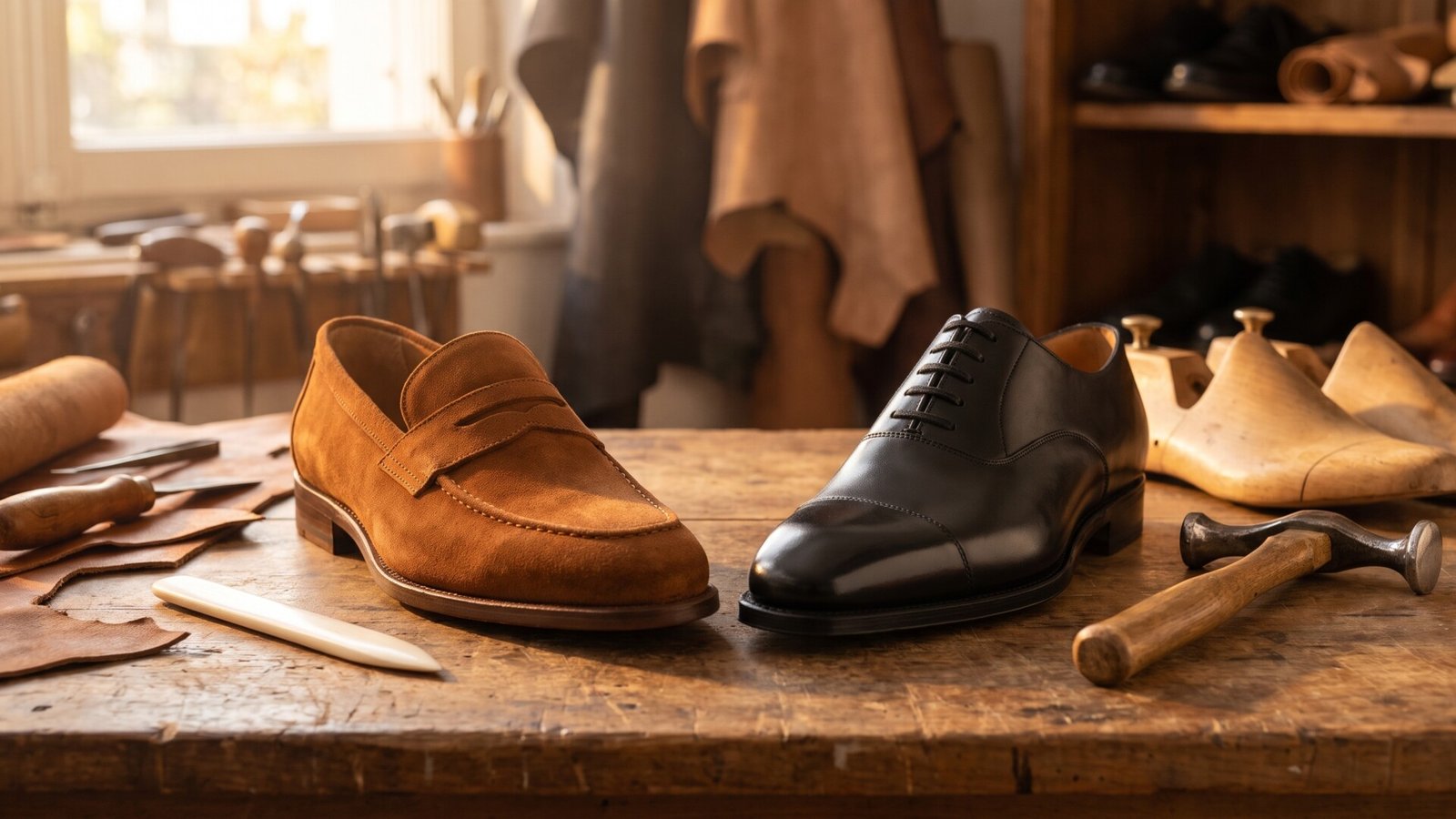
The construction behind that comfort is often Blake stitching – a method where the upper, insole, and sole are joined by a single row of stitching running through all three layers. It produces a lighter, more flexible shoe than a welted construction, and it can be resoled, though the number of resoles is limited because each one passes through the same stitch holes. Goodyear welted construction, by contrast, attaches the sole with a stitched welt that can be replaced repeatedly, at the cost of weight and initial stiffness. Many Italian casual shoes use neither – they are cemented, meaning the sole is glued, which is fine for a sneaker and less fine for a $700 dress shoe. A fourth method worth knowing is Bologna (sacchetto) construction, where the lining is sewn into a sock-like tube under the foot instead of being lasted over a stiff insole; it is used for some unlined loafers and soft dress shoes and explains why they can feel almost slipper-like.
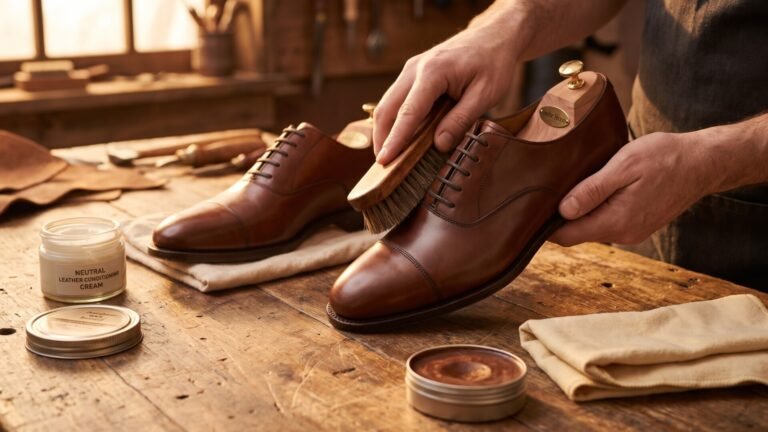
Softer leather improves comfort but has consequences. It creases more readily across the vamp – the front upper of the shoe – and it can stretch. A soft loafer worn without shoe trees will eventually sag at the heel and lose its shape. Fit matters more, not less, because there is less structure to compensate for a wrong size. Our guide to caring for Italian leather shoes covers trees, conditioning, and rotation.
Italian production is not one thing. Santoni, founded in 1975 in Corridonia in the Marche, is known for hand-applied color and burnishing that give its formal shoes visible depth and patina. Tod’s builds soft, flexible loafers and driving shoes around a rubber-pebbled sole. Ferragamo covers the broad middle – loafers, pumps, flats – with strong heritage and recognizable details. Zegna makes contemporary sneakers and business-casual shoes. Brunello Cucinelli works in quiet, refined materials. Same country, five different answers to the question of what a shoe is for.
French construction and materials
French luxury footwear typically emphasizes refined lasts, clean finishing, polished leather, formal proportions, and structured silhouettes. The shoe is built to hold its shape. That has a cost: it is often firmer out of the box, and the break-in period is longer and less forgiving of a sizing mistake.
J.M. Weston is the clearest example of classic French shoemaking – structured loafers and formal shoes built on solid lasts, made to be resoled and kept for decades. Paraboot is the practical counterweight: robust, weather-tolerant footwear with a distinctive identity, including the Michael model with its thick rubber sole and Norwegian welt construction, where the upper is stitched to the sole with a visible external seam that keeps water out. Berluti works in heavily patinated leather with a strong visual signature and correspondingly high maintenance. Roger Vivier and Christian Louboutin occupy the couture and occasion end – refined women’s shoes with hardware (Vivier) or a recognizable red sole (Louboutin), built for impact rather than all-day walking. Repetto, founded in Paris in 1947 as a maker of ballet shoes, uses what it calls a “stitch-and-return” method: the shoe is sewn inside out and then turned, which is why its Cendrillon ballerina (1956) is so flexible. Maison Margiela sits at the fashion-led edge, where the design idea leads and the construction follows; its split-toe Tabi is the obvious example.
One caution that applies across French luxury: a French brand’s country of origin does not mean every shoe is handmade in France. Large houses subcontract, produce in Italy, Portugal, or Spain, and label by brand rather than by bench. Check the individual product’s manufacturing details if origin matters to you.
Where the Italian-French line blurs
The national labels are cleaner in marketing than in ownership and production. A few examples, checked against brand, retailer, and reference sources at the time of writing:
- Roger Vivier is a Parisian house controlled by Italy’s Tod’s Group, in which the Della Valle family holds the majority. Its creative director since 2018, Gherardo Felloni, is Italian.
- Berluti was founded in Paris in 1895 by Alessandro Berluti, an Italian émigré, and has belonged to LVMH since 1993. Its footwear is produced in Gaibanella, near Ferrara, in Italy.
- Christian Louboutin (founded in Paris in 1991) lists its So Kate pump as made in Italy on retailer product pages. Exor, the Agnelli family’s holding company, bought a 24% stake in 2021.
- Maison Margiela is part of OTB, the Italian group led by Renzo Rosso.
- By contrast, J.M. Weston still makes the 180 loafer at its factory in Limoges, and Paraboot builds the Michael in France.
None of this makes a shoe better or worse. It does mean that “French design” and “French-made” are separate claims, and in several well-known cases the French-designed shoe is built in Italy.
What matters more than the country label
Here is the checklist that actually predicts whether you will still be wearing the shoe in five years.
- Leather selection. Press your thumb into the upper near the toe. Good calfskin creases in fine, tight lines and springs back. Cheap leather creases in broad, papery folds and stays creased.
- Lining. Run your finger inside. A full leather lining, neatly stitched at the heel, tells you the maker expected the shoe to last. Loosely glued linings can lift at the heel with regular wear.
- Stitching. Look at the welt or the Blake stitch row. Even spacing, consistent tension, no skipped stitches. Hand-stitching is irregular in a way machine stitching is not, and that irregularity is a good sign, not a flaw.
- Sole attachment. Ask how the sole is fixed. Welted, Blake, or cemented. Each has a different resole ceiling.
- Heel construction. Turn the shoe over. A stacked leather heel with a rubber top piece can be rebuilt. A molded plastic heel cannot.
- Edge finishing. Run your thumb along the inside edge of the topline – the opening where your foot goes in. If it catches, the edge was painted rather than folded and burnished, and it was finished in a hurry.
- Replaceability. Can the insole be replaced? Can the sole be resoled by a local cobbler, or does it need to go back to the brand?
Construction quality is more predictive of satisfaction than any marketing term. “Artisan” and “hand-finished” have no fixed legal meaning, and “Made in Italy” or “Made in France” is an origin label tied to where the product was last substantially made, not a promise that it was made by hand or in one workshop. Our explainer on what “handmade” really means in Italian footwear takes that apart properly. And the sole question – leather versus rubber – is covered in leather soles vs. rubber soles for luxury shoes.
Design, Comfort, and Everyday Wear
Think about where the shoe will actually go – commuting, a business-casual office, a wedding, a week of travel, an evening out. Italian and French shoes perform differently across those cases, and the difference is mostly about how much structure the shoe carries.
Italian shoes often feel more forgiving early. A soft Tod’s loafer or a supple Ferragamo flat will usually be wearable within a few days. French shoes built on a precise last often feel tight and stiff at first, then settle into a fit that is more exact and holds its shape longer. Neither is better in the abstract. It depends on your break-in tolerance and how precisely you were fitted. If you do choose a firmer shoe, our guide on how to break in leather shoes applies just as well to a French loafer.
Silhouette drives comfort more than most buyers realize. Toe-box shape decides whether your toes have room to spread. Heel height changes the load on the ball of your foot. Sole flexibility affects how the shoe rolls as you walk. Upper stiffness determines how much the shoe fights your foot in the first month. Arch support is often minimal in both traditions – luxury dress shoes and loafers are not walking shoes, and a close-fitting last is not a relaxed fit.
The most common mistake is assuming softer leather equals better comfort. It does not. Last shape and sizing matter more, particularly for loafers, dress shoes, and pointed-toe women’s footwear. A soft Italian pointed pump on the wrong last will hurt more than a firm French shoe that fits. How Italian designer shoes should fit covers sizing in depth, and Italian luxury sneakers that are actually comfortable is the practical guide for the casual end. Sizing systems differ too: J.M. Weston, for example, uses UK-based sizes and width fittings, and Mr Porter’s listing for the 180 advises taking a size smaller than usual, so check each brand’s chart and our Italian vs. US and UK size conversion before ordering online.
The Brands and Shoe Types That Best Represent Each Tradition
Strong Italian choices
Tod’s is the reference point for soft leather, flexible construction, driving shoes, and understated casual luxury. The Gommino – the driving shoe introduced in 1979, named for the rubber pebbles on its sole – is the model most buyers know, and it earns its reputation for relaxed daily wear. Best for buyers who want one shoe to cover weekends, travel, and smart-casual. Note that the pebbles wear down on pavement; see why the Tod’s Gommino is so popular and our best Italian driving shoes guide for alternatives.
Santoni makes polished leather dress shoes with refined finishing and more visible color and patina than most Italian formal shoes. Suited to buyers who want Italian formality with personality. Our Santoni shoes review goes deeper, and Tod’s vs. Santoni compares the two most common Italian shortlist picks.
Ferragamo, established in Florence in 1927, covers loafers, pumps, flats, and formal shoes with strong heritage and recognizable design details, including the Gancini hardware and the low-heeled Vara pump with its grosgrain bow (1978). Broad wardrobe usefulness, and a safe first purchase for buyers new to Italian luxury. Our Ferragamo shoes guide covers the signature styles and sizing.
Zegna makes contemporary luxury sneakers, the Triple Stitch among them, and business-casual footwear for buyers who want understated status and practical versatility. Our Zegna Triple Stitch review explains the appeal, and Zegna vs. Tod’s helps if you are choosing between the two for casual wear.
Gucci deserves a place on any Italian shortlist for one model: the Horsebit loafer, introduced in 1953, whose metal snaffle detail references the house’s equestrian imagery. It is a fashion-house loafer rather than a bench-made one, so judge each version on its construction. For women’s heels, Italian specialists such as Gianvito Rossi and Aquazzura are the closest Italian answer to Louboutin and Vivier; our Italian designer heels guide covers them.
Brunello Cucinelli and Golden Goose represent two ends of Italian casual luxury – Cucinelli for quiet, refined materials, Golden Goose for deliberately distressed, fashion-led sneakers. Both are legitimate; they answer different questions.
Strong French choices
J.M. Weston makes structured loafers and formal shoes for buyers who value shape, heritage, and long-term polish over immediate softness. The 180 loafer, created in 1946 and Goodyear welted, is the classic; the house says each pair takes 180 manual operations in Limoges. Expect a real break-in and decades of wear.
Paraboot is robust, practical French footwear with a distinctive identity – durability and weather tolerance for everyday use, particularly the Michael (developed in 1945) and Chambord models, both Norwegian welted on rubber soles the company moulds itself.
Berluti works in highly distinctive patinated leather and formal luxury, finished by hand in layered color. Best for buyers who value visual individuality and accept the maintenance that patina demands.
Roger Vivier makes refined women’s shoes with strong hardware and couture influence, suited to formal and occasion dressing. The Belle Vivier pump with its square metal buckle first appeared in 1965 and remains the house’s best-known shoe. Vivier himself is widely credited with developing the modern stiletto heel in the 1950s.
Christian Louboutin is statement heels and recognizable red soles, best for buyers prioritizing visual impact and occasion appeal over all-day practicality.
Three more French names belong on a serious shortlist. Hermès is strongest outside the dress category, notably with the flat Oran sandal; its footwear has long been associated with designer Pierre Hardy, who joined the house’s shoe studio in 1990. Chanel‘s two-tone slingback, introduced in 1957, is the French counterpart to Ferragamo’s Vara as a low-heeled classic. And Repetto‘s Cendrillon ballet flat and Zizi oxford are the lightest, most flexible shoes in this comparison, with the thin soles that come with that.
Italian vs. French Luxury Shoe Brands: Comparison Table
| Feature | Italian luxury shoe brands | French luxury shoe brands | Best for |
|---|---|---|---|
| Typical design language | Expressive, sculpted, relaxed, material-led | Refined, structured, polished, house-led | Depends on wardrobe |
| Immediate comfort | Often softer and more flexible | Often firmer and more structured | Italian for quick comfort |
| Formality | Broad range from sneakers to dress shoes | Particularly strong in formal and occasion footwear | French for formal polish |
| Materials and finishing | Supple leather, color, patina, flexible soles | Polished leather, precise finishing, structured uppers | Depends on model |
| Everyday versatility | Strong in loafers, sneakers, driving shoes, and soft dress shoes | Strong in loafers, boots, formal shoes, and statement styles | Italian for casual wardrobes |
| Long-term value | Best when the model has durable construction and lasting demand | Strongest for iconic houses and distinctive heritage models | Model-specific |
Read that table as a set of tendencies, not a ranking. The Tod’s Gommino, a pair of Santoni dress shoes, the Zegna Triple Stitch, a J.M. Weston loafer, and the Paraboot Michael serve completely different purposes. Judging them by one comfort or formality standard is like comparing a raincoat to a dinner jacket.
Signature models side by side
Prices below are US retail at the time of writing, checked on brand or major retailer pages; they change often and vary by material and retailer, so treat them as orientation rather than quotes.
| Model | House and origin | Introduced | Construction and production | Approx. US price | Best for |
|---|---|---|---|---|---|
| Tod’s Gommino | Italian (Tod’s, Marche) | 1979 | Soft suede or leather upper; rubber-pebble sole; very flexible, but harder to resole than a welted shoe | Roughly $600–$700 | Driving, travel, weekends |
| J.M. Weston 180 loafer | French (Limoges, 1891) | 1946 | Goodyear welted; made in Limoges; firm break-in | Roughly $1,000–$1,100 | Office wear, long-term ownership |
| Paraboot Michael | French (founded 1908) | 1945 | Norwegian welt on a rubber sole; made in France | Roughly $600–$650 | Wet weather, casual wardrobes |
| Christian Louboutin So Kate 120 | French (Paris, 1991) | – | 120mm stiletto pump; red lacquered sole; listed as made in Italy | Roughly $800–$950 | Occasion and evening wear |
The table makes one point clearly: the most structured, longest-lasting shoe here is French, the most flexible is Italian, and the statement heel is French-designed but Italian-made. For a fuller look at what the price premium buys, see whether luxury Italian shoes are worth the money.
In short: Italian brands offer the broader range for a modern mixed wardrobe, because they cover more everyday situations. French brands can be the better choice for a sharply defined formal or fashion-led wardrobe, where precision and house identity matter more than flexibility.
What Most Buyers Get Wrong About Italian and French Shoes
The first wrong assumption is that Italian shoes are always more comfortable. They are not. A narrow Italian last, a rigid sole, a pointed toe, and fashion-led construction can produce a shoe less practical than a well-designed French alternative. Plenty of expensive Italian pumps and pointed loafers are beautiful objects that hurt by the second hour.
The second is that French shoes are always more formal and durable. Some French luxury models prioritize branding, ornament, or runway impact over repairability and daily wear. A couture heel with a delicate sole and a glued construction is not a durable shoe, however French it is.
The third is that price tracks craftsmanship. It does not, reliably. An expensive fashion-house shoe and a less conspicuous specialist shoe at half the price can differ enormously in construction, and the specialist often wins. What you pay for at the top of the market is design, brand, and distribution as much as bench time.
The fourth, and the one that costs the most, is ignoring use case. A Tod’s Gommino may be a better purchase than a formal dress shoe for a driver or a frequent traveler. A structured J.M. Weston loafer may be better for office wear and long-term polish. Neither is the wrong shoe. They are wrong for each other’s jobs.
A buyer filter helps.
- Choose Italian first if flexibility, soft leather, casual versatility, and immediate wearability matter most.
- Choose French first if structure, formal elegance, iconic house codes, or a distinctive occasion silhouette matter most.
- Look beyond nationality if repairability, wide-foot accommodation, or demanding daily walking is the main concern. Some of the best answers in those cases come from neither tradition. If you do stay Italian, start with our guides to Italian designer shoes for wide feet and Italian shoes for walking all day.
Which Choice Still Makes Sense in Three Years?
Ask what you will still be wearing after the novelty fades. Neutral loafers. Understated sneakers. Classic pumps. Formal lace-ups. The highly recognizable statement design is the one most likely to sit in the box after a season, whichever country made it.
Durability problems show up later, and they are predictable. Collapsed heel counters – the stiffened back of the shoe – from wearing loafers without a shoe horn. Stretched uppers from soft leather stored without trees. Worn rubber pods on the sole. Creased patent leather, which cannot be repaired, only lived with. Scuffed polished leather, which can. Stained suede, which needs protecting before the first wear, not after. And soles that are difficult or expensive to replace, which is the hidden cost of a cemented construction.
Cost per wear is the honest framework. Estimate how many days a year you will actually wear the pair. Add the maintenance – resoling at roughly $100 to $200 depending on construction and cobbler, polishing, weather protection, cedar shoe trees, and occasional professional repair. Then penalize any style that only works with one outfit category. A $900 loafer worn 120 days a year for a decade is a better buy than a $600 statement shoe worn eight times.
Resale is where buyers overestimate. Recognizable models from Tod’s, Ferragamo, J.M. Weston, Berluti, and the major French fashion houses do attract secondhand attention. But condition, size, color, originality, and current demand matter more than nationality. A scuffed, heavily worn pair in an odd size will not hold value because of the label.
The three-year recommendation, concretely:
- Best Italian long-term buys: understated Tod’s loafers and Gommino styles, Santoni’s classic dress shoes, Ferragamo loafers, and neutral Zegna sneakers.
- Best French long-term buys: classic J.M. Weston loafers, durable Paraboot models, restrained Berluti dress shoes, and a carefully chosen Roger Vivier or Louboutin occasion style when you have a real use for it.
- Avoid either country’s most visibly trend-driven shoe bought solely because it is currently recognizable.
Practical Buying Framework: Which Country Fits Your Wardrobe?
The comfort-led daily wearer. Start with Tod’s, Ferragamo, Zegna, or carefully selected Italian luxury sneakers. Prioritize a forgiving last, a rubber sole, a secure heel, and a replaceable insole where possible. This buyer will get the most out of the Italian tradition, because the shoes are built for regular wear rather than occasional display. Our guide to the best Italian luxury sneakers for everyday walking is the place to go deeper on the casual end.
The formal wardrobe buyer. Compare Santoni, Berluti, J.M. Weston, and other structured dress-shoe options on toe shape, leather finish, resoling potential, and the formality of your existing tailoring. A shoe that is too formal for your suits is as useless as one that is too casual. Our complete guide to Italian dress shoes covers the Italian side, and the best Italian oxford shoes for men narrows it to specific models.
The quiet-luxury buyer. Consider Zegna, Brunello Cucinelli, J.M. Weston, Paraboot, and understated Ferragamo styles. Avoid prominent logos and overly seasonal details. The test is whether the shoe still looks right with everything in your wardrobe in three years, not whether it photographs well now.
The statement-shoe buyer. Consider Roger Vivier, Christian Louboutin, Golden Goose, or more distinctive Italian and French fashion-house designs, but treat them as occasion or style purchases rather than universal daily shoes. Buy them because you have a use for them, not because they are recognizable.
The final fit test applies to both countries. Walk on a hard surface, not carpet. Check heel security – your heel should lift slightly but not slide out. Make sure your toes are not compressed when you stand. Find the flex point and confirm it matches where your foot naturally bends. Then distinguish normal break-in from an actually incorrect size. A firm shoe that grips your heel and leaves room at the toe is breaking in. A shoe that pinches across the ball or lets your heel slide is the wrong size, and no amount of wearing will fix it. How to style Italian shoes for every occasion and the best Italian designer shoes for business casual outfits cover how the choice plays out in a real wardrobe.
Buying Verdict: Which Is Better?
Choose Italian when softness, quick break-in, and a wardrobe spanning loafers, driving shoes, sneakers, and dress shoes come first. Choose French when structure, formal polish, and strong house codes matter more. The overall winner depends on the buyer, not the nationality.
- Best all-around choice for most modern wardrobes: Italian brands, especially Tod’s, Ferragamo, Santoni, and Zegna, because they cover more everyday situations.
- Best for formal precision and distinctive house identity: French brands, especially J.M. Weston, Berluti, Paraboot, Roger Vivier, and selected Christian Louboutin styles.
- Best investment-minded approach: buy the best-constructed, most wearable model in either country, not the most famous label.
No shoe should be called an investment solely because it is expensive. Its value depends on wear frequency, construction, maintenance, and continued relevance – all of which you can assess before you pay.
The decisive question is not which country makes better shoes. It is which pair you will wear often enough to justify its price and maintain well enough to remain useful. Answer that honestly – count the days, name the outfits, budget the resoling – and the nationality question usually answers itself. If you want the shorter, style-led version of this comparison, see Italian shoes vs. French shoes; for the broader philosophy behind the two countries’ luxury houses, French Designer Vault’s French vs. Italian designer comparisons covers bags and clothing as well.
Frequently Asked Questions About Italian Vs. French Luxury Shoe Brands
Are Italian luxury shoes better than French luxury shoes?
Italian shoes are often better for flexible everyday luxury and broad wardrobe versatility. French shoes can be stronger for structured formal footwear and distinctive house design. Construction and the specific model remain more important than nationality, and a well-made example of either will outperform a poorly made example of the other.
Which country makes the most comfortable luxury shoes?
Comfort depends on last shape, sizing, upper softness, sole flexibility, and your own foot shape. Tod’s and some Italian casual models are common comfort choices because they are built soft and flexible. Well-fitted French shoes can be very comfortable once broken in, but the break-in is real and a sizing error is less forgiving.
Do Italian or French luxury shoes last longer?
Lifespan depends on construction, materials, wear frequency, weather exposure, storage, and repairability. Structured French shoes may hold their shape well over time. High-quality Italian shoes can offer excellent durability when maintained correctly. A resolable shoe in either tradition will outlast a cemented one, regardless of origin.
Are French luxury shoes more formal than Italian shoes?
French brands have a strong formal and couture tradition, but French footwear also includes rugged and casual options such as Paraboot. Italian brands span the widest range, from driving shoes and sneakers to formal dress shoes. Formality is a property of the model, not the country.
Are French luxury shoes made in France?
Not always. Some are: J.M. Weston makes the 180 loafer in Limoges, and Paraboot builds the Michael in France. Others are French-designed but Italian-made: retailer listings show Christian Louboutin’s So Kate as made in Italy, and Berluti produces its footwear near Ferrara. Check the origin line on the specific product page rather than assuming from the brand’s nationality.
How much do signature Italian and French luxury shoes cost?
At the time of writing, US retail is roughly $600–$700 for a Tod’s Gommino in suede, $600–$650 for a Paraboot Michael, $800–$950 for a Christian Louboutin So Kate 120, and $1,000–$1,100 for a J.M. Weston 180 loafer. Prices vary by material, retailer, and season, so confirm before buying.
Which brands are best for luxury loafers?
Compare Tod’s, Ferragamo, Santoni, and Gucci’s Horsebit with the J.M. Weston 180 and selected French fashion-house loafers. Frame the choice around softness, structure, formality, fit, and repair expectations rather than brand prestige alone. The soft Italian loafer and the structured French loafer are different tools, and most wardrobes can use one of each before they need two of either. For specific models, see the best Italian penny loafers for men and best Italian designer loafers for women.
Which is better for business casual: Italian or French shoes?
Italian loafers, understated sneakers, and soft dress shoes often integrate easily into modern business-casual wardrobes. Structured French loafers and formal shoes suit more tailored offices. Our guide to the best Italian designer shoes for business casual outfits works through the specific combinations.
Do luxury Italian and French shoes hold their value?
Resale value is strongest for recognizable, wearable, well-maintained models with original packaging and desirable sizing. Neither nationality guarantees value retention. Heavily worn or highly seasonal shoes can depreciate quickly, and the secondhand market rewards condition and current demand over country of origin.