Alessandro Michele
Alessandro Michele has had one of the most closely watched careers in modern fashion: a long-serving studio designer who revolutionised one of fashion’s biggest houses, then took the helm at another major label. This profile covers his biography, his aesthetic, the pieces most associated with him, and the questions around his legacy.
Alessandro Michele at a Glance
| Fact | Detail |
|---|---|
| Born | 25 November 1972, Rome |
| Training | Accademia di Costume e di Moda, Rome |
| Early career | Les Copains (1994); Fendi accessories under Silvia Venturini Fendi and Karl Lagerfeld (from 1997) |
| Gucci | Joined in 2002 on handbags; senior leather goods designer 2006; associate creative director 2011; creative director January 2015 to November 2022 |
| Valentino | Named creative director in March 2024, succeeding Pierpaolo Piccioli; debut show Spring/Summer 2025 |
| Recognition | International Fashion Designer of the Year (British Council Fashion Awards, 2015); Time 100 Most Influential People (2017) |
From Rome Beginnings to Fashion Reinvention
Alessandro Michele was born and raised in Rome. He completed fashion studies at the Accademia di Costume e di Moda in Rome, then spent years behind the scenes: at the knitwear firm Les Copains in Bologna from 1994, and from 1997 at Fendi, where he became a senior accessories designer for leather goods working with Silvia Venturini Fendi and Karl Lagerfeld. Our guide to Fendi covers that house.
In 2002, Tom Ford invited him to Gucci’s London design office, initially to handle handbags. He was named senior designer of Gucci leather goods in 2006 and promoted to associate creative director under Frida Giannini in 2011. In January 2015 he was asked to step in as interim designer for the men’s show and was appointed Gucci creative director two days later. He also became creative director of the porcelain maker Richard Ginori in 2014.

The Gucci Years (2015–2022)
At Gucci, Michele brought a “sophisticated, intellectual and androgynous” feel, according to accounts of his first women’s show, and a maximalist mix of vintage references, theatre, cinema and gender-fluid dressing. Practical moves included reintroducing the double-G logo, creating the Dionysus handbag, reviving Gucci Beauty and launching the house’s first fine jewelry collection in 2019. He left in November 2022. The era is why Gucci is still so closely linked to his name; for how it has been rebuilt since, read the Sabato De Sarno effect and Gucci Jackie 1961 vs the new reimagining.
The Big Move: Taking Over at Valentino
In March 2024, Valentino announced that Michele would succeed Pierpaolo Piccioli, who had worked at the house for 25 years and whose departure was described as a “joint decision”. Michele’s Rome roots made it a homecoming, and his debut runway show was for Spring/Summer 2025 at Paris Fashion Week, reviewed at the end of September 2024.
The pairing raised eyebrows. Valentino is known for elegance and refined couture, and Michele’s previous work was louder and more eclectic. The house’s ownership has also been evolving: Mayhoola for Investments holds 70% and Kering bought 30% in July 2023, with the stated intention of acquiring the entire company by 2028. In September 2025 the two sides pushed that timetable back: Mayhoola’s options to sell the rest to Kering now fall in 2028 and 2029, and Kering’s option to buy it in 2029. The house’s founder, Valentino Garavani, died in January 2026, aged 93. For more on the brand, see our full Valentino profile.

Michele’s Valentino Collections So Far
The best-documented recent show is Spring/Summer 2026, titled Fireflies and presented in Paris in October 2025. It drew on Pier Paolo Pasolini’s 1975 letter about fireflies surviving in dark times. The collection had 80 looks, opened with a muted blue tunic with bows at the neckline and hem, and used bows as a unifying motif. Reviewers noted sharper tailoring than usual — single-breasted blazers, long coats and broad-shouldered minidresses — plus a palette of bubblegum pink, tangerine, lilac and lemon yellow, and heavy embellishment later in the show. Accessories included bow-topped open-toe pumps, snake-embellished heels, beaded butterfly brooches, fringe bags and floral-beaded bags compared to the Vain bag. For the bags to know, read 5 bags from the debut collection and Valentino crossbody bags; for a hardware classic, the history of the Valentino Rockstud.
What Makes His Style? The Signatures
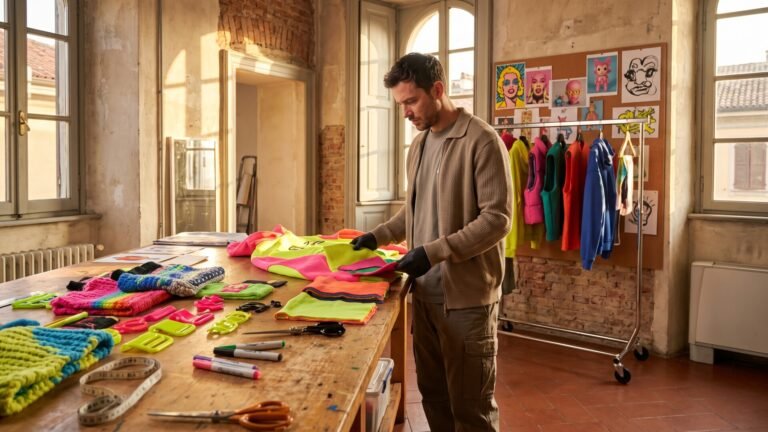
Here’s what you see when you spot a Michele piece. He describes himself as an “art archaeologist” rather than a creative director, and his work draws on cinema, theatre, post-punk, crochet and glamour.
- Eclectic layering and vintage soul: old references, vintage textures, bold prints and unexpected combinations.
- Gender fluidity: he blurred menswear and womenswear; at Gucci he gave menswear a feminised slant and moved the brand toward a post-gender identity.
- Archival reinterpretation: whether at Gucci or Valentino, he studies the past — archives, history, heritage — then reshapes it.
- Colour and texture: rich fabrics, embellishment and unusual colour mixes held together by a cohesive vision.
Signature pieces and categories:
- At Gucci: the revived double-G logo, the Dionysus handbag, and a refreshed approach to heritage designs such as the Jackie.
- At Valentino: bow motifs, embroidery and embellishment, sharper tailoring, and accessories that sit between heritage and play.
Why He Matters: Cultural Impact and Fashion Shift
Michele shifted how luxury fashion thinks about identity, humour, gender and heritage. At Gucci he made the brand a story, a vibe and a celebrity moment, and many brands followed the wave. He also showed that a designer doesn’t have to hide behind modesty: his personal vision became part of the house’s voice.

Now at Valentino, his challenge is different: preserve the house’s romance and couture heritage while adding his own energy.
Key Moments in His Journey
- 1994–1997: Les Copains, then Fendi accessories.
- 2002: Joins Gucci’s London design office to work on handbags.
- 2011: Associate creative director at Gucci under Frida Giannini.
- January 2015: Appointed Gucci creative director.
- 2019: Revives Gucci Beauty and designs the first fine jewelry collection.
- November 2022: Leaves Gucci.
- March 2024: Named Valentino creative director.
- Autumn 2024: Debut Valentino show, Spring/Summer 2025, Paris.
- October 2025: Fireflies, Spring/Summer 2026.
How to Wear and Buy Michele-Era Pieces
Michele’s maximalism is easier to wear in pieces than in head-to-toe looks. A practical approach: pick one statement element — an embellished bag, a bow-detail shoe, a printed shirt — and keep the rest of the outfit simple. When buying, check the current season’s listings on Valentino’s own site or an authorised retailer; prices and availability change each season and we do not quote figures here. If you buy pre-owned Gucci from his 2015–2022 era, read how to spot authentic Italian designer pieces first.
Challenges and What’s Next
Shifting a giant brand’s identity is hard. He must balance the house’s legacy, commercial demands and his own voice, and comparisons with his Gucci years are inevitable. Reviewers of the Spring/Summer 2026 show noted sharper tailoring than usual. His peers are also in flux: Giuliano Calza of GCDS represents a different, streetwear-led route into the same conversation.

Frequently Asked Questions About Alessandro Michele
Who is Alessandro Michele?
An Italian fashion designer, born in Rome in 1972, who was Gucci’s creative director from 2015 to 2022 and has led Valentino since 2024.
Why did Alessandro Michele leave Gucci?
He stepped down in November 2022. We have not found a reliable source for the reason, so we don’t speculate.
Who replaced Pierpaolo Piccioli at Valentino?
Alessandro Michele was named creative director in March 2024, after Piccioli’s departure.
What is Alessandro Michele known for?
A maximalist, eclectic, gender-fluid aesthetic at Gucci, including the double-G logo’s return and the Dionysus bag; at Valentino, bows, embellishment and sharper tailoring.
Who owns Valentino?
Qatar’s Mayhoola for Investments holds 70% and Kering holds 30%; under a 2025 amendment, Kering could take full ownership from 2028 or 2029 at the earliest.
Final Thoughts: Why You Should Care
- He shows that fashion can be fun, identity-driven and heritage-rich all at once.
- He proves a designer can lead a mainstream luxury house and keep personality.
- His move from Gucci to Valentino shows that vision evolves with the house.

Next time you spot a bold logo, a dress layered with textures, or an accessory that demands attention, you may be seeing the ripple effects of Alessandro Michele’s aesthetic. For more profiles of current icons, browse our Italian fashion designers guide.