How to Waterproof Italian Suede Without Darkening It
Suede is the one Italian leather that punishes a single rainy commute. Its surface is the flesh side of the hide (or the buffed underside of a split), sanded to raise a fine nap, and those exposed fibres soak up water, dust and oil far faster than smooth, finished leather. The good news is that you can protect it without ending up with a stiff, darker, patchy surface. The risk of darkening comes mostly from how you apply a protector, not from the idea of waterproofing itself.
This guide covers how suede behaves when it gets wet, how to choose a protector, a step-by-step method built around a hidden-spot test and two light coats, the mistakes that cause darkening, and how often to re-treat. It sits alongside our other care guides, including best suede cleaners that actually work and how to care for Italian leather goods.
Quick Answer: How to Waterproof Suede Without Darkening It
- Brush off dust and lift marks with a suede brush or eraser, and let the piece dry completely.
- Test your chosen spray on a hidden area (inner heel edge, underside of a tongue, bag base edge) and let it dry fully before judging colour.
- Spray from the distance on the can (roughly 20-30 cm / 8-12 in), in light sweeping passes, in a ventilated room.
- Let the first coat dry, then add one more thin coat rather than one heavy one.
- Brush the nap back with a clean suede brush once fully dry, and re-treat when water stops beading.
Understanding Italian Suede
Suede is made from the inner side of the skin, usually lamb, calf, goat or deer, which is buffed to create a velvety nap. Italian makers are known for fine, supple suede in saturated and pastel colours, but the material is the same in principle as suede anywhere: an open, fibrous surface with no protective finish on top. That open structure is what gives suede its soft hand, and it is also why water, grease and dirt get in so easily.
This is also why smooth-leather products backfire. Waxes, creams and oil-rich conditioners are designed to sit in or on a finished surface. On suede they mat the nap and leave dark, greasy patches, which is why a dedicated suede protector is the right tool. If you are unsure which leather you own, see our guides to caring for Italian leather shoes and protecting nappa leather from water and spills, since smooth leathers need a different routine.
What Water Actually Does to Suede
When a drop lands on untreated suede, the nap absorbs it and the fibres swell and flatten. As the water dries it can carry dirt and soluble salts from the leather and dye towards the edge of the wet area, which leaves a visible ring. Dried suede can also feel stiffer until it is brushed and flexed. Heavy soaking is harder to reverse than a light splash, so the aim of a protector is to buy you time: water beads on the surface, and you can blot it before it sinks in.
Protection also makes routine care easier. Treated nap tends to shed dry dust under a brush more readily, and light food or drink spills are easier to blot before they soak in. A protector is not a force field, though: it will not make suede safe for puddles, snow-melt or salt.
Is Waterproofing Worth It for Designer Suede?
For a pair of suede loafers or boots or a suede handbag that cost several hundred dollars or more, a protector costing roughly $13-$30 a can (see the product notes below) is cheap insurance, and professional suede cleaning or restoration usually costs more than that. The main caveat is that every treatment carries a small risk of changing colour on some dyes, which is why the hidden-spot test below is not optional.
Choosing the Right Suede Protector
Look for a spray that names suede and nubuck on the label, applies as a fine mist, and dries without a visible film. Water-based and solvent-based formulas both exist; neither is automatically safer for colour, so test whichever you choose. Below are four widely sold options, with details taken from retailer and brand listings in late 2026. Formulas, sizes and prices change, so check the current label before buying.
Saphir Médaille d’Or Super Invulner
Saphir is a French shoe-care house, and Super Invulner is its protective spray for smooth leather and suede. Retailer listings describe a 300 ml can made in France with “non-aggressive solvents” that leave no residue or discolouration, and Saphir’s guidance (as relayed by retailers) is to clean first, spray from about 20 cm, let it dry for at least 30 minutes, and reapply roughly every two to three months. Expect to pay roughly $20-$30 per can depending on the retailer. It is the pricier option here and a sensible choice for pale or delicate colours, but test it like any other. [Affiliate: Check the price for Saphir Super Invulner Spray on Amazon]
Collonil Carbon Pro
Collonil is a German shoe-care brand. Carbon Pro is a 400 ml aerosol that retailers list as suitable for suede, nubuck, velour and smooth leather as well as textiles, and as fluorine-free. It is a flammable aerosol, so use it in a ventilated space away from heat. The label advice is to spray from at least 30 cm onto a clean surface, let it dry fully, test colourfastness on a hidden area first, and refresh after about 12 to 15 wears. Expect roughly $13-$20 per can, depending on the retailer. [Affiliate: Check the price for Collonil Carbon Pro Spray on Amazon]
Nikwax Nubuck & Suede Proof
Nikwax, a UK outdoor-care brand, describes this as a water-based, spray-on formula with no fluorocarbons or VOCs that aims to keep the breathability and texture of nubuck and suede. REI lists the 4.2 fl oz size at about $12.95. Note that Nikwax’s instructions differ from the sprays above: it is designed to be applied to clean, damp footwear, not bone-dry shoes, and drying can take a long time, so follow the bottle rather than the generic method here. Some buyer reviews report a slightly splotchy finish on certain suedes, which is another reason to test first. [Affiliate: Check the price for Nikwax Nubuck & Suede Proof on Amazon]
Bickmore Gard-More Water & Stain Repellent
Bickmore is a US brand known for leather and western-wear care. Gard-More is sold as a 5.5 oz aerosol for leather, suede, nubuck, fabric and felt, with retailers listing it at about $14. The retailer pages we checked say it dries clear and does not change the look or feel of the item, but they do not state its chemistry or give application steps, so rely on the label and test it. We could not confirm any UV-protection claim, so do not count on it to stop fading. [Affiliate: Check the price for Bickmore Gard-More on Amazon]
| Product | Size (listed) | Approx. price (USD) | Notes |
|---|---|---|---|
| Saphir Super Invulner | 300 ml | ~$20-$30 | Smooth leather and suede; solvent-based; reapply every 2-3 months per Saphir |
| Collonil Carbon Pro | 400 ml | ~$13-$20 | Fluorine-free aerosol; suede, nubuck, smooth leather; flammable |
| Nikwax Nubuck & Suede Proof | 4.2 fl oz | ~$13 | Water-based, no fluorocarbons; applied to clean, damp footwear |
| Bickmore Gard-More | 5.5 oz | ~$14 | Multi-material aerosol; chemistry not stated on retailer pages |
Prices are approximate, converted or rounded from retailer listings checked in November 2026, and vary by seller, size and stock.
Step-by-Step: Waterproofing Italian Suede
These steps follow the common guidance printed on suede protectors. If your can says something different (Nikwax is the main exception), follow the can.
1. Clean and dry
Protector seals in whatever is on the surface, so start clean. Use a [Affiliate: suede brush] to lift the nap and remove loose dirt, brushing gently in one direction. Rub light marks with a [Affiliate: suede eraser]. For ground-in dirt or stains, see our guide to suede cleaners. Make sure the piece is completely dry before you spray.
2. Test a hidden area
Spray a small patch in an inconspicuous spot, such as the inner edge of a heel, the underside of a tongue, or the base edge of a bag. Let it dry fully, ideally for several hours, because suede can look darker while damp and lighten as it dries. Judge colour and texture only when it is dry. If the patch is visibly darker or stiffer, do not use that product on the visible surface.
3. Spray in light passes
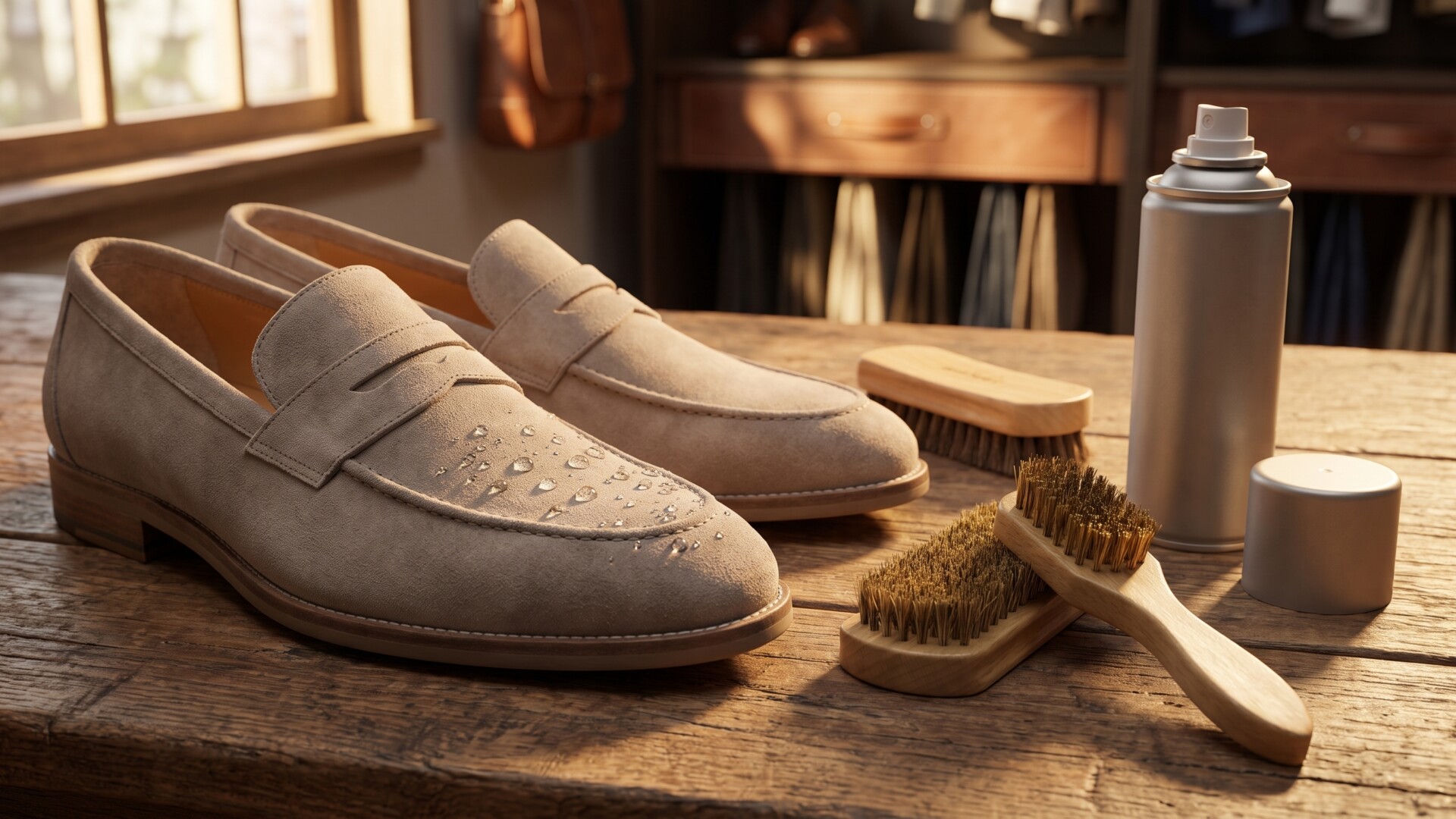
Work in a ventilated space, away from flames and heat sources. Hold the can at the distance printed on the label (the brands above specify roughly 20-30 cm). Move steadily in overlapping sweeps so the surface looks only faintly damp, not wet. Over-saturation is the usual cause of darkening, because heavy coats mat the nap and leave visible pooling. Treat seams and welt edges lightly but do not skip them, since water often enters there.
4. Let it dry, then add a second thin coat
Leave the first coat to dry for at least the time on the label (Saphir cites at least 30 minutes). Two thin coats give more even coverage than one heavy coat. Allow the second coat to dry fully, in a cool, dry place away from radiators and direct sun.
5. Brush and check
Once fully dry, brush lightly to restore the nap. To check the result, put a few drops of water on an inconspicuous spot: they should bead up rather than darken the surface. If they soak in, the coverage is thin or has worn off, so apply another light coat.
Common Mistakes That Cause Darkening
Heavy, wet coats. Soaking the nap is the main cause of dark patches. Use thin passes and build up.
Skipping the hidden-spot test. Dyes and finishes vary between makers and colours, so a product that is invisible on one pair can mark another. Pale, pastel and very saturated suedes deserve the most caution.
Spraying over dirt. Protector locks in what is on the surface and can leave uneven patches.
Judging colour while damp. Wet suede always looks darker. Wait until it is dry.
Using the wrong brush or conditioner. A stiff shoe brush can scuff the nap, and leather creams or oils will darken suede. A [Affiliate: suede brush with brass bristles] is for cleaning, and a softer brush is for finishing. See our guide on leather conditioners to understand why they are not for suede.
How Often to Reapply
Brand guidance varies: Saphir suggests reapplying roughly every two to three months, while Collonil suggests refreshing after about 12 to 15 wears. A practical rule is to test with a few water drops. When they stop beading, re-treat. Items worn weekly in changeable weather will need it more often than occasional-wear pieces. Clean before each re-treatment so layers of dirt do not build up.
Day-to-Day Suede Care
After each wear, let suede air out and rest before storing, and brush off dust. Use a [Affiliate: suede eraser] for scuffs. If suede gets wet, blot gently with a clean, dry cloth, stuff shoes with paper or fit shoe trees to hold their shape, and dry them naturally at room temperature. Never use a hairdryer or radiator, since heat can shrink and stiffen leather. Brush the nap once dry. Store in a breathable dust bag, not plastic, which traps moisture; see how to store luxury boots and dealing with mould on stored leather for longer-term storage.
Trade-Offs to Know About
Protectors reduce absorption but do not make suede waterproof in the way a rubber boot is, and heavy rain, standing water and winter salt can still stain it. Some formulas can slightly change the feel or shade of certain suedes, which is why testing matters. Aerosol products are flammable and need ventilation. If a piece has a stubborn stain, has been soaked, or is a valuable vintage item, a professional cobbler or leather specialist is the safer route; our guide on DIY vs professional cobbler explains when to hand it over. Other leathers have different needs, for example natural vegetable-tanned bags.
Conclusion
Waterproofing Italian suede without darkening it comes down to a clean dry surface, a product that names suede, a hidden-spot test judged when dry, and two thin coats. Re-treat when water stops beading, brush the nap, and keep suede out of deep puddles and salt. For more, read our Italian leather care guide.
[Shop Waterproofing Sprays] [Shop Suede Care Kits]
Frequently Asked Questions About Waterproofing Italian Suede
Is waterproofing necessary for Italian suede?
It is strongly advisable for anything you plan to wear outdoors. A protector helps water bead on the surface and gives you time to blot spills, but it will not make suede safe for heavy rain, puddles or salt.
Will waterproofing darken my Italian suede?
It can, especially with heavy coats or an unsuitable product. Use a spray that names suede on the label, test a hidden area and judge it only when completely dry, and apply two thin coats rather than one heavy one.
How often should I waterproof my Italian suede?
Saphir suggests roughly every two to three months, and Collonil suggests refreshing after about 12 to 15 wears. A simple water-drop test tells you when to re-treat: if drops stop beading, apply another light coat.
Can I use regular leather water repellents or conditioners on suede?
Generally no. Creams, waxes and oils made for smooth leather can mat the nap and leave dark patches. Use a product that lists suede or nubuck on the label.
What should I do if my suede gets wet?
Blot gently with a clean, dry cloth without rubbing, keep the shape with shoe trees or paper, and let it dry naturally at room temperature away from heat. Brush the nap once it is fully dry.
How can I clean Italian suede before waterproofing?
Use a suede brush to lift dust and a suede eraser for light marks. For tougher stains use a dedicated suede cleaner and follow its instructions, then let the piece dry fully before applying protector.