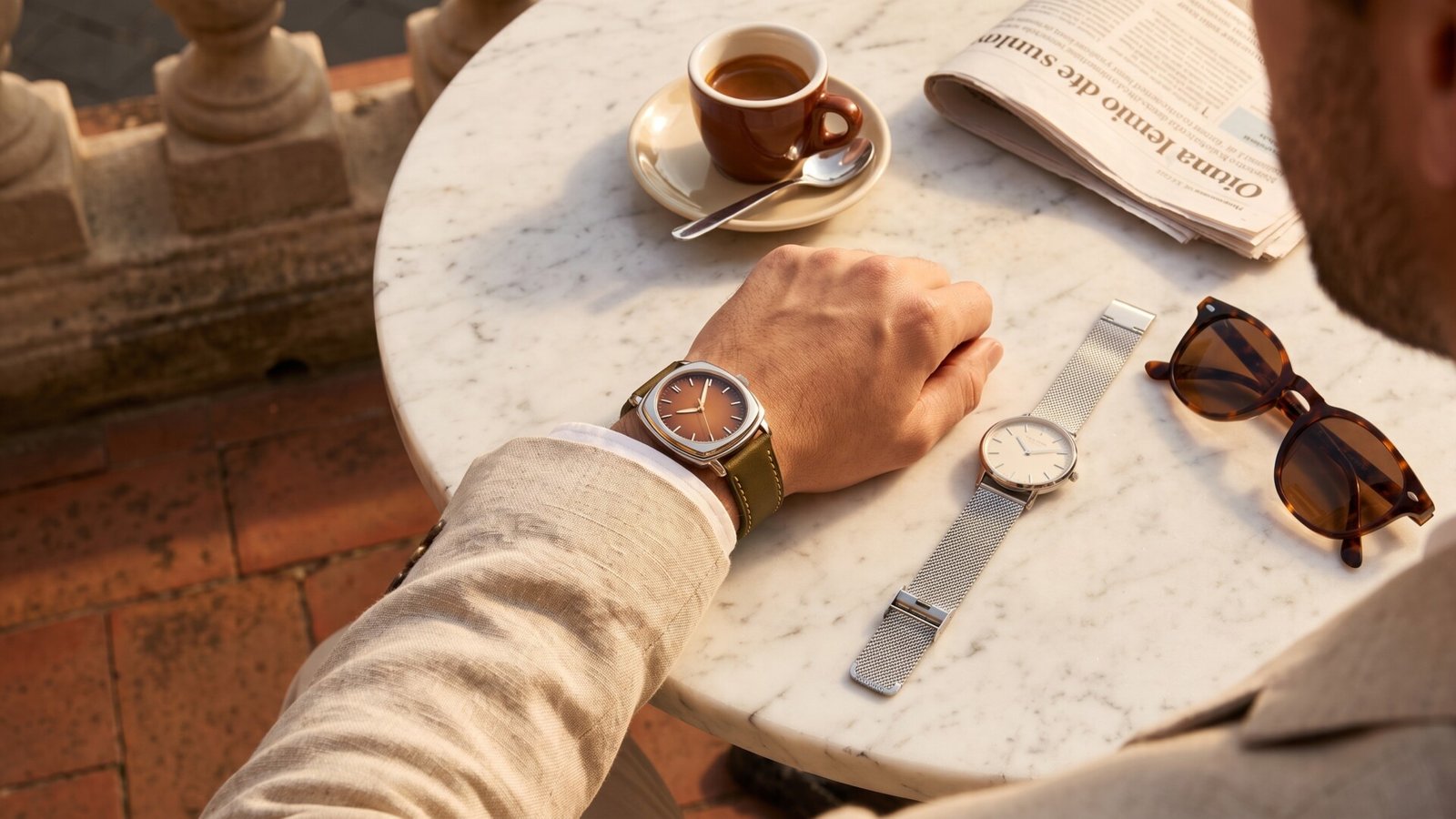
Italian Designer Watches You Need to Know
Italy rarely gets first billing in watchmaking. Switzerland owns the technical story and Japan the precision-for-the-price story, and Italian watches are often dismissed as “style over substance”. That is only half true. Italian watchmaking has always started from design: case shape, dial balance, legibility and how a watch looks on the wrist. This guide maps the Italian watch landscape, from fashion houses to tool-watch makers, explains how Italian watches compare with Swiss ones, and is honest about where each watch is actually made and what it costs.
This article is part of our wider Italian Designer Accessories hub. For the other categories, see must-have Italian accessories for 2026.
Italian Watch Brands at a Glance
| Brand | Italian roots | Where watches are made | Style | Approx. US price |
|---|---|---|---|---|
| Panerai | Founded in Florence, 1860 | Neuchâtel, Switzerland (owned by Richemont) | Large, military-derived diver look | About $4,900-$9,600 for core steel models |
| Bulgari | Roman jeweller | Switzerland | Architectural, luxury, ultra-thin | $14,100 for a steel Octo Finissimo |
| Unimatic | Founded in Milan, 2015 | Italy; Seiko or Sellita movements | Minimalist tool watches | From roughly $750-$800 |
| Anonimo | Florentine brand | Watchmaking has moved to Switzerland | Robust divers and military-inspired tools | Not verified |
| Locman | Isle of Elba, 1986 | Cases made in Italy; movements from Japan | Sporty, light, colourful | Not verified |
| Gucci | Fashion house | Swiss movements | Fashion-led | Varies by model |
| Emporio Armani | Fashion house | Made under licence by Fossil Group | Slim, understated | Varies by model |
| Ferragamo | Fashion house | Swiss movements | Classic with small twists | Varies by model |
Prices are US retail checked between June and November 2026 (sources in each section) and change often. Where we could not verify a current price, we say so rather than guess.
How Italian Watches Compare With Swiss Watches
This is the question most buyers start with, and the honest answer is that many of the best-known “Italian” watches are Swiss watches. Panerai and Bulgari both make their watches in Switzerland, so the comparison is less “Italy versus Switzerland” than “Italian design versus Swiss design”. The difference shows up in three places:
| Question | Typical Swiss brand | Typical Italian brand |
|---|---|---|
| Where does the design start? | Often with the movement and its finishing | With case shape, dial balance and how it sits on the wrist |
| Who makes the movement? | Frequently in-house at the top end, or ETA and Sellita below | Usually bought in from Swiss or Japanese makers; only Swiss-made Italian brands such as Bulgari and Panerai make their own calibres |
| What does the label guarantee? | “Swiss Made” is a legal standard with minimum Swiss content | “Made in Italy” depends on where the last substantial manufacturing step took place |
The labels matter more than many buyers realise. Under Swiss law, a watch can be called “Swiss Made” only if its movement is Swiss, it is cased up and finally inspected in Switzerland, and at least 60% of its manufacturing costs arise there. “Made in Italy” on a watch follows the general EU origin rule instead, based on the last substantial transformation, so an Italian-assembled watch can carry a Japanese or Swiss movement and still be labelled Italian. Neither label is a guarantee of quality on its own, but the Swiss one tells you more about what is inside.
The Decision Rule: Which Kind of Italian Watch Are You Buying?
Rather than ranking brands, it helps to sort Italian watches into three groups, because each one answers a different need:
- Italian heritage, Swiss watchmaking (Panerai, Bulgari): choose these if you want the movement quality, servicing network and resale market of a Swiss luxury watch, with Italian design. Expect to pay from about $5,000 into five figures.
- Italian-made with bought-in movements (Unimatic, Locman, U-Boat, Visconti): choose these if “made in Italy” and design matter more to you than an in-house movement, and you want a lower price. Ask which movement is inside, because that decides servicing cost.
- Fashion-house watches (Gucci, Emporio Armani, Ferragamo): choose these if the watch is mainly an accessory that matches the rest of what you wear. They are built for daily wear but are not watchmaking statements, and they rarely hold value on resale.
Mixing the groups up is the most common mistake: paying Swiss-luxury money for a fashion watch, or expecting a small Italian assembler to have the service network of Panerai.
How Italian Watch Design Is Different
Italian designers often start with the wrist rather than the movement. They concentrate on case shape, dial balance, font choice and finishing, and many brands deliberately use proven Swiss or Japanese movements so they can spend time on proportion and materials rather than reinventing mechanics.
Italy also has a real military and maritime watch tradition, particularly with naval divers. That legacy shapes brands such as Panerai and Anonimo, and explains why so many Italian watches favour large, legible dials and protected crowns.
Panerai: The Cornerstone of Italian Watchmaking
Panerai was founded in Florence in 1860 by Giovanni Panerai as a watchmaking workshop and shop. It became an official supplier to the Royal Italian Navy, providing technical equipment and precision instruments. Between 1935 and 1970 it delivered around 1,600 watches, mostly to the Italian Navy, and it stopped supplying them in 1970.
The two names you will see on almost every Panerai trace back to that naval work. Radiomir was the radium-based luminous paste Panerai patented in the early 20th century, and the Radiomir watch keeps the 1930s design: a cushion case with wire-style lugs and no crown guard. Luminor was the safer, tritium-based material that replaced it around 1950, and the Luminor watch adds the signature lever-locking bridge over the crown, developed to keep water out. In practice, choose the Radiomir if you want the slimmer, more vintage look, and the Luminor if you want the bolder tool-watch silhouette most people picture as “a Panerai”.
Richemont, then the Vendôme group, bought Panerai in 1997 and relaunched it internationally the following year. Today it is a wholly owned subsidiary of Richemont and its watches are made in Neuchâtel, Switzerland, where the brand also develops its own calibres for many models. That does not erase the Italian design: the cushion case, large crown guard and bold, legible dial are unmistakable. A June 2026 price guide put core steel models at about $4,900 for the Radiomir Officine, $6,300 for the Luminor Base Logo, $7,800 for the 40 mm Luminor Marina Quaranta, $9,200 for the 44 mm Luminor Marina and $9,600 for the 42 mm Submersible.
Panerai suits you if you like strong wrist presence, appreciate military and dive-watch history, and want a recognisable design that does not rely on logos. Most models are 42 to 47 mm and wear larger than the number suggests because of the cushion case and crown guard, so try one on. The 40 mm Quaranta is the obvious starting point for smaller wrists.
Bulgari: Italian Luxury and Serious Watchmaking
Bulgari is best known as a Roman jeweller, but its watch division is serious, especially in ultra-thin mechanical watches. Its Octo collection, with a faceted, angular case, has become a modern icon, and the Octo Finissimo line has set several records for thinness. Bulgari’s watches are Swiss-made.
The watchmaking credentials are relatively recent. Bulgari has sold watches since the 1970s, when the Bulgari-Bulgari model with the name engraved on the bezel became a signature, but the big step came in 2000, when it bought the Swiss makers Gérald Genta and Daniel Roth and with them movement and case-making expertise. LVMH acquired Bulgari in 2011, and the Octo, whose octagonal case draws on Genta’s design language, followed in 2012. Bulgari now produces movements, cases and bracelets in its own Swiss workshops, which is unusual for a house better known for jewellery.
On Bulgari’s US site in November 2026, the steel Octo Finissimo Automatic was $14,100 for a 40 mm case just 6.4 mm thick, powered by Bulgari’s own BVL 138 calibre with a platinum micro-rotor. That combination of an in-house ultra-thin movement and an integrated-bracelet design is what you pay for. Bulgari suits buyers who want luxury without traditional Swiss conservatism and care about both aesthetics and engineering.
Unimatic: Modern Italian Tool Watches
Unimatic represents the new wave. It was founded in Milan in 2015 and focuses on minimalist, utilitarian watches inspired by military and dive designs, labelled “Made in Italy” and using Seiko (Japan) or Sellita (Switzerland) movements. Its UC1 Classic, for example, has a 40 mm case (41.5 mm with the bezel) and a Seiko NH35A automatic movement, and in November 2026 was listed on Unimatic’s site at a price equivalent to roughly $750-$800.
The appeal is restraint: little text on the dial, clean lines and robust construction. It suits you if you like minimalist design, want a tool watch that does not look tactical, and are comfortable buying a smaller independent brand, often direct or through selected retailers. Many models are limited editions, so availability varies, and the simple Seiko movement is inexpensive to service.
Anonimo: Florence’s Other Tool Watch Legacy
Anonimo is a Florentine brand that carries forward the Panerai-style philosophy of watches built for professionals: robust, legible divers and military-inspired designs, with stronger crown protection and more pronounced cases than Panerai. Its watchmaking has moved to Switzerland. It suits dive-watch enthusiasts and fans of Italian military design, and anyone who wants a functional watch rather than a luxurious one.
Locman: Italian Sport and Lifestyle Watches
Locman comes from the island of Elba and was founded in 1986. Its watches are produced on Elba, with cases made in Italy (often in lightweight materials such as titanium and carbon composites) and movements from Japan. They are sporty, colourful and designed for everyday wear at accessible prices; the Montecristo, in titanium, is its best-known line. They suit casual wearers who want Italian design without luxury money and who prefer a lighter watch. The range includes both quartz and automatic models, so check the listing for which movement you are buying.
Other Italian Makers Worth Knowing
| Brand | Founded and place | Notes |
|---|---|---|
| Breil | 1939, Milan | Part of the Milan-based Binda Group; Swiss-made quartz and mechanical movements |
| Visconti | 1988, Florence | Designed and assembled in Florence with Swiss movements |
| U-Boat | 2000, Lucca | Designed and built in Lucca; Italian cases and straps, Swiss movements; known for very large cases |
| Officina del Tempo | 2000, Rome | Designed in Rome; movements mostly quartz from Japan and Switzerland |
| Zannetti | 1982, Rome | Family business; Swiss mechanical movements |
| Giuliano Mazzuoli | 2004, Tuscany | Family business; movements from ETA (Switzerland) |
Gucci Watches: Fashion-First, Design-Driven
Gucci watches are fashion watches: bold colours, graphic dials and strong branding, often with motifs from the house’s bags and shoes. They use Swiss movements and are built to be worn daily, but you are buying them mainly for how they finish an outfit, not for movement specifications. They make sense if you see watches as accessories and already wear Gucci.
Emporio Armani and Armani Exchange Watches
Emporio Armani watches are clean, modern and understated, designed to sit with tailored clothing. Armani Exchange is more casual and trend-driven. Both are produced under licence by Fossil Group rather than by Armani itself; in January 2026 Italian trade press reported that the jewellery and watch group Morellato had taken over Fossil’s distribution in Italy, including these two Armani watch licences. Most are quartz or simple automatic fashion watches, priced well below the Swiss-made brands above. For the brand behind them, see how Giorgio Armani changed Italian fashion.
Salvatore Ferragamo Watches
Ferragamo watches are classic with small design twists such as lug shapes, Gancini details and refined dials. They pair with dressier outfits without feeling stiff, and suit buyers who want something different from mainstream Swiss brands. Specifications vary by collection, so check the dial or caseback for the movement’s origin.
How to Choose an Italian Watch
| You want… | Look at |
|---|---|
| A bold, military-derived dive watch | Panerai, Anonimo |
| Luxury with modern design and an in-house movement | Bulgari |
| A minimalist tool watch made in Italy for under $1,000 | Unimatic |
| A light, sporty everyday watch | Locman |
| A watch that finishes an outfit | Gucci, Emporio Armani, Ferragamo |
| Italian assembly with Swiss movements | Visconti, U-Boat, Zannetti |
| A smaller case for a slim wrist | Panerai Luminor Marina Quaranta (40 mm), Bulgari Octo Finissimo (40 mm), Unimatic (40 mm) |
What to Check Before Buying
- Origin: ask where the case is made, where it is assembled and where the movement comes from, and look for “Swiss Made” or “Made in Italy” on the dial or caseback.
- Movement: quartz is simplest and cheapest to service; automatics need periodic servicing, and an in-house calibre usually has to go back to the brand.
- Size: case diameter and lug-to-lug length matter more than the label. Panerai and U-Boat in particular wear large.
- Water resistance: check the rating for your use. Fashion watches are not necessarily built to swim in.
- Retailer: buy from the brand or an authorised dealer, and keep the warranty card and box; both matter for service and resale.
Buying an Italian Watch Pre-Owned
Panerai and Bulgari have large pre-owned markets, and buying second-hand can save a meaningful share of the retail price. It also carries more risk than buying a handbag pre-owned, because the movement can be worn, replaced or not genuine even when the case looks right. A few checks help:
- Papers and box: a warranty card matching the case serial number is the first thing to ask for, and it usually lifts resale value later.
- Service history: ask when the watch was last serviced and by whom. An automatic that has never been serviced may need a full service soon after you buy it, which can be costly for an in-house calibre.
- Seller: buy from a dealer that authenticates watches, opens the caseback to check the movement, and offers a return window or its own warranty.
Fakes of Panerai in particular are common, so treat a price far below other listings as a warning sign rather than a bargain.
Why Italian Watches Age Well (Design-Wise)
Italian watches built on proportion and balance, rather than novelty, tend to look intentional for longer than trend-led designs. A clean dial and a considered case can look as relevant ten years on as the day they were bought; the Panerai Radiomir and Luminor shapes have changed little in decades. Fashion-driven pieces are the exception, since they are tied to a house’s design moment.
Frequently Asked Questions About Italian Watches
Do Italian watches hold their value?
It depends on the group. Swiss-made Italian brands such as Panerai and Bulgari have active resale markets, though most models still sell below retail. Small Italian makers and fashion-house watches usually lose more of their value, so buy those for wearing rather than resale.
Where can I service an Italian watch?
Panerai and Bulgari watches are best serviced through the brand or an authorised service centre, especially models with in-house movements. Watches with common Seiko, ETA or Sellita movements, such as Unimatic, can usually be serviced by any qualified independent watchmaker, often for less.
Is a fashion-brand watch worth buying?
Yes, if you want it as an accessory. Gucci, Emporio Armani and Ferragamo watches are built for daily wear and match the rest of those wardrobes. They are not a substitute for a watchmaking brand if you care about the movement or long-term value.
Is Panerai an Italian or a Swiss brand?
Both, in a sense. Panerai was founded in Florence and keeps its Italian design identity, but it has been owned by the Swiss group Richemont since 1997 and its watches are made in Neuchâtel, so they are Swiss watches with Italian heritage.
Is a Seiko movement a drawback in an Italian watch?
Not necessarily. Seiko’s NH35 family is a robust, widely serviced automatic movement, which is why brands like Unimatic use it to keep prices low. It is less finely finished and less accurate out of the box than a high-end Swiss calibre, which is part of what the price difference reflects.
Final Thoughts
Italian watches win on design and how they feel to wear, not on specification sheets. Decide first which kind you want, Swiss-made Italian heritage, Italian-made with a bought-in movement, or a fashion-house accessory, then check where it is made, try the size on, and choose the one that suits how you dress. For more Italian pieces to go with it, see our Italian Designer Accessories hub.