Lanificio Colombo vs Loro Piana: Quality, Craftsmanship, and Price Compared
If you want a sweater that survives a decade of hard wear, neither of these houses is the obvious place to start. That is not a knock on Lanificio Colombo or Loro Piana; both make serious cloth. But the Lanificio Colombo vs Loro Piana question, as most people frame it, assumes you are choosing between two brands. You are actually choosing between two garments, and the label is the least reliable thing on either one. Loro Piana is not automatically the better buy because it is more famous, and Colombo is not automatically the bargain because it is less visible. One sells you a mill; the other sells you a world. Over five years of ownership, which of those you actually paid for decides whether the purchase was sensible.
This comparison sits under our Loro Piana guide and our Italian designer brands guide. For the full background on the smaller house, read our Lanificio Colombo guide.
How the Two Houses Approach Luxury Textiles
Most comparisons miss a simple fact: these two mills are near-neighbours. Loro Piana has been based in Quarona since 1924, and Lanificio Colombo was founded in 1967 a few miles down the Sesia river in Borgosesia, with a second plant in Ghemme. Both sit in Piedmont’s Valsesia, on the edge of the Biella wool district. They draw on the same regional know-how, and both buy cashmere and rare fibers such as vicuña and guanaco from the same small set of herding regions. What separates them is not geography but business model.
| Lanificio Colombo | Loro Piana | |
|---|---|---|
| Founded | 1967, Borgosesia | 1924, Quarona |
| Ownership | Colombo family | LVMH, which took control in 2013 |
| Main business | Cloth and yarn for other luxury houses; Colombo-label knitwear, outerwear, accessories | Global luxury house: knitwear, tailoring, outerwear, shoes, bags, interiors |
| Signature materials | Cashmere, kid cashmere, vicuña, guanaco, camel hair, superfine wool | Baby Cashmere, vicuña, The Gift of Kings merino, Storm System outerwear |
| Plain cashmere crewneck (Nov 2026) | About $1,300-$1,850 full price (Farfetch, Harrods) | $1,900 Baby Cashmere Classic Crewneck (Loro Piana US) |
| Retail | Mainly multi-brand retailers and marketplaces | Large network of own boutiques and its own US website |
Colombo is, at its core, a mill. Italian business press puts its turnover around €100 million and most of its output goes into other brands’ cloth; the Colombo label is the smaller part. Loro Piana started the same way, as a family textile business, and then turned a fabric operation into a global luxury house. The cloth is still central, but the finished garments, boutiques, accessories, proprietary materials and the visibility of the name now carry a large share of what the customer pays for.
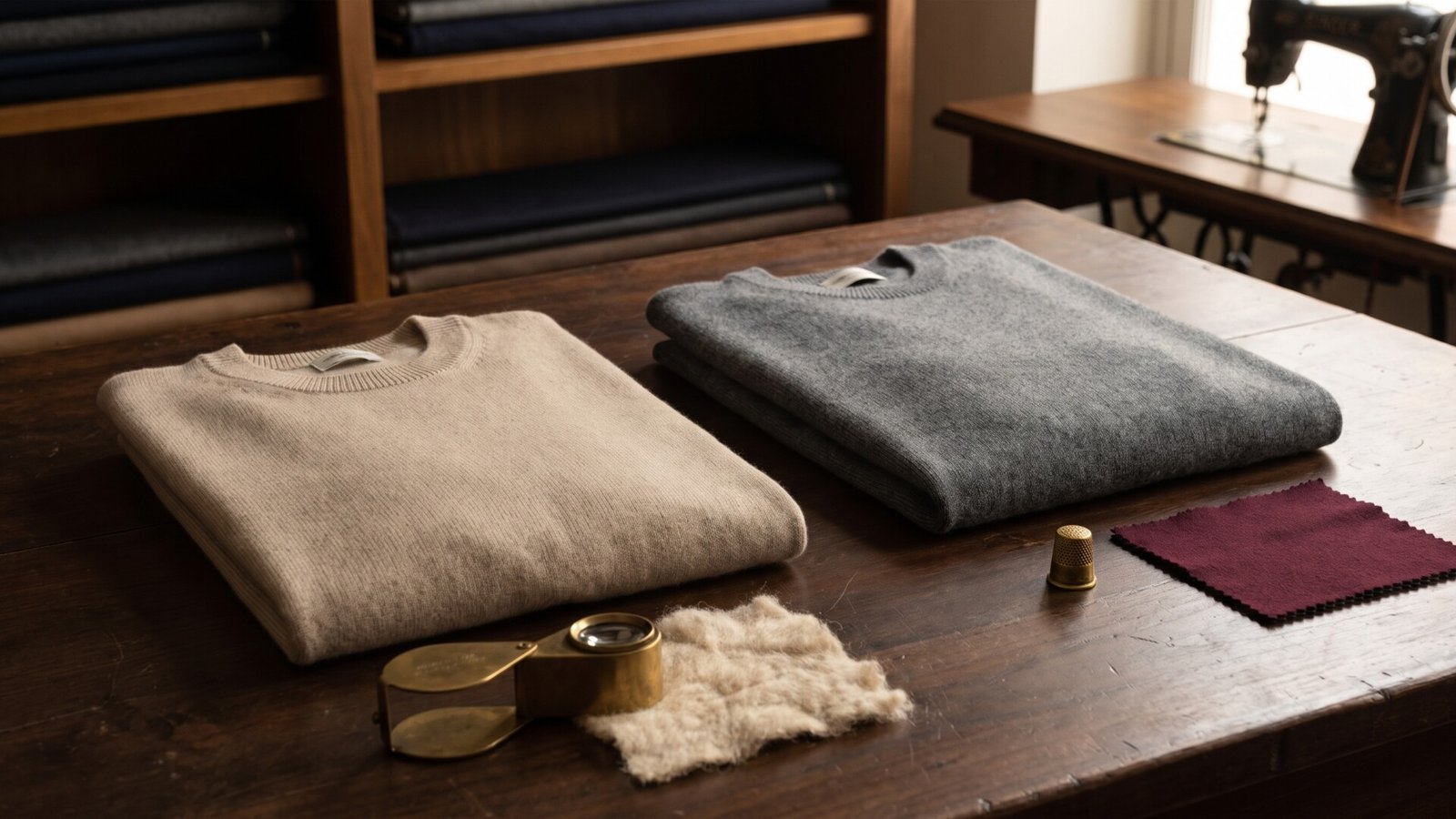
That is the first real distinction. Colombo’s luxury is quiet and textile-led. Loro Piana’s luxury is visible and complete. Neither positioning guarantees anything about the specific item in front of you. Fiber grade, yarn structure, knit density, finishing, construction and care requirements still decide how it performs. The brand tells you where to look, not what you will find.
Quality and Materials: What Are You Actually Buying?
"100 percent cashmere" is not a quality statement. It is a fiber-content statement, and it is the most misleading line on any label in this category.
Cashmere quality comes down to things the label rarely tells you. Fiber fineness, measured in microns, sets the ceiling on softness. Fiber length decides how well the yarn holds together: long fibers spin into a stronger, smoother yarn, short fibers into one that pills and sheds. Yarn twist determines how the knit behaves, and finishing decides how it feels and ages. Two sweaters can both read "100 percent cashmere" and differ by a factor of three in what they cost to make. Our guide to how Italian cashmere is made walks through each stage.
Here is where most buyers go wrong: the softest cashmere in the store is often the most fragile. Very fine, lofty, loosely spun cashmere feels extraordinary and abrades quickly under a bag strap. A slightly firmer hand, a denser knit with a touch more twist, frequently signals a garment that will look the same in year four. Softness is a first-touch sensation; durability is a fifth-year one.
Loro Piana’s material story is built around proprietary categories. Baby Cashmere is combed from the undercoat of young goats, and the house states a fiber diameter of about 13.5 microns. It also works with vicuña, the very fine fiber of a protected Andean camelid, and with treatments such as Storm System, which makes outerwear fabrics water- and wind-resistant while keeping their natural hand. When a Loro Piana piece is priced around a genuine proprietary fiber or technical treatment, part of the premium buys something that actually exists.
Colombo’s strength is a material specialist’s strength: cashmere and kid cashmere, rare animal fibers, and superfine wool (it markets a 12.8-micron Kid Wool), well spun and finished, without a visible fashion identity. You are closer to paying for the fiber and the making and further from paying for the name. Neither house uses universally better fibers; both run ranges from exceptional to ordinary depending on piece and price. What matters is how to inspect the thing in your hands.
The hand test for cashmere:
- Weight and density. Gather a handful of fabric. It should feel substantial for its thickness, not airy to the point of transparency.
- Recovery. Stretch a section gently and let go. Good cashmere springs back; if it stays stretched, the garment will bag at the elbows and cuffs.
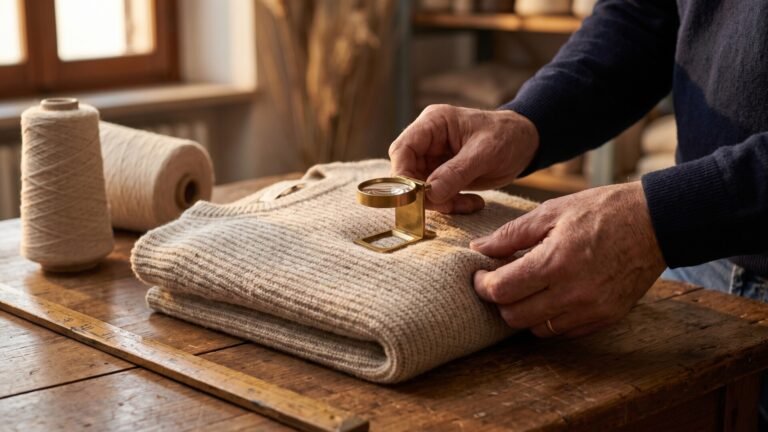
- The surface. Look across the knit at a low angle in good light. An even, tight surface beats a fuzzy halo, which often means short fibers working free.
- The label. Read the care instructions before you fall in love. A garment that demands cold hand-washing and flat drying is telling you what ownership will cost.
Craftsmanship, Construction, and Durability
Craftsmanship in this category happens at two levels, and buyers tend to conflate them. The first is the textile level: fiber selection, spinning, weaving or knitting and finishing. This is where both houses are strong, and where Colombo’s mill identity gives it a genuine claim. You cannot build a durable sweater on a poor yarn.
The second is the garment level: pattern cutting, seams, closures, collar construction and reinforcement in high-contact areas. This is where a beautiful fabric can be quietly undermined by a seam sewn too tight or a collar with a cheap interlining. A high-quality fabric does not guarantee a high-quality garment. A mill can make superb cloth and still ship a finished piece whose fit lets it down.
Density matters more than most buyers realize. A dense, well-balanced knit will usually outlast a loftier, more delicate alternative, even when the delicate one feels more luxurious on the shelf. Loft is air; air is comfortable and fragile. Cashmere wears out first at the cuffs and elbows, the underarms, pocket edges and plackets, collars, and anywhere a bag strap or seat belt crosses the body.
A practical inspection checklist that works on either brand:
- Shape retention. Hold the garment up by the shoulders. Does it hang straight, or has it started to twist? Lay it flat and check that the side seams are even.
- Knit evenness. Uneven tension shows as visible rows or gaps and predicts distortion.
- Seams. Turn it inside out. Seams should lie flat, be neatly finished and not pull; if your thumb catches on the inside edge, it was finished in a hurry.
- The rebound test. Gently bunch a sleeve and release. It should recover its shape quickly.
- The friction zones. Inspect the cuffs, underarms and pocket edges first, because that is where the garment will fail first.
One honest caveat: the most expensive item in either house is not automatically the most durable. Vicuña, ultra-fine Baby Cashmere and lightweight summer knits are made to be worn carefully. If your life involves a shoulder bag, a car commute and a washing machine, a heavier wool or denser cashmere blend will serve you better than the rarest fiber on the shelf.
Price Compared: What Explains the Difference?
Prices move with the collection, so treat these as a November 2026 snapshot. The surprise for most buyers is how close the two are on a plain sweater: a full-price Colombo cashmere crewneck sat at about $1,300-$1,850, against $1,900 for Loro Piana’s Baby Cashmere Classic Crewneck. The gap widens on outerwear and signature fabrics, where Loro Piana’s proprietary materials and brand premium do more of the work, and it widens in Colombo’s favour in end-of-season sales, where marketplace discounts on Colombo knitwear are common.
| Factor | Lanificio Colombo | Loro Piana |
|---|---|---|
| Market position | Quiet, textile-led Italian luxury | Global luxury house with textile and fashion divisions |
| Typical buying appeal | Material quality and understated value | Material quality, recognition, design and prestige |
| Plain cashmere crewneck | About $1,300-$1,850 full price; frequently discounted | About $1,900; seldom discounted |
| Best value opportunity | Core cashmere and wool pieces with restrained design, bought on sale | Pieces where proprietary materials, construction or resale recognition matter |
| Main risk | Lower visibility and less consistent retail access | Paying for the name when a simpler garment performs the same |
A price gap here reflects far more than raw fiber: design and product development, finishing, retail infrastructure, service, distribution, scarcity and brand positioning. Some of that is value you can feel; some you can only see on the receipt. So compare like with like. A basic cashmere crewneck should be judged against another basic cashmere crewneck, not against a Storm System jacket or a vicuña coat.
The tool that settles it is cost per wear. A $1,850 sweater worn twice a week through five winters (roughly 250 wears) costs about $7.40 a wear before care. A $400 sweater that loses its shape in year two, or that you rarely reach for, can be the more expensive purchase. For the wider field, see our best Italian cashmere brands guide, and if Loro Piana’s price is the sticking point, our list of Loro Piana cashmere sweater alternatives covers cheaper routes to the same look.
What Most Buyers Get Wrong About This Comparison
Three assumptions do most of the damage.
The first is that softest equals best. Immediate softness is a function of fineness and loft, and both can come at the cost of abrasion resistance. Optimize for the fifth year, not the first touch.
The second is that a textile specialist automatically makes a better finished garment. A mill’s genius is in the cloth. Whether that cloth becomes a well-cut, wearable garment depends on pattern cutting, seams, closures and design. Buy the garment, not the fabric swatch.
The third is that Loro Piana’s visibility makes every Loro Piana item a better long-term buy. Brand prestige, material performance and resale demand are three separate variables. A basic cashmere piece with no material or construction advantage can carry a premium that has nothing to do with how it will wear.
There is also a quieter point: discreet design is a cost-per-wear advantage. A charcoal or navy crewneck in a clean silhouette earns more wears than a distinctive seasonal piece, whichever label is inside. And it is worth naming the psychology. Colombo appeals to the buyer who wants connoisseur-level quality without signaling; Loro Piana to the buyer who values recognition, heritage and a complete luxury experience. Neither motive is wrong, but knowing which drives you changes what counts as a good purchase.
Which Brand Makes More Sense for Different Buyers?
Choose Lanificio Colombo if
- Fine Italian textile quality and understated design are the priorities. You want the cloth, not the crest.
- You are comfortable assessing the garment itself (fiber, density, seams, fit) rather than relying on a recognizable label.
- Your wardrobe needs versatile cashmere sweaters, scarves or wool pieces worn frequently and styled many ways.
- You can buy through a reputable retailer with clear information on composition, origin, care and returns. This matters more with a quieter label, because the retailer does more of the explaining.
[Affiliate: Browse Lanificio Colombo knitwear at a trusted retailer] to see how the current range is priced against the Loro Piana equivalent.
Choose Loro Piana if
- You value a global luxury house, boutique experience and strong recognition, and are happy to pay for the complete experience.
- The specific piece offers a material or construction feature that justifies its price: Baby Cashmere, vicuña, Storm System outerwear or a hard-to-replace design.
- You want a recognizable luxury gift, or expect to resell through a market that knows the label.
- You prefer easy try-on, alterations and after-sales service through the brand’s own stores.
[Affiliate: Explore Loro Piana cashmere and signature materials] to compare the proprietary collections directly.
Skip both if
- The purchase is driven only by softness, status or a sale price without checking fit and construction.
- The garment will face heavy daily abrasion or frequent washing. Buy a durable wool or tougher blend instead.
- A simpler merino, cashmere blend or accessible Italian label would serve the use better. Our comparisons of Gran Sasso vs Loro Piana and Loro Piana vs Falconeri show what you give up for a far lower price.
Ownership, Care, and Long-Term Value
The label inside the collar does less for a garment’s lifespan than the care routine you keep. Vicuña and ultra-fine cashmere want gentle handling, infrequent cleaning and careful storage. Technical fabrics like Storm System need their water-repellent performance maintained rather than assumed. The hidden costs are real: professional cleaning, depilling and moth repairs, reshaping hand-washed knits while damp, breathable storage, and the opportunity cost of a delicate piece you are afraid to wear. Rotate two or three good sweaters, fold rather than hang, and keep moths away. Our guides on how to care for luxury sweaters and how to clean Loro Piana cashmere cover the routine.
On resale, be honest with yourself. Loro Piana generally has stronger recognition in the luxury resale market, but condition, model, material, color, season and documentation matter enormously. Colombo appeals to a narrower, more knowledgeable audience. Do not buy either expecting appreciation; treat them as wardrobe purchases with different liquidity. Our guide on whether cashmere holds its value explains what moves the number.
Comparison Verdict: Lanificio Colombo or Loro Piana?
- Best for textile-led value: Lanificio Colombo, especially bought on sale.
- Best for brand prestige and recognition: Loro Piana.
- Best for distinctive materials and technical fabrics: Loro Piana, when the specific garment justifies the premium.
- Best for quiet wardrobe building: Lanificio Colombo.
- Best resale visibility: Loro Piana, with condition and product choice decisive.
- Best overall purchase: whichever offers the better fabric, fit, construction and expected wear at the actual price.
That last line is the whole comparison. A plain Colombo crewneck and a plain Loro Piana crewneck are close cousins once you strip away the branding, made a few miles apart and priced within a few hundred dollars. A Loro Piana Storm System jacket and a Colombo cashmere scarf are not competing products at all. Buy Colombo when quality-per-dollar and discretion lead. Buy Loro Piana when the material innovation, design, service or resale recognition makes the premium meaningful to you. And if you want a sweater you can wear hard and forget about, buy neither and put the money into a denser wool.
For how these two sit among the wider field, see the three-way Piacenza 1733 vs Lanificio Colombo vs Loro Piana and Loro Piana vs Brunello Cucinelli vs Lanificio Colombo comparisons, or start with our Italian cashmere guide.
Frequently Asked Questions About Lanificio Colombo Vs Loro Piana
Are Lanificio Colombo and Loro Piana related?
No. They are separate companies, but they are neighbours: Loro Piana is based in Quarona and Colombo in nearby Borgosesia, both in Piedmont’s Valsesia. They share a regional textile tradition and compete for some of the same rare fibers, but have different owners and business models.
Who owns Loro Piana and Lanificio Colombo?
LVMH took control of Loro Piana in 2013, buying 80% from the Loro Piana family. Lanificio Colombo remains family-owned; Roberto Colombo built its international business and the founder’s grandson has joined the company.
Does Loro Piana cashmere last longer?
Not automatically. Durability depends on fiber length, fabric weight, knit structure, garment design, friction and care. Very fine Baby Cashmere is luxurious and also delicate. A denser, slightly firmer knit from either house may outlast a finer, loftier one.
Is Lanificio Colombo good for everyday cashmere?
Yes, if you choose the right pieces: medium-weight knits in restrained colors, a good fit, and garments you rotate rather than wear daily. Save the lightest, loftiest knits and rare-fiber pieces for gentler use.
Which brand has better resale value?
Loro Piana usually has broader resale recognition, so it is easier to sell. Colombo pieces appeal to a smaller, more knowledgeable audience. Condition, documentation, material and color often matter more than the brand, so do not assume either label guarantees strong resale.
Where can I buy each brand in the US?
Loro Piana sells through its own US boutiques and website, which makes try-on and alterations easy. Colombo knitwear is sold mainly through multi-brand luxury retailers and online marketplaces such as Farfetch, so check stock, sizing and returns before ordering.