Lanificio Colombo vs Piacenza 1733: Which Italian Cashmere Is Better?
The question you are actually asking is not which of these two mills makes better cashmere. Both make very good cashmere, and both are mills first: they spin yarn and weave cloth for other labels as well as selling knitwear under their own names. The real differences are age, price tier and what each house does with its own collection. Lanificio Colombo, founded in 1967 in Borgosesia, is the younger cashmere and rare-fibre specialist, and its own-label knitwear is priced well above Piacenza 1733’s. Piacenza 1733, founded in 1733 in Pollone near Biella and still run by the founding family, sells a broader and more accessibly priced collection. Neither house is universally better. Which one is better for you depends on your budget and on how you will actually wear the thing.
The short answer (prices checked November 2026): a plain 100% cashmere crewneck from Piacenza 1733 lists at about $800 at Mr Porter, while a Colombo kid-cashmere V-neck lists at $1,600 at Harrods. If you want one classic sweater and price matters, Piacenza 1733 gets you a mill-made Italian crewneck for roughly half the money. Pay the Colombo premium only if you specifically want its rare-fibre range (kid cashmere, vicuña, guanaco) and you will rotate and hand-wash what you buy.
The Two Houses: Similar Heritage, Different Luxury Positions
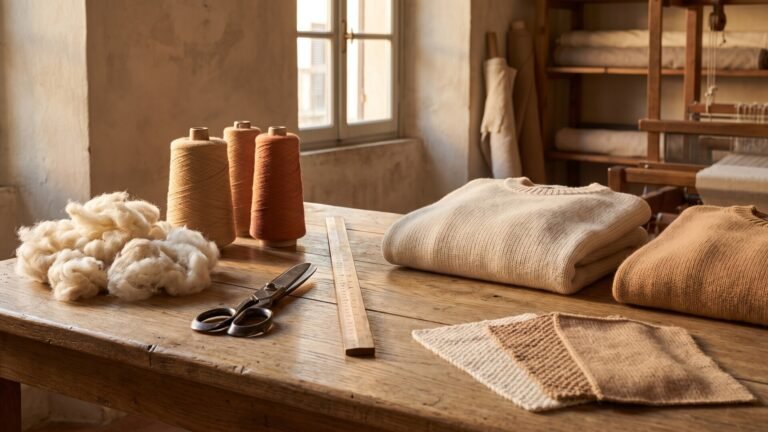
Lanificio Colombo is a textile producer first. Luigi Colombo founded the mill in 1967 in Borgosesia, in the Valsesia just east of the Biella wool district, and production runs at two plants, in Borgosesia and Ghemme. Milano Finanza described it in December 2025 as mainly a maker of cashmere and fine-fibre fabrics and yarns for luxury brands, with a smaller finished-products division for knitwear, outerwear and accessories; the family still runs it, with the founder’s grandson, also named Luigi, now in the business. Beyond cashmere, the mill works vicuña, guanaco and camel hair. That vertical integration matters more than any heritage plaque. When a house controls its own yarn and its own cloth, it can decide the fiber fineness, the twist, the density, and the finish at the source rather than buying a finished fabric on the open market and cutting around its limitations.
Piacenza 1733 is older by more than two centuries. Pietro Francesco Piacenza and his son Giovanni Francesco set up a wool mill in Pollone, in the Biella foothills, in 1733, and the family still owns it; Mr Porter’s journal names Vasiliy and Ettore Piacenza as the 14th generation. According to The Rake, cashmere entered the story in 1913, when Mario Piacenza encountered the fibre on a Himalayan trip. The group is still growing: in November 2022 it bought Lanificio Fratelli Cerruti, the Biella cloth maker. Today the house mills cashmere, camelhair, vicuña, alpaca, mohair, wool and silk, and sells knitwear, scarves and accessories under the Piacenza 1733 name alongside its fabric business.
Both sit in the premium-to-luxury segment, but at different price tiers, and you will feel the difference in the shop. Colombo reads as material-led and discreet – the label is small, the colors are quiet, the garment asks to be touched rather than noticed. Piacenza 1733 mixes classic basics with what the family calls “emotive fantasies” – jacquard scarves, jewel-toned brushed cashmere – so its collection is the more visibly seasonal of the two. If you want the wider context on how these two fit among the country’s makers, our guide to Italian cashmere maps the whole field, and our three-way comparison of Gran Sasso vs Piacenza 1733 vs Lanificio Colombo adds a third, more accessible knitwear maker.
What Actually Separates Colombo Cashmere From Piacenza 1733?
Fiber quality and yarn character
Here is the first thing most buyers get backwards. Softer is not better. Softer is a choice with consequences.
Cashmere comes from the undercoat of the cashmere goat, and the fiber is graded largely by fineness, measured in microns – one micron being a thousandth of a millimeter. Finer fiber feels more luxurious against the skin. It is also more fragile, and a yarn spun from extremely fine fiber pills more readily and loses its shape sooner under friction. Neither house publishes micron figures for its sweaters, so you cannot compare them on a spec sheet. What you can say is that Colombo leans hardest into the finest end of the range – kid cashmere and vicuña – which feels best but asks for the gentlest handling, while Piacenza 1733’s core crewnecks are sold as midweight 100% cashmere, the more forgiving end. For the full chain from Mongolian fibre to finished knit, see how Italian cashmere is made.
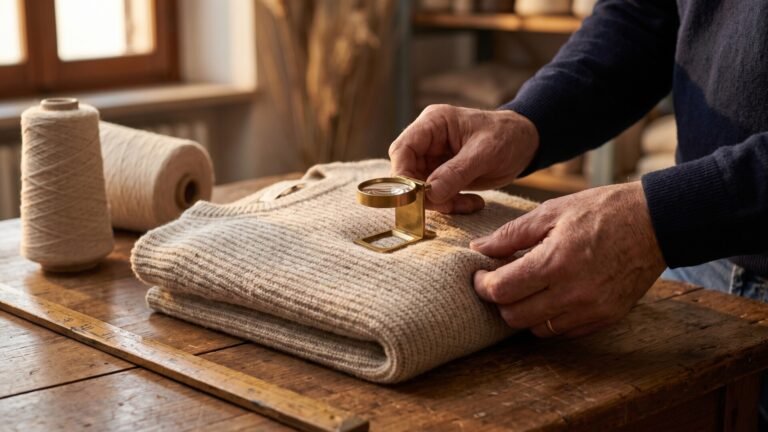
So when you compare Colombo cashmere and Piacenza 1733 cashmere, do not stop at the first touch. Press the knit flat with your palm and let go. Watch whether it springs back or stays flattened. Run your thumb along the inside edge of a seam – if it catches, it was finished in a hurry. Look at the surface under a bright light for consistency: a good yarn has an even halo, the soft fuzz that stands up from the surface, not patchy tufts.
Construction and finishing
Two sweaters can share identical fiber and still be completely different objects, because gauge, knit structure, and finishing decide how the garment lives.
Gauge is the count of stitches per inch – a fine-gauge knit is thin and fluid, a mid-gauge is denser and holds its shape, a chunky gauge is heavy and warm. Brushing is a mechanical finish that raises surface fibers for softness, and it can be overdone until the knit feels plush in the store and thin in a season. Washing and pressing after knitting settle the stitch and set the final hand.
A dense, well-balanced knit almost always outlasts a lighter garment that feels more luxurious on the hanger. That is the honest trade-off. The lighter piece wins the first minute. The denser piece wins the third winter.
Before you decide between two similarly priced pieces, turn both inside out. Check the shoulder seams – are they neatly linked or bulky and puckered? Look at the armhole, where friction concentrates. Flex the cuff and see whether it recovers. The finishing tells you what the mill thought the garment was for.
Design and wardrobe role
Colombo’s design language is quiet, tactile, and material-led. The garment is meant to be the best version of a plain thing – a crewneck, a cardigan, a scarf – and the pleasure is in the cloth, not the cut. That suits a wardrobe built on navy, charcoal, camel, cream, and black.
Piacenza 1733 gives you more variety at a lower entry price. Plain crewnecks sit alongside polos, cashmere-silk and cashmere-linen blends for warmer months, and patterned scarves. If your goal is several layers that speak to each other across a season, that breadth is a real advantage.
Lanificio Colombo vs Piacenza 1733: Side-by-Side Comparison
| Feature | Lanificio Colombo | Piacenza 1733 |
|---|---|---|
| Founded | 1967, Borgosesia (Valsesia) | 1733, Pollone (Biella) |
| Ownership | Colombo family | Piacenza family, 14th generation |
| Main business | Cashmere and rare-fibre fabrics and yarns for luxury brands, plus its own finished line | Fabric mill (owns Lanificio Cerruti since 2022), plus its own knitwear and accessories |
| Fibres worked | Cashmere, kid cashmere, vicuña, guanaco, camel hair | Cashmere, camelhair, vicuña, alpaca, mohair, wool, silk |
| Example price (Nov 2026) | $1,600, kid-cashmere V-neck (Harrods) | About $800 list, 100% cashmere crewneck (Mr Porter) |
| Design character | Understated, tactile, discreet | Classic basics plus seasonal jacquards and colour |
| Best for | One or two exceptional staples, rotated and hand-washed | A first serious cashmere sweater or several coordinated layers |
Read that table as a buying framework, not a laboratory ranking. Individual garments inside each brand vary enormously – a heavy Colombo cardigan and an ultralight Colombo crewneck have less in common than two different brands’ midweight sweaters.
Compare like for like. Put a fine-gauge crewneck against a fine-gauge crewneck, a cardigan against a cardigan, a scarf against a scarf. A common mistake is holding a dense Piacenza sweater next to an ultralight Colombo knit and crediting every difference to brand quality. It is not. It is weight and purpose.
For price context: at around $800 list, a Piacenza 1733 crewneck sits well above Falconeri, while Colombo’s $1,600 knitwear is in the bracket of Loro Piana and Brunello Cucinelli. The variables that actually decide your purchase are intended wear, climate, friction, washing habits, fit, and whether you want one excellent piece or a coordinated wardrobe.
What Most Buyers Get Wrong About Luxury Cashmere
The belief worth taking apart: that the most delicate-feeling cashmere is the best long-term buy. It is often the opposite.
Ultrafine, lightly spun cashmere asks for careful rotation and gentle maintenance. Wear it three days running under a rough coat strap and it will tell you so – stretched cuffs, a tired surface, pills at the underarm. A slightly denser, more balanced knit feels less ethereal in the hand and holds up far better in rotation. The luxury is real either way. The question is whether the luxury survives your week.
Pilling is the second thing buyers misread. Pills are small tangles of loose fiber that form where friction acts – under the arms, along the sides, where a bag strap crosses. Some early shedding is normal even in excellent cashmere, because short fibers work their way free as the garment settles. What signals a genuine problem is persistent pilling that keeps returning after careful removal, especially combined with a thin, unbalanced yarn. That points to construction, not to the fiber being “bad.”
Price deserves the same skepticism. A high price reflects fiber rarity, finishing time, brand positioning, and retail structure as much as raw quality. It is not a simple quality scale you can read off a tag. Our explainer on why Italian cashmere costs more than Mongolian cashmere breaks down what the money pays for, but the practical rule is this: buy for the garment’s role first, then check whether its construction and care demands match that role. A scarf can be delicate. A sweater you live in cannot.
Which Brand Makes More Sense for Different Buyers?
Choose Lanificio Colombo if…
- Your priority is the finest possible tactile experience and understated luxury rather than a logo or a seasonal statement.
- You are selecting one or two exceptional staples, your budget covers roughly $1,500 or more per sweater, and you will rotate them and follow the care instructions.
- Your wardrobe favors quiet colors, elegant layering, and tailored clothing that does not depend on visible branding.
- You want rare fibres such as kid cashmere or vicuña from a mill that supplies cloth to other luxury labels.
Choose Piacenza 1733 if…
- You want a mill-made Italian cashmere crewneck at roughly half Colombo’s price, especially if you can buy in end-of-season sales.
- Practical versatility and styling range matter as much as softness, and you want cashmere that works inside a broader wardrobe.
- You prefer a more traditional Italian presentation that moves between work, travel, and smart-casual dressing.
- You want to compare multiple weights and blends, from midweight cashmere to cashmere-silk, within one house.
Neither may be right if…
- The garment will be worn every day under a rough coat strap, backpack, or seat belt without rotation.
- You cannot commit to proper washing, drying, storage, and depilling.
- You are deciding on the label while the fit, weight, and construction are wrong for you.
- Your budget points lower: our comparison of Piacenza 1733 vs Falconeri weighs Piacenza against a cheaper Italian label.
Ownership, Durability, and Cost Per Wear
Judge both brands over several seasons, not one. What matters is shape retention, surface change, pilling, stretching at the cuffs, color stability, and how easily the piece can be repaired. A good knit can be re-cuffed by a competent tailor. A badly balanced one cannot be saved.
Cost per wear is the honest calculator. An $800 Piacenza 1733 crewneck worn 60 times costs about $13 a wear. A $1,600 Colombo knit worn on special occasions only – call it 12 times a year for three years – works out to roughly $44 a wear. The cheaper garment is not the one with the lower price. It is the one you actually reach for. These are illustrative figures, not guarantees.
Then count the hidden costs. Specialist cleaning adds up. Worn cuffs need replacing. Poor storage – a knit crammed on a hanger in a damp closet – quietly shortens life.
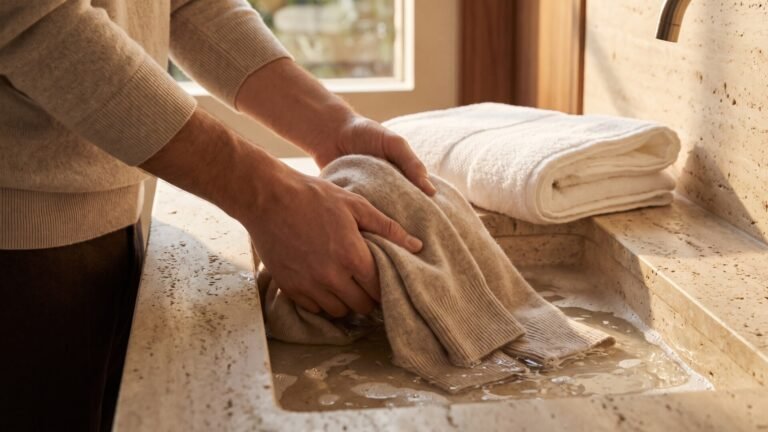
Build a rotation. Let knitwear rest a day between wears so the fibers recover. Fold lightweight cashmere rather than hanging it, because a hanger stretches the shoulders. Remove pills carefully with a cashmere comb rather than pulling them off. And follow the care label – not all cashmere can be treated alike, and a delicate fine-gauge knit is not a machine-washable midweight. Our guide on how to care for luxury sweaters covers washing, drying and moth-proof storage properly.
Styling, Use Cases, and Wardrobe Fit
For a professional wardrobe, both houses deliver, but differently. Colombo’s neutral crewnecks, fine-gauge turtlenecks, and cardigans layer under tailoring with almost no bulk – the garment disappears under a jacket and does its work at the collar and cuff. Piacenza 1733 gives you more pieces to coordinate, which helps if you are building several looks across a season. Our Italian knitwear guide explains how gauge changes the way a knit sits under a jacket.
Travel is where weight matters most. A midweight cashmere knit recovers from a suitcase far better than an ultrafine one, resists the friction of a luggage strap, and handles the temperature swing from a cold cabin to a warm arrivals hall. For travel, lean toward the denser garment in either house.
For a quiet-luxury wardrobe built around navy, charcoal, camel, cream, black, and muted earth tones, Colombo is the natural fit – the palette and the material philosophy are the same idea. Piacenza 1733 suits the same palette but gives you more silhouettes to vary the line.
On gifting, a neutral accessory such as a cashmere scarf is safer than fitted knitwear, because fit is personal and a scarf is not. But the recipient’s care habits still matter – a beautiful scarf that goes through a hot wash is a waste of money. If you are buying for someone whose laundry routine you do not know, a scarf in a midweight knit is the forgiving choice; our guide to Italian cashmere scarves compares more options.
Long-Term Value, Resale, and Which Option Still Makes Sense in Three Years
Be clear about one thing. Neither brand is a financial investment. Buy either house because you will wear it, not because you expect it to appreciate.
Resale value depends on condition, color, size, seasonality, recognizable labeling, original packaging, and continued demand for the specific garment. Both labels are far less recognized on the resale market than Loro Piana or Brunello Cucinelli, so expect a quiet Colombo or Piacenza piece to sell to a buyer who knows the mill rather than one searching for a big name. Neither comes with a fixed resale percentage, and anyone who quotes you one is guessing. For the wider numbers, see does cashmere hold its value.
The safest long-term purchases are the boring ones: classic crewnecks, cardigans, scarves, and restrained colors with minimal seasonal detailing. A camel crewneck in a midweight knit will still make sense in three years. A cropped, color-blocked statement piece probably will not. The better three-year choice is the item that stays easy to wear, easy to care for, and appropriate across several settings – not necessarily the one with the highest original price.
Buying Verdict: Which Italian Cashmere Is Better?
Lanificio Colombo is the stronger choice for the buyer who places rare-fiber refinement, quiet luxury, and specialist textile expertise above breadth and price. If you want the best possible version of a plain thing, made by a mill that spins and weaves for other luxury houses, and you will pay roughly double for it, Colombo is the answer.
Piacenza 1733 takes the edge for buyers who want polished versatility at a lower price – a broader selection of pieces from a family mill with nearly three centuries in Biella. If you are building a wardrobe rather than buying a single object, the breadth and the price gap are worth more than the specialist’s edge.
The decision framework:
- Choose Lanificio Colombo for the most material-focused, discreet, and tactile purchase.
- Choose Piacenza 1733 for adaptable luxury knitwear, broader wardrobe integration and a lower entry price.
- Choose neither if the expected use involves heavy friction, frequent washing, or neglect of care.
If you are still mapping the field, our guide to the best Italian cashmere brands places both houses in context, Lanificio Colombo vs Gran Sasso sets Colombo against a more affordable knitwear specialist, and our Italian designer clothing guide shows where cashmere fits in a full wardrobe.
Frequently Asked Questions About Lanificio Colombo Vs Piacenza 1733
Is Piacenza 1733 connected to the city of Piacenza?
No. Piacenza is the founding family’s surname, not a reference to the city. The mill is in Pollone, in the province of Biella in Piedmont, while the city of Piacenza is in Emilia-Romagna. The 1733 in the name is the year Pietro Francesco Piacenza and his son Giovanni Francesco set up the wool mill.
Does Piacenza 1733 own Cerruti?
The Piacenza group owns Lanificio Fratelli Cerruti, the Biella fabric mill. In November 2022 Gruppo Piacenza bought the 80% stake held by the fund Njord Partners and the remaining 20% held by the Cerruti family. The mill is separate from the Cerruti 1881 fashion label, so do not read a Cerruti clothing tag as a Piacenza product.
Is Piacenza 1733 knitwear made in Italy?
Check the label of the specific garment, because Made in Italy is a per-product claim. The 100% cashmere Piacenza 1733 crewnecks listed at Mr Porter in November 2026 were labelled made in Italy. The same check applies to Colombo: retailer listings for its kid-cashmere crewneck also state Italy.
Why is Lanificio Colombo cashmere so expensive?
Several things stack up: rare-fibre selection such as kid cashmere and vicuña, a vertically integrated mill that spins and weaves its own cloth, finishing time, Italian manufacturing, and luxury retail positioning at stores such as Harrods. Price is not a pure measure of softness; you are paying for the whole chain from fibre to finished garment.
What is kid cashmere?
Kid cashmere is fibre from young goats. Harrods describes Colombo’s as coming from the naturally shedding undercoat of young Hircus goats. Fibre from young animals tends to be finer and softer, but like any very fine cashmere it pills and stretches more readily than a midweight knit. Rotate it and hand-wash it.
Do Piacenza 1733 sweaters go on sale?
Yes, through multi-brand retailers. In November 2026 Mr Porter had Piacenza 1733 100% cashmere crewnecks reduced from $800 to $320. Sale items there can be final sale and non-returnable, so confirm your size and the garment’s weight before you buy.
Which brand is better for a first cashmere purchase?
For most first-time buyers, a midweight, neutral Piacenza 1733 crewneck is the easier start: it costs roughly half a comparable Colombo knit and is more forgiving in daily wear. Choose Colombo first only if you already know you want an ultrafine or rare-fibre piece and will care for it carefully.