Piacenza 1733 vs Falconeri: Which Cashmere Brand Offers Better Value?
A sweater that costs $300 and gets worn eight times is worse value than one that costs $650 and gets worn eighty. That is the whole trade-off between Piacenza 1733 and Falconeri, and it is why the cheaper tag is not automatically the smarter buy, nor the dearer one automatically the better. Piacenza 1733 is the textile house: a family woollen mill since 1733, selling knitwear made from its own cloth and yarn. Falconeri is the accessible route: clean Italian styling, a very wide cashmere offer, and US prices that let you build a rotation instead of making one purchase a major decision. Which one offers better value depends on how often you will wear the piece, how you will care for it, and whether you are buying a garment or a fibre.
Brand Positioning: Heritage Mill Versus Accessible Specialist
Piacenza 1733 takes its name from the year Pietro Francesco Piacenza and his son Giovanni set up a woollen mill in Pollone, in the Biella foothills of the Alps – the northern Italian district that has spun and woven cloth for tailors and fashion houses for generations. The company is still entirely family-owned, now run by the fourteenth generation, brothers Vasiliy and Ettore Piacenza, and describes a fully integrated chain from raw fibre to finished product. It is best known for cashmere cloth, including brushed cashmere, as well as alpaca. A mill thinks in yarn lots, fibre microns and loom settings, and when it makes a sweater, the starting point is the material and the finishing, not the season’s silhouette.
Falconeri sits in a different part of the market. It is the cashmere and fine-knitwear brand of Oniverse (the Italian group called Calzedonia Group until December 2023), based in Avio in Trentino, where it does most of its knitting in-house; the raw fibre is processed in Biella first. Its business is making cashmere feel normal rather than ceremonial: crewnecks, cardigans, rollnecks, a broad colour wall, and simple shapes that layer under a coat. You are not paying for a mill’s three-century history. You are paying for competent, Italian-designed knitwear at a level where buying two or three pieces a season is not absurd.
Those are two different kinds of luxury. Piacenza 1733 sells textile authority. Falconeri sells wearability and access. The premium you pay for a mill’s name has to come back to you somewhere: in hand feel, density, and a garment that improves with careful wear. If what you actually need is a navy crewneck that gets worn twice a week, paying for textile heritage you cannot perceive is money spent on someone else’s priorities. For the wider field of makers, our Italian cashmere guide maps the category.
The Price Gap in 2026, and the Wear Count That Closes It
At the time of writing (November 2026), Falconeri’s US site lists men’s 100% cashmere sweaters from about $295 to $425: the Ultrafine Cashmere Crewneck at $295, Ultrafine V-necks and mock necks around $355, and the heavier Ultrasoft crewneck and turtleneck at $425. Piacenza 1733 cashmere crewnecks at US retailers list around $630, cashmere-silk crewnecks around $760, and half-zips and jacquard cardigans from about $755 to $995.
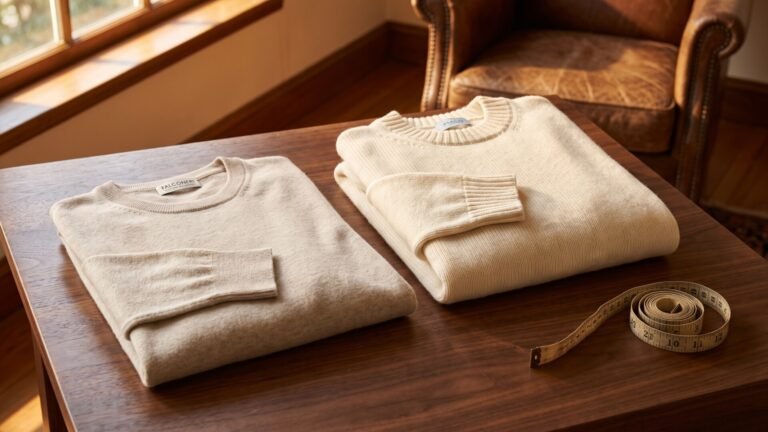
That makes the comparable crewneck roughly twice the price at Piacenza 1733. The useful question is not which is “worth it” but how many more wears the dearer sweater needs to cost the same per wear. The answer is simple: a $630 Piacenza crewneck has to be worn about 2.1 times as often, or last about 2.1 times as long, as a $295 Falconeri crewneck to break even. Worn 30 times a season, the Falconeri costs about $3.30 a wear over three seasons; the Piacenza reaches the same figure only if it gives you more than six seasons at that rate.
So the decision rule is: choose Piacenza 1733 if you will keep a crewneck in rotation for six or more winters and care for it properly, or if the hand and density matter to you beyond cost per wear. Choose Falconeri if you replace knitwear every few seasons, want several colours, or are still learning cashmere care. Neither brand publishes durability data, so that break-even is the honest way to compare them.
What You Are Actually Paying For
Fiber quality and yarn character
Cashmere quality is not the same thing as softness, and this is where most buyers get led astray. Softness in the fitting room can come from three places: genuinely fine, long fibres; a very loose, light knit; or a softener applied in finishing that washes out after a few wears. Only the first is durable.
What you want to assess is fibre length – longer fibres spin into a stronger yarn that sheds and pills less – and fineness, measured in microns, where a lower number means a finer, softer fibre. Fine is good, but fine and short is fragile. The best yarns are both fine and long, and that combination is expensive because the raw material has to be sorted and graded to get it. Our guide to how Italian cashmere is made walks through that grading.
Then there is yarn construction and knit density – how tightly the loops are formed and how much air is in the fabric. Hold a sweater up to a window. If you can read a newspaper through it easily, it is a light, delicate knit meant for layering and gentle wear, not for daily commuting under a rough coat.
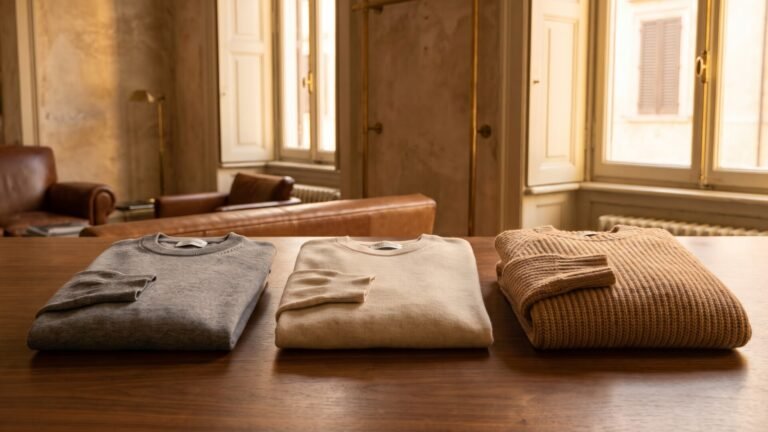
Piacenza 1733 is the brand to investigate when textile nuance is what you are after; the mill background shows in the yarn character and finishing more than in any label claim. Falconeri splits its offer into named qualities – lightweight Ultrafine and denser Ultrasoft – which makes like-for-like comparison easier. But individual garment specifications still matter more than the name: a heavy ribbed Falconeri cardigan can outlast a featherweight knit from anyone.
Construction, finishing and origin
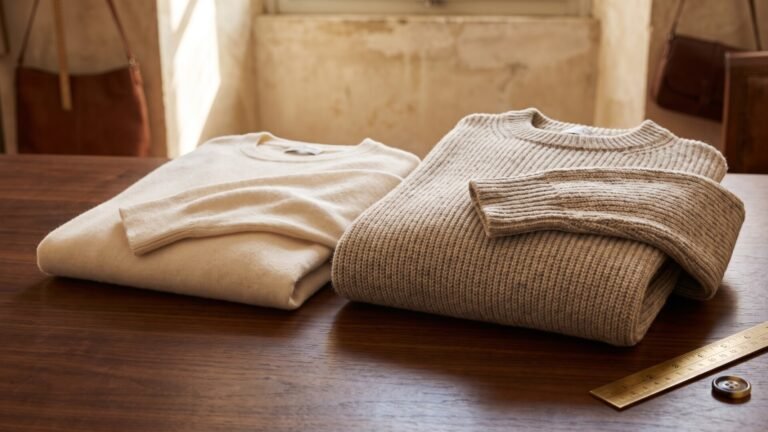
Construction decides whether a sweater is still useful after two winters. Look at the shoulders first: a well-shaped shoulder sits flat and returns to shape when pressed. Then the collar – a crewneck or rollneck should spring back when you stretch it gently and release. Run your thumb along the inside of a seam; if it catches, it was finished in a hurry. Stretch a cuff and let go: good rib – the elastic knit at cuffs, collar and hem – snaps back, weak rib stays baggy. On cardigans, a button sewn with a proper shank will survive; one attached with four loose stitches will not.
Check the origin label too, because “Made in Italy” applies per product, not per brand. Falconeri says most of its garments come from its own factories, but its US product page for the Ultrafine crewneck does not state a country of manufacture, so read the sewn-in label before you buy if Italian manufacture matters to you. Piacenza 1733 presents itself as producing from fibre to finished knit in its own supply chain; the label on the specific piece is still the proof.
Not every Piacenza 1733 piece is better built than every Falconeri piece. Compare typical positioning, then judge the specific item. A simple, sturdy knit is easy to repair and restyle for years, while a very fine knit asks more of you as an owner.
Piacenza 1733 vs Falconeri: Side-by-Side Comparison
| Feature | Piacenza 1733 | Falconeri |
|---|---|---|
| Origins | Woollen mill founded 1733 in Pollone (Biella) | Cashmere brand of Oniverse (ex-Calzedonia Group), based in Avio (Trentino) |
| Ownership | Piacenza family, 14th generation | Oniverse group |
| Cashmere crewneck, US price | About $630-$760 | About $295-$425 |
| Overall positioning | Heritage textile house, fabric-led knitwear | Accessible luxury, broad everyday cashmere offer |
| Design language | Understated, quietly traditional | Clean, versatile, wide colour range |
| Best for | Fewer, finer pieces kept for many seasons | A rotation of staples at approachable prices |
| Main caution | Premium pricing demands close inspection of each piece | Durability varies by quality line; check origin label |
Prices are US full prices seen in November 2026 and change with season and retailer. Before you buy either, confirm fibre composition, knit weight, country of manufacture and care instructions on the specific item. The [Affiliate: Piacenza 1733 cashmere collection] and the [Affiliate: Falconeri cashmere collection] pages let you compare current pieces directly.
On resale: recognisable, classic, well-maintained garments hold value better than seasonal colours or unusual silhouettes, regardless of label. Do not buy cashmere as an investment; our look at whether cashmere holds its value shows how far resale prices fall below retail.
What Most Buyers Get Wrong About Cashmere Value
The softest sweater in the fitting room is usually not the best buy. Excessive softness often signals a light knit, a softening finish, or a delicate hand that will not tolerate weekly wear. The garment that feels slightly firmer, with a denser surface and a bit more weight, is often the one still going strong in year four.
The second error is assuming a higher price guarantees better long-term value. A premium garment has to justify itself through weight, construction, fit and a care burden you will actually meet. If a $650 sweater is so delicate you are afraid to wear it, its cost per wear is terrible no matter how fine the fibre.
The third error runs the other way: buying several cheap pieces that lose shape and pill visibly within a season. One versatile neutral from a better material platform can be more economical over three years than three replacements from a weaker one – but a buyer who owns one precious sweater and wears it to death will get worse value than someone rotating several accessible ones. Frequency and care decide this, not the label.
Ownership in the Real World
Which brand works better for frequent wear?
Think about the actual week: commuting, office layering, travel, weekends, the occasional dinner. A garment dense enough to hold its shape, that fits without pulling and works with your coats, will outlast a more precious piece that only comes out on special occasions.
Falconeri’s pricing is a genuine advantage here. When a sweater costs less, you are more willing to build a rotation, and rotation is the single best thing you can do for cashmere. Five sweaters shared across a week wear far better than one sweater worn five days running, because the fibres need rest between wears to recover. For how Falconeri’s rotation pieces compare with another maker in the same price conversation, see Falconeri vs Malo and Gran Sasso vs Falconeri.
Piacenza 1733 suits the buyer who wants fewer, more carefully chosen pieces and will maintain them. If you own three excellent sweaters and treat them well, the material refinement pays you back in feel and longevity. If you want a different colour for every mood, the mill premium is harder to justify across a large wardrobe.
Pilling, shape retention, and care burden
Some pilling is normal in cashmere. It happens where the fabric rubs – under the arms, where a bag sits, at the seat-belt line, at the cuffs – as short fibres work to the surface and tangle. A cashmere comb lifts the pills off in a few minutes. The denser knit usually pills less and holds shape better; the fine knit asks for more careful handling. Neither brand can promise a lifespan, because care and wear frequency vary so much.
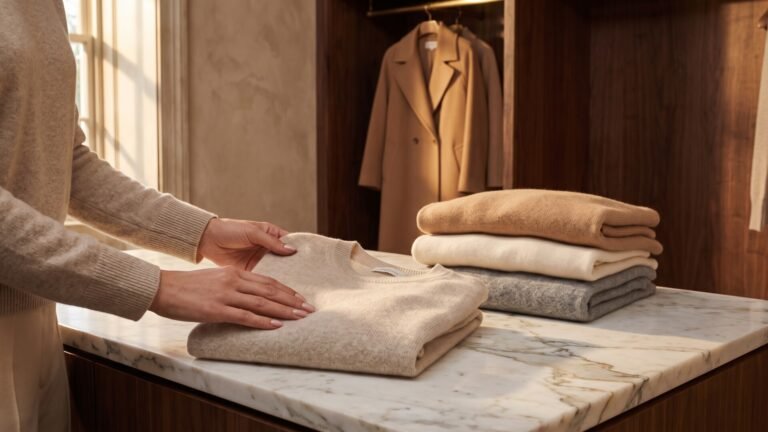
The care routine is the same for both. Follow the label first – Falconeri’s Ultrafine crewneck, for example, is labelled for gentle cold hand wash, flat drying and no tumble drying. Use a wool or cashmere wash in cool water, squeeze rather than wring, dry flat on a towel and reshape while damp. Never hang a wet sweater. Store folded in breathable cotton and watch for moths in the off-season. Our guide on how to care for luxury sweaters covers the full routine.
The hidden cost of poor care is real: professional cleaning, repairs and replacements all erode the benefit of a lower price. A $300 sweater ruined by a hot wash is worse value than a $650 one kept properly for years.
Fit and wardrobe integration
A classic crewneck, cardigan or rollneck in a neutral earns its keep in a way a fashion-led piece rarely does. A slightly less luxurious garment that fits correctly and works with your trousers, denim, tailoring and outerwear will beat a finer one that fights your wardrobe. For a first purchase from either brand, start with navy, grey, camel, cream or black, then add seasonal shades once you have a reliable core.
- Falconeri for the person building a colour rotation, layering under tailoring, and wanting a travel-friendly knit they are not afraid to pack.
- Piacenza 1733 for the person who wants one refined rollneck or cardigan that feels special every time and will be maintained carefully.
The Hidden Cost of Choosing the Wrong Brand
A low price becomes poor value fast if you buy the wrong size, choose a fragile weight for daily use, or have no realistic care routine. A premium price becomes poor value just as fast if the garment is too formal, too delicate, too warm for your climate, or impossible to combine with what you own. The expensive mistake and the cheap mistake end the same way: a garment you do not wear.
Long-term relevance comes down to classic design, neutral colours and repairability. A restrained crewneck in navy does not date; a seasonal shade in an unusual silhouette might. That slightly favours Piacenza 1733’s quieter design language, but Falconeri’s core neutrals are just as classic – it is the trend-led pieces on either side that age badly.
- Choose Piacenza 1733 when material refinement, textile heritage and a smaller, higher-quality wardrobe matter most to you.
- Choose Falconeri when approachable pricing, everyday rotation and broad styling flexibility matter most.
- Choose neither if you will not follow cashmere care instructions, or if what you really need is a hard-wearing travel garment – look at a sturdy merino or a technical knit instead.
Buying Verdict: Which Cashmere Brand Offers Better Value?
Best overall for material-focused buyers: Piacenza 1733. If you value textile heritage, a refined hand and a small wardrobe of premium knitwear you will maintain for years, the mill premium earns its keep. Start with a classic crewneck or rollneck in a neutral. [Affiliate: Browse the Piacenza 1733 cashmere collection].
Best overall for everyday accessibility: Falconeri. If you are building a rotation, want clean staples, or are working within a moderate luxury budget, Falconeri delivers wearable cashmere at a price that supports frequent wear. [Affiliate: Shop Falconeri cashmere].
Best for a first cashmere purchase: Falconeri if you want a versatile entry point and are still learning how you will care for cashmere; Piacenza 1733 if you already understand cashmere ownership and want to upgrade deliberately.
Best for long-term wardrobe value: the specific garment with the better combination of fit, knit weight, neutral styling and realistic wear frequency – which may produce different winners for different pieces. Buy the garment you will wear often and care for properly, because that, not the label, turns a price into value.
To go further, compare Piacenza against another mill in Lanificio Colombo vs Piacenza 1733 and against the top of the market in Piacenza 1733 vs Loro Piana, or browse the best Italian cashmere brands and our wider Italian knitwear guide, part of our Italian designer clothing hub.
Frequently Asked Questions About Piacenza 1733 Vs Falconeri
Who owns Falconeri?
Falconeri belongs to Oniverse, the Italian group behind Calzedonia, Intimissimi and Tezenis, which was called Calzedonia Group until December 2023. It is based in Avio, in Trentino, where most of its knitwear is produced in-house after the raw fibre is processed in Biella. That group backing is part of why it can offer 100% cashmere at lower prices than independent mills such as Piacenza 1733.
What is the difference between Falconeri Ultrafine and Ultrasoft cashmere?
They are Falconeri’s two main cashmere qualities. Ultrafine is the lighter, finer-gauge knit, priced from about $295 for a men’s crewneck in the US; Ultrasoft is a heavier, plusher knit at about $425. Ultrafine suits layering under jackets, while Ultrasoft is warmer and better suited to wearing as a top layer. Compare the knit weight in hand, since names alone do not tell you durability.
Does Piacenza 1733 only make knitwear?
No. Piacenza is first a fabric mill, weaving cashmere and other noble-fibre cloth, and the Piacenza 1733 knitwear and accessories collection grew out of that. Its range also includes alpaca and cashmere-silk blends, and cashmere-blend cardigans and half-zips, so check composition: a blend sweater is a different product from a 100% cashmere crewneck.
Is Falconeri cashmere made in Italy?
Falconeri says most of its garments come from its own factories in Avio, Italy, but origin is stated per product, and its US product pages do not always list it. Check the sewn-in label or ask customer service before buying if Italian manufacture is important to you. The same per-product rule applies to Piacenza 1733 and every other brand.
Which brand is less likely to pill?
There is no guaranteed winner. Pilling depends on fibre length, knit structure, friction, garment weight and care. A denser knit generally pills less than a very fine one, so a Falconeri Ultrasoft piece may pill less than a featherweight knit from any maker. Assess the specific item rather than the brand, and remove early pills with a cashmere comb.