The Evolution of Prada: Past to Present
Prada began in 1913 as a leather goods shop in Milan and is now a group of seven brands that includes Miu Miu, Church’s and, since December 2025, Versace. The change came from a handful of decisions: using nylon as a luxury material, building ready-to-wear on top of leather goods, treating the brand as a cultural project as well as a business, and, more recently, buying other houses. This article follows that evolution decade by decade, with dates that can be checked against Prada Group’s own reports, and ends with what the history means if you are buying Prada, new or vintage, today.
For the house in a single page, see our Prada guide; for the designer herself, see Miuccia Prada.
Prada Timeline at a Glance
| Year | Milestone |
|---|---|
| 1913 | Mario Prada opens a leather goods store in Galleria Vittorio Emanuele II, Milan |
| 1919 | Becomes an official supplier to the Italian royal family |
| 1977 | Patrizio Bertelli’s company IPI obtains a licence to produce Prada leather goods |
| 1978 | Miuccia Prada takes over the family business |
| Mid-1980s | Black nylon bags and backpacks establish the house’s signature |
| 1988 | First women’s ready-to-wear collection; international expansion begins |
| 1993 | Menswear debut; Miu Miu created; the art programme that became Fondazione Prada |
| 1997 | Linea Rossa leisurewear launched |
| 1999 | Church’s, the English shoemaker, acquired |
| 2001 | First Epicenter store opens in New York |
| 2003 | Eyewear licence signed with Luxottica |
| 2004 | Car Shoe controlling stake; first fragrance, Amber |
| 2007 | Galleria bag introduced |
| 2011 | Listed on the Hong Kong Stock Exchange, 24 June |
| 2019 | Re-Nylon, the regenerated-nylon line, launched |
| 2020 | Raf Simons joins Miuccia Prada as co-creative director |
| 2023 | Andrea Guerra becomes group CEO |
| December 2025 | Prada Group completes its acquisition of Versace |
1. The Founding of Prada
Prada began in 1913, when Mario Prada and his brother Martino opened Fratelli Prada in the Galleria Vittorio Emanuele II in Milan. Early products were leather handbags, travel trunks and accessories for a wealthy clientele, and in 1919 the house became an official supplier to the Italian royal family, which allowed it to use the House of Savoy’s coat of arms in its logo.
Mario Prada also has a link to the leather that now defines the brand: Saffiano, the pressed, wax-finished calfskin that trade sources say he patented in 1913. The early identity was functional and durable rather than fashion-led. For the craft tradition behind that, see Italian leather craftsmanship.
2. The Growth Under Miuccia Prada
Mario Prada’s granddaughter, Miuccia Prada, took over the business in 1978. She had a degree in political science from the University of Milan, had been a member of the Italian Communist Party and had trained as a mime at the Piccolo Teatro, none of which pointed to a career in luxury. The shift she led was less about adding products than about changing what the products meant.
The Business Partnership
Patrizio Bertelli, a Tuscan leather goods manufacturer who later married Miuccia, ran a company called IPI, which obtained a licence to produce Prada leather goods in 1977. Together they built the brand into an international group, with Bertelli running the commercial and industrial side and Miuccia leading design. That division still shapes the group: Bertelli is chairman, and the family’s holding company controls the business.
The Nylon Breakthrough
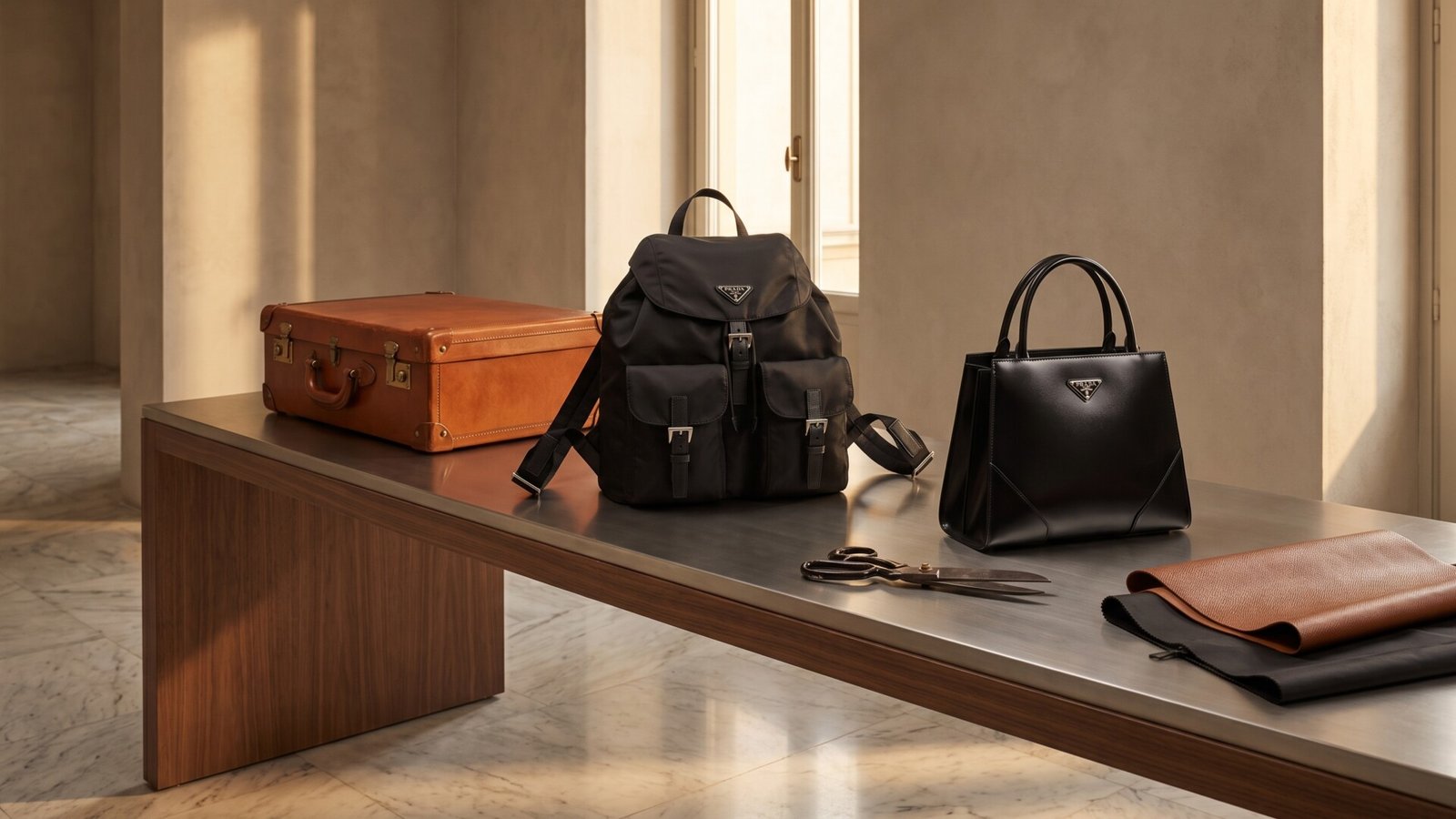
In the mid-1980s (sources date the first backpacks to 1984 or 1985), Prada began making bags from a tough, light black nylon called Pocone, a material associated with utilitarian uses rather than fashion. Nylon was a utility fabric, not a luxury one, and the bags were initially unconventional. They became the defining Prada product, and showed that luxury could use unconventional materials if the finish and design were serious.
3. Prada in the 1980s and 1990s
- 1979: first women’s footwear collection, an early step beyond bags.
- 1988: first women’s ready-to-wear collection, marking the move from leather goods to a full fashion house, and the start of international expansion.
- 1993: menswear debut. The same year saw the creation of Miu Miu, Miuccia’s younger and more playful label named after her family nickname, and of the art programme that later became Fondazione Prada.
- 1997: Linea Rossa leisurewear, the house’s sportswear line, recognisable by its red stripe, and the start of the Luna Rossa sailing project for the America’s Cup.
Through these years the “Prada look” took shape: minimal silhouettes, muted palettes and a deliberately slightly-off sense of proportion that critics came to call “ugly chic”. Our profile of Miuccia Prada covers the thinking behind it in more detail.
4. Prada’s Iconic Products
The Nylon Backpack
Introduced in the mid-1980s in black nylon with a small triangular metal logo plaque, the backpack redefined the relationship between luxury and practicality. It has been revived repeatedly, most visibly in the Re-Edition bags and, since 2019, in Re-Nylon.
The Re-Edition Bags
Around 2019 and 2020 Prada reissued two of its early-2000s nylon shoulder bags as the Re-Edition 2000 and Re-Edition 2005, small baguette-style bags with a detachable pouch on some versions. They brought the nylon story to a new generation and became some of the house’s best-known bags of the decade. On Prada’s US site in November 2026, the Re-Edition 2005 Re-Nylon shoulder bag was $2,250, a little under half the price of a small Galleria, which makes it the usual entry point to a Prada bag.
The Galleria Bag
Introduced in 2007, the Galleria is a structured Saffiano bag named for the Milan arcade where Mario Prada opened his first store in 1913. It is made in Italy and is one of the house’s most-carried handbags. On Prada’s US site in November 2026 the small Saffiano Galleria (24.5 x 16.5 x 11 cm) was $4,900, with larger sizes costing more; check Prada’s site for current prices. If you own Saffiano, our ink stain guide and the Saffiano vs smooth leather comparison explain how it wears, and Prada Saffiano vs Gucci GG Marmont compares it with a rival.
Prada Shoes
Footwear began in earnest in 1979 and now covers heels, loafers and sneakers, often using technical fabrics alongside leather. Prada also owns Church’s, the English shoemaker founded in Northampton in 1873, acquired in 1999, and has held a controlling stake in the Italian driving-shoe brand Car Shoe since 2004. Church’s makes Goodyear-welted shoes that can be resoled, a different construction from most of Prada’s own fashion footwear.
5. Prada’s Approach to Innovation
Technical Fabrics
Prada was among the first luxury houses to put nylon and performance materials at the centre of its identity, and it continues to experiment with technical textiles. The most unusual recent example is its work with Axiom Space on the spacesuits designed for NASA’s Artemis III Moon mission, unveiled in 2024, where Prada contributed materials and design expertise to the outer layer.
Architecture and Art
The first Epicenter store opened in New York in 2001, designed with Rem Koolhaas’s OMA, and treated the shop as a cultural space. Tokyo’s Aoyama Epicenter by Herzog & de Meuron followed in 2003 and a Los Angeles Epicenter by OMA in 2004. The Fondazione Prada, which grew out of the 1993 art programme, opened its permanent Milan venue, a converted distillery redesigned by OMA, in 2015, and also runs a space in Venice. Its exhibitions often connect to the house’s themes. Prada’s factories are part of the same thinking: several of its Tuscan production sites are “garden factories” designed by the architect Guido Canali.
Re-Nylon and Sustainability
Re-Nylon is Prada’s regenerated nylon, launched in 2019 and made from recycled sources such as discarded fishing nets and textile waste, and it is used in bags, clothing and accessories. The house states its own targets and progress in its sustainability reporting, which is the place to check specific claims.
6. Prada in the 21st Century
Going Public and Growing the Group
Prada Group listed on the Hong Kong Stock Exchange on 24 June 2011, while the family kept control. It operates Prada, Miu Miu, Church’s and Car Shoe, and in March 2014 took control of the Milan patisserie Pasticceria Marchesi 1824. Eyewear is produced under a licence with Luxottica, signed in 2003, and beauty under a licence with L’Oréal. According to the group’s 2026 profile, it runs 25 production sites, 23 of them in Italy.
The Versace Acquisition
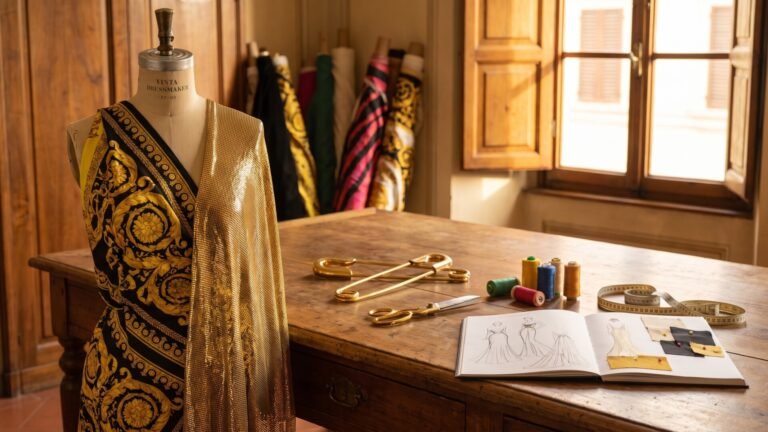
On 2 December 2025, Prada Group completed the purchase of Versace from Capri Holdings, for roughly $1.4 billion. Lorenzo Bertelli, Miuccia Prada and Patrizio Bertelli’s son, became Versace’s executive chairman. Creative director Dario Vitale left shortly after the deal, and in February 2026 Versace announced Pieter Mulier, previously at Alaïa, as its new creative director from July 2026. The group has said it expects Versace’s sales to shrink and losses to continue in 2026 while it is restructured. The two houses remain stylistically opposite, with Prada understated and Versace maximalist, and are run as separate brands. For the Versace story, see Gianni Versace.
Creative and Business Leadership
In 2020 Raf Simons joined Miuccia Prada as co-creative director of the main line, and the group’s 2026 profile still lists both in that role. On the business side, Andrea Guerra became group CEO in 2023, and in 2025 Patrizio Bertelli confirmed that Lorenzo Bertelli is expected to take over as CEO in time. Miu Miu remains Miuccia Prada’s own label.
Five Turning Points and Why They Mattered
Read as a whole, Prada’s history turns on a few decisions, each of which changed what the house could sell and to whom:
| Decision | When | What it changed |
|---|---|---|
| Licensing production to Bertelli’s IPI | 1977 | Gave the family an industrial partner, which made later expansion possible |
| Black nylon bags | Mid-1980s | Made a utility fabric the house signature and set Prada apart from logo-led rivals |
| Ready-to-wear and Miu Miu | 1988 and 1993 | Turned a bag maker into a fashion house with two distinct audiences |
| Listing in Hong Kong while keeping family control | 2011 | Raised capital and profile in Asia without selling the business |
| Buying Versace | 2025 | Added a house with the opposite aesthetic, making the group a multi-brand Italian rival to the French conglomerates |
A pattern runs through all five: Prada has grown by adding things that look like a contradiction at first, such as nylon in luxury, a playful label beside an austere one, or Versace beside Prada, and then making the contrast part of the identity.
7. The Prada Group Today: Which Brand Is Which
The group’s evolution means that “Prada” now covers several quite different labels. If you are buying, it helps to know where each sits:
| Brand | Joined the group | What it is | Who it suits |
|---|---|---|---|
| Prada | 1913 | The main line: Saffiano and nylon bags, ready-to-wear, shoes | Buyers who want understated, structured design |
| Miu Miu | 1993 | Miuccia Prada’s younger, more playful label | Buyers who want fashion-forward pieces and smaller bags |
| Linea Rossa | 1997 | Prada’s technical sportswear line, marked by a red stripe | Outerwear and sneakers for active use |
| Church’s | 1999 | English welted shoes from Northampton | Classic menswear and dress-shoe buyers |
| Car Shoe | 2004 | Italian driving moccasins | Buyers who want a soft, casual loafer |
| Versace | 2025 | Maximalist Milan house with the Medusa logo | Buyers who want bold, glamorous pieces |
The numbers show how the balance has shifted. In 2025 the group’s revenue grew 9%, to roughly $6.6 billion, but almost all of that growth came from Miu Miu, whose retail sales rose 35%, while Prada-brand retail sales slipped about 1%. Versace, consolidated only from December, had about $790 million in revenue for the full year. For a house that began with one shop, the newest chapter is about managing a portfolio rather than a single label.
8. Prada by Era: What the History Means for Vintage Buyers
Most Prada histories stop at the timeline. If you are buying pre-owned, the same dates are a practical tool, because a piece’s features should match the era it claims to come from. Use this as a first check, not as proof of authenticity:
- 1980s-1990s nylon: black or dark nylon backpacks and shoulder bags with the triangular metal plaque. This is the era most collectors look for. A listing that calls a bag 1990s but describes it as Re-Nylon is wrong, because Re-Nylon did not exist before 2019.
- Late 1990s-2000s sportswear: Linea Rossa pieces with the red stripe date from 1997 onwards, and became especially popular in technical jackets and sneakers.
- 2007 onwards, the Galleria: a “vintage” Galleria cannot be older than 2007. Earlier structured Saffiano bags exist, but under other names.
- 2019 onwards, Re-Nylon and Re-Edition: the current nylon bags are reissues of older shapes. If you want an original 1990s bag rather than a reissue, check the label and lining, and ask the seller for the year.
Resale prices for vintage Prada depend on condition, model and demand, and nothing is guaranteed. Buy for use first, and buy pre-owned only from sellers who authenticate and accept returns. No date check replaces a professional authentication for an expensive piece.
9. Prada’s Design Philosophy and Influence
- Minimalism and understatement: clean silhouettes and subtle details.
- Material innovation: nylon, technical fabrics and Saffiano.
- Function meets fashion: practical pieces that still look considered.
- Cultural awareness: collections that often engage with social themes and art.
Prada’s influence shows up in several trends. Technical, utilitarian fabrics in luxury clothing and bags, understatement over overt logos, and the crossover between luxury and sportswear all owe something to the house. Its approach to luxury minimalism is shared, in different ways, by Giorgio Armani, and its contrast with maximalist and romantic houses is clear when set beside Valentino Garavani or Gianfranco Ferré.
10. Prada Lifestyle Products
- Eyewear: produced under licence with Luxottica since 2003.
- Fragrance and beauty: starting with Amber in 2004, with Prada Candy among later launches; beauty is now licensed to L’Oréal.
- Travel: luggage and travel bags in nylon and leather.
- Food: Pasticceria Marchesi 1824, with shops in Milan.
Key Takeaways
- Heritage craftsmanship: from 1913 leather goods to a global group, leatherwork has stayed central, and most production is still in Italy.
- Material innovation: nylon in the 1980s changed what luxury could use, and Re-Nylon updated it in 2019.
- Brand building: ready-to-wear (1988), menswear (1993) and Miu Miu (1993) widened the house; Miu Miu now drives much of the group’s growth.
- Group strategy: Church’s, Car Shoe and now Versace make it a multi-brand group, still controlled by the family.
Frequently Asked Questions About The Evolution Of Prada
Is Prada still a family business?
Largely, yes. The Prada and Bertelli families control the group through their holding company, while a minority of shares trade on the Hong Kong Stock Exchange. Patrizio Bertelli is chairman, Miuccia Prada is co-creative director, and their son Lorenzo Bertelli is expected to become CEO in time.
Where are Prada products made?
Mostly in Italy. The group’s 2026 profile lists 25 production sites, 23 of them in Italy, mainly in Tuscany and the Marche. Church’s shoes are made in Northampton, England. As with any brand, check the label of the specific item for its country of manufacture.
What is the difference between Prada and Miu Miu?
Both are designed under Miuccia Prada, but Miu Miu is the younger, more playful label, with smaller bags and more experimental ready-to-wear. Prada is the main line, built around structured Saffiano and nylon pieces and a more austere look.
Did Prada really design a spacesuit?
Yes. Prada worked with Axiom Space on the spacesuit developed for NASA’s Artemis III Moon mission, unveiled in 2024. Prada’s role was the materials and design of the outer layer, drawing on its experience with technical fabrics.
Is vintage Prada nylon worth buying?
It can be, if the condition is good and the seller authenticates it. Original 1980s and 1990s nylon pieces are sought after, but corners, zips and the lining wear with age. Compare the price with a new Re-Edition bag before you buy, since a reissue may suit everyday use better.
Conclusion
Prada’s evolution is the story of one leather goods shop that became a group by treating materials, art and architecture as part of the product, and that is now learning to run several very different houses at once. For the house today, see the Prada guide, and for related Italian designers explore Angela Missoni and our wider Italian fashion designers guide.