Does Cashmere Hold Its Value? Resale Prices, Luxury Brands, and What to Expect
A plain cashmere crewneck from Loro Piana costs $1,500 or more at US retail at the time of writing, and buyers often justify that price by calling the sweater an investment. It is not one. Even a well-kept classic from a top house usually resells for a fraction of what it cost, and the size of that fraction is what this guide is about: what decides it, which brands and pieces keep more of it, and how to reason about the money before you buy.
Here is the correction up front. Most cashmere depreciates the moment you wear it, and no sweater you buy at retail is a financial asset. What separates a garment that recovers a meaningful share of its price from one that recovers almost nothing is not the price tag. It is fiber quality, a recognizable name, condition, a timeless cut, and whether anyone actually wants it secondhand. Premium Italian cashmere can hold value better than anonymous or heavily trend-driven knitwear, but brand prestige alone guarantees nothing.
What Cashmere Value Really Means on the Resale Market
Three different values get bundled into one word, and separating them is the first useful thing you can do.
Original retail value is what the boutique charged. Practical ownership value is what the garment gives you in warmth, wear, and pleasure across its life. Resale value is what a stranger will pay for it after you have finished with it. A sweater can be a superb purchase on the second measure and a poor one on the third, and that is not a contradiction. It is the normal case.
A simple framework helps you judge any piece before you buy it. Ask five questions: What will it resell for? How many times will I realistically wear it? What will it cost me to maintain? What condition will it be in after three winters? And will the style still look reasonable when I am done with it? A garment that scores well on all five is a sound purchase. One that scores well only on resale is a speculation, and cashmere is a bad thing to speculate in.
Resale platforms judge cashmere very differently from a boutique sales assistant. The platform buyer cannot feel the fabric through the photograph, so they lean on what they can see and verify: visible pilling, thinning at the elbows, whether the ribbing has gone slack, the brand on the label, the size, the color, and whether the piece is easy to wear. They also weigh authenticity, which is why a receipt and a label photograph matter more than you would expect.
Retail price is an unreliable guide to any of this. A high price can reflect boutique positioning, marketing, or a designer’s name rather than a proportionate increase in what you can recover; our explainer on why Italian cashmere is more expensive than Mongolian cashmere breaks down which parts of the premium are fibre and finishing and which are brand. The market does not care what you paid. It cares what the piece is worth to the next person.
What Determines Cashmere Resale Prices
Fiber and construction quality
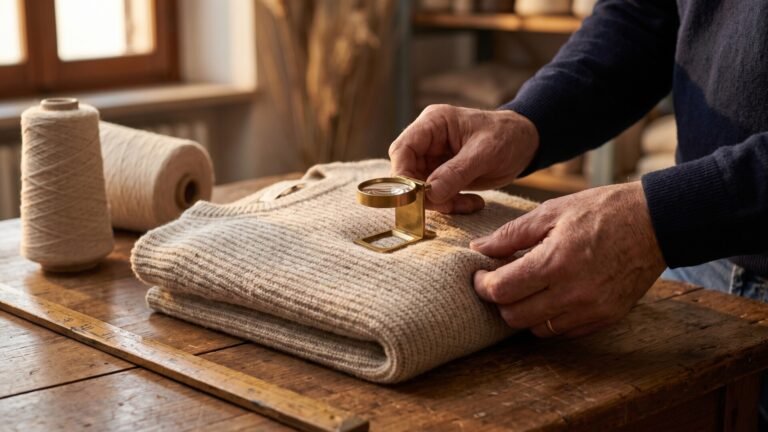
Softness is the most misleading signal in cashmere. A very soft sweater can be loosely spun from shorter fibers or heavily washed and finished to feel luxurious on the shelf, and both of those shortcuts shorten its life. What you want is density — how tightly the yarn is knitted — and a fiber long enough to resist pilling at friction points. Our guide to Italian knitwear explains gauge and ply if the labels are unfamiliar.
Run your thumb across the surface and look at how the knit behaves. A dense gauge holds its shape when you stretch it gently and springs back. A loose one stays stretched. Turn the sweater inside out and look at the seams: a properly finished garment has flat, secure seams, with panels linked or sewn cleanly rather than raw edges overlocked in a hurry.
Weight and structure decide which pieces survive to resale. A substantial crewneck or cardigan with a firm hand has a far better chance of passing inspection after years of wear than a featherweight fashion knit. Lightweight cashmere has its place, but it is the first to thin, pill, and lose its shape.
The resale killers are specific and predictable: severe pilling, thinning at the elbows and under the arms, stretched necklines and cuffs, moth holes, visible repairs, stains, and persistent odor. Any one of these can sharply cut what a buyer will offer, and a couple together can make a garment unsellable at any price.
Brand recognition and provenance
Established names — Loro Piana, Brunello Cucinelli, Malo, The Elder Statesman, N.Peal — attract more resale interest than an unrecognized label even when the material is comparable. That is not a judgment about quality. It is a fact about how buyers search. They type a brand name into a platform, not a fiber specification.
But a brand’s general reputation is not the same as the resale strength of a specific product. A classic scarf or a plain crewneck from a famous house is easy to move. An unusual seasonal piece from the same label can sit for months, because the buyer who wants that house and the buyer who wants that design are two different people, and the overlap is small.
Documentation reduces hesitation, particularly at higher prices. Receipts, dust bags, original tags, and proof of purchase all make a buyer more comfortable and support a better price. Keep them. It costs you nothing and it is worth real money at the point of sale.
Design, color, and size
The strongest resale candidates are boring in the best sense: classic crewnecks, cardigans, polo sweaters, turtlenecks, simple scarves, neutral colors, and wearable proportions. Camel, grey, navy, cream, black. These find buyers because the next person can imagine wearing them.
Extreme oversized shapes, loud logos, unusual embellishment, cropped cuts, and highly seasonal colors all narrow the pool. They can be wonderful to own. They are simply harder to sell, and you should buy them knowing that.
Size matters more than most sellers expect. Common adult sizes reach the widest audience. An unusually small or large size can take much longer to sell even when the garment is excellent, and the price often has to come down to compensate.
Which Cashmere Brands Hold Value Best?
No brand guarantees a resale percentage. Prices move with the market, the season, the condition, the color, the size, and the platform. What follows is a comparison of tiers, not a promise.
At the top, Loro Piana and Brunello Cucinelli carry the strongest recognition and the deepest international demand, and their classic knitwear in neutral colors is the easiest cashmere to resell. Both are priced accordingly. In November 2026, plain cashmere crewnecks listed at roughly $1,500-$2,750 on Loro Piana’s US site and at Mytheresa US, while Brunello Cucinelli’s plain cashmere crewnecks started around $1,350 at Mytheresa US, with cable knits at $3,500 and up. Our Loro Piana vs Brunello Cucinelli comparison covers how the two houses differ. The catch is arithmetic: because the original prices are so high, the absolute loss in dollars can still be substantial even at a healthy retention rate.
The specialists — The Elder Statesman, based in Los Angeles, and London’s N.Peal — are not Italian, but they appeal strongly to informed cashmere buyers. N.Peal’s clear association with cashmere and wearable silhouettes helps it move. The Elder Statesman trades on design identity and scarcity, which cuts both ways: a distinctive piece in a wearable color finds its buyer, while a bold seasonal piece can sit.
Malo and similar established Italian houses offer excellent material value and a genuine craftsmanship story, but general-market recognition is thinner. You may get a superb garment for the money and find the resale audience smaller than the quality deserves; see our Falconeri vs Malo comparison for how Malo is positioned.
Accessible premium brands — Falconeri, part of Italy’s Calzedonia group, the US label Quince, and comparable mid-market cashmere — have lower entry prices, which makes cost per wear attractive and resale demand weaker. Falconeri’s men’s cashmere crewnecks were $295-$425 on its US site in November 2026. Buyers do not chase these pieces secondhand because replacement is affordable. Our Gran Sasso vs Falconeri comparison covers the next step up in Italian knitwear.
When you research a brand, look at completed sales, not asking prices. An asking price is a wish. A completed sale is evidence. Use the platforms as market data, never as proof that a garment will appreciate.
Comparison Table: Cashmere Brands and Likely Value Retention
| Brand or tier | Typical buyer appeal | Resale strengths | Main resale risk | Best purchase strategy |
|---|---|---|---|---|
| Loro Piana (Italy) | Quiet luxury, understated design | Strong recognition and classic styles | Very high original price; condition is scrutinized | Choose timeless sweaters, scarves, and neutral colors |
| Brunello Cucinelli (Italy) | Refined styling, luxury positioning | Brand prestige and broad international appeal | Seasonal designs and embellishment may narrow demand | Favor restrained knitwear over heavily decorated pieces |
| Malo (Italy) | Italian cashmere heritage and material quality | Specialist appeal and strong craftsmanship story | Lower general-market recognition | Buy classic pieces at a sensible price |
| The Elder Statesman (US) | Collector appeal, distinctive color | Scarcity and strong design identity | Bold colors and high prices limit the buyer pool | Buy only if the design suits your wardrobe and has lasting appeal |
| N.Peal (UK) | Cashmere specialization | Clear category association and wearable styles | Resale depends heavily on condition and color | Favor classic basics and proven silhouettes |
| Falconeri or similar accessible premium | Lower entry price and practical everyday wear | Attractive cost per wear | Lower resale urgency because replacement cost is lower | Buy for use, not for resale |
| Unbranded or lightly recognized cashmere | Material-focused bargain buying | Can offer strong personal value | Difficult authentication and weak buyer demand | Purchase only when quality and price are clearly favorable |
Treat the table as directional, not precise. The spread between a well-kept classic and a pilled seasonal piece from the same brand is often wider than the spread between two brands. For fuller brand profiles and price tiers, see our guide to the best Italian cashmere brands.
The Hidden Cost of Choosing Cashmere for Resale
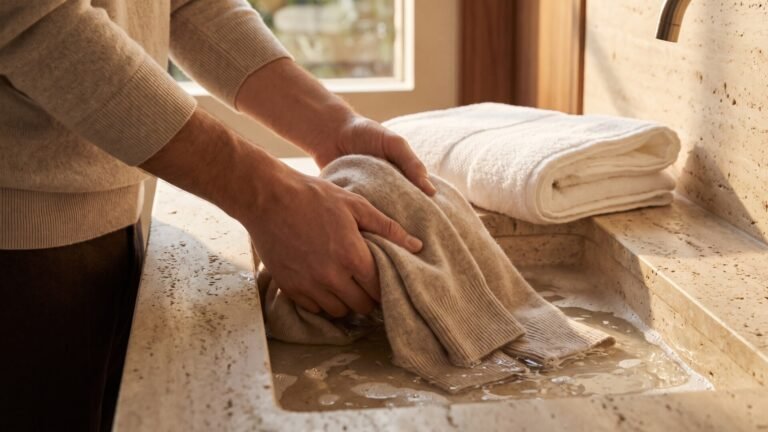
Care affects value more than almost any buyer expects. Hand washing or manufacturer-approved cleaning, drying flat, folding instead of hanging in the wardrobe, and proper storage all protect both wearability and resale condition. A sweater that has been hung on a hanger for two years has stretched shoulders that no buyer will forgive. Our guide on how to care for luxury sweaters covers washing, de-pilling, and moth-proof storage step by step.
The listing price and the money you actually receive are different numbers. On eBay in the US, most clothing pays a final value fee of 13.6% of the total sale amount, shipping included, plus $0.40 per order, according to eBay’s seller fee page at the time of writing. A sweater that sells for $300 plus $12 buyer-paid shipping costs about $43 in fees; after you pay the $12 to ship it, you keep around $257. Consignment services such as The RealReal set commission per item and pay lower rates on lower-value, lower-demand pieces, so a mid-priced sweater can net noticeably less in exchange for less work. Add cleaning, repairs, and the risk of a return, and always reason from net proceeds.
Which Cashmere Purchases Still Make Sense in Three Years?
A practical framework sorts most buying decisions before you reach the checkout.
Buy for long-term wear. Choose a garment you will wear frequently, regardless of resale prospects. This is the strongest case for most buyers, and it is where cashmere earns its keep.
Buy for value retention. Prioritize a respected brand, a classic style, a neutral or established color, excellent construction, and complete documentation. This narrows the loss without pretending it is a gain.
Buy for immediate luxury enjoyment. Distinctive colors, oversized silhouettes, and elaborate details may give you more pleasure but less resale liquidity. Buy them for the pleasure and be honest about the trade.
Avoid as a resale strategy. Do not buy purely because a product is expensive, labeled limited edition without proven demand, or described as an investment without transaction evidence. Those are marketing categories, not financial ones.
Does resale value change which sweater you should buy?
Rarely, and the arithmetic shows why. The real cost of a sweater is its purchase price minus your net resale proceeds, divided by the times you wear it. Take a $1,500 Loro Piana crewneck and a $295 Falconeri crewneck, each worn 60 times over four winters. Assume, for illustration only, that the Loro Piana later sells for $450 (30% of retail) and the Falconeri for $60. After eBay’s fees and shipping, as above, those sales net about $387 and $50.
| Scenario | Net cost after resale | Cost per wear (60 wears) |
|---|---|---|
| Loro Piana, $1,500, resold for $450 | About $1,113 | About $18.55 |
| Falconeri, $295, resold for $60 | About $245 | About $4.08 |
| Falconeri, $295, never resold | $295 | About $4.92 |
Even with a far better resale outcome, the luxury sweater would need about 270 wears to match the Falconeri’s cost per wear. So the decision rule is simple: choose the expensive sweater because you want its fibre, hand, and fit and will wear it hard, never because it resells. Resale only tips the choice between two pieces at similar prices, where the better-known name and the more classic cut can recover the difference. Our Piacenza 1733 vs Falconeri comparison applies the same cost-per-wear thinking to two Italian mid-range options.
An item bought on sale, through a reputable outlet, or pre-owned in excellent condition often has a better value equation than a full-price purchase, because you have removed some of the depreciation before you start. And wardrobe fit still decides everything. The best resale candidate is a poor purchase if its warmth, weight, silhouette, or maintenance needs do not suit how you actually live.
Italian Cashmere: Quality, Heritage, and Resale Reality
Italian production earns its reputation for specific reasons: long-standing textile districts such as Biella in Piedmont, knitwear makers clustered in Umbria, careful attention to hand feel and finishing, refined color development, and an emphasis on understated design that ages well. These are real advantages, and they support durability. Our Italian cashmere guide explains fibre length, ply, and the main houses.
But manufacturing origin and resale performance are separate questions. Italian production can support quality, yet buyers still pay for brand recognition, condition, style, and proof of authenticity, and the same holds for the Scottish mills compared in our Italian vs Scottish cashmere guide. A beautiful sweater from a small Italian maker with no international name will not command the price of a famous label, even if it is better made. If you plan to keep a garment for years, material value matters more; if you plan to resell, recognition does. Decide which you are doing before you buy.
Italian cashmere most likely justifies its premium when the knit is dense, the construction is classic, the finishing is durable, the color is versatile, and the price remains sensible relative to expected wear. When you are judging a piece in person, the hand test still decides it: press the fabric, watch it spring back, turn it over and find the seam, and check whether the edges are finished or hurried. For what happens between raw fibre and finished sweater, see how Italian cashmere is made.
How to Sell Cashmere Without Destroying Its Value
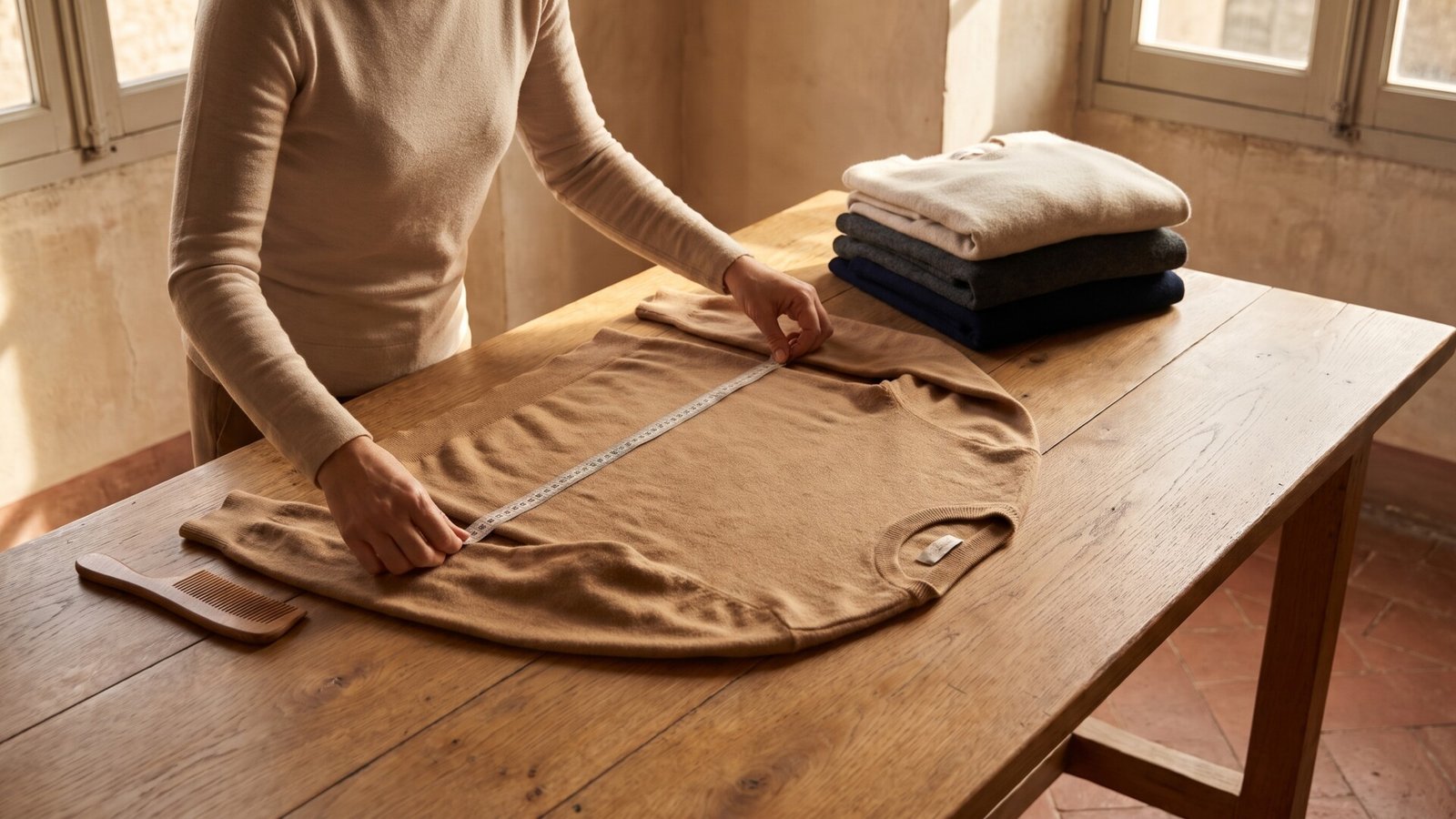
Preparation matters more than the listing copy. Clean the garment according to the care label, remove light surface pilling carefully with a cashmere comb, and have minor issues repaired professionally rather than leaving them for the buyer to discover. Photograph the label and the fabric up close, and record the actual measurements — chest, length, sleeve — because buyers cannot try it on.
Then choose your channel. A luxury consignment specialist brings a qualified audience and handles authentication and photography, at the cost of a higher commission and less control over price. A peer-to-peer marketplace gives you pricing control and a direct audience, but you carry the fraud and return risk. A general resale platform sits in between, with broad reach and variable buyer quality. [Affiliate: Compare pre-owned cashmere on a luxury resale platform]
Price from completed sales, not from your original receipt. Start realistic, account for fees, and reduce gradually rather than anchoring to what you paid. A trustworthy listing names the brand, the model or collection if known, the fiber information from the label, the size, the actual measurements, the color, the condition, any flaws, the purchase history if available, and the storage history.
And resist overclaiming. "Rare," "investment piece," and "like new" are words that invite disputes when the garment shows wear. Accurate disclosure protects your reputation and, counterintuitively, supports a stronger transaction, because buyers trust a seller who names the flaw.
Buying Verdict: Is Cashmere a Good Investment?
Best recommendation for most buyers: buy cashmere for long-term wear, not as a financial asset. Prioritize a garment you will wear regularly and maintain correctly; our guides to the best Italian cashmere sweaters for men and for women compare the classic styles that do this best.
Best option for value retention: a classic, well-constructed piece from Loro Piana, Brunello Cucinelli, Malo, N.Peal, or another recognized specialist, purchased at a reasonable price and kept in excellent condition.
Best option for cost per wear: a durable mid-range classic such as Falconeri or a comparable premium label, especially when bought below full retail.
Best option for collectors: distinctive pieces from The Elder Statesman or another design-led house, but only when you value the garment independently of its future resale price.
Who should skip the purchase: buyers seeking guaranteed appreciation, buyers unwilling to follow care requirements, and buyers choosing a premium garment mainly because its retail price implies future value.
Most readers do not need to spend four figures to get cashmere that holds its value in the way that actually matters. A well-made mid-range classic, bought below full retail, worn hard, and cared for properly will beat a prestige purchase worn twice a season on every measure except the label. Spend more only if the garment itself — the density, the finishing, the color you will still want in five years — genuinely earns it. For how cashmere fits into a wider wardrobe, see our guide to Italian designer clothing.
Frequently Asked Questions About Cashmere Value
Do cashmere blends hold their value?
Less well than 100% cashmere. Resale buyers filter by fibre content, and a blend with a small share of cashmere is priced closer to fine wool. A blend from a top house still trades partly on the brand name, but it rarely matches the same house’s pure cashmere. Photograph the composition label clearly, because buyers will ask for it before they pay.
Do cashmere scarves hold value better than sweaters?
Often, yes. A scarf has no size, so every buyer is a potential buyer, and it avoids the elbow, underarm, and cuff wear that ruins sweaters. A plain scarf in a neutral color from a recognized house is one of the easiest cashmere pieces to resell. See our guide to the best Italian cashmere scarves.
Can I sell a cashmere sweater with moth holes?
You can, but expect a steep discount and disclose every hole with a close-up photograph. Small holes can be reknitted or rewoven by a specialist, which is worth paying for only on a high-value piece. Before listing, freeze or clean the garment so you are not passing larvae to the buyer, and check that the platform accepts damaged items.
When is the best time of year to sell cashmere?
Demand for knitwear rises as the weather cools, so listing from early autumn into winter puts your piece in front of the most buyers. Listing in late spring or summer usually means fewer views and more price cuts. If you are clearing a wardrobe in spring, it can pay to store pieces carefully and list them in the autumn.
How can I tell if a pre-owned luxury cashmere sweater is authentic?
Buy from platforms that authenticate items or offer buyer protection, and ask for photographs of the brand label, composition and care labels, and any interior tags. Compare them with the brand’s current product pages. No home checklist can prove authenticity, so for high-value pieces rely on a reputable authentication service and keep the seller’s documentation.