Gran Sasso vs Falconeri vs Brunello Cucinelli: Italian Knitwear at Different Price Points
You are standing in a knitwear department with three plain cashmere crewnecks in front of you. At US list prices in late 2026 the tags read roughly $300 for Falconeri, $600 for Gran Sasso and $1,250 for Brunello Cucinelli. To your hand they feel closer than the numbers suggest. This is the whole problem with Gran Sasso vs Falconeri vs Brunello Cucinelli in a single moment: the price ladder is real, but it does not map cleanly onto a quality ladder. Falconeri sells accessible cashmere and polished basics. Gran Sasso is a knitwear specialist with technical breadth across cashmere, merino, cotton and linen. Brunello Cucinelli sells a design experience, a finished look and a specific softness of proportion, and charges a very large brand premium for it. The right choice depends on whether you want easy everyday cashmere, technical value, or the design itself.
Short answer: Falconeri for the least expensive well-made Italian cashmere, Gran Sasso for the widest choice of fibres and weights from one maker, Brunello Cucinelli only when you are buying its look.
How the Three Brands Occupy Different Levels of Italian Knitwear
Start by separating five things that price bundles together: the fiber, the labor, the design, the brand, and the retail structure. A sweater’s ticket is the sum of those, not a measurement of any one of them.
Falconeri sits at the accessible end of Italian cashmere. Launched in 2000 and part of the Calzedonia group (now called Oniverse) since 2009, it designs and knits at its own plant in Avio, in Trentino; in a 2022 interview with Forbes Italia the brand said about 92% of its garments are produced in-house there. It built its identity on cashmere and refined wardrobe essentials, at a price that makes a first cashmere purchase feel possible. Its strength is simplicity: clean crewnecks, cardigans, fine-gauge layers that slip under tailoring without fuss. Our Falconeri brand guide covers its Ultrasoft and Ultrafine lines in detail.
Gran Sasso sits in the middle of the price ladder and at the technical end of the range. The company was founded in 1952 by the four Di Stefano brothers in Sant’Egidio alla Vibrata, in the province of Teramo near the Abruzzo–Marche border, and is still run by the family. It is a knitwear specialist first, working across extra-fine merino, cashmere, cotton, linen and silk blends, with fine-gauge pieces built for layering. That range matters more than any single garment. A specialist can offer you a four-season rotation from one label and teach you, by comparison, what a good knit feels like at several weights. See our Gran Sasso knitwear guide for the full range.
Brunello Cucinelli sits at the top. Founded in 1978 and based in the restored hamlet of Solomeo in Umbria, it is a fashion and lifestyle house rather than a knitwear workshop. Material selection is excellent, but it is only one input. Design language, finishing, exclusivity, presentation, and the recognizability of the look all carry weight in the price. Our complete Brunello Cucinelli guide explains the house, its prices and how it compares with Loro Piana.
Here is the warning that should frame everything else. If you compare a plain cashmere crewneck from each brand as though price alone measures quality, you will reach a misleading conclusion. You are not comparing three versions of the same object. You are comparing three different products that happen to share a shape.
What the Same Budget Buys at Each Brand
Most comparisons line these brands up by prestige. It is more useful to line them up by what a fixed budget buys, because the ranges overlap in places the price ladder hides. US prices below are list prices seen at the brands’ own stores and major US retailers in 2026; sale prices run lower.
| Budget | Falconeri | Gran Sasso | Brunello Cucinelli |
|---|---|---|---|
| About $300–$425 | Pure cashmere crewnecks and turtlenecks | Extra-fine merino, cotton or wool-cashmere crewnecks (from about $295) | Nothing in knitwear |
| About $500–$850 | Above most of its knitwear | Pure cashmere crewnecks and V-necks | Nothing in knitwear |
| $1,250 and up | Not applicable | Not applicable | Plain cashmere crewneck $1,250–$1,400; English-rib and cable styles about $2,000–$4,000 |
The decision rule that falls out of this: under about $450, the real choice is Falconeri cashmere versus Gran Sasso merino, not Gran Sasso versus Cucinelli. Choose the Falconeri if warmth for weight and softness come first and you will hand wash. Choose the Gran Sasso merino if the sweater will be worn hard, under a coat strap and through a working week. Between $500 and $850, Gran Sasso cashmere is the only one of the three in play, and it is where the maker’s specialism shows most. Above $1,250 you are no longer buying a better basic: the extra cost of a Cucinelli crewneck goes on proportion, colour and finishing, so buy one only if that is what you want.
Materials, Construction, and What You Are Actually Paying For
Fiber and yarn quality
Cashmere, merino, extra-fine wool, cotton, silk, and blends all behave differently, and each brand leans on a different mix. Cashmere gives warmth for very little weight. Merino gives resilience and a smoother, denser hand that survives frequent wear. Extra-fine wool sits between the two. Silk blends add drape and a cool finish.
Fiber origin and softness will not tell you whether a sweater will last. Two cashmere crewnecks can feel identical in the shop and diverge within a month. What separates them is yarn twist (how tightly the fibers are spun, which controls how much the surface frizzes), gauge (how many stitches per inch, which sets density and weight), the finishing, and the knit structure itself. A denser, slightly humbler yarn resists pilling and asks for less delicate care, which is why a less expensive wool or blend can be the smarter buy.
Construction and finishing
Turn the sweater inside out before anything else. You are looking at the seams, and they will tell you most of what you need.
Check the shoulders and armholes first. A well-made knit is usually fully fashioned, meaning the panels are knitted to shape rather than cut from a flat sheet of fabric, so the edges are clean and the seams do not bulk. Look at the linking, the seam that joins panels stitch to stitch. It should lie flat and even, with no ridge you can feel through the outside.
Run your thumb along the inside edge of a seam. If it catches, it was finished in a hurry. Press the collar and cuffs and watch them come back. Good ribbing has recovery; cheap ribbing stays stretched. Hold it to the light and check the tension is balanced, with no thin patches or visible laddering.
Then separate the categories. A fine-gauge business knit and a chunky weekend sweater are different engineering problems, and a brand can excel at one and coast at the other. Assess the individual garment, not the name on the label.
Why the price gap is not purely a quality gap
The gap between a $300 Falconeri crewneck and a $1,250 Brunello Cucinelli crewneck is not $950 of extra cashmere. It is raw materials, Italian labor, design development, finishing, limited production, retail structure, branding, and distribution, stacked in different proportions. Falconeri keeps its price down by knitting in its own plant and selling largely through its own stores; Cucinelli sells through flagship boutiques and luxury department stores, and that structure is part of what you pay for.
Which leads to the contrarian point worth holding onto. Brunello Cucinelli may offer the most distinctive luxury experience of the three without being the most rational choice for basic everyday knitwear. If what you want is a soft grey crewneck to wear under a jacket three days a week, the premium buys you design and feeling, not durability. Gran Sasso and Falconeri compete strongly on comfort and wardrobe usefulness precisely because they are not charging you for the look.
Gran Sasso vs Falconeri vs Brunello Cucinelli: Side-by-Side Comparison
| Factor | Gran Sasso | Falconeri | Brunello Cucinelli |
|---|---|---|---|
| Founded and base | 1952, Sant’Egidio alla Vibrata (Abruzzo) | 2000, Avio (Trentino) | 1978, Solomeo (Umbria) |
| Ownership | Di Stefano family | Oniverse (formerly Calzedonia group) since 2009 | Listed company founded by Brunello Cucinelli |
| Overall positioning | Specialist Italian knitwear with strong technical breadth | Accessible premium cashmere and wardrobe essentials | Luxury Italian fashion and lifestyle house |
| US cashmere crewneck (list) | About $500–$850 | About $295–$425 | About $1,250–$1,400 |
| Lowest entry point | Merino and cotton from about $295 | Cashmere from about $295 | Wool-cashmere from about $1,200 |
| Design language | Classic, adaptable, often quietly detailed | Clean, refined, understated | Soft, relaxed, layered, highly recognizable |
| Best for | Buyers prioritizing construction, variety, and value | Buyers wanting easy-to-wear cashmere at an approachable price | Buyers seeking distinctive design, finishing, and prestige |
| Main tradeoff | Less immediate status recognition | Less distinctive design; some variation by item | Large brand premium and higher maintenance cost |
Read the table as a set of trade-offs rather than a scorecard. Gran Sasso wins on material breadth and on what its cashmere offers for the money. Falconeri wins on low-risk everyday purchasing: you know what you are getting and it is easy to wear. Brunello Cucinelli wins on design-led luxury, and that is a real category, not a consolation prize.
What Most Buyers Get Wrong About Italian Cashmere
The most common mistake is buying the softest sweater in the shop. Softness is a surface quality, and it is often produced by finishing the yarn and the surface to a high fuzz. That fuzz is exactly what pills. A cashmere that feels slightly firmer and denser in the hand frequently outlasts the cloud-soft one, because the fibers are spun and knitted to hold together.
The second mistake is assuming lightweight equals luxury. A very fine, light cashmere piece feels wonderful and layers beautifully, but it is a poor candidate for daily rotation. Under a coat strap, against a bag, across a desk, the friction wins. A denser merino or a wool-cashmere blend will often outlast it in exactly the situations people actually wear sweaters.
Third, price-per-wear changes the ranking entirely. An expensive Brunello Cucinelli piece worn twice a week for years can be perfectly reasonable. A special-occasion design that comes out four times a winter never gets there, whatever it cost. Do the division before you decide the premium is unjustifiable or the bargain is a bargain.
Finally, distinguish buying a brand’s signature aesthetic from buying the best technical knit for a specific need. If you want the Brunello look, buy the Brunello look and enjoy it. If you want a workhorse layer, buy the workhorse.
Which Brand Is Best for Different Wardrobes and Use Cases?
For a professional capsule wardrobe
Gran Sasso is the strongest foundation here. You can build several reliable layers across weights, colors, and fibers from one label, and each piece earns its place. Falconeri works well for simple cashmere cardigans, crewnecks, and fine-gauge pieces that sit under tailoring without bulk. Brunello Cucinelli is worth considering for one refined statement layer, not for the whole workwear base.
For travel and frequent wear
Judge packability, wrinkle recovery, layering, odor management, and care demands. Pure delicate cashmere is a demanding travel companion; midweight merino or a wool-cashmere blend handles repeated wear and a hotel sink far better. Favor neutral colors, resilient knit structures, and pieces that do not demand constant dry cleaning. Here the technical breadth of Gran Sasso usually serves a traveler better than the design pull of the top house.
For relaxed luxury and weekend dressing
This is Brunello Cucinelli’s territory. Softer proportions, texture, shoulder shape, and volume are what make an outfit read as expensive, and the house is expert at that layered, easy elegance. Gran Sasso covers classic versatility, Falconeri covers polished ease. If you want the specific softness of proportion, pay for the design language, not for a basic crewneck you could buy elsewhere.
For a first Italian knitwear purchase
Falconeri is the least intimidating entry point if cashmere basics are the goal. Gran Sasso is the better first purchase if you want to learn construction and compare fibers, because the range teaches you what you like. Brunello Cucinelli is best approached after you know your fit, gauge, color palette, and wearing habits, so the premium lands on a piece you will actually reach for.
For the wider picture, see our Italian cashmere guide, and our ranking of the best Italian cashmere brands if you want Loro Piana, Malo or Fedeli in the frame. If you have narrowed it to two, our head-to-heads cover Gran Sasso vs Brunello Cucinelli and Brunello Cucinelli vs Falconeri. For mill-made cashmere at the top of the market, compare Piacenza 1733 vs Brunello Cucinelli and Lanificio Colombo vs Brunello Cucinelli.
The Hidden Cost of Choosing the Wrong Knitwear
The purchase price is only the first bill. Knitwear carries a maintenance cost that most buyers underestimate, and it lands hardest on the most delicate pieces.
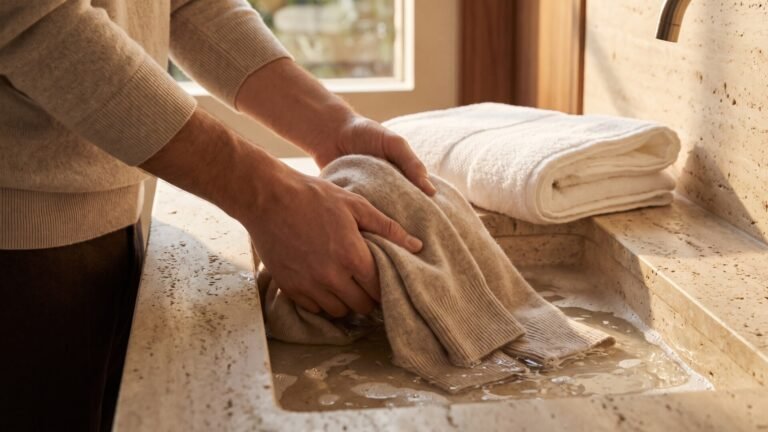
Hand washing or specialist cleaning, drying flat, storing folded, depilling, and protecting against moths and abrasion all take time and attention. Pilling, stretching, collar distortion, and color transfer are the quiet failures. A too-soft, too-light sweater worn against a bag strap, a coat, a desk, and a plane seat will show all of them sooner than a denser knit. Our guide on how to care for luxury sweaters covers washing, drying and moth-proof storage step by step.
Fit is part of lifespan. Overly tight knitwear strains seams and wears the surface faster. Overly oversized pieces can lose shape and date quickly. The sweet spot is a fit with a little ease that lets the knit move without pulling.
Here is the decision rule worth carrying into the shop: choose the most luxurious fiber your lifestyle can realistically maintain, not the most luxurious fiber you can afford. If you will not hand wash and dry flat, buy the merino. If you travel constantly, buy the blend. The best sweater is the one that survives your actual week.
[Affiliate: Browse cashmere care essentials] if you want the comb, the wash, and the storage to protect whatever you buy.
Value, Longevity, and Resale Potential
Judge value through three lenses: cost per wear, expected wardrobe lifespan, and resale appeal.
On cost per wear and lifespan, classic Gran Sasso and Falconeri staples frequently beat highly seasonal luxury pieces, even when the latter carry more prestige. A restrained navy crewneck worn for years wins the arithmetic. A Brunello Cucinelli piece with distinctive styling can win on resale interest because the brand is recognizable, but high original prices and strict condition requirements make the outcome variable, and no knitwear should be bought as a financial asset. Our Brunello Cucinelli Solomeo guide works through the cost-per-wear math and what resale realistically returns.
The pieces most likely to age well are the same across all three houses: restrained colors, classic crewnecks, cardigans, fine-gauge turtlenecks, and versatile neutral layers. Trend-forward shapes and loud colors are where cost per wear collapses.
A simple long-term framework:
- Buy Gran Sasso when construction and wardrobe breadth are the priority.
- Buy Falconeri when accessible cashmere and straightforward wearability matter most.
- Buy Brunello Cucinelli when the design, finish, and emotional appeal genuinely justify the premium beyond fiber content.
Buying Verdict: Which Brand Should You Choose?
Choose Gran Sasso if you want the strongest balance of Italian manufacturing, knitwear expertise, material variety, and rational long-term value. It is the specialist’s choice, and it rewards a buyer who wants to understand what they are wearing.
Choose Falconeri if you want approachable cashmere essentials, clean styling, and the least expensive step into Italian cashmere of the three. It is the low-risk choice.
Choose Brunello Cucinelli if you value a recognizable luxury aesthetic, refined proportions, exceptional presentation, and design details more than price efficiency. It is the design choice, and it is a legitimate one. If you are also weighing Loro Piana at the same level, our Loro Piana cashmere sweater alternatives guide shows where the quiet-luxury look can be had for less.
Skip all three temporarily if the wardrobe need is not clear. A well-fitting midweight wool sweater may serve you better than an expensive cashmere piece you wear occasionally.
Ranked by buyer type rather than one universal winner:
- Best overall value: Gran Sasso.
- Best accessible cashmere: Falconeri.
- Best high-luxury design experience: Brunello Cucinelli.
- Best for a first purchase: Falconeri or Gran Sasso, depending on whether softness or construction matters more.
- Best for a luxury collection: Brunello Cucinelli, used selectively rather than as the default.
[Affiliate: Explore Gran Sasso knitwear] and [Affiliate: shop Falconeri cashmere] to see the ranges side by side. For how these three sit among the other houses, see our guide to Italian designer brands.
Frequently Asked Questions About Gran Sasso Vs Falconeri Vs Brunello Cucinelli
Is Falconeri made in Italy?
Falconeri designs and knits at its own plant in Avio, Trentino, and said in 2022 that about 92% of its garments are produced in-house there. The raw cashmere comes from Mongolia and China, as it does for almost every Italian brand. Check the label on each piece, since Made in Italy applies garment by garment.
Who owns Falconeri, and is it a luxury brand?
Falconeri has belonged to the Calzedonia group, now renamed Oniverse, since 2009; the same group owns Intimissimi and Tezenis. It is best described as accessible premium: Italian-knitted cashmere at prices well below Loro Piana or Brunello Cucinelli, sold mainly through its own stores rather than luxury department stores.
Is Falconeri real cashmere?
Yes, its core range is 100% cashmere, sold in lines such as Ultrafine and Ultrasoft. The brand also sells wool, cotton and blends, so check the fiber content on the specific garment before you compare prices. A wool-cashmere blend at a similar price is a different product, not a cheaper version of the same sweater.
How do Italian knitwear sizes convert to US sizes?
All three brands use Italian sizing on many pieces. As a rule of thumb, Italian 48 is about a US 38 chest, 50 about a 40 and 52 about a 42. Fit differs by cut, so check each brand’s size chart; Cucinelli’s relaxed shapes often allow sizing down.
Should I buy cashmere or merino wool from these brands?
Choose cashmere for softness and warmth for weight. Choose merino for frequent wear, resilience and easier care. At around $300, that is the real choice: a Falconeri cashmere crewneck or a Gran Sasso merino one. Let the use decide, not the prestige.
Do these brands go on sale?
Yes. At the end of each season, multi-brand retailers often mark Gran Sasso and Falconeri knitwear down by a third to a half, and Brunello Cucinelli pieces also appear reduced at department stores and online luxury retailers. Classic colours sell out first, so sale stock leans toward seasonal shades.
How should Italian cashmere be cared for?
Follow the care label, hand wash cool with a wool detergent or use a specialist cleaner, and never tumble dry. Dry flat, fold rather than hang, rest pieces between wears and store them clean against moths. See our luxury sweater care guide for the full routine.