How to Care for Luxury Sweaters: Cashmere, Merino Wool, and Fine Knitwear
Most damage to fine knitwear is not ordinary wear. It is heat, friction, bad drying and careless storage, and each of those is a decision the owner makes. A cashmere crewneck washed in warm water with ordinary detergent, wrung out and dried on a radiator can come out a size smaller with a felted surface, and that kind of damage does not reverse. Treated correctly, the same sweater can stay in rotation for many seasons.
The correction is worth stating plainly, because it runs against the received wisdom. Your sweaters do not need dry cleaning after every wear, and they do not benefit from being washed as little as possible. They benefit from being aired, washed gently when they actually need it, dried flat, and stored clean and dry. Get those four things right and a well-made Italian cashmere sweater will outlast most of the wardrobe around it.
Why Luxury Knitwear Needs a Different Care Routine
Wool is a protein fiber, and protein responds to heat and agitation in ways cotton and synthetics do not. Under warm water and friction, the scales along each wool fiber lock together and the fabric felts – the fibers mat into a denser, shorter, irreversibly tighter mass. Cashmere, merino, alpaca, and wool-silk blends all share this vulnerability to different degrees, which is why they need a routine of their own rather than a slot in the general laundry.
Cashmere comes from the undercoat of the cashmere goat, and its fibers are finer and shorter than sheep’s wool. Fine means soft against the skin. Short means more fiber ends working loose at the surface, which is the root of pilling; our guide to how Italian cashmere is made explains why fiber length is graded so closely at the spinning stage. Merino is sheep’s wool bred fine, with longer fibers and a natural crimp that gives it elasticity and resilience. Alpaca is warmer and denser for its weight but has little memory – it drapes beautifully and sags if you hang it wet. Silk blends add sheen and drape and demand cool water. Fine cotton knits are more forgiving of heat but stretch under their own weight when wet.
Construction matters as much as fiber. Gauge is the number of needles per inch on the knitting machine; higher gauges mean finer, thinner fabric that is more vulnerable to snagging and distortion than a chunky knit. Loose stitches catch on rings and bag hardware. Brushed surfaces, the fuzzy finish you see on some cashmere, show wear and matting faster than smooth ones. Ribbed trims at cuffs and hem are denser and recover well, but they are also where friction concentrates. The Italian knitwear guide covers gauge and ply in more depth. Softness is not durability: a very fine-gauge cashmere feels extraordinary in the hand and needs more careful handling than a denser merino or a wool-cashmere blend.
The care label is your starting point, not a substitute for judgment. Several knitwear brands, Eileen Fisher among them, tell customers that “dry clean only” on a plain wool or cashmere sweater can usually be set aside in favor of careful hand-washing. On an embellished, lined, or shaped garment, the label means what it says. Read the fiber and the construction together, and the label becomes a guide rather than a rule you either obey or ignore.
Washing Cashmere, Merino Wool, and Fine Knitwear Without Damaging It
When to wash and when to air
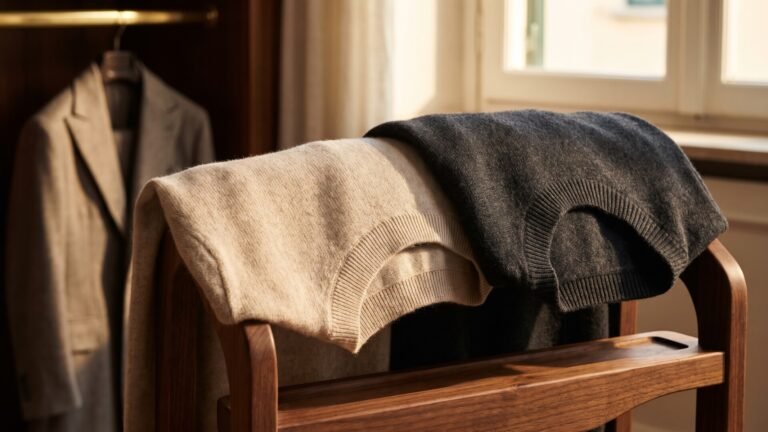
A sweater worn over a shirt in a cool office does not need washing after every wear. Wool resists odor well, and airing does most of the work. Lay it over a chair or a wide wooden hanger in a ventilated room overnight, and rotate two or three sweaters through the week so each one gets several days to recover its shape between wears.
Brand care guides disagree sharply on how often to wash. J.Crew’s cashmere guide suggests about every three wears; Eileen Fisher says roughly every seven to ten; Veronica Beard advises once or twice a season, including before storage. They are not contradicting each other so much as describing different wearers. A simple rule resolves it:
- Worn directly against the skin, or in a warm environment: every three to five wears, because body oils collect at the collar, cuffs and underarms and attract moths.
- Worn over a shirt or base layer: every seven to ten wears, with airing in between.
- Worn occasionally, as an outer layer or for formal use: once mid-season if needed and always before storage.
Outside that rhythm, wash when there is a reason: odor that airing does not shift, a visible mark, a spill. Do not confuse airing with masking. Spraying perfume on a sweater to cover odor leaves residue that attracts moths and dulls the surface. If it smells, it needs air or a wash.
Hand-washing method
Hand-washing is the safest method for anything you care about, and it takes about fifteen minutes of actual attention:
- Check the label. Note the fiber, any temperature restriction, and whether the garment is embellished or lined.
- Close fastenings on cardigans and turn the garment inside out to protect the surface.
- Fill a basin with cool or lukewarm water – never hot, and never water you would not put your hand into comfortably.
- Dissolve a small amount of wool-specific detergent; a capful is usually plenty. Many regular detergents contain enzymes (such as protease) and optical brighteners, and protease breaks down protein fibers like wool and cashmere.
- Submerge the sweater and let it soak for five to ten minutes. Press it gently under the water. Do not rub, wring, or agitate. Friction is what felts wool.
- Rinse in water of the same temperature. A sudden change from warm to cold encourages the fiber scales to lock and shrink.
- Press the water out – do not twist. The drying section below covers the rest.
Skip prolonged soaking: an hour in water weakens fibers and can cause dye to bleed. For makeup, food, or drink marks, blot rather than rub, work from the outside of the stain inward, and test any treatment on an inside seam first. Oily or strongly colored stains on a delicate finish are worth a professional’s time.
Machine washing and professional cleaning
Some modern wool cycles are genuinely gentle, and some cashmere and merino garments are labeled for machine washing. When that is the case, use a mesh laundry bag, a cold wool cycle with low spin, one garment at a time, and a wool-specific detergent. Remove the sweater promptly when the cycle ends – leaving it damp in the drum invites creases and a stretched shape. A “hand wash” label on a shaped, embellished or blended garment is telling you something; the time saved by overriding it is rarely worth a ruined sweater.
Professional cleaning has a place: structured garments, complex blends, stubborn stains, and anything you are unsure of. Choose a cleaner who understands knitwear – ask whether they hand-finish and whether they block the garment back into shape after cleaning.
Drying, Reshaping, and Preventing Shrinkage
Most sweater damage happens in the drying. Wringing twists the fibers and distorts the knit. Hanging a wet sweater puts the entire weight of the water into the shoulders, which stretch into permanent points. Radiators and tumble dryers apply the heat that felts wool. All of these are irreversible.
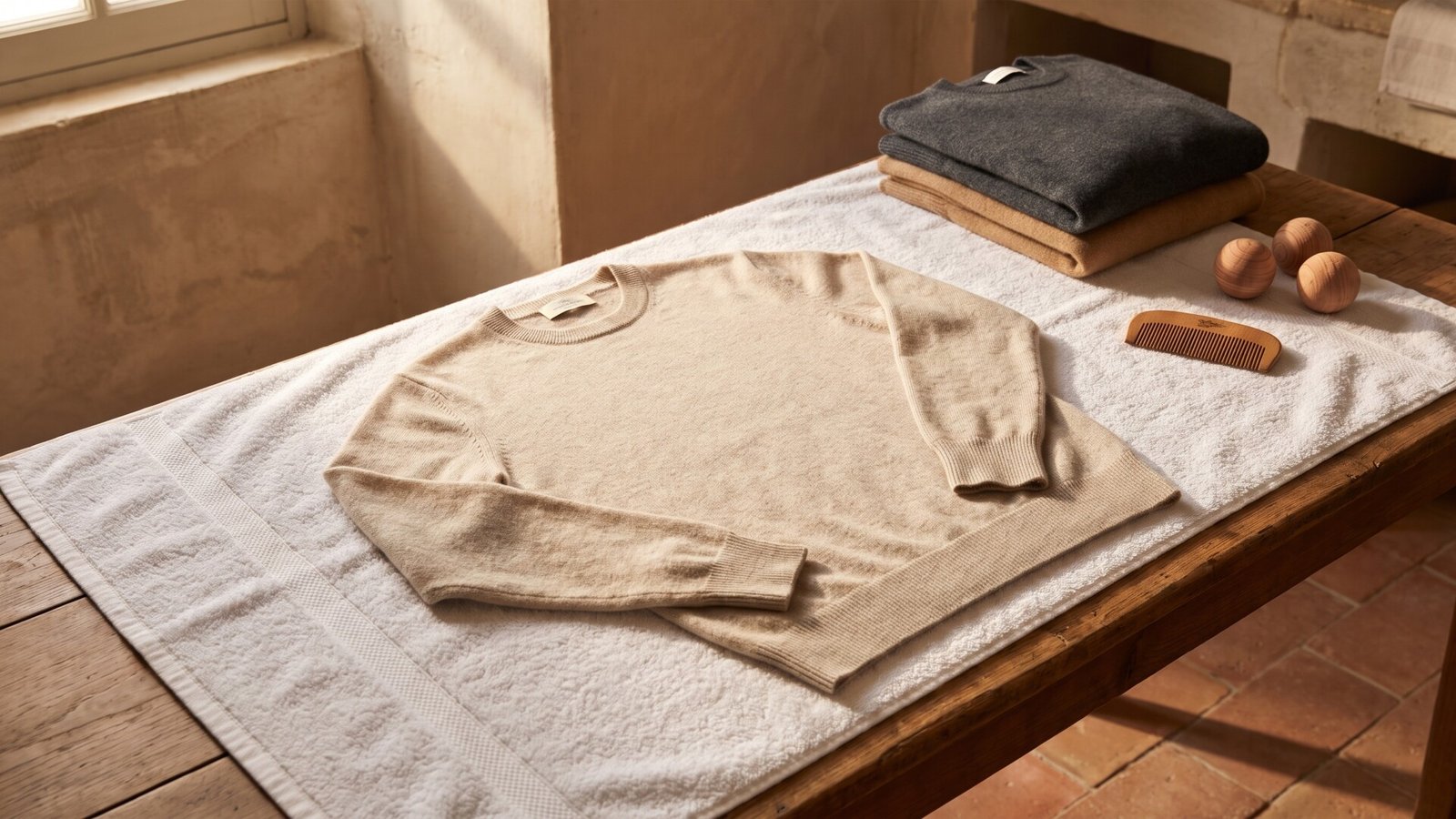
- Press the excess water out between your palms, then lay the sweater on a clean white towel and roll the towel up with the sweater inside. Press down along the roll. The towel absorbs most of the moisture.
- Lay the sweater flat on a dry towel or a breathable drying rack.
- Reshape it immediately – shoulders squared, sleeves straight, neckline and hem eased back to their original proportions. Measuring chest width and body length before the first wash gives you something to reshape against.
- Leave it in a ventilated room, away from direct sun and radiators. Drying usually takes a day or two depending on the weight of the knit.
- After a day, turn it carefully and check the underside. Moisture trapped underneath can leave a damp smell and encourage mildew.
If a sweater has already shrunk, be honest about the odds. Minor shape changes from a single wash can sometimes be eased back by soaking in cool water and gently stretching while damp. Heat-related felting – the matted, dense surface that comes from hot water or a dryer – is usually permanent, and aggressive stretching can distort the knit further. A specialist knitwear repair service can sometimes reblock a garment, and it is worth asking before you give up on an expensive piece.
What Most Owners Get Wrong About Pilling, Snagging, and Shedding
Pilling is the single most misunderstood thing about fine knitwear. Those small fiber balls at the underarms, cuffs, and side seams are not automatically a sign of poor quality. They are loose fiber ends working to the surface under friction and tangling together. Short fibers pill more than long ones, which is why some very soft, very fine cashmere pills more than a denser, longer-fiber merino. High-friction areas – underarms, cuffs, where a bag strap crosses the body, the back of a chair – are where it shows first.
A new sweater often pills in the first few wears as the shortest fibers work loose; groom it and it usually settles. Excessive shedding, where the surface thins and fibers come away in quantity, points to a fiber or construction problem worth raising with the retailer. A hole, a pulled thread or a thinning patch is structural damage and needs repair, not grooming.
For surface pills, use a cashmere comb with a light hand: lay the garment flat, comb in short strokes in one direction, and test on an inconspicuous area first. Electric fabric shavers are better kept for sturdier merino and wool knits. A comb removes surface pills but cannot repair broken yarn, and pressing too hard pulls good fibers loose and invites more pilling.
For a pulled thread, resist the urge to cut the loop. Smooth the knit around it, then ease the loop through to the inside with a blunt needle or fine crochet hook. If it will not go, have a repair specialist secure it.
Storing Luxury Sweaters Between Seasons
Folding versus hanging
Fold your knits. Hanging a cashmere or merino sweater – especially a heavy one – stretches the shoulders into permanent bumps and pulls the whole garment out of shape over a season. Fold in half lengthwise, fold the sleeves across the body, then fold in thirds. Avoid hard creases down the front, keep heavier knits at the bottom of a stack, and do not overfill drawers. Structured cardigans with reinforced shoulders may tolerate a padded hanger; when in doubt, fold.
Moths, moisture, and ventilation
Clothes moth larvae feed on the keratin in wool and cashmere and are drawn to garments carrying skin oils, food residue and sweat. A clean garment is your first and best defense. Store sweaters clean, dry, and in a breathable environment – a cotton sweater bag or a breathable garment box rather than sealed plastic, which traps moisture and can encourage mildew over months.
Cedar, lavender, and similar deterrents help but do not guarantee protection; cedar also loses its scent and needs sanding or replacing. Use them alongside regular inspection, not instead of it. Check dark drawers and rarely opened wardrobes every few months for small holes, webbing, or larval casings. Catching it early is the difference between one damaged sweater and a whole drawer.
Long-term storage preparation
At the end of each season: wash or professionally clean each sweater, dry it completely, remove pills, inspect for damage, fold, and store with breathing room. Vacuum compression bags distort fine knits and crush the loft out of the yarn – avoid them. Inspect once at the start of the season and once mid-season for moth activity, dampness, discoloration, and developing holes. The same routine applies to Italian cashmere scarves, which are lighter but just as attractive to moths.
What Poor Care Actually Costs
The cheapest detergent and the quickest drying method are often the most expensive choices in the long run. Under-care – wearing a sweater repeatedly without airing or washing – lets oils build up, attracts moths, and dulls the surface. Over-cleaning wears fibers and fades color. Incorrect cleaning does the most damage of all, and it is usually irreversible.
Cost per wear is the honest way to think about it. Italian cashmere crewnecks run from roughly $300 for a Falconeri piece to well over $1,000 for Loro Piana or Brunello Cucinelli at the time of writing (US retail, November 2026). Take a $600 sweater worn twenty times a season: kept for eight seasons it costs under $4 a wear; felted in its second season it costs $15 a wear, before you buy the replacement. Against that, a bottle of wool shampoo and a comb are a rounding error. The Piacenza 1733 vs Falconeri comparison runs the same price-per-wear logic between two brands, and condition is also what decides whether cashmere holds its value on the resale market.
Professional services are worth paying for when the problem is beyond home care: stubborn stains, reshaping, reknitting, mending, and cleaning complex blends or heavily finished garments. Some brands also offer repair or aftercare, so ask where you bought the sweater before going elsewhere.
Buying Knitwear That Is Easier to Maintain
Maintenance requirements should shape what you buy, not just how you treat it afterward. A fine-gauge, lightweight Italian cashmere piece is a beautiful thing and a demanding one. A denser everyday knit holds its shape and resists friction, so it often delivers better value for frequent wear. A useful wardrobe has categories rather than duplicates – an everyday crewneck, a layering cardigan, a winter turtleneck, a travel layer that folds small – and rotation spreads the wear.
Fiber composition deserves a clear eye. Pure cashmere is softest and lightest and needs the most care. Merino is resilient and lower-maintenance. Cashmere-merino blends balance softness and durability. Wool-silk blends drape and demand cool water. Cashmere-cotton blends are practical for transitional weather. A higher cashmere percentage is not automatically better – the blend that suits your routine is the better buy. Our Gran Sasso vs Falconeri comparison sets merino and cashmere from two Italian makers side by side. Color and finish matter too: dark colors show lint, pale colors reveal stains, and brushed finishes show wear faster than smooth knits.
A buying checklist for long-term care:
- Fiber composition and yarn density.
- Construction quality and recovery at cuffs and neckline.
- Care-label requirements, and whether you will actually follow them.
- Likely friction points with coats, seat belts and handbags.
- Availability of repair or aftercare from the brand.
For brand-by-brand detail, see the best Italian cashmere brands guide, and the edits of Italian cashmere sweaters for men and Italian cashmere sweaters for women.
Care Products and Tools Worth Buying
A small toolkit covers almost everything:
- A wool-specific detergent such as The Laundress Wool & Cashmere Shampoo (enzyme-free, made for cold water; about $30 for 16 fl oz on the brand’s US site in November 2026) or a comparable specialist formula. [Affiliate: Check the price on Amazon]
- A cashmere comb such as The Laundress Sweater Comb, which has fine metal mesh screens on a beechwood handle (about $22 at the time of writing). It removes surface pills. [Affiliate: Check the price on Amazon]
- A breathable sweater storage bag or cotton garment box. It keeps dust off and lets air circulate. [Affiliate: Check the price on Amazon]
- Clean white towels for pressing and flat drying. You likely already own these.
- A cedar storage solution, used alongside inspection rather than as a complete moth-control system. [Affiliate: Check the price on Amazon]
Each item solves one problem and no more. A comb removes pills but cannot repair broken yarn. Detergent cleans but cannot reverse felting. Cedar deters but does not guarantee. Avoid sharp razors, aggressive electric shavers on cashmere, fabric softener, chlorine bleach, scented beads, and unverified stain-removal mixtures. Fabric softener coats wool fibers and reduces their natural resilience; bleach and harsh chemicals destroy them.
Care Routine by Ownership Scenario
- Weekly wear: air after each wear, rotate with other sweaters, inspect high-friction areas, and fold rather than hang.
- Travel: let the sweater air before packing, fold loosely, use breathable packing layers, and never leave damp knitwear compressed in luggage.
- Office or commuting: protect against friction from coat straps, seat belts, desk edges, and handbags; rotate shoulder bags and outer layers.
- Occasional formal wear: inspect before wearing, remove pills gently, and avoid last-minute washing unless there is time for complete flat drying.
- After a spill or accident: blot rather than rub, isolate the garment, follow the fiber-specific label, and use professional cleaning for oily, strongly colored, or delicate-finish marks.
Care Comparison Table
| Care consideration | Cashmere | Merino wool | Fine blended knitwear |
|---|---|---|---|
| Washing frequency | Every 3-10 wears, depending on skin contact | Moderate, depending on wear and finish | Depends on the blend and care label |
| Main risk | Friction, pilling, shrinkage, moth damage | Heat, felting, loss of shape | Fiber-specific damage, unpredictable response |
| Best drying method | Press gently, dry flat | Dry flat unless label permits otherwise | Follow label; flat is usually safest |
| Pill removal | Comb only, light strokes | Comb or fabric shaver | Comb; test first |
| Storage | Folded, clean, dry, breathable | Folded with seasonal inspection | Folded unless construction supports hanging |
| Best owner profile | Willing to handle carefully and rotate | Wants warmth, resilience, easier wear | Wants a balance of softness, durability, price |
Buying Verdict: Which Luxury Sweater Is Right for Your Care Habits?
- Choose pure cashmere if you value softness and light warmth and will accept hand-washing, flat drying, regular grooming and occasional repair as part of ownership.
- Choose merino if you want resilience, temperature regulation, frequent wear and the option of a machine-washable label.
- Choose a cashmere-merino or other quality blend if you want a practical compromise between softness, durability and price.
- Skip very fine, loosely knitted or heavily brushed knitwear if it will be worn daily under rough outerwear, packed often, or washed without careful attention.
The best luxury sweater is not the softest or the most expensive option. It is the one whose care demands match your real routine: air it, wash it gently when it needs it, dry it flat, groom it lightly, and store it clean and dry. For the wider wardrobe these pieces belong to, start with our guide to Italian designer clothing.
Frequently Asked Questions About Caring For Luxury Sweaters
Is dry cleaning bad for cashmere?
Occasional professional cleaning by a knitwear specialist is fine, but routine dry cleaning is unnecessary for a plain sweater. Eileen Fisher, for example, notes that dry-cleaning chemicals can weaken fibers and suggests saving it for embellished, lined or heavily stained pieces. For a simple crewneck, careful hand-washing in cool water with a wool detergent is gentler and cheaper.
Can you iron a cashmere sweater?
Steaming is safer than ironing. Turn the sweater inside out and hold a handheld steamer about an inch away so the plate never presses the knit. If you must iron, use the wool setting with a damp pressing cloth between iron and sweater, press rather than slide, and let it cool flat before wearing or folding.
Can you use baby shampoo or hair shampoo on cashmere?
A mild, enzyme-free baby shampoo is a reasonable stand-in for wool detergent; both J.Crew and Veronica Beard suggest it in their knitwear care guides. Avoid shampoos with added conditioners or silicones, which can coat the fiber, and never use ordinary laundry detergent containing protease enzymes, which break down protein fibers.
What should you do if you find moth holes in a sweater?
Isolate the sweater, then check everything stored nearby, since larvae rarely attack only one garment. Wash or clean affected pieces, steam them to help kill remaining larvae, and vacuum and wipe the drawer or shelf before restocking. Small holes can often be darned or reknitted by a specialist repair service if you act before they spread.
How do you remove odor from a sweater without a full wash?
Start with airing overnight in a ventilated room, then steaming, which refreshes the fiber without water. For a stubborn smell, Eileen Fisher suggests a cold-water soak with a cup of white vinegar before a gentle hand wash. Avoid perfume or scented sprays, which leave residue that attracts moths.
Are expensive cashmere sweaters easier to maintain?
Price alone does not determine maintenance. Fiber length, ply, knit density, finishing and construction are more useful indicators. A long-fiber, tightly knitted two-ply sweater usually pills less than a loosely knitted, brushed one at a similar price, while a very lightweight luxury piece can need more care than a denser mid-priced knit.