Top 5 Italian Designers for Sustainable Luxury: Who is Actually Net-Zero in 2026?
Sustainable luxury can sound like a contradiction. Leather is resource-intensive, global supply chains add transport emissions, and fashion’s appetite for newness works against environmental goals. Yet Italian sustainable luxury is also where some of the most detailed public targets in fashion are being set, from recycled nylon to science-based emissions pledges. This guide reads those commitments closely and separates what the houses have published from what is still marketing.
“Net-zero” is the benchmark people now ask about, but it is often misused. Carbon neutrality can be reached partly by buying offsets. Net-zero, as defined by the Science Based Targets initiative (SBTi), requires deep cuts in emissions across the value chain, with only a small residual balanced by permanent removals. We look at five houses covered across our guide to Italian designer brands: Zegna, Gucci, Prada, Ferragamo and Bottega Veneta. The short answer to the title question is that no Italian house can honestly claim to be net-zero today.
A note on method: this is a desk review of company statements, sustainability reports and press coverage, not an audit. Where a figure could not be confirmed from a primary source, we have left it out. Targets and progress change every reporting cycle, so check each brand’s latest sustainability report before relying on a number.
What Does “Net-Zero Luxury” Actually Mean?
Greenhouse gas emissions are divided into three scopes:
- Scope 1: direct emissions from owned sources, such as factory boilers and company vehicles.
- Scope 2: indirect emissions from purchased electricity, heating and cooling.
- Scope 3: everything else in the value chain, including raw materials, transport, use and disposal. For most fashion companies this is the large majority of the footprint.
Fashion is hard to decarbonise because the biggest impacts happen upstream. Cattle farming and leather tanning, wool and cashmere production, and synthetic fibres made from fossil fuels all sit in Scope 3, far from the boutique. A brand can run every store on renewable electricity and still have most of its emissions untouched.
Carbon Neutral vs Net-Zero
Carbon-neutral claims can rely on offsets, such as forestry or renewable-energy projects, to balance emissions that are not reduced. Net-zero under the SBTi standard asks for steep absolute cuts first, with removals used only for the residual. Third-party validation of targets, transparent reporting and lifecycle assessments are the signals that separate a real programme from a slogan.
Why Italy Is a Natural Home for Sustainable Luxury
Three structural features help. First, much of Italian luxury production is spread across specialised regional districts, from tanneries around Santa Croce sull’Arno and Arzignano to textile mills near Biella and Como. Short distances between tanner, mill and maker cut some transport, and shared infrastructure can make water treatment and energy projects easier to organise.
Second, durability is built into the product. A well-made coat, bag or pair of shoes that is repaired and worn for years has a lower footprint per wear than a disposable alternative. That logic underpins our guides to Brunello Cucinelli and Loro Piana, which both centre on long-lived natural fibres.
Third, Italian mills and yarn makers are active in recycled and regenerated materials. Prada’s Re-Nylon, for instance, was developed with the Italian yarn producer Aquafil.
There is a caveat. Many small workshops lack the capital for expensive energy and process upgrades, so progress at the large listed groups does not automatically extend to the smaller subcontractors that make much of the product. We could not verify industry-wide statistics on renewable-energy adoption among small Italian leather producers, so we do not quote any here.
The Top 5 Italian Designers for Sustainable Luxury
1. Ermenegildo Zegna: Vertical Integration
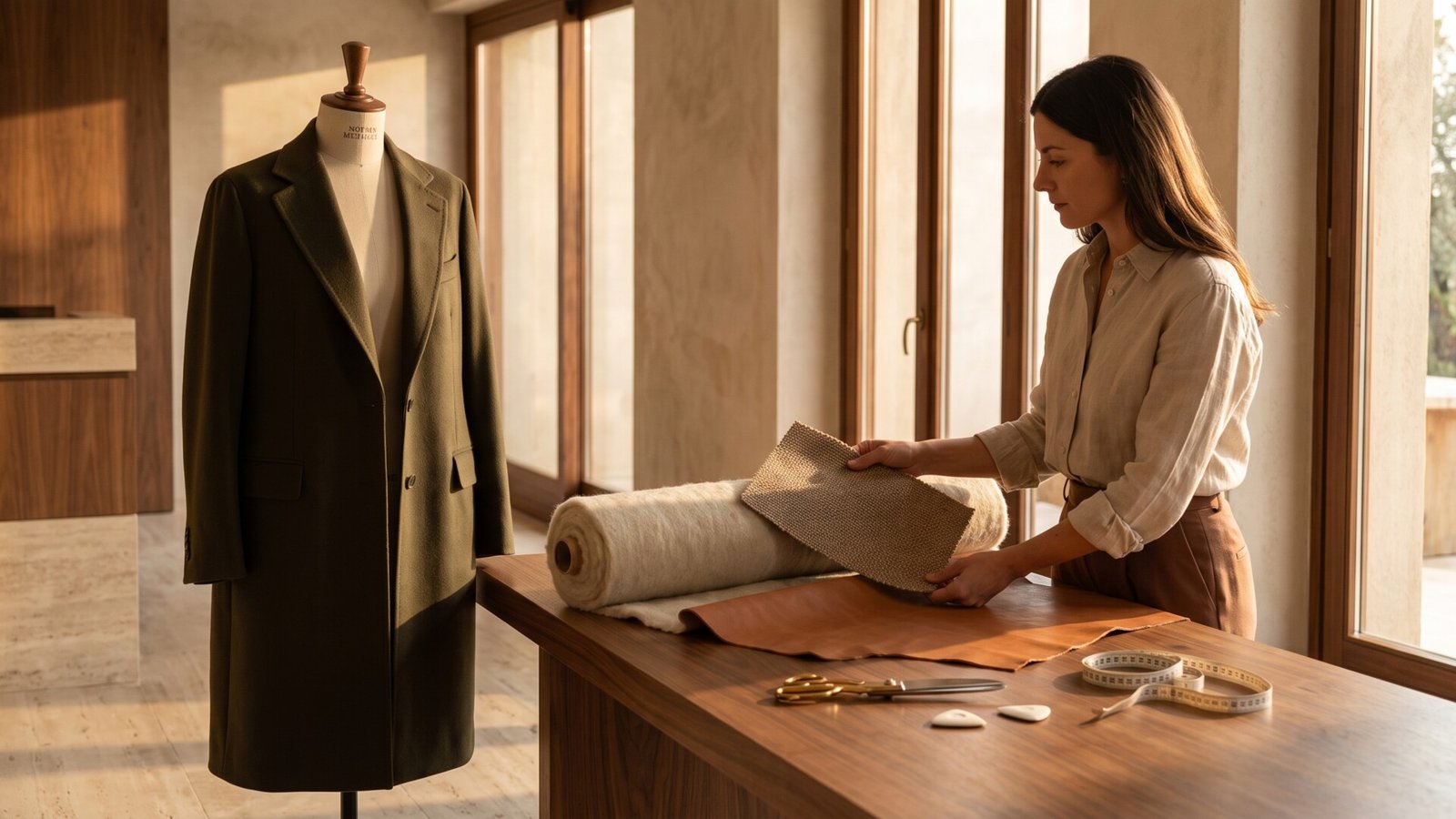
Ermenegildo Zegna has an advantage that most luxury houses lack: control over much of its textile chain, from wool and fabric to finished tailoring. Knowing where a fibre comes from and how it was processed makes emissions easier to measure and reduce. The group has made SBTi commitments aligned with limiting warming to 1.5°C, according to third-party tracking of its disclosures.
The company also points to the Oasi Zegna nature reserve in the Piedmont Alps, created by its founder in the 1930s, and to its Oasi Cashmere programme as evidence of a long-term relationship with raw-material suppliers. Both are the company’s own framing, so read them as context rather than proof of low emissions. We could not confirm precise reduction percentages or target years from a primary source, so check Zegna’s latest sustainability report for the exact numbers.
Net-zero status: committed to science-based targets, not yet net-zero. Strongest structural position because of supply-chain control.
2. Gucci: Transparency and Offsets
Gucci belongs to Kering, and much of its climate reporting runs through the group. Kering has said its brands have been carbon neutral since 2018, a status reached through a mix of emissions cuts and purchased offsets. In 2023 the group also committed to cutting absolute greenhouse gas emissions by 40% by 2035 against a 2021 baseline, covering its own operations and its value chain.
The debate is about offsets. Neutrality that depends partly on compensation is not the same as eliminating emissions, which is why the 2035 reduction target matters more than the 2018 label. Gucci’s Off The Grid line, made with recycled and regenerated materials such as ECONYL nylon, is a product-level example of the shift. For more on the house itself, see our Gucci guide, or compare how Gucci and Prada hold value over time in Gucci vs Prada for brand reputation and resale value.
Net-zero status: carbon neutral by Kering’s definition, with a published 2035 reduction target. Offsets are part of the story.
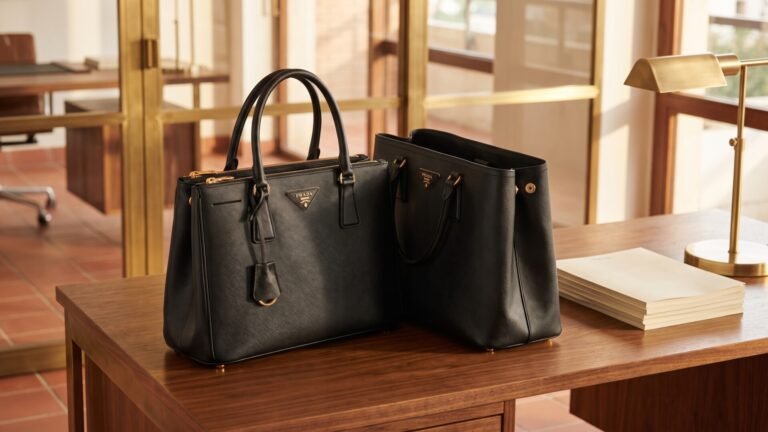
3. Prada: Circular Materials
Prada took a materials route. In 2019 it launched Re-Nylon, a regenerated nylon made with Aquafil’s ECONYL yarn from recovered plastic waste, including ocean plastic, fishing nets and textile fibre waste. ECONYL can be recycled repeatedly without losing quality. At launch Prada said it aimed to replace all of its virgin nylon with regenerated nylon by the end of 2021.
Re-Nylon addresses synthetic fibres, but not the footprint of leather, which makes up much of Prada’s bag and shoe range. Prada has been less detailed than some peers about its Scope 3 reporting, so the programme shows genuine materials innovation without proving a net-zero trajectory.
Net-zero status: leader in a specific material category, with less public detail on whole-company decarbonisation.
4. Salvatore Ferragamo: Measurable Targets
Ferragamo publishes some of the clearest numbers in this group. Its sustainability plan lists SBTi-approved targets: a 42% absolute reduction in Scope 1 and 2 emissions and a 42% reduction in the Scope 3 categories covered (purchased goods and services, and downstream transport and distribution) by 2029 from a 2023 base year, with net-zero by 2050. It also targets 100% renewable energy at directly operated sites by 2030.
On progress, the company reports that its 2025 Scope 1 and 2 emissions were 5.0% below 2023 and Scope 3 emissions 17.8% below, and that all of its Group electricity is covered by certified Guarantees of Origin. Guarantees of Origin certify that an equivalent amount of renewable electricity was generated, so they are a market-based measure rather than a direct supply of renewable power to each site. Progress on Scope 1 and 2 is modest so far, which is a useful reminder that approved targets are the beginning of the work.
Net-zero status: SBTi-approved near-term and net-zero targets with early, reported progress.
5. Bottega Veneta: Longevity First
Bottega Veneta, also part of Kering, builds its sustainability case on durability. Intrecciato woven leather is labour-intensive and hard-wearing, and the brand’s minimal, logo-light designs date more slowly than trend pieces. Its group-level emissions targets are the Kering targets above. The brand publishes less house-specific emissions data than Ferragamo, so its strongest argument is the product itself: a bag you keep for years. Our comparison Bottega Veneta Intrecciato vs Gucci Marmont looks at that longevity question from a buyer’s side.
Net-zero status: inherits Kering group targets. Strongest on product longevity, thinner on brand-level data.
Scorecard: Where Each House Stands
| Brand | Published climate position | Strength | Open question |
|---|---|---|---|
| Zegna | SBTi commitments aligned to 1.5°C | Control over textile supply chain | Specific reduction figures need checking in its report |
| Gucci (Kering) | Carbon neutral since 2018 per Kering; group target of -40% by 2035 vs 2021 | Detailed group reporting | Reliance on offsets for neutrality |
| Prada | Re-Nylon programme with Aquafil | Circular synthetic materials | Less public Scope 3 detail; leather not covered by Re-Nylon |
| Ferragamo | SBTi-approved: -42% by 2029 (2023 base), net-zero 2050 | Clear targets and reported progress | Scope 1 and 2 cut only 5.0% so far |
| Bottega Veneta (Kering) | Kering group targets | Product longevity | Limited brand-level data |
The pattern is consistent: every house has targets or flagship projects, none has reached full value-chain net-zero, and the strongest evidence tends to sit in one area (materials, operations or product life) rather than across the whole business.
Which Luxury Houses Lead on Sustainable Leather?
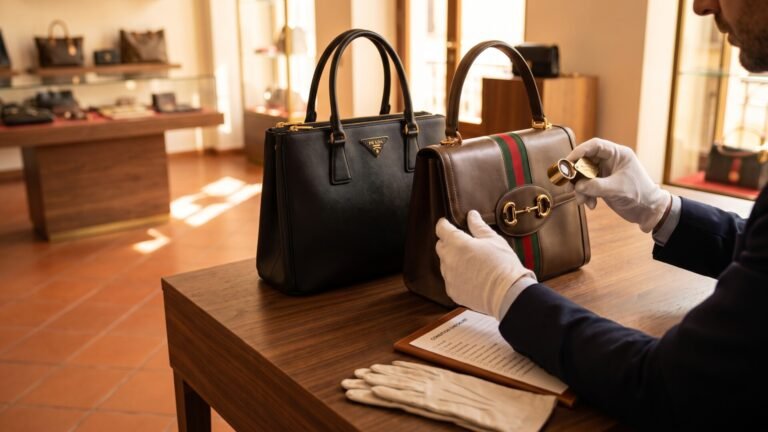
Leather is where many of these brands’ impacts concentrate, and it is the area the headline net-zero figures say least about. For buyers, three questions are more useful than a marketing label. Does the tannery hold a recognised audit such as Leather Working Group certification, which assesses environmental management in tanneries? Is the hide’s origin traceable to a country or supplier? And does the brand repair the product, so that the leather lasts?
Vegetable tanning, which uses plant tannins, is often associated with sustainability but is not automatically lower-impact. It is slower and suits certain leather styles, while chrome tanning produces the soft, consistent leathers many luxury bags rely on. For background on leather families and longevity, see our guide to Italian leather handbags.
The Problem with “Net-Zero” in Luxury
Greenwashing is the main risk. A neutrality claim based on low-quality offsets can leave the underlying production process unchanged. Offsets also carry permanence risks: forests can burn or be logged, and additionality is hard to prove. Critics argue that the word “neutral” should be reserved for companies that have already cut most of their own emissions, although there is no single agreed threshold in fashion.
Scope 3 is the second obstacle. Raw materials are often several tiers down the supply chain, and even transparent companies struggle to get primary data from every supplier. Growth is the third. If production volumes rise each year, per-unit emissions must fall faster just to keep absolute emissions flat, which is why absolute targets, like Ferragamo’s and Kering’s, are more meaningful than intensity targets.
How to Read a Luxury Brand’s Sustainability Claim
- Look for validation. SBTi-approved targets are checked by a third party. Self-declared goals are not.
- Check the scope. A claim about stores or offices (Scope 1 and 2) says little about materials (Scope 3).
- Ask about the base year and target year. A 40% cut is only meaningful against a stated baseline.
- Separate reductions from offsets. Reports should show both.
- Prefer product-level proof. Named recycled materials, certified tanneries and published repair services are easier to verify than slogans.
What This Means When You Shop
The most reliable sustainability decision a buyer makes is buying something they will use for years. Check the house’s repair policy before purchase, store leather goods properly (our guide to dealing with mold on stored designer leather goods covers the main risk), and consider pre-owned pieces from reputable resellers. Resale prices vary widely and are not guaranteed, so treat any resale value as a bonus, not a plan.
If you are choosing between houses on sustainability grounds alone, the evidence supports a simple rule: favour brands with validated targets and detailed reporting (Ferragamo and Kering’s brands publish the most), and favour product categories, such as tailoring in natural fibres or hard-wearing leather bags, where durability does the work. Buying less and keeping it longer beats any individual label.
Frequently Asked Questions About Italian Sustainable Luxury
What does net-zero mean in fashion?
Net-zero means cutting greenhouse gas emissions across the whole value chain by the amount climate science requires, then balancing only the small residual with permanent removals. It is different from carbon neutrality, which can rely heavily on offsets.
Is Gucci or Prada more sustainable?
They lead in different areas. Gucci’s parent Kering publishes detailed group-level targets, including a 40% absolute emissions cut by 2035 against 2021. Prada’s strongest public programme is Re-Nylon, a regenerated nylon made with Aquafil’s ECONYL. Neither is net-zero.
Is any Italian luxury brand fully net-zero in 2026?
None of the five houses reviewed here claims full value-chain net-zero today. Ferragamo has SBTi-approved targets including net-zero by 2050, and Zegna has made SBTi commitments aligned to 1.5°C.
Which Italian brand has the clearest climate targets?
Of the houses reviewed, Ferragamo publishes some of the most specific figures: a 42% absolute reduction in Scope 1, 2 and the covered Scope 3 categories by 2029 from a 2023 base, and net-zero by 2050.
Does carbon neutral mean the same as net-zero?
No. Carbon-neutral claims can be met partly by buying offsets. Net-zero under the SBTi standard requires deep absolute emissions cuts first, with removals only for the residual.
Does sustainable luxury cost more?
Not always, and a higher price is not proof of better practice. Recycled or traceable materials can add cost, but the biggest saving comes from durability: a well-made piece worn for many years has a lower cost per wear.
Is sustainable luxury a good investment?
Durable, classic pieces tend to hold appeal longer, but resale values vary by brand, model and condition and are never guaranteed. Treat sustainability as a reason to buy for longevity, not as a financial promise.
Conclusion
Italian luxury has moved from vague sustainability messaging to published targets, regenerated materials and repair services. The honest scorecard is mixed: Ferragamo and Kering’s brands offer the most specific climate numbers, Zegna’s supply-chain control is a structural advantage, Prada has a proven materials programme, and Bottega Veneta’s case rests on how long its products last. None has reached net-zero, and several rely on offsets or have modest early reductions.
Explore more: Gucci | Prada | Zegna | Bottega Veneta | Ferragamo | All Italian designer brands