The forgotten history of Ferragamo’s Rainbow platform shoe
Ask most people where the rainbow platform shoe came from and they will point to a recent fashion trend. The original is much older. Salvatore Ferragamo designed the Rainbow wedge sandal in 1938 for the actress Judy Garland, and the Museo Salvatore Ferragamo in Florence still holds it. The shoe is often described loosely, so this guide separates what is documented from what is repeated as legend, explains how the sandal was built, and covers what you can and cannot buy today. It is part of our wider coverage of the house: see the complete guide to Salvatore Ferragamo and the guide to Italy’s most influential fashion houses.
About the sources: the facts below come from the Museo Ferragamo’s catalogue entry on Google Arts & Culture, Ferragamo’s own sustainability pages, and published biographies. We have not handled the original or a reissue. Where a claim could not be confirmed we have left it out.
The Rainbow Sandal at a Glance
| Detail | What is documented |
|---|---|
| Designer | Salvatore Ferragamo (1898–1960) |
| Year | 1938 |
| Made for | Judy Garland |
| Made in | Florence, Italy |
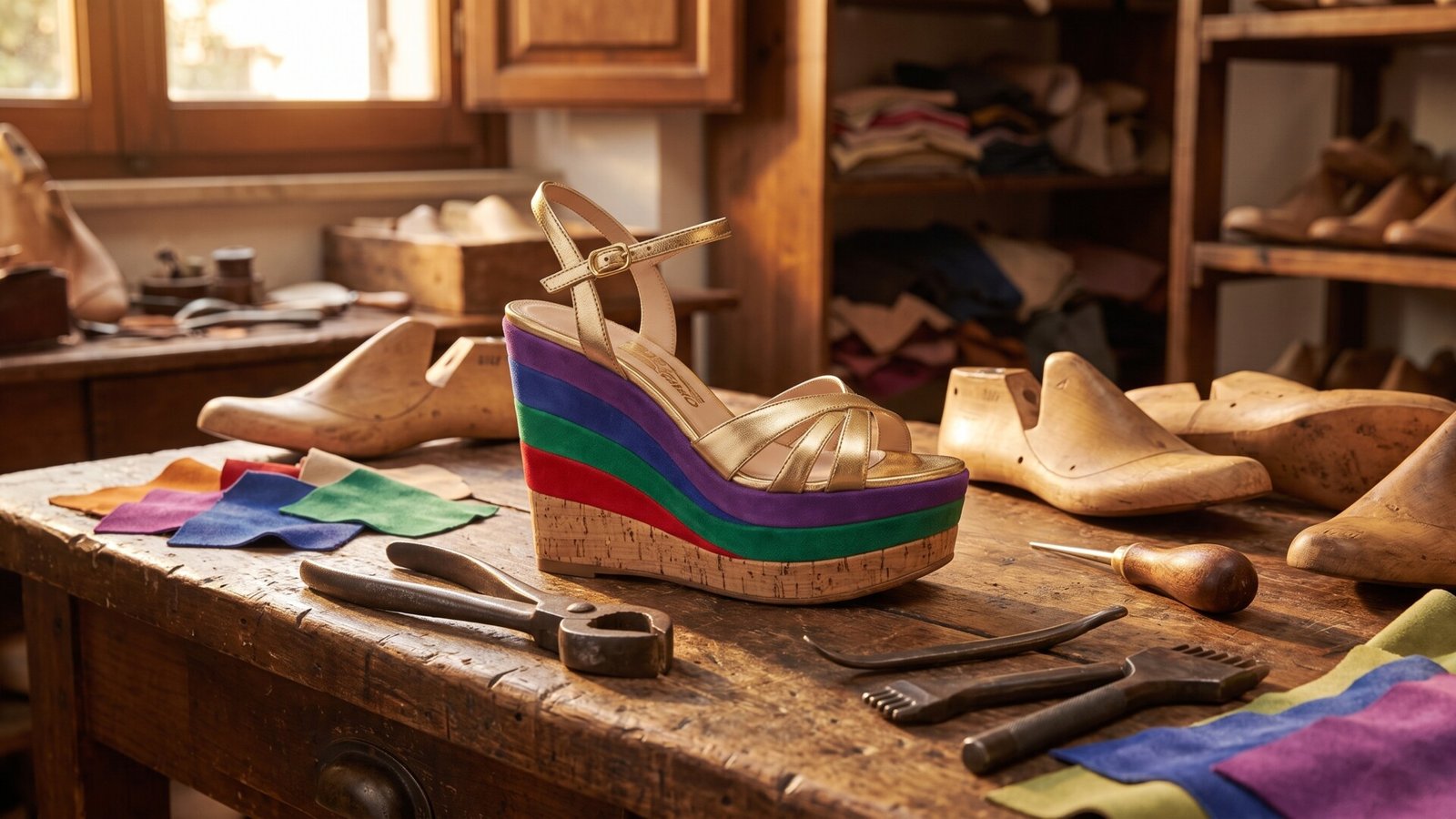
| Materials (original) | Kidskin, cork and suede, with a sole and heel of layered cork and a suede-covered heel |
| Silhouette | Multicoloured platform wedge sandal |
| Where the original is held | Museo Salvatore Ferragamo, Florence |
| Link to film | Reported as a tribute to the song “Over the Rainbow” from The Wizard of Oz (1939), not a costume for the film |
Salvatore Ferragamo: From Bonito to Hollywood to Florence
Ferragamo was born in Bonito, in Campania, on 5 June 1898, the eleventh of fourteen children. By his own account he made his first pair of shoes at nine and decided to become a shoemaker. After a year of training in Naples he opened a small workshop in his parents’ home at fourteen. In 1914 he emigrated to the United States, first to Boston and then to Santa Barbara, California, where his brothers were already living.
In California he studied anatomy at the University of Southern California to understand how shoes could be made to fit the foot better, a detail that shaped his reputation for comfort as well as looks. In 1923 he bought the Hollywood Boot Shop on Hollywood Boulevard, and film clients such as Rudolph Valentino, Gloria Swanson, Joan Crawford and Clara Bow earned him the nickname “Shoemaker to the Stars”.
One common error is worth fixing here. Ferragamo did not found his house in a Hollywood workshop and move to Florence in 1957. He returned to Italy in 1927 and set up a workshop in Via Mannelli in Florence, and he died in Florence on 7 August 1960. His autobiography, Shoemaker of Dreams, appeared in 1957. The Rainbow sandal therefore belongs to his Florentine period, after the Hollywood years, even though its famous recipient was an American film star. The family firm continued after his death, and the Museo Salvatore Ferragamo opened in the Palazzo Spini Feroni, the house’s Florence headquarters, in 1995. For more on how the house operates today, see our piece on Ferragamo loafers and Italian production.
The Making of the Rainbow
Judy Garland was born in 1922, so she was sixteen when the sandal was made in 1938. The Wizard of Oz was released in 1939. The museum record states the shoe was designed for Garland, and Ferragamo’s own reissue material describes the colourful platform as a tribute to “Over the Rainbow”. That is the extent of what is firmly documented.
Several details repeated in popular retellings could not be confirmed and should be treated with caution. The sandal is often described as a costume for the film, but Dorothy’s film costumes were created by the studio’s costume department, and the Rainbow is recorded as a Ferragamo design made for Garland. It is also sometimes described as a Hollywood creation, but the museum records it as made in Florence. And it is occasionally confused with the “invisible” nylon-thread sandal, which is a different design.
Design and Construction
Platform and Cork Wedge
The sandal sits on a platform and wedge built from layered cork. A wedge supports the arch along its whole length rather than leaving a gap under the foot, which is why wedge platforms of this type are generally easier to walk in than a stiletto of the same height. Ferragamo developed the cork wedge heel and a steel shank in the 1930s, and cork became even more important in the 1940s when wartime shortages pushed him to use unconventional materials such as cork, raffia and nylon.
Colour and Upper
The museum lists kidskin, cork and suede, with the heel covered in suede. The multicoloured effect comes from stacked layers of coloured material on the platform and heel. The exact number and order of colours varies between descriptions, so we have not specified one, and reissues have used different palettes.
Craft Then and Now
The 1938 sandal was a bespoke piece made in Ferragamo’s Florence workshop. Today’s reissues come from the company’s archive programme, described by Ferragamo as limited-edition, numbered replicas. These are made in small runs and are not the same as a mass-produced ready-to-wear shoe, though we could not confirm the number of steps done by hand, so the claim that every pair is fully handmade should be checked with the house.
Cultural Afterlife
The Rainbow is one of the best-known shoes in the Ferragamo archive and a staple of fashion history surveys. The Victoria and Albert Museum in London also lists a Ferragamo sandal in its collection, which shows how widely the house’s 1930s and 1940s work is studied. The Rainbow’s influence is easiest to see in the platform sandal, now a standard shape across luxury brands. Our best Italian designer platform sandals and Italian designer sandals guide show how the silhouette is built today.
The house itself returns to the design periodically. Ferragamo’s Creations line reissues archive models, and the Rainbow Future sandal, listed on Ferragamo’s sustainability site, is a wood wedge made with GOTS-certified organic crocheted cotton, produced as a limited edition of 100 pairs. More recently, creative director Maximilian Davis has reinterpreted the Rainbow platform, as reported by V Magazine and other fashion media. For the designer’s wider work, see our article on the Ferragamo Hug bag and Maximilian Davis.
Can You Buy a Rainbow Today?
There are four routes, each with a different outcome.
The original: the 1938 sandal is in the museum collection and is not for sale. Archive replicas: limited, numbered runs from Ferragamo’s Creations line appear occasionally and sell out quickly, so check the house’s site for current availability. Rainbow-inspired designs: the house and other brands sell platform sandals that reference the idea without being replicas, usually at a wide range of prices. Vintage and resale: pieces sold as vintage Rainbow need careful authentication, because the shoe is both rare and widely imitated.
We could not verify current US prices or recent auction results, so none are quoted. Prices for archive reissues and resale pairs change with each release and condition, and any figure quoted without a date and a source is worth treating with caution. A reasonable first step is to check Ferragamo’s own site for current availability, then compare authorised retailers. [Affiliate: Shop the current Ferragamo collection at Neiman Marcus]
Authenticity Checks
Counterfeits exist, and no list of tips can prove a pair is genuine. General principles apply: buy from the brand or an authorised retailer where possible, and for pre-owned pairs choose a reseller that authenticates items and offers returns. Ask for documentation or provenance for vintage claims, and be sceptical of a price far below what comparable pairs fetch. Branding is usually found on the insole, but its position and style differ by period, so compare against the brand’s own images for the specific model. Platforms such as The RealReal, Vestiaire Collective and 1stDibs authenticate their items. [Affiliate: Browse vintage Ferragamo on The RealReal]
Wearing a Colourful Platform
A multicoloured platform is the statement piece, so the rest of the outfit usually works best in neutral tones: black, white, beige or denim. A midi dress, cropped trousers or a tailored suit all let the shoe stand out without competing with it. A wedge platform of this kind is also easier to wear for long periods than a thin heel, though comfort varies with the height and the fit of the ankle strap. If you are between sizes, try the shoes on at a boutique, since strap placement affects how the shoe holds.
For other Ferragamo pieces worth pairing with a colourful shoe, the Vara bow pump is a long-standing house classic, and our Varina flats article covers a related 1978 design. For fit and sizing across the house, see the Ferragamo shoes guide. [Affiliate: Explore Ferragamo handbags and accessories]
Caring for Suede and Cork
Suede marks easily and is vulnerable to water, so a rainbow suede platform is best kept for dry days. Brush it gently with a suede brush, use a protector spray after testing it on a hidden area, and store the shoes away from direct sunlight, which can fade dyes. Stuff the toe area with acid-free paper and keep the pair in a breathable dust bag. Cork can dry and crack with age and should never be soaked. Our guide to waterproofing Italian suede without darkening it explains the options in detail, and for vintage pairs a specialist restorer is safer than home repair.
Is a Rainbow an Investment?
Treat any luxury shoe as something you buy to wear. Collectors value archive pieces for their history, but resale values depend on edition size, condition and demand, and nobody can promise a return. Limited editions tend to attract more interest than standard releases, and a shoe worn often will show it. If you wear a pair twenty times a year for five years, a hypothetical $1,000 purchase works out at $10 a wear before resale, a simple way to judge the value without relying on a forecast. For a wider look at that question, see are luxury Italian shoes worth the money.
Ferragamo Timeline: Where the Rainbow Fits
| Year | Milestone |
|---|---|
| 1898 | Salvatore Ferragamo born in Bonito, Campania |
| 1914 | Emigrates to the United States, Boston then Santa Barbara |
| 1923 | Buys the Hollywood Boot Shop on Hollywood Boulevard |
| 1927 | Returns to Italy and opens a workshop in Via Mannelli, Florence |
| 1928 | Creates the “Bella” pumps worn by Gloria Swanson in Sadie Thompson |
| 1933 | Files for bankruptcy during the Depression |
| 1930s | Develops the cork wedge heel and steel shank |
| 1938 | Designs the Rainbow wedge sandal for Judy Garland |
| 1940s | Works with cork, raffia and nylon during wartime material shortages |
| 1957 | Publishes his autobiography, Shoemaker of Dreams |
| 1960 | Dies in Florence on 7 August |
| 1995 | Museo Salvatore Ferragamo opens in the Palazzo Spini Feroni |
Seen in sequence, the Rainbow is the product of a designer who had already spent years working on structure. The 1933 bankruptcy did not end the business, and the cork wedge developed in the same decade gave him a lightweight, mouldable base that other materials could not match. That context explains why the Rainbow looks so different from the stiletto-heeled pumps most people associate with high-end shoes of the period.
Rainbow Versus Other Ferragamo Icons
The Rainbow is a historical and collector’s piece, while other Ferragamo shoes are built to be worn daily. If your interest is a shoe you can buy and wear this season, the Varina ballet flat and the Vara pump are the house’s best-known everyday designs, and the Ferragamo loafers covered in our factory-focus article show where the house’s everyday craft is concentrated. For platform shapes in particular, compare designs in our platform sandals guide before you decide whether you want the archive reference or a modern equivalent.
Questions to Ask Before Buying Any Archive Reissue
- Is it numbered, and what is the total edition size?
- Does it come with the original box, dust bag and any certificate or numbering card?
- What are the materials of the upper, lining and sole in this particular edition?
- Is the palette the same as the 1938 original, or a modern reinterpretation?
- What is the return policy if the platform height or strap does not suit you?
Why the Story Still Matters
The Rainbow sandal shows how Ferragamo worked: an anatomical understanding of the foot, an interest in unusual materials and a client list that kept him in the public eye. It also shows how easily a good story can pick up errors as it is retold. The documented version, a 1938 Florentine design for Judy Garland, made of kidskin, cork and suede and held by the house museum, is interesting enough without embellishment.
To keep exploring the house, start with our guide to Ferragamo shoes and the main Ferragamo guide. If you are ready to look at current pieces, [Affiliate: browse the current Ferragamo collection] or [Affiliate: explore vintage options on The RealReal].
Frequently Asked Questions About Ferragamo Rainbow Shoe
When was the Ferragamo Rainbow shoe made, and for whom?
Salvatore Ferragamo designed the Rainbow wedge sandal in 1938 for the actress Judy Garland. It was made in Florence, and the original is held by the Museo Salvatore Ferragamo.
What materials were used in the original Rainbow sandal?
The museum lists kidskin, cork and suede, with a sole and heel of layered cork and a suede-covered heel. Reissues use goatskin leather and suede, according to published reports.
Was the Rainbow sandal worn in The Wizard of Oz?
No. It was made as a tribute to the song Over the Rainbow, from the 1939 film, and the film’s costumes were made by the studio’s costume department.
How do I care for rainbow suede platforms?
Brush gently with a suede brush, use a protector spray after testing on a hidden area, avoid rain, and store away from direct sunlight in a breathable dust bag. Use a specialist for vintage or damaged pairs.
Can I buy a Ferragamo Rainbow today?
The 1938 original is a museum piece. Ferragamo has released limited, numbered archive replicas and a Rainbow Future edition of 100 pairs, so check the house’s website and authorised retailers for what is available now.
Are Ferragamo Rainbow shoes a good investment?
Resale value is not guaranteed and depends on edition, condition and demand. Buy a pair because you will wear it, and verify authenticity through the brand or an authenticating reseller.
How does sizing run for Ferragamo shoes?
Sizing varies by model and last, so check the brand’s size guide and our Ferragamo shoes guide. For ankle-strap styles, try them on if you can, as strap position affects fit.