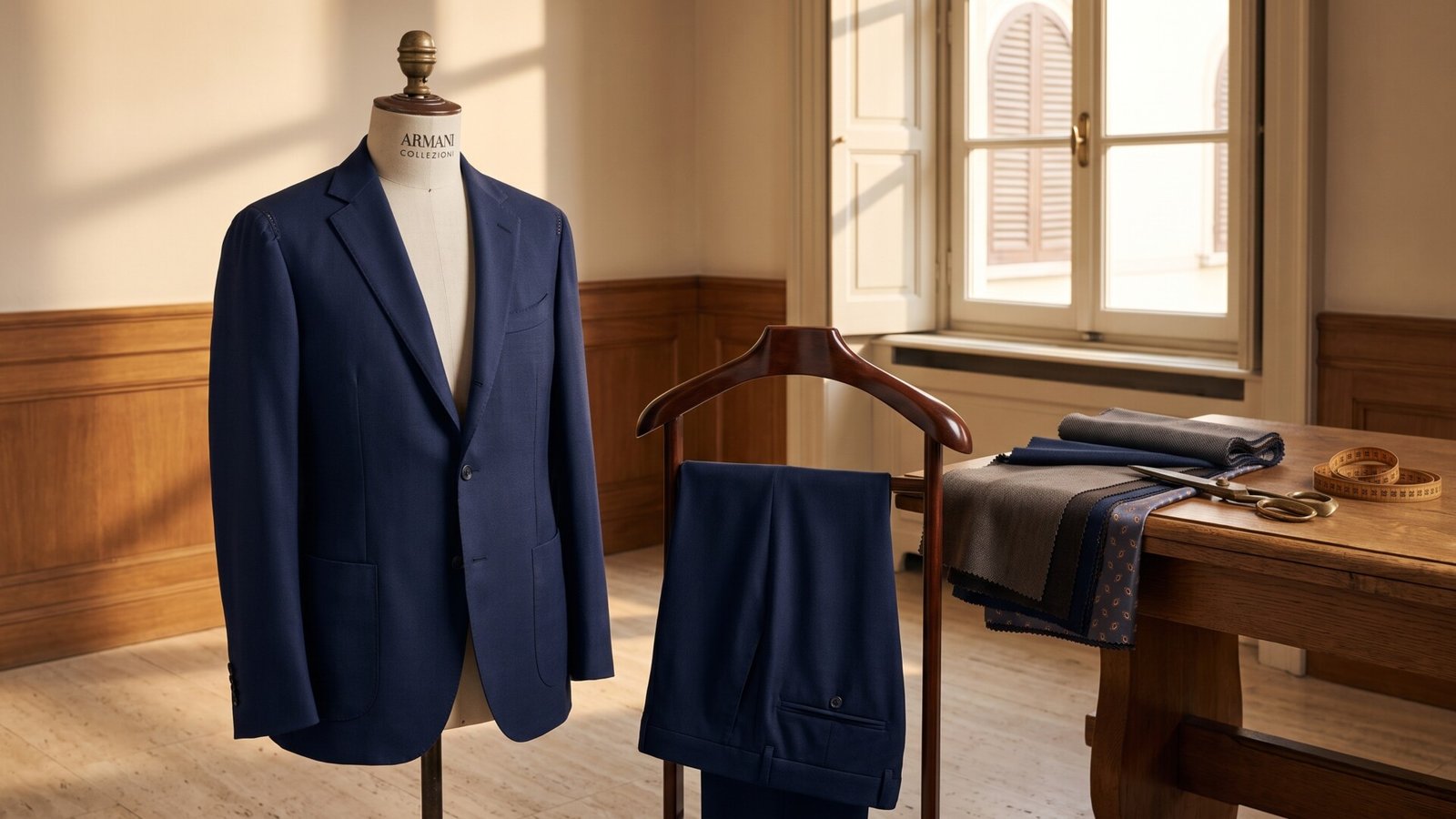
Is Armani Collezioni Considered High Fashion?
Short answer: Armani Collezioni was not high fashion in the haute couture or runway sense, but it was a luxury ready-to-wear line built on Armani tailoring. It was the house’s business-oriented line, positioned below Giorgio Armani and, on price, above Emporio Armani. Armani announced in 2017 that it would be folded away, with the change taking effect from the spring-summer 2018 season, so every Collezioni piece you see today is secondhand or old stock.
The Confusion Around Armani Labels
Armani has run more labels than almost any other Italian house: Giorgio Armani, Emporio Armani, Armani Jeans, EA7, Armani Exchange, Armani Privé and, until 2017, Armani Collezioni. Collezioni is the one buyers most often second-guess. Is it diffusion? Is it the main line under another name? Is it still made?
The answer depends on what you mean by high fashion, so this guide covers where the line sat, how its quality compares, why it ended, how to read the label on a secondhand piece, and what to buy today if you want the same kind of tailoring. If you are new to the wider family, our overview of Italian designer brands shows where Armani sits among the other major houses.
The Armani Family of Lines at a Glance
Most of the confusion comes from the fact that Armani has, at different times, run several parallel labels with different price points and audiences. This table summarises how the main ones are generally understood. Positioning is the house’s and the trade press’s general framing, not a price guarantee, and the lineup has changed over the years.
| Line | General positioning | Status | Typical buyer |
|---|---|---|---|
| Armani Privé | Haute couture, shown in Paris | Active | Red-carpet and private clients |
| Giorgio Armani | Main luxury ready-to-wear line | Active | Buyers who want the core Armani tailoring and fabrics |
| Armani Collezioni | Business-oriented luxury tailoring | Folded away from spring-summer 2018 | Professionals, executives, travellers |
| Emporio Armani | Younger, contemporary, more accessible | Active; outside creative director since 2026 | Fashion-aware buyers who want Armani design at a lower tier |
| Armani Jeans | Casual denim and daywear | Folded away at the same time as Collezioni | Everyday casual wear |
| EA7 Emporio Armani | Sportswear and athleisure | Active | Active and sports-minded customers |
| Armani Exchange (A|X) | Entry-level, street and urban | Active | Younger, price-conscious shoppers |
For a deeper look at the two lines most people compare, read Giorgio Armani vs Emporio Armani: What’s the Difference?
What Armani Collezioni Was Designed to Be
Armani Collezioni (earlier labelled Giorgio Armani Le Collezioni) served people who wanted the Armani look — polished, streamlined, office-ready — without the full price and exclusivity of the main Giorgio Armani line. It was not meant for couture, the red carpet or runway moments; it was nothing like Valentino gowns or Chanel tweed reinvented on a Paris catwalk. It was sold in Armani boutiques, including stand-alone Collezioni stores, and in department stores such as Harrods, Harvey Nichols, Bloomingdale’s and Neiman Marcus, rather than shown at Milan Fashion Week, where Giorgio Armani and Emporio Armani held the spotlight. The line was aimed at an older customer who wanted classic pieces rather than trend-driven design.
Its buyers were professionals, executives and business travellers who valued quality tailoring and understated design more than runway trends. In the Armani boutique of the 2000s, the Giorgio Armani jacket was the flagship, the Emporio one the younger choice, and the Collezioni one the suit for a board meeting and a client dinner.
Resale platforms often quote 1979 as the launch year, but we could not confirm a launch date or production details from Armani’s own archive, so treat any specific year quoted by sellers with caution.
The Aesthetic: Understated Minimalism
Armani Collezioni stuck closely to the DNA that made Armani famous: clean lines, soft shoulders, neutral palettes and minimal logos. That DNA traces back to Giorgio Armani’s deconstructed jacket of the late 1970s and early 1980s, which removed much of the padding and stiff lining from men’s tailoring; the story is told in Why Giorgio Armani Became the King of Minimalism and followed through the decades in The Evolution of Armani Suits Through the Decades.
If Giorgio Armani was artful minimalism, Collezioni was functional minimalism: tailored suits, blazers, silk shirts, topcoats and evening separates in charcoal, navy, ivory, black and camel, with no loud patterns or aggressive branding. It was made to fit into a working wardrobe, not to disrupt it.
The Quality: Luxury, Not Fast Fashion
“Diffusion line” has become a dismissive phrase, but Collezioni was not a cheap line. It offered tailoring in the Armani idiom, with fabrics generally regarded as a step above Emporio but below the main Giorgio Armani line, precise cuts and construction meant to last. If Emporio Armani was luxury casual, Collezioni was luxury business.
A caution on “Made in Italy”: it is a labelling claim that applies garment by garment, and production of secondary lines varied over the years. Resale listings show Collezioni pieces labelled as made in Italy and others made elsewhere, including China. The care label inside the garment, not the line name, is the reliable guide to where a specific jacket was made and what it is made of.
Fibre content also varied more than the line’s reputation suggests. Current resale listings include a wool and cashmere blazer, a virgin wool and viscose blazer, an alpaca and mohair bouclé coat, a silk and acetate skirt suit and wool-blend trousers. A viscose or acetate blend is not a defect, but it wears, creases and cleans differently from pure wool, so price it accordingly.
Reading the Label: Which Armani Line Is This Piece?
Secondhand listings often just say “Armani”, and sellers mix up the lines. The label name tells you more about where a piece sat than the listing title does:
| Label reads | What it is | Era |
|---|---|---|
| Giorgio Armani Le Collezioni | The earlier name of the business line | Older pieces, before the Armani Collezioni name took over |
| Armani Collezioni | The business tailoring line covered here | Up to the 2017 restructuring |
| Giorgio Armani | The main ready-to-wear line | Any era; still current |
| Emporio Armani | The younger, more accessible line | Any era; still current |
| Armani Jeans | Casual denim line | Up to the 2017 restructuring |
| Armani Exchange or A|X | Entry-level urban line | From 1991; still current |
A listing that calls a Collezioni suit “Giorgio Armani mainline” is overstating it, and one priced like mainline should be compared with genuine mainline pieces before you pay that premium.
How to Judge a Collezioni Suit Today: What to Check
Because the line is no longer made, most readers meet Collezioni through the secondhand market. Judging quality piece by piece is more useful than relying on the label alone. These are general tailoring checks, not an authentication method, and they apply to any suit or coat.
- Fabric content: read the care label. Wool or a wool blend suits most office climates, and the percentage tells you more than the brand name. Heavily synthetic blends will drape and breathe differently.
- Lining and shoulder: a soft, lightly padded shoulder and a fully lined or half-lined body are consistent with Armani’s softer tailoring. Check that the lining is intact, because lining tears are the most common repair on older jackets.
- Stitching and buttonholes: look for even stitching along the lapel, pockets and armholes, and for buttonholes that are cleanly finished and not fraying.
- Fit and alteration room: check seam allowances at the waist, sleeves and trouser hem. Pieces from the 1990s and 2000s often have a cut that suits today’s relaxed tailoring, but the proportions may need a tailor’s help.
- Condition problems: moth holes in wool, shine at the elbows and seat, underarm staining and shoulder-pad distortion are harder to fix than a hem.
If you are comparing a vintage Collezioni suit with a current one from a different house, our guide to Italian suits explains the construction differences between canvassed, half-canvassed and fused jackets, and what to look for in each. For secondhand shopping in general, our guide to buying used Armani online covers resale platforms and the limits of any authenticity checklist.
Was Armani Collezioni High Fashion?
If your definition of high fashion is haute couture, Paris runway exclusivity, red-carpet dressing or experimental design, then no. Collezioni did not push creative boundaries or chase editorial headlines. In Armani’s own structure, couture belongs to Giorgio Armani Privé, which is shown separately in Paris.
If your definition includes luxury craftsmanship, Italian tailoring heritage and designer-label quality, then yes: Collezioni sits comfortably in the high-end fashion zone. Not couture, not avant-garde, but premium and recognisably Armani. Its closest equivalents are lines that sell luxury without runway theatre, such as Zegna tailoring or Ralph Lauren Purple Label, or a technical offshoot like Prada Linea Rossa.
If you picture the Armani lines as a ladder (our own informal framing, not an official Armani ranking):
Haute Couture (Armani Privé)
→ Runway Luxury (Giorgio Armani)
→ High-End Luxury Ready-to-Wear (Armani Collezioni)
→ Contemporary Luxury (Emporio Armani)
→ Premium Street/Diffusion (A|X)
Why the Line Eventually Got Discontinued
In March 2017, after the Emporio Armani show, Giorgio Armani announced that the group would restructure its lines to simplify branding. From the spring-summer 2018 season, the group’s main fashion lines would be reduced to three:
- Giorgio Armani
- Emporio Armani
- Armani Exchange
This meant Armani Collezioni and Armani Jeans were folded into the core brands. The three-line description applies to the main fashion lines: Armani Privé couture and the EA7 sportswear label continued separately.
The stated reason was clarity rather than failure: a lineup with this many collections was hard for shoppers and wholesale buyers to read. Trade reports at the time also noted that the restructuring weighed on the group’s results for the year, so it was a deliberate, costly simplification rather than a free rebrand.
Giorgio Armani himself put it plainly in 2017: “There was too much confusion with so many collections,” adding that “times have changed, and we have to evolve.” He also described Emporio Armani as becoming a broader “cluster of ideas” across retail and wholesale. Public reports did not spell out which remaining line took over which part of Collezioni, so the exact mapping of pieces is not something we can state.
Armani After 2025: What Changed at the Top
Giorgio Armani died on 4 September 2025 at the age of 91. In October 2025 the group named long-time executive Giuseppe Marsocci as chief executive. Leo Dell’Orco, Armani’s partner and long-time head of menswear design, became chairman of the group’s board and of the Giorgio Armani Foundation; Reuters reported that he holds about 40% of the voting rights and the foundation about 30%. Silvana Armani, the founder’s niece, leads womenswear design.
Armani’s will asks for an initial stake of about 15% to be sold within 12 to 18 months of his death, with LVMH, L’Oréal and EssilorLuxottica named as preferred buyers, followed later by a larger sale or a stock-market listing. In August 2026 Corriere della Sera reported, via Reuters, that the sale might not be completed before the March 2027 deadline, as evaluations were still preliminary.
On 16 September 2026 the group named Dario Vitale, formerly of Miu Miu and Versace, as creative director of Emporio Armani and Giorgio Armani accessories, the first person outside the Armani family in that role. Giorgio Armani ready-to-wear stays with Silvana Armani and Dell’Orco. For Collezioni buyers, the point is that the two surviving tailoring lines are now drifting further apart in creative leadership, which makes the old middle line easier to place: it sat closer to today’s Giorgio Armani than to Emporio.
Why People Still Look for Armani Collezioni Today
Vintage Collezioni pieces turn up regularly on resale platforms, especially suits, blazers and wool coats from the late 1990s and 2000s. Well-made wool tailoring often still holds up, the soft-shouldered cuts suit today’s relaxed tailoring, and logo-light clothing is back in favour. The renewed interest in understated dressing, covered in our pieces on why quiet luxury became a global trend and Italian quiet luxury brands, is a large part of why a 1990s Armani suit looks current again.
Buying Vintage Collezioni: What You Are Actually Paying For
Resale prices vary widely by platform, size, fabric and condition, so think about value in terms of what the money buys:
- Cut and tailoring: a soft-shouldered, well-proportioned jacket is the main attraction. This is also what costs money to replicate new.
- Fabric: wool and wool-blend suiting, silk shirts and wool coats are the pieces collectors look for. Fabric that has pilled or thinned costs more to restore than it is worth.
- The label: a vintage designer label commands a premium, but a clean, well-fitting piece without the label may be a better buy than a damaged one with it.
- Tailoring budget: factor in alterations and a professional clean. A good fit can matter more than the line name.
Resale is not an investment strategy for this line: values depend on condition and demand, and nothing guarantees a piece will hold its price. Buy because you will wear it.
Vintage Collezioni or Something New? A Decision Rule
Most guides stop at “it was high-end, not couture”. The more useful question is what to buy if you want that kind of tailoring now:
- Choose vintage Collezioni if you want the soft 1990s and 2000s Armani shoulder at a fraction of new prices, are happy to pay a tailor, and can inspect the piece or return it.
- Choose current Giorgio Armani if you want the closest living successor: classic Armani tailoring, now led by Leo Dell’Orco for menswear and Silvana Armani for womenswear.
- Choose Emporio Armani if you want Armani tailoring at a lower price and are comfortable with a more fashion-led direction, especially once Dario Vitale’s collections arrive.
- Look beyond Armani if business tailoring matters more than the name: Canali is the classic like-for-like alternative, Brioni sits well above the old Collezioni price, and Loro Piana suits buyers who care most about cloth.
Caring for Older Armani Tailoring
Older wool tailoring rewards conservative care. Brush wool jackets and coats after wearing, hang them on a shaped wooden hanger, rest them for a day or two between wears, and avoid dry cleaning more often than necessary because repeated solvent cycles can stiffen the cloth. Store in a breathable garment bag rather than plastic, and keep cedar or similar moth protection in the wardrobe, since moths target wool and silk. Test any spot cleaner in an inconspicuous area first, and take valuable or silk-lined pieces to a specialist cleaner rather than treating them at home.
So… Is Armani Collezioni High Fashion?
Not in the haute couture or runway sense. It did not show at fashion week, set trends or chase avant-garde silhouettes. But it was a high-end luxury ready-to-wear line, with Armani tailoring and materials, sitting above Emporio and below the main Giorgio Armani collection. Treat a Collezioni piece as good Armani tailoring from a closed chapter: judge it on cloth, cut and condition, and pay accordingly.
Frequently Asked Questions About Armani Collezioni
Is Armani Collezioni better than Emporio Armani?
They served different buyers. Collezioni focused on classic business tailoring and was priced higher, while Emporio Armani is younger and more fashion-led. Fabric and construction varied by season and piece, so judge a specific garment by its care label and condition rather than the line name.
Is Armani Collezioni the same as Giorgio Armani?
No. It was a separate, business-oriented line positioned below the main Giorgio Armani collection. Some older labels read Giorgio Armani Le Collezioni, which causes confusion, but that is still the business line rather than the mainline.
Is Armani Exchange the same as Armani Collezioni?
No. Armani Exchange (A|X) is the entry-level, urban line launched in 1991, while Collezioni was a business tailoring line positioned much higher. A|X remains one of the group’s three main fashion lines.
How much is vintage Armani Collezioni worth?
It depends on the piece and condition. On 1stDibs, sold prices over a recent 12-month period ran from about $140 for blouses and skirts to about $930 for a blazer, with coats around $300. Prices on other platforms differ, so compare similar items in similar condition.
Was Armani Collezioni made in Italy?
Not always. Resale listings show Collezioni pieces labelled Made in Italy and others made elsewhere, including China. Check the care label on the specific garment rather than assuming the whole line was Italian-made.
Where can I buy Armani Collezioni today?
Only secondhand or as old stock, through resale marketplaces, vintage dealers and consignment stores. Ask for photos of the care label and lining, check measurements against a jacket you own, and buy where returns are possible.