Italian Suits: The Complete Guide to Italy’s Finest Tailoring (2026 Edition)
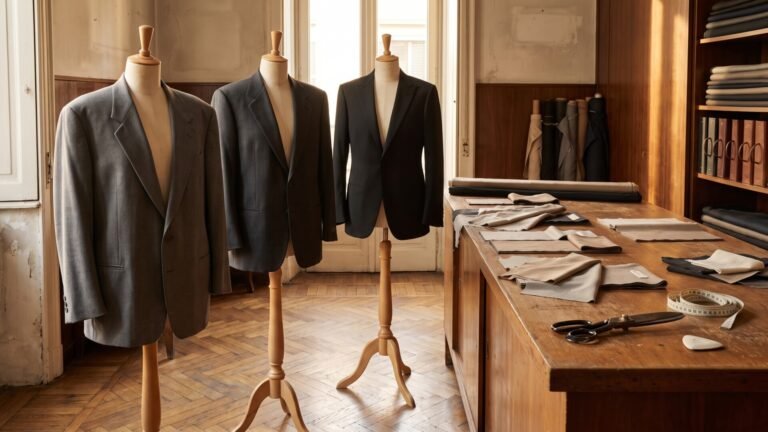
A suit jacket can be built to hold its wearer upright or to move with them. Traditional British tailoring tends towards the first: heavier canvassing, structured shoulders and a firm chest. Italian tailoring, and Neapolitan work in particular, tends towards the second. Shoulders carry little or no padding, the chest is lightly canvassed or left unlined, and the sleeve is set high so that raising an arm does not drag the whole jacket with it.
That difference in construction is what people usually mean when they search for an “Italian cut suit” or “Italian style suit”. It is not one look: Milan, Naples and Rome each have their own silhouette, and the big houses (Brioni, Kiton, Zegna, Canali, Isaia, Armani) interpret them differently.
This guide covers the regional traditions, how to read a jacket’s construction, the main Italian suit brands, made-to-measure versus bespoke, sizing, styling and care, so you can judge a suit on its shoulder, cloth and canvas rather than on its label alone.
This article is part of our larger Italian Designer Clothing hub. Check it out for an overall picture.
The History of Italian Tailoring
Origins of Italian Tailoring Culture
Italy’s tailoring tradition is rooted in the Renaissance, when Florence, Venice and Rome were centres of textile and garment production. Guilds of tailors, known as sartori, maintained standards of craftsmanship and worked in wool, silk and velvet for nobility and clergy.
Modern Italian menswear, though, took shape after the Second World War. A new class of businessmen wanted elegant clothing that was lighter and more comfortable than British and French formal wear and suited the warm Mediterranean climate.
Post‑War Revolution in Italian Menswear
Brioni was founded in Rome in 1945 by Nazareno Fonticoli and Gaetano Savini. In 1952 it staged a menswear show at the Sala Bianca of Palazzo Pitti in Florence, which the house describes as the first men’s fashion show. Its Penne plant in Abruzzo opened in 1959. Bespoke houses such as Caraceni, founded in Rome by Domenico Caraceni in 1913, built international reputations among private clients. From the mid‑1970s, Giorgio Armani reworked menswear with unstructured jackets, stripping out much of the lining and padding so that the jacket draped like a cardigan; our piece on the evolution of Armani suits through the decades traces that change.
This “deconstructed” approach became a signature of Italian style. It contrasted with the more structured suits of Savile Row and the formal tailoring traditions of France (see our Italian vs French fashion comparison).
Milan vs Naples vs Rome Tailoring Schools
Italian tailoring is usually described through three regional traditions, each with its own silhouette. The labels are shorthand: individual houses mix and soften them.
- Milanese tailoring: The most structured of the three. Milanese suits typically have lightly padded shoulders, a defined waist and a clean, modern line, which suits business and formal occasions. Large northern houses such as Zegna (Trivero, Piedmont) and Canali (Brianza, between Milan and Lake Como) work in this cleaner northern line, although both are industrial makers rather than Milanese sartorie.
- Neapolitan tailoring: The softest, most relaxed school. Neapolitan jackets typically have minimal shoulder padding, high armholes and a gathered “shirt” sleeve attachment (spalla camicia) that allows free movement. The chest is lightly canvassed or unlined. Kiton and Cesare Attolini (founded in Naples around 1930 by Vincenzo Attolini) are among the best-known names; Isaia brings the same silhouette to a more fashion-led offer.
- Roman tailoring: Often described as a middle ground between Milan and Naples, with a fuller, slightly extended shoulder, a fitted chest and a more formal line than Neapolitan work, though softer than British tailoring. The Roman bespoke tradition is associated with Caraceni, and Brioni is the Roman house best known for taking that look into ready-to-wear.
What Defines an Italian Suit?
Soft Construction Philosophy
The defining characteristic of an Italian suit is softness. The shoulders are lightly padded or not padded at all. The chest is canvassed with light, breathable materials. The lapels are rolled rather than pressed flat, creating a gentle curve. The jacket is cut to move with the body rather than hold a fixed shape.
Softness is not a shortcut. A soft shoulder must be cut and sewn precisely or it collapses, and a lightweight canvas has to be balanced so that the chest keeps its shape. When the work is done well the jacket looks relaxed because the structure is hidden inside it.
Italian Suit Fabrics
Italy has long been a major source of suiting cloth, with mills concentrated around Biella in Piedmont. Key materials include:
- Wool Super 100s–200s: Fine merino worsteds, many woven by mills around Biella. The Super number indicates fibre fineness: higher numbers (Super 180s, 200s) feel softer but crease more easily and wear faster, so Super 110s–150s is the practical range for a suit worn every week.
- Cashmere blends: Adding cashmere to wool creates a softer, warmer cloth, useful in winter. Our Italian cashmere guide explains how the fibre is graded and why it costs what it does.
- Lightweight summer wools: Fresco, high‑twist and tropical wools are open-weave, breathable and resist creasing.
- Linen suits: Linen breathes and wrinkles by nature, which suits warm weather and relaxed dress codes.
Fit and Movement
Italian suits are cut to allow natural movement. The armholes are high, reducing fabric bunching under the arms. The sleeves have enough width to layer over a shirt without pulling. The jacket length is typically shorter than British styles, ending around the first knuckle of the thumb. Trousers are often cut slimmer, with a single forward pleat or none at all.
Hand‑Tailored Italian Suits: Finishing Details to Look For
“Hand-tailored” is used loosely in marketing, and the amount of handwork varies widely between a bespoke suit, a luxury ready-to-wear suit and an industrial one. These are the details that indicate real handwork, though none of them is proof on its own:
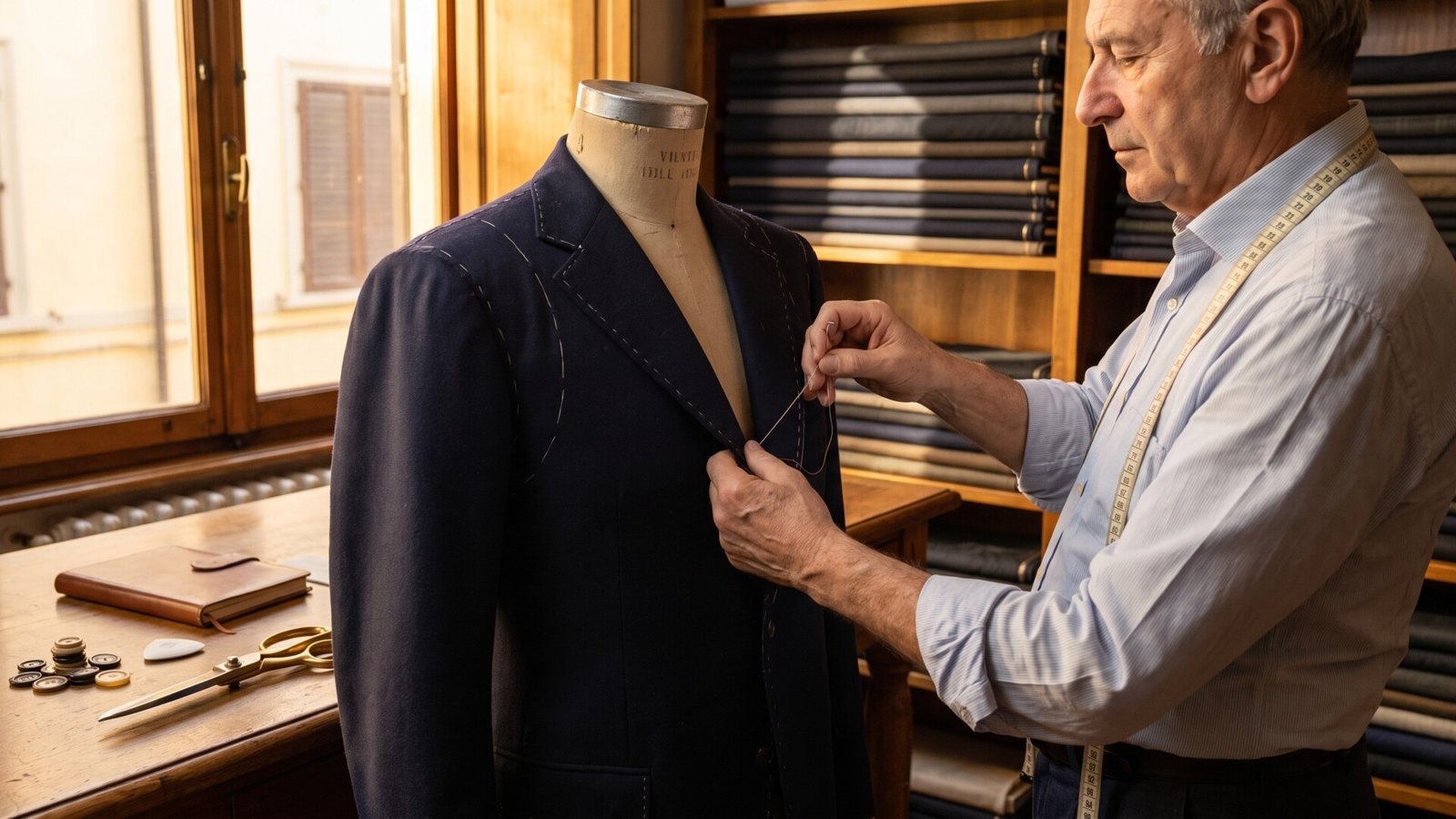
- Hand‑stitched lapels: Pad stitching holds the canvas to the lapel and gives it a natural roll; the stitches are small and slightly irregular.
- Soft, shaped shoulders: The sleeve head is eased into the armhole with a small amount of gathering (the spalla camicia in Neapolitan work) rather than pressed flat.
- Floating canvas: The chest canvas is stitched in rather than glued, which lets the jacket mould to the wearer.
- Hand‑set sleeves: On some makers’ work the sleeve is attached by hand, which helps the sleeve hang without puckering.
Fused, Half-Canvas or Full-Canvas: What Sits Inside the Jacket
The single most important quality marker in a suit jacket is invisible: the interlining that gives the chest its shape. There are three levels, and price alone will not tell you which one you are buying, so ask the sales associate or check the product description.
| Construction | How it is made | How it wears | Where you find it |
|---|---|---|---|
| Fused | A synthetic interlining is glued (heat-bonded) to the cloth across the front of the jacket. | Flat and slightly stiff; can bubble after repeated dry cleaning or steaming. | Most mass-market and many diffusion-line suits. |
| Half-canvas | A floating canvas of wool or horsehair runs through the chest and lapel; the lower front is fused. | Natural lapel roll and better drape at a lower cost than full canvas. | Good mid-range ready-to-wear and some entry luxury lines. |
| Full-canvas | A floating canvas runs the full length of the front, attached with pad stitching rather than glue. | Moulds to the wearer over time, breathes better and tends to last longest. | Top ready-to-wear houses, many made-to-measure programmes and true bespoke. |
A quick in-store check: pinch the cloth just below the top buttonhole and gently pull the outer fabric away from the lining layer. If you can feel a separate, loose third layer moving between them, the jacket is canvassed there. If the outer cloth and interlining feel bonded into one stiff sheet, that area is fused. The check is a useful guide rather than proof, because a half-canvas jacket will feel canvassed at the chest and fused lower down.
Made in Italy: What the Label Does and Does Not Tell You
“Made in Italy” is a labelling claim that applies to a specific product, not automatically to every item a brand sells. A suit can be made from Italian cloth in an Italian factory, or cut in Italy and finished elsewhere, and large houses often produce across several sites and lines. Look for the origin on the garment’s own label and the product page, and check the cloth label separately, since the mill and the tailoring workshop are often different companies. Our explainer on handmade versus mass-produced Italian fashion goes further into what “handmade” can and cannot mean.
The Major Types of Italian Suits
Business Suits
Everyday professional tailoring. Typically single‑breasted, two‑button, in navy, charcoal or grey. Milanese in structure, with moderate padding and a clean silhouette. Zegna and Canali are two of the most visible names in this category.
Formal Suits
Evening wear and black‑tie adaptations. Strictly, black tie means a dinner suit (tuxedo) with a bow tie; Italian houses often cut theirs in midnight blue with a shawl or peak lapel. A dark suit worn with a long black tie is a lounge-suit alternative for less formal evenings, not black tie. Brioni, with its fitted Roman line, is a common reference point for formal tailoring.
Soft Tailored Suits
The signature Italian category. Unstructured jackets, often in cashmere or wool‑silk blends, that can be worn with trousers or jeans. Neapolitan and Milanese soft lines both qualify. Giorgio Armani is closely associated with this style.
Summer Linen and Lightweight Suits
Light colours (beige, light grey, pastel blue), breathable fabrics and minimal lining. They suit Mediterranean summers, destination weddings and travel. Isaia and Boglioli are both worth checking for linen and lightweight tailoring. If you are dressing for a ceremony, see what to wear to an Italian summer wedding as a guest.
Double‑Breasted Suits
The Italian double‑breasted suit is usually cut slimmer and shorter than its British counterpart. It emphasises the waist and creates a V‑shaped silhouette. Kiton and Brioni both make double‑breasted jackets.
Casual Tailoring (Unstructured Suits)
Knit suits, jersey suits and deconstructed jackets are the most relaxed category. They drape like a cardigan but keep the look of a suit, which works for creative workplaces and smart casual events. Several Italian houses, Zegna among them, offer jersey and knit tailoring alongside their classic suits; availability changes by season, so check current collections.
Italian Suit Brands: Brioni, Kiton, Zegna, Canali, Armani and Isaia
Ownership and creative leadership at fashion houses change often. The notes below reflect public sources checked in October 2026; confirm the current position on each brand’s own site before buying.
Brioni
Roman tailoring at the formal end of the market. Founded in Rome in 1945 by tailor Nazareno Fonticoli and Gaetano Savini, Brioni is known for a fitted chest, defined shoulder and fine cloths. Its production plant at Penne, in Abruzzo, opened in 1959, and the house opened its own tailoring school there, the Scuola di Alta Sartoria, in 1985. Brioni was acquired by PPR (renamed Kering in 2013) in 2011. Creative leadership has changed several times, most recently with the reported end of Norbert Stumpfl’s tenure after seven years, so check who currently leads design. Brioni offers ready-to-wear and made-to-measure; we have not verified current prices and do not quote them. For the boardroom angle, see Brioni suits for a modern CEO.
Best for: Buyers who want a fitted, formal Roman line.
Kiton
Neapolitan craftsmanship at the top of the market. Kiton is the trademark of Ciro Paone S.p.A., a company founded in 1956 by Ciro Paone; the Kiton brand dates from 1968, and the company is based in Arzano, on the outskirts of Naples. The house is known for hand‑stitched canvases, shirt shoulders (spalla camicia) and the curved barchetta breast pocket. The silhouette is soft and comfortable. Kiton positions itself among the most expensive ready-to-wear tailoring in the world; we have not verified current prices and do not quote them, and made-to-measure costs more still.
Best for: Buyers who value handwork and soft construction over brand recognition.
Zegna
Fabric‑led, modern tailoring. Zegna was founded in 1910 by Ermenegildo Zegna in Trivero, in the Biella Alps, began as a wool mill, and still weaves cloth there, some of which it also sells to other tailoring brands. The family-controlled group has been listed on the New York Stock Exchange since December 2021, and Alessandro Sartori has been its artistic director since 2016. Fabric names worth knowing include Trofeo and Centoventimila for fine wools and High Performance for travel cloth. (Oasi Zegna, often confused with the mill, is the nature reserve above it.) The suits are cleaner and more structured than Neapolitan tailoring but softer than Brioni’s, and Zegna’s Su Misura service, which dates from 1972, covers made‑to‑measure. Prices depend heavily on cloth and market, so check Zegna’s own site.
Best for: First‑time luxury suit buyers and professionals who care about cloth.
Canali
Business tailoring from Brianza. Founded in 1934 by brothers Giovanni (a fabric merchant) and Giacomo (a tailor) Canali in Triuggio, in Brianza between Milan and Lake Como, Canali is now headquartered nearby in Sovico and is still led by the family’s third generation. It makes clean, business-ready suits and a made-to-measure service (Su Misura), and its Impeccabile cloth is designed to resist creasing on travel days. Canali is generally positioned a step below Zegna and Brioni, and multi-brand retailers frequently discount it. Many buyers find the cut slightly more generous than Zegna’s.
Best for: Buyers who want a classic Italian business suit without paying top-tier house prices.
Giorgio Armani
Soft tailoring pioneer. Armani‘s unstructured, deconstructed jackets redefined menswear from the mid-1970s. Giorgio Armani died on 4 September 2025, aged 91. His longtime menswear designer Leo Dell’Orco and his niece Silvana Armani (womenswear) have continued the main collections, and on 16 September 2026 Armani Group announced Dario Vitale, who briefly led Versace’s creative direction in 2025, as creative director of Emporio Armani and Giorgio Armani accessories (per the Associated Press), the first designer from outside the Armani family to lead an Armani line. The house’s best-known lines are Giorgio Armani (the signature tailoring), Emporio Armani and Armani Exchange. If you are deciding between the first two, read Giorgio Armani vs Emporio Armani. The Giorgio Armani silhouette is relaxed and fluid.
Best for: Quiet luxury enthusiasts who prefer soft, fluid shapes.
Isaia
Colourful Neapolitan tailoring. Isaia began in 1920 as Enrico Isaia’s fabric shop in Naples and became a tailoring company in 1957, when the family moved production to Casalnuovo, near Naples. Its small red coral logo is a Neapolitan good-luck charm. The construction is Neapolitan, with soft shoulders and high armholes, but the house is known for brighter cloths, wider lapels and a more fashion-led attitude than Kiton. Isaia is positioned in the same upper tier as the other top Neapolitan labels; check its site for current prices.
Best for: Fashion‑forward professionals who want a colourful, Neapolitan-built suit.
More Italian Names Worth Knowing: Cesare Attolini, Caraceni and Quiet-Luxury Tailors
Cesare Attolini was founded in Naples around 1930 by Vincenzo Attolini, is headquartered in Casalnuovo di Napoli, and is run by his grandsons Giuseppe and Massimiliano Attolini. It is a core Neapolitan name alongside Kiton. Caraceni is a family of related and unrelated houses: Domenico Caraceni founded the original Rome house in 1913, his brother Augusto opened A. Caraceni in Milan in 1946, and Ferdinando Caraceni, an unrelated tailor trained in the family workshops, opened his own Milan house in 1967. These are the names to look at for true bespoke. For soft tailoring in a quiet-luxury register, Brunello Cucinelli and Loro Piana are the usual references; our Loro Piana vs Brunello Cucinelli comparison covers how they differ on cloth.
Italian Suit Brands Compared
Market positioning is relative and based on how each house presents itself; it is not a quoted price. Founding details come from the brands’ own histories and reference sources checked in October 2026.
| Brand | Founded / base | House style | Relative positioning | Best for |
|---|---|---|---|---|
| Brioni | 1945, Rome; plant in Penne | Roman: fitted, formal line | Top tier | Formal and executive wardrobes |
| Kiton | Company 1956, brand 1968; Arzano (Naples) | Neapolitan: spalla camicia, heavy handwork | Top tier | Buyers who prioritise handwork and cloth |
| Zegna | 1910, Trivero (Biella) | Clean, modern northern line; own cloth | Luxury | Business suits, cloth-first buyers |
| Isaia | 1920, Naples; tailoring since 1957 | Neapolitan, colourful and fashion-led | Luxury | Statement and smart-casual tailoring |
| Giorgio Armani | 1975, Milan | Soft, fluid, deconstructed | Luxury | Relaxed, minimal tailoring |
| Canali | 1934, Brianza (Triuggio; now Sovico) | Classic business cut, performance cloths | Entry luxury | First luxury suit, frequent travellers |
Neapolitan vs Milanese vs Roman Suits: Style Comparison
These are typical characteristics of each tradition, not rules. A specific house or tailor may sit between two columns.
| Style | Shoulder | Chest and canvas | Formality | Associated names |
|---|---|---|---|---|
| Neapolitan | Minimal padding, gathered shirt sleeve | Light canvas or unlined | Medium | Kiton, Cesare Attolini, Isaia |
| Milanese | Lightly padded, clean line | Medium structure | High | Zegna, Canali (northern industrial makers) |
| Roman | Fuller, more defined | Structured, fitted chest | Very high | Brioni; Caraceni (bespoke) |
| Unstructured | Unpadded | Minimal or no canvas, little lining | Low to medium | Giorgio Armani, Brunello Cucinelli, Loro Piana |
| Linen / summer | Soft | Unlined or half-lined | Medium | Isaia, Boglioli, Loro Piana |
What Most Buyers Get Wrong About Italian Suits
The Myth of Structure = Quality
Many buyers assume that heavy padding, thick canvassing and rigid shoulders signal higher quality. Structure is a style choice, not a quality grade. A soft, unpadded shoulder has to be cut and sewn precisely to avoid collapsing, and a lightweight floating canvas needs correct tension to hold its shape, so soft tailoring can demand more skill, not less.
The Overlooked Importance of Fabric
Cloth matters as much as the label. A suit in a mediocre cloth will disappoint at any price, while a sensibly chosen Super 130s–150s wool will wear well. Learn to judge cloth by touch and drape before you worry about the label. Zegna’s own mill in Trivero weaves well-regarded suiting cloth and sells it to other makers too. A smaller maker’s suit in Zegna, Loro Piana or Vitale Barberis Canonico cloth can be a better buy than a big-name suit in an unknown cloth, so read the cloth label inside the jacket, not just the brand.
Why Fit Is More Important Than Brand
A top-tier suit that does not fit you is a poor purchase, and a mid-priced suit that has been properly tailored can look better. Italian suits are designed to be altered: sleeves can be lengthened or shortened, waists suppressed, trousers hemmed. Always budget for tailoring, and never buy a suit that does not fit in the shoulders. Shoulders are the hardest and most expensive thing for a tailor to change, and often cannot be fixed well at all.
The Real Value of Italian Suits
Longevity comes from adaptability, not stiffness. A heavily structured suit will always look formal and is hard to dress down. A soft, unstructured Italian suit can be worn with a tie or an open collar, which means more wears per year and a lower cost per wear.
How to Choose the Right Italian Suit
Start with where and how often you will wear the suit, then choose the cut, cloth and brand to match. The table below matches five common buyers to a cut, cloth and brand shortlist.
| Buyer | What to look for |
|---|---|
| Business Professionals | Milanese-style suit, navy or charcoal, single‑breasted, two‑button. Zegna or Canali are the obvious starting points. Consider a second pair of trousers, since they wear out faster than jackets. |
| Style‑Focused Buyers | Neapolitan soft tailoring from Kiton, Cesare Attolini or Isaia. A double‑breasted jacket in a bolder colour (midnight blue, dark grey or olive) with loafers and an open‑neck shirt. |
| Warm Climates | Linen or lightweight wool suit in beige, light grey or pastel blue, unlined or half‑lined. Look at Boglioli or the Loro Piana summer collection. |
| First‑Time Buyers | A versatile navy or charcoal single‑breasted suit in a classic cut, from Zegna’s more accessible lines or Canali. Avoid extremes: not too slim, not too full. Make sure the shoulders fit. |
| Quiet Luxury Enthusiasts | Minimal branding, good cloth, understated details: Giorgio Armani’s unstructured jackets, Loro Piana’s cashmere blends or Brunello Cucinelli‘s soft tailoring. More in our guide to Italian quiet luxury and on why quiet luxury became a global trend. |
Whatever the shortlist, the order of priorities stays the same: shoulder fit first, then cloth weight for your climate, then construction, and only then the label.
Ready-to-Wear, Made-to-Measure or Italian Bespoke Suits?
| Option | How it works | Fittings and lead time | Best for |
|---|---|---|---|
| Ready-to-wear | Made in standard sizes; altered by the store or your tailor (sleeves, waist, trousers). | Usually one alteration appointment; days to a couple of weeks. | Standard builds, first luxury suit, trying a brand’s cut. |
| Made-to-measure | The brand adjusts an existing pattern to your measurements and lets you choose cloth, lapels, buttons and lining. Zegna (Su Misura) and Canali (Su Misura) run named programmes, and Brioni, Kiton and Isaia also offer made-to-measure. | One measuring session, sometimes a final fitting; typically several weeks. | Off-the-rack sizes that never quite fit, or a specific cloth. |
| Bespoke | A tailor drafts a new pattern for your body and builds the suit by hand through basted fittings. | Usually two or three fittings; often several months. | Unusual proportions, or a suit meant to be the reference piece of a wardrobe. |
Made-to-measure is the sweet spot for most buyers: you keep the house style and construction, but correct the fit points that alterations cannot reach, such as shoulder slope or a forward stance. True bespoke only pays off if you are willing to commit to the fittings. For Italian bespoke specifically, the Caraceni houses in Rome and Milan are the historic reference points.
Italian Suit Sizing Explained
Italian jackets are sized in even numbers that roughly equal your US/UK chest size plus 10: an Italian 48 is approximately a US/UK 38, a 50 is a 40, a 52 is a 42 and a 54 is a 44. Lengths are usually marked Regular, Short or Long (some brands use separate numbers, for example 24–27 for short sizes). Many houses also sell suits by “drop”, the difference between jacket chest and trouser waist, with drop 6 or 7 as the standard and drop 8 for a slimmer waist.
Treat any conversion as a starting point. Neapolitan cuts with high armholes often feel snug in your usual size, while some northern houses cut fuller, so try at least two sizes when you can and judge by the shoulder seam, which should end where your shoulder ends without divots in the sleeve head.
Italian Suit Styling Guide
Formal Styling
- Dress shirt: White or light blue, with a spread or semi‑spread collar.
- Tie: Silk, in a complementary colour. Avoid novelty patterns. (Here is how to care for a silk Italian tie.)
- Shoes: Oxfords or wholecuts in black or dark brown. See our guides to the best Italian dress shoes and Italian dress shoes in general.
- Accessories: A simple watch, a silk pocket square, and a slim leather belt matched to your shoes (or skip the belt and use side adjusters). Options in Italian designer belts for business attire.
Smart Casual Tailoring
- Shirt: Open‑collar linen or cotton. No tie.
- Knitwear: A fine‑gauge cashmere or merino turtleneck under the jacket (see Italian knitwear).
- Shoes: Suede loafers or leather derbies. Our best Italian loafers guide covers the classics, and the Italian loafers overview explains the styles.
- Accessories: A leather watch strap, no tie bar.
Modern Luxury Styling
- Footwear: Minimal leather sneakers (the Zegna Triple Stitch, Common Projects). Our Zegna Triple Stitch review covers how it wears with tailoring.
- Shirt: A plain white t‑shirt under the jacket.
- Trousers: The suit trousers, but with a casual jacket from a different suit (separates).
- Outer layer: A lightweight overcoat or technical jacket; see Italian leather jackets for a more casual option.
Investment Value: Are Italian Suits Worth It?
Cost‑Per‑Wear Logic
An illustrative calculation: a suit costing $4,000 and worn 40 times a year for ten years works out to $10 per wear. A suit costing $800 worn 20 times a year for two years works out to $20 per wear. The numbers are examples, not quoted prices, but the logic holds: a better-made suit that you wear often and that can be altered and repaired usually costs less per wear than a cheap one replaced every few years.
Longevity and Repairability
Italian suits can be altered, repaired and refreshed. Seams can be reinforced, linings replaced, trousers recut. A well‑made suit, rotated and cared for, can reasonably last a decade or more, and the jacket often outlives the trousers. Many owners change shape before the cloth wears out.
Resale Market Reality
Suits have limited resale value because body shapes vary so widely. Sought‑after brands in pristine condition and common sizes sell more easily on resale platforms such as The RealReal, but typically for a fraction of the original retail price. Buy a suit to wear, not to resell.
Wardrobe Investment Perspective
Core suits in navy and charcoal in classic cuts are the foundation of a professional wardrobe. Spend more on these. Statement suits (bold colours, double‑breasted, linen) can come second.
Care and Maintenance of Italian Suits
Rotation Strategy
Avoid wearing the same suit two days in a row. Wool and cashmere need time to recover from body moisture and stress. If you wear a suit daily, rotating among three to five suits is a common recommendation.
Dry Cleaning Best Practices
Dry clean suits sparingly, when they are visibly soiled or at most once or twice a year, because frequent cleaning can wear the cloth and, on fused jackets, contribute to bubbling. Brush the cloth after wearing and air the suit. Spot‑clean minor stains gently with a damp cloth, testing a hidden area first, and take valuable suits to a specialist cleaner.
Storage
- Hangers: Use wide, wooden suit hangers that support the shoulders. Wire hangers distort the shape.
- Garment bags: Store suits in breathable cotton or linen bags. Plastic can trap moisture.
- Folding: Hang a jacket rather than folding it.
Tailoring Maintenance
Have your tailor check the suit once a year. Seams may need reinforcing, hems adjusting and buttons replacing. Small repairs done early cost far less than big ones later.
The Future of Italian Tailoring
Soft Tailoring Dominance
Soft, unstructured tailoring remains the direction of travel. Even the more formal houses now sell softer jackets, travel cloths and tailored separates alongside their classic suits.
Sustainability in Suit Production
Several Italian mills and houses now publish traceability and responsible-sourcing programmes. Zegna promotes its Oasi Cashmere and Oasi Lino lines as traceable from farm to garment, and Loro Piana promotes its responsibly sourced vicuña and cashmere programmes. Treat these as the brands’ own commitments and look for the third-party certifications they cite.
Hybrid Workwear Evolution
As workplaces become more casual, suits are adapting. Knit suit jackets, jersey blazers and technical fabrics let one jacket work on a plane and in a meeting. The same applies to what goes over the suit: lightweight down and unlined coats have joined the classic overcoat, as covered in our Italian outerwear guide.
Frequently Asked Questions About Italian Suits
What makes Italian suits different from British suits?
Italian suits tend to be softer and lighter, with little or no shoulder padding, high armholes and lighter canvassing. British (Savile Row) tailoring is generally more structured, with firmer shoulders and a more rigid silhouette. Both can be made to a very high standard; the difference is in style and construction.
What is an Italian cut suit?
An Italian cut suit usually means a jacket with a soft or lightly padded shoulder, high armholes, a shorter length and a slimmer trouser. The details vary by region: Neapolitan is softest, Milanese is more structured and Roman is fuller in the shoulder and more formal.
Which Italian brand makes the best suits?
There is no single best. Kiton and Cesare Attolini are known for Neapolitan handwork, Brioni for Roman tailoring, Zegna for cloth-led modern suits and Canali for accessible business tailoring. The right choice depends on your build, budget and how you will wear the suit.
Are Neapolitan suits better than Milanese suits?
Neither is objectively better. Neapolitan suits are softer and more relaxed; Milanese suits are more structured and formal. Neapolitan work suits casual elegance, while Milanese lines suit conventional business dress.
Are Italian suits hand tailored?
It depends on the maker and the line. Bespoke suits are built largely by hand, luxury ready-to-wear houses combine machine and hand work, and industrial lines are mostly machine-made. Ask what is done by hand (canvas, lapel, sleeve) rather than relying on the phrase hand-tailored.
What does Made in Italy mean on a suit?
It is a labelling claim that applies to the specific product, not to a whole brand. Check the garment label and product page, and read the cloth label separately, since the mill and the tailoring workshop are often different companies.
How long should a luxury suit last?
With proper care and rotation, a decade or more is realistic. The trousers often wear out first, and the jacket can be kept much longer.
Are Italian suits worth the investment?
For most regular wearers, a well-made suit that fits and can be altered costs less per wear than replacing cheap suits every couple of years. Resale value is limited, so buy to wear rather than to resell.
What is the most versatile Italian suit colour?
Navy works for business, weddings and evening events. Charcoal is a close second.
Can Italian suits be worn casually?
Yes. An unstructured Neapolitan or soft Milanese jacket can be worn with a knit, an open collar or a t-shirt, and a linen suit is inherently relaxed.
What fabric is best for an Italian suit?
For year-round use, Super 110s to 150s wool balances softness with durability. For summer, lightweight wool or linen. For winter, wool-cashmere blends.
What size is an Italian 50 suit?
Italian jacket sizes are roughly your US/UK chest size plus 10, so an Italian 50 is approximately a US/UK 40 and a 52 is a 42. Cuts vary by brand, so use it as a starting point and check the shoulder fit.
How can I tell if a suit jacket is canvassed or fused?
Pinch the cloth just below the top buttonhole and pull the outer fabric gently away from the lining side. A loose separate layer moving inside suggests a floating canvas; a single stiff, bonded layer suggests fusing. Ask the retailer to confirm, since half-canvas jackets are canvassed only in the chest.
Conclusion
Choose an Italian suit on fit and construction first: the shoulder, the canvas and the cloth. Then choose the school that matches how you dress: Neapolitan for softness, Milanese for conventional business, Roman for a fitted formal line. Brioni, Kiton, Zegna, Canali, Isaia and Armani each represent a different answer, and made-to-measure is often the most practical way to get the fit right.
Explore more Italian designer clothing: Italian Cashmere | Italian Leather Jackets | Italian Knitwear | Brioni | Kiton | Zegna | Canali | Brunello Cucinelli | Loro Piana | Italian Outerwear | Italian Luxury Basics