Giorgio Armani vs Emporio Armani: What’s the Difference?
Armani sells under several labels, and the two that cause the most confusion are the namesake Giorgio Armani line and Emporio Armani. They share a founder and a design sensibility, but they differ in price, fabrics, tailoring construction, intended customer and even in how loudly the logo is displayed. This guide explains the difference line by line so you can decide where your money is best spent.
The short version: Giorgio Armani is the house’s top ready-to-wear and tailoring line, built around soft, fluid tailoring and muted palettes. Emporio Armani is the younger, more casual, more affordable line, known for contemporary cuts, visible branding and a broad range of accessories. If you are still mapping the wider landscape of Italian houses, our complete guide to Italian designer brands shows where Armani sits among its peers.
At a Glance: Giorgio Armani vs Emporio Armani
| Factor | Giorgio Armani | Emporio Armani |
|---|---|---|
| Launched | 1975 (company founded by Giorgio Armani and Sergio Galeotti) | 1981 |
| Position | Top ready-to-wear and tailoring line | Younger, more accessible “contemporary” line |
| Signature look | Soft, unstructured tailoring; greige, navy, black | Sharper, trend-aware cuts; visible eagle logo |
| Core categories | Suits, tuxedos, eveningwear, coats, leather goods | Casual wear, knitwear, denim, sneakers, watches, eyewear |
| Typical suit price (USD, approximate) | Roughly $2,500 – $5,000+ | Roughly $600 – $1,500 |
| Best for | Formal occasions, long-term wardrobe anchors | Smart-casual and everyday style |
Prices are approximate US-dollar ranges for new full-price pieces at the time of writing; they vary by season, retailer and fabric, and sale pricing is common.
The Tale of Two Labels
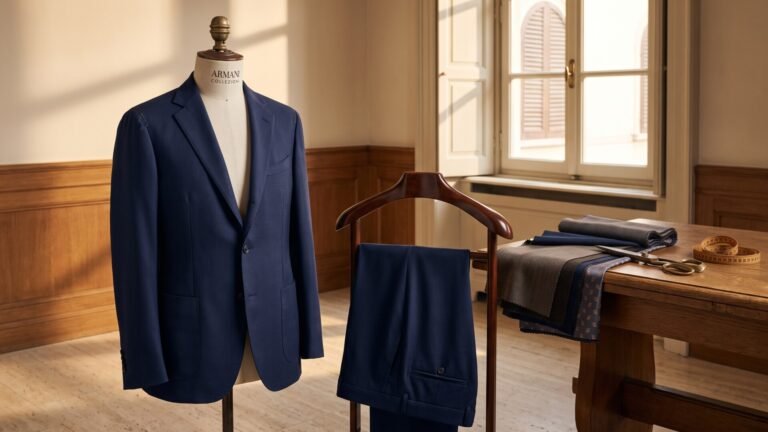
Giorgio Armani and his partner Sergio Galeotti founded the company in Milan in 1975. Armani had previously worked at Nino Cerruti and as a freelance designer, and his early menswear became known for removing the heavy padding and rigid lining of the traditional jacket. The resulting soft, “unstructured” silhouette became the foundation of the house and is the starting point for the Giorgio Armani line today.
Emporio Armani followed in 1981. The name “emporio” can be translated as “emporium” or department store, and the idea was a complete wardrobe for a younger customer at lower prices than the main line. Further labels arrived over the following decades, including Armani Exchange (1991) and the sportswear line EA7, while couture sits under Armani Privé, which was introduced in 2005. If you want to see how one of the intermediate labels fits in, see our guide on whether Armani Collezioni is considered high fashion, and for couture, our article on buying pre-owned Armani Privé safely.
The brand’s structure is also changing. Giorgio Armani died on 4 September 2025 at the age of 91. He had set out a succession plan before his death, and the group has since been run by the people and the foundation he designated. Because ownership and creative leadership arrangements can shift, check the group’s official communications for the current picture before relying on any single source.
The Philosophical Divide
The most significant difference is not the stitching but the point of view behind the clothes.
The Giorgio Armani Ethos
Giorgio Armani is about restraint. The line leans on minimal ornament, tonal palettes (the famous “greige”, navy, charcoal, black) and a cut that skims the body rather than clinging to it. Logos are small or absent. It is the line associated with boardrooms, formal dinners and red-carpet dressing, and it is the closest match to what people mean by “quiet luxury”. Our profile of why Giorgio Armani became the king of minimalism goes deeper into that design language, and the Giorgio Armani brand page collects the rest of our coverage.
The Emporio Armani Spirit
Emporio Armani is more casual, more experimental and more openly branded. The eagle logo appears on T-shirts, sneakers, belts and accessories. Cuts are slimmer and more season-driven, and the line covers jeans, knitwear, outerwear, underwear, sportswear-inspired pieces and a wide range of licensed accessories such as eyewear and watches. It is designed for everyday dressing with an Italian finish rather than for a once-in-a-decade tailoring purchase.
A practical consequence: an Emporio Armani blazer is generally lighter and softer in structure than a main-line jacket. That is a design choice, not necessarily a flaw, and it makes Emporio pieces comfortable for casual use. It is simply not the same product as a canvassed formal suit.
A Tale of Two Wardrobes
The product ranges reflect those philosophies. Here is what you can actually expect to find in each.
What Giorgio Armani Offers
- Formal Wear: The suits and tuxedos that define the brand, like the [Giorgio Armani Classic Tailored Suit](Affiliate: Giorgio Armani Classic Tailored Suit). Full-price main-line suits commonly sit in the low-to-mid thousands of dollars. The cut is engineered to follow the body without hugging it.
- Eveningwear and Couture: Couture is produced under Armani Privé, a separate label, and is priced accordingly. Giorgio Armani ready-to-wear includes eveningwear and gowns that are widely seen on red carpets.
- Luxury Accessories: Handbags, like the [Giorgio Armani Leather Handbag](Affiliate: Giorgio Armani Leather Handbag), are typically understated in design with minimal hardware. Leather grade and finishing vary by style, so check the product page for the specific leather and country of manufacture rather than assuming.
What Emporio Armani Offers
- Casual Wear: The heart of the line: T-shirts such as the [Emporio Armani Logo T-Shirt](Affiliate: Emporio Armani Logo T-Shirt), knitwear, denim and contemporary tailoring.
- Activewear: Sportswear-influenced pieces. Note that the dedicated performance line is EA7, a separate Armani label.
- Accessible Accessories: Watches, eyewear and bags. An [Emporio Armani Watch](Affiliate: Emporio Armani Watch) is typically priced from roughly $150 to $500 for common quartz and chronograph styles, with automatic and connected models costing more. Armani watches are made under licence by Fossil Group, which is worth knowing when comparing them with Swiss watches.
In short, Giorgio Armani sells tailoring and permanence, while Emporio Armani sells everyday style.
Who Are You Buying For?
-
Giorgio Armani suits the established professional, the formalwear buyer and anyone who prefers discretion over visible branding. It is the better fit if you need one dependable suit or coat for weddings, interviews and events.
-
Emporio Armani suits younger or style-led buyers who want an Armani look for everyday wear and are comfortable with a more visible logo. It is also a sensible way to try the brand’s cut before committing to main-line prices.
Neither is inherently better. They answer different needs.
The Craftsmanship Gap
Price differences between the two lines reflect fabric, construction and production volume. The brand does not publish a line-by-line construction breakdown, so treat the points below as general patterns and check each garment’s care label and product description.
-
Fabrics: Main-line tailoring commonly uses fine wools, wool-silk and wool-cashmere blends from Italian mills; the fabric content is printed on the label, so look for fibre composition and wool grade rather than relying on marketing terms. Emporio Armani uses a wider mix, including cotton, jersey, technical blends and standard wools, chosen for easy care and lower cost.
-
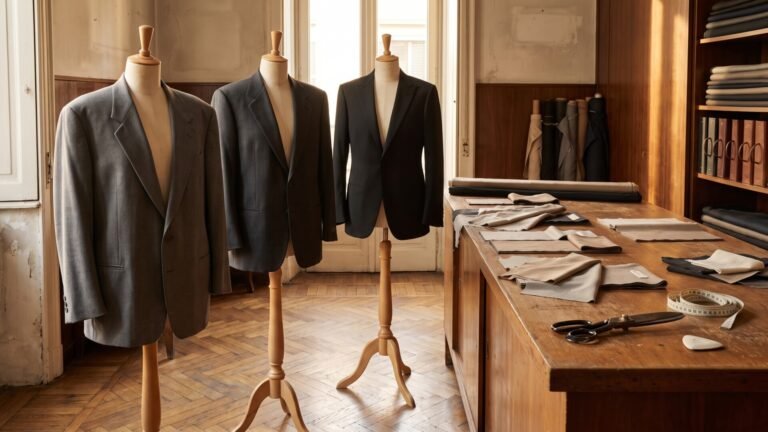
Construction: Quality tailoring is usually judged by what is inside the jacket. A fully canvassed jacket has a floating horsehair or similar canvas layer that moulds to the wearer over time, whereas a fused jacket uses adhesive interlining that is faster and cheaper to produce. Main-line suits are generally positioned at the more structured end of that scale and Emporio at the lighter end, but individual products differ, so ask the retailer or check the description.
-
Where it is made: “Made in Italy” is a labelling claim that applies product by product. Some Armani garments are made in Italy and others in other countries, so check the label of the specific item instead of assuming a line is entirely Italian-made.
A simple in-store test applies to any suit: hold the lapel and chest area between finger and thumb. A canvassed jacket feels like it has a separate soft layer inside, while a fused one often feels flat and uniformly stiff. Weight, drape and how the jacket holds its shape on a hanger are also telling.
The Price of the Name
| Item | Giorgio Armani (approx. USD) | Emporio Armani (approx. USD) |
|---|---|---|
| Suit | $2,500 – $5,000+ | $600 – $1,500 |
| Blazer / sport coat | $1,500 – $3,500 | $400 – $1,000 |
| Logo or basic T-shirt | $150 – $400 | $60 – $150 |
| Sneakers | $400 – $900 | $150 – $400 |
| Watch | Not a core category | $150 – $500+ |
Indicative full-price ranges at the time of writing. Markdowns, outlet pricing and department-store promotions can shift them considerably, and exact prices vary by retailer and season.
You pay for the brand name in both cases. With Giorgio Armani, a larger share of the price also goes toward fabric and tailoring; with Emporio Armani, a larger share goes toward design and brand positioning.
How to Tell Them Apart
- Label and logo: Emporio Armani uses an eagle emblem prominently; Giorgio Armani uses the “Giorgio Armani” wordmark with little or no ornament.
- Product name: Retail listings always state the label. Beware listings that just say “Armani”.
- Fit: Emporio cuts are typically slimmer; Giorgio Armani is softer and more relaxed through the shoulder and chest.
- Price: A suit at a fraction of main-line pricing is almost certainly a different line, a previous season, or a resale item. For second-hand buying, always ask for care-label photos and the seller’s return policy.
Building the Armani Wardrobe
-
Formal anchors: For interviews, client meetings or weddings, a main-line Giorgio Armani suit is the sound long-term choice. Our history of Armani suits through the decades explains the silhouettes you may encounter.
-
Everyday pieces: For smart-casual dinners, weekends or creative workplaces, an Emporio Armani blazer, knit or pair of sneakers is a practical way to get the look.
-
Mixing the two: A plain Emporio Armani T-shirt under a Giorgio Armani blazer, or main-line trousers with Emporio knitwear, works because both share proportion and colour sensibility.
The key is to be intentional. Do not buy an Emporio Armani suit expecting it to behave like a main-line one. Buy it because it is a good-looking suit at its price.
Cost per Wear, Resale and the Logo Question
-
Cost per wear: This is a simple illustration, not a measurement. A $4,000 suit worn 30 times a year for 10 years works out to about $13 per wear; a $1,000 suit worn 30 times a year for 4 years works out to about $8 per wear. The cheaper suit can win on paper if it lasts well, so the sensible question is how long a garment will actually stay wearable and appropriate for you, not just its price.
-
Resale: Clothing generally loses value quickly. Classic main-line pieces in good condition tend to find buyers on resale platforms more readily than trend-led pieces, but resale prices are not guaranteed and are usually well below retail. Do not treat either line as an investment in the financial sense.
-
The logo question: If you buy Emporio Armani mainly for the eagle, you are paying partly for branding. If you like the cut and fabric, the logo is incidental. Be honest with yourself about which it is.
Caring for Armani Tailoring
Whichever line you choose, tailoring lasts longer with conservative care. Rotate suits so each rests for at least a day between wears, use a contoured wooden hanger, brush wool gently after wearing, and dry-clean only when necessary since repeated cleaning wears down fabric and pressing can flatten the lapel roll. Always follow the garment’s care label, and ask a trusted tailor before attempting alterations on a fully canvassed jacket.
The Brands Today
The casualization of the workplace has reduced demand for the formal suit, and Armani has responded with softer tailoring, relaxed trousers and knit-based jackets in the main line. Emporio Armani, with its focus on casual wear and lifestyle, remains the brand’s main route to younger customers.
The quiet-luxury trend favours the main line’s logo-free, fabric-focused approach, while Emporio’s visible branding sits on the other side of that conversation. Both can coexist in one wardrobe, which is why the choice is less about loyalty and more about the occasion.
The Buying Verdict
Choose Giorgio Armani if:
- You need a reliable suit or coat for formal and professional settings.
- You value fabric, drape and tailoring over visible branding.
- You are buying one long-term wardrobe anchor rather than many seasonal pieces.
Choose Emporio Armani if:
- You are building a wardrobe on a tighter budget.
- You want the Armani aesthetic for casual, everyday wear.
- You like a more current, more visibly branded look.
If you have one big purchase to make, a main-line piece is the more durable choice for formalwear; for a weekend refresh, Emporio Armani is the more practical one.
Your Armani Questions, Answered
Frequently Asked Questions About Giorgio Armani Vs Emporio Armani
Is Giorgio Armani worth the extra cost compared to Emporio Armani?
For formal tailoring that you plan to wear for many years, usually yes, because main-line suits typically use finer fabrics and more structured construction. For casual, trend-driven items, Emporio Armani generally offers better value for the price.
What are the key quality differences between the two lines?
The main differences are fabric choice, jacket construction (canvassed versus fused) and level of finishing. Individual products vary, so check the fabric composition and product description rather than relying on the label alone.
Is Emporio Armani a lower-quality line?
It is a more accessible line with different goals: casual, contemporary clothing at lower prices. It is not designed to compete with main-line formal tailoring, but it is not poor quality by default.
What does Emporio mean in Emporio Armani?
Emporio can be translated as emporium or department store. The line launched in 1981 as a broader, more affordable wardrobe for younger customers.
Which pieces hold their value best?
Classic, well-kept main-line tailoring and outerwear tend to resell more readily than trend-led pieces, but clothing rarely holds its retail price and resale values are not guaranteed.
Are Armani watches made by Armani?
Emporio Armani watches are produced under licence by Fossil Group, rather than by a Swiss watchmaker. They are fashion watches priced accordingly.
Where is Armani clothing made?
It varies by product. Check the label of the specific item, because Made in Italy applies to individual products and not automatically to an entire line.
The Takeaway
The difference between Giorgio Armani and Emporio Armani is the difference between a tailoring house and a lifestyle label. Use the main line for pieces you want to keep for years, and Emporio Armani to make everyday dressing more interesting. To compare directly, explore our curated selection of [Giorgio Armani investment pieces](Affiliate: Shop Giorgio Armani) and [Emporio Armani lifestyle essentials](Affiliate: Shop Emporio Armani). For more guidance, read our guide to Italian fashion houses.