Is It Safe to Buy Used Armani Privé Online? A Guide to Pre-Owned Haute Couture
Armani Privé is the haute couture line of Giorgio Armani, shown in Paris since 2005. A gown or tailored piece from the line is made with couture techniques, and that is exactly why people look at the pre-owned market: new couture is made to order and the house does not publish prices. But buying used haute couture online raises fair questions. Is it safe? How do you know a piece is genuine? And which platforms actually sell clothing of this kind?
This guide covers what Armani Privé is, the real risks of buying it secondhand, how the main resale platforms differ on authentication and returns, and how to inspect and care for a piece once you have it. It gives general guidance only. No online check can prove a garment is authentic, and the safest route is always a seller who stands behind authentication and offers returns.
Understanding Armani Privé
Giorgio Armani founded his company in 1975 in Milan, and the house became best known for soft, unstructured tailoring (the story is told in our guide to why Giorgio Armani became the king of minimalism). Armani Privé arrived much later. It was presented for the first time in Paris in 2005, and it sits above the ready-to-wear lines such as Giorgio Armani and Emporio Armani. Our article on Giorgio Armani vs Emporio Armani explains those lower tiers.
| Line | What it is | How it is sold |
|---|---|---|
| Giorgio Armani Privé | Haute couture, shown in Paris since 2005 | Made to order through the house; prices not published |
| Giorgio Armani | Main ready-to-wear line | Boutiques, department stores, online |
| Emporio Armani | Younger, more accessible line | Boutiques, department stores, online |
| Armani Collezioni | Business and casual line (see our Armani Collezioni guide) | Boutiques, department stores, outlets |
As the house presents it, Armani Privé pieces are defined by the following characteristics. These are brand descriptions rather than independently tested claims, so read them as the house’s positioning:
- Couture construction: the house describes the collection as built with precious materials and skilled embroidery by hand, rather than industrial production.
- Small production: couture is made to order or in very small runs, which is why far fewer pieces reach the secondhand market than ready-to-wear.
- Luxury fabrics: silks, chiffons, tulle and heavily embellished textiles are typical of the line, although the exact materials vary by season and piece.
- Fit to the client: couture is fitted to an individual client, so a pre-owned piece may carry the proportions of its first owner.
To mark the line’s twentieth anniversary, the house staged a retrospective, Giorgio Armani Privé 2005-2025: Twenty Years of Haute Couture, at the Armani/Silos museum in Milan, running from 21 May 2025 to 3 May 2026. If you are researching a piece, the exhibition and the seasonal collection pages on the house’s own site are the sort of primary material worth comparing against a listing.
Risks of Buying Pre-Owned Haute Couture Online
Buying used Armani Privé can be rewarding, but several risks are specific to couture:
- Authenticity concerns: counterfeit and misdescribed designer clothing exists on every marketplace. Because couture is made in small numbers and varies piece to piece, there is no uniform label or tag to check against, and authentication needs someone who knows the house.
- Mislabelled listings: the name “Armani Privé” is used loosely in some searches. A look at one resale marketplace’s Armani Privé page showed T-shirts, leggings and beanies alongside dresses, which suggests the tag does not reliably mean haute couture. Always confirm which line a piece belongs to.
- Condition issues: silk, tulle, chiffon and embroidery are fragile. Underarm staining, snagged beadwork, weakened seams and fading from poor storage can all be present and sometimes hard to see in photos.
- Fit and sizing: couture is cut for a particular body, so a standard size chart may not apply and alterations can be needed.
- Transaction security: private sales and unverified marketplaces may offer no buyer protection, and payments by bank transfer are difficult to recover.
- Limited returns: return windows on pre-owned luxury are short and vary by platform. Check them before you buy.
Understanding these risks is the first step to a safe and informed purchase.
Where Pre-Owned Armani Privé Comes From
Couture is not sold from a shelf, so the secondhand supply is different from ready-to-wear. Pieces enter the resale market when a client sells or consigns something they commissioned or bought, when an estate or wardrobe is sold, or when a vintage dealer acquires older pieces. Because this supply is thin, listings are sporadic. You may search for months and find only a handful of genuine couture pieces, mixed with ready-to-wear pieces that use the Privé name in the title.
This scarcity also affects the buying process. A rare piece will often be sold quickly, and the pressure to act fast is the exact moment to slow down and check the seller, the return policy and the photographs.
How to Safely Buy Pre-Owned Armani Privé Online
1. Choose Established Resale Platforms
The most reliable approach is to use a resale platform that authenticates items itself, publishes its return rules and keeps the payment inside its checkout. The table below summarises how the main platforms differ, based on a 2026 platform comparison and the platforms’ own published information. Policies and fees change, so confirm current terms on the platform before buying.
| Platform | What it sells | Authentication approach | Returns (as reported) |
|---|---|---|---|
| Vestiaire Collective | Peer-to-peer marketplace with handbags, ready-to-wear, shoes | Physical authentication at its hubs for higher-value items; lower-priced items rely more on photos and spot checks | Around 14 days when a dispute is opened through the platform |
| The RealReal | Consignment across handbags, jewelry, watches and ready-to-wear | In-house team of brand authenticators | Roughly 14 to 21 days depending on option |
| 1stDibs | Marketplace of dealers and boutiques, including vintage designer clothing | Sold by independent dealers, so verify the seller’s policies and ask what authentication they provide | Set by the individual seller; check each listing |
| Specialist vintage boutiques | Curated couture and archival clothing | Varies; the dealer’s reputation and expertise matter most | Varies; often limited |
A note on Fashionphile: it is frequently mentioned among resale platforms, but it focuses mainly on handbags and accessories and is not a reliable source of couture clothing, so we do not recommend it for this purpose.
Whichever platform you use, look for these protections:
- Authentication: who examines the piece, and whether they are the platform’s own staff or a third party.
- Condition reporting: detailed descriptions and clear photographs noting wear, repairs and alterations.
- Payment protection: payment held or processed by the platform rather than sent directly to the seller.
- Return and refund terms: what happens if the item is not as described, and whether a refund applies if the item is later found not to be genuine.
2. Do Your Own Research Without Relying on It
Careful buyers do their own homework, but it is worth being honest about what it can and cannot do. Identifying the collection, season and look of a piece, and comparing it with runway images and the house’s published collection pages, helps you ask better questions and spot descriptions that do not match. It cannot prove that a garment is authentic. Fabrics, finishing and labels are best judged by someone who has handled genuine pieces, which is why independent authentication matters most for higher-priced items.
General steps that help:
- Ask the seller for the collection and season, and look it up in published runway coverage.
- Request clear photographs of the label, interior finishing, linings, closures and any embellishment, plus the full garment front and back.
- Ask whether the seller has the original receipt, invoice, garment bag or any correspondence with the house.
- Consider asking a professional authenticator or an experienced couture dealer to review the piece before you commit, particularly for high-value purchases.
3. Check Condition Carefully
Couture is delicate, and pre-owned garments may show signs of wear. Ask about each of the following:
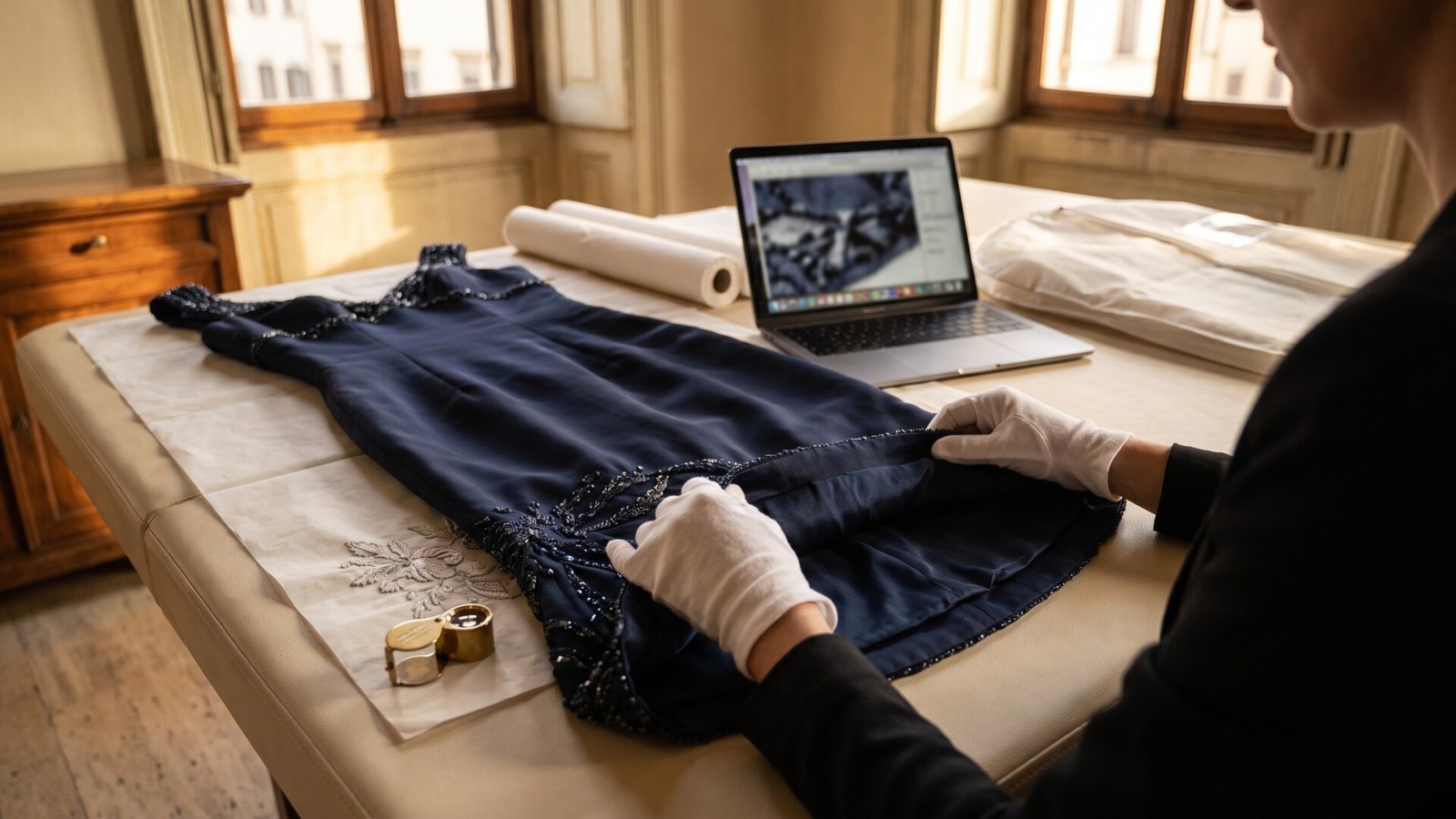
- Fabric: discoloration, fraying, watermarks or thinning, especially at seams and underarms.
- Embroidery and beading: whether beads, sequins and appliqués are secure, and whether any have been replaced.
- Alterations: small adjustments are normal, but heavy tailoring can limit what a later owner can do and may reduce what buyers will pay.
- Odor and stains: silk and other delicate fabrics absorb odors, and not every stain can be removed.
- Lining and structure: boning, interfacing and linings can deteriorate even when the outer fabric looks fine.
A seller who is happy to describe flaws in detail is a better sign than one who offers only glamour shots.
4. Verify Sizing and Fit
- Measurements over size labels: ask for bust, waist, hip, length and shoulder measurements taken flat, rather than relying on a printed size.
- Tailoring possibilities: minor adjustments are often possible, but structured, embroidered or heavily lined pieces are harder to change. Ask a couture-experienced tailor before buying if you can.
- Return options: some platforms allow returns, which lowers the risk of an ill-fitting purchase. Check how long you have and who pays for shipping.
5. Think Realistically About Value
Pre-owned couture is not just a fashion purchase, but it should not be treated as a guaranteed investment either. Resale prices depend on many things, and nobody can promise that a piece will hold or increase its value. Factors buyers commonly weigh include:
- Rarity and desirability: distinctive designs from a recognisable collection tend to draw more interest than generic pieces.
- Condition: pieces in clean, original condition are easier to sell than damaged or heavily altered ones.
- Documentation: receipts, invoices, runway references and a clear ownership history make a piece easier to trust.
- Market taste: demand changes over time, so what sells well today may not tomorrow.
What Does Pre-Owned Armani Privé Cost?
There is no reliable price list for pre-owned Armani Privé, partly because the house does not publish prices for new couture and partly because the name is applied to a wide mix of items online. Some context from research at the time of writing:
- In November 2026, 1stDibs’ Armani Privé pages showed items priced from about $260 to about $10,700, including a couture evening jacket, shoes and a clutch. The listing average was around $900, which suggests many results are not full couture gowns.
- On Vestiaire Collective’s US Armani Privé page in November 2026, the dozen items on display were mostly accessories and casual pieces (beanies, a T-shirt, leggings, a scarf) priced from about $35 to just under $1,000; the one silk dress was listed at about $600.
These figures are snapshots of listings, not sale prices or guarantees, and they will have changed. Their main use is as a sanity check: a genuine couture evening gown listed for a few hundred dollars deserves extra questions, and a high price is not proof of authenticity either. Compare several listings of similar pieces before you decide what is reasonable.
Red Flags to Watch For
- A price far below comparable listings: a steep discount is a reason to ask more questions, not to hurry.
- Pressure to pay outside the platform: requests to move to direct bank transfer, messaging apps or gift cards remove your protection.
- Vague or recycled photographs: no label shot, no interior photos, or images that appear on other listings.
- No collection information: a seller who cannot say which season or collection a couture piece comes from may not know what they are selling.
- No returns, no refund: for a high-value item, a final-sale-only policy shifts all the risk onto you.
- Claims that sound too certain: be wary of a seller who says a feature “proves” authenticity. Authentication is a judgment by an expert, not a single detail.
Common Mistakes to Avoid
- Buying based solely on price: a steep discount may signal an authenticity or condition problem.
- Skipping authentication: never assume a piece is genuine without independent or platform verification.
- Ignoring condition reports: even a genuine garment can be hard to resell if heavily damaged.
- Overlooking return policies: make sure there is a safety net if the item does not match its description.
- Ignoring fit: couture is tailored, and an ill-fitting piece can require costly alterations.
- Confusing the lines: a Giorgio Armani, Emporio Armani or Armani Collezioni piece is not Armani Privé, whatever the listing title says.
Armani Privé Compared With the Other Armani Lines
If your goal is Armani tailoring rather than couture specifically, the ready-to-wear lines may suit you better, and the pre-owned market for them is much larger. The trade-offs are summarised below.
| If you want… | Consider | Why |
|---|---|---|
| Red-carpet and evening couture | Armani Privé | Made-to-order couture, but scarce secondhand and harder to authenticate |
| Classic Armani tailoring and suits | Giorgio Armani main line | Larger supply; see our guide to the evolution of Armani suits |
| A more accessible, younger look | Emporio Armani | Much wider availability; see Giorgio Armani vs Emporio Armani |
| Business and smart-casual wear | Armani Collezioni | See whether Armani Collezioni counts as high fashion |
For a wider look at where Armani sits among Italian houses, our guide to Italian designer brands compares the major names, and our profile of Giorgio Armani covers his career in more detail.
How to Care for Pre-Owned Armani Privé
Once you acquire a pre-owned garment, careful handling matters. This is general guidance, and a specific piece may need different treatment, so follow any care label and a specialist’s advice:
- Professional cleaning: use a cleaner with experience in couture and embellished garments, and tell them about embroidery, beading and linings before they start. Avoid home cleaning for delicate or embellished fabrics.
- Storage: store in a breathable garment bag, away from direct light and humidity. Avoid long-term storage in plastic.
- Hanging versus folding: structured garments are generally better on padded hangers, while heavily beaded or very delicate pieces are often stored flat with acid-free tissue so the weight of the embellishment does not stretch the fabric.
- Wear sparingly: delicate fabrics and beadwork wear faster with repeated use.
- Regular inspection: check for loose threads, beads and sequins after each wear, and have repairs made by someone experienced with the technique.
Good care keeps a garment wearable, and it also makes any future resale easier, although it cannot guarantee a price.
Final Checklist Before You Buy
- Confirm the line: couture Armani Privé, not another Armani line or an unrelated item with the name in the title.
- Identify the collection and season and compare them against published runway coverage.
- Check the platform’s authentication process, return window and refund terms in writing.
- Read the condition report and examine every photograph, asking for more if needed.
- Compare measurements with your own, and get a tailor’s view if alterations may be needed.
- Pay only through the platform’s protected checkout.
- Keep every receipt, tag and piece of documentation.
Conclusion
Buying pre-owned Armani Privé online can be done with care, but it is not risk-free. The safest approach is to buy from a platform or dealer that authenticates items, publishes return terms and keeps payment secure, to check that the piece really is couture, and to inspect condition and fit closely. Treat any research you do as a way to ask better questions rather than as proof, and treat the purchase as something you want to own rather than a guaranteed asset.
If you decide Privé is out of reach, the wider Armani range is a good place to continue, starting with our guide to Giorgio Armani and minimalism, then the evolution of Armani suits and Armani Collezioni.
Frequently Asked Questions About Buying Used Armani Privé
Is it safe to buy used Armani Privé online?
It can be, but the safety comes from the seller and the paperwork rather than from the garment. Buying through a platform that authenticates items in-house, publishes a return policy and keeps payment inside its own checkout is lower risk than a private sale by direct bank transfer. No platform removes the need to read the listing, ask for photos and confirm the return terms before paying.
Is everything labelled Armani Privé on resale sites actual haute couture?
Not necessarily. Searches for the name on resale marketplaces return a mix of items, and some of them are accessories, casualwear or older pieces whose connection to the couture line is unclear. Treat the title as the seller’s description and look for the collection, season and label details in the photographs.
How much does a pre-owned Armani Privé piece cost?
There is no standard price. A listing search on 1stDibs for the name showed items between roughly $260 and $10,700 in November 2026, but that mixes different kinds of items and the range will have moved since. Couture-level gowns sit at the upper end of what appears, and the house does not publish prices for new couture.
Can an Armani Privé garment be altered to fit?
Often, within limits. Couture is cut and built for a specific body, so structured pieces, boned bodices and heavily embroidered fabrics are harder to adjust than a simple silk dress. A couture-experienced tailor should assess the piece before you buy, and you should ask the seller whether any alterations were already made.
Does Armani Privé still exist after Giorgio Armani's death?
Giorgio Armani died on 4 September 2025 at the age of 91. The house has continued to present Giorgio Armani Privé on the Paris haute couture calendar since then, including an Autumn-Winter 2026-2027 presentation reported in the press.
Should I buy pre-owned couture as an investment?
No outcome can be promised. Resale prices depend on condition, the specific piece, documentation and what buyers want at the time of sale. Buy because you want to wear or collect the piece, and treat any later resale value as a possible bonus rather than a plan.
What is the difference between Armani Privé, Giorgio Armani and Emporio Armani?
Privé is the haute couture line shown in Paris, Giorgio Armani is the house’s main ready-to-wear line, and Emporio Armani is a younger, lower-priced line. Our comparison of Giorgio Armani and Emporio Armani explains how the ready-to-wear tiers differ.