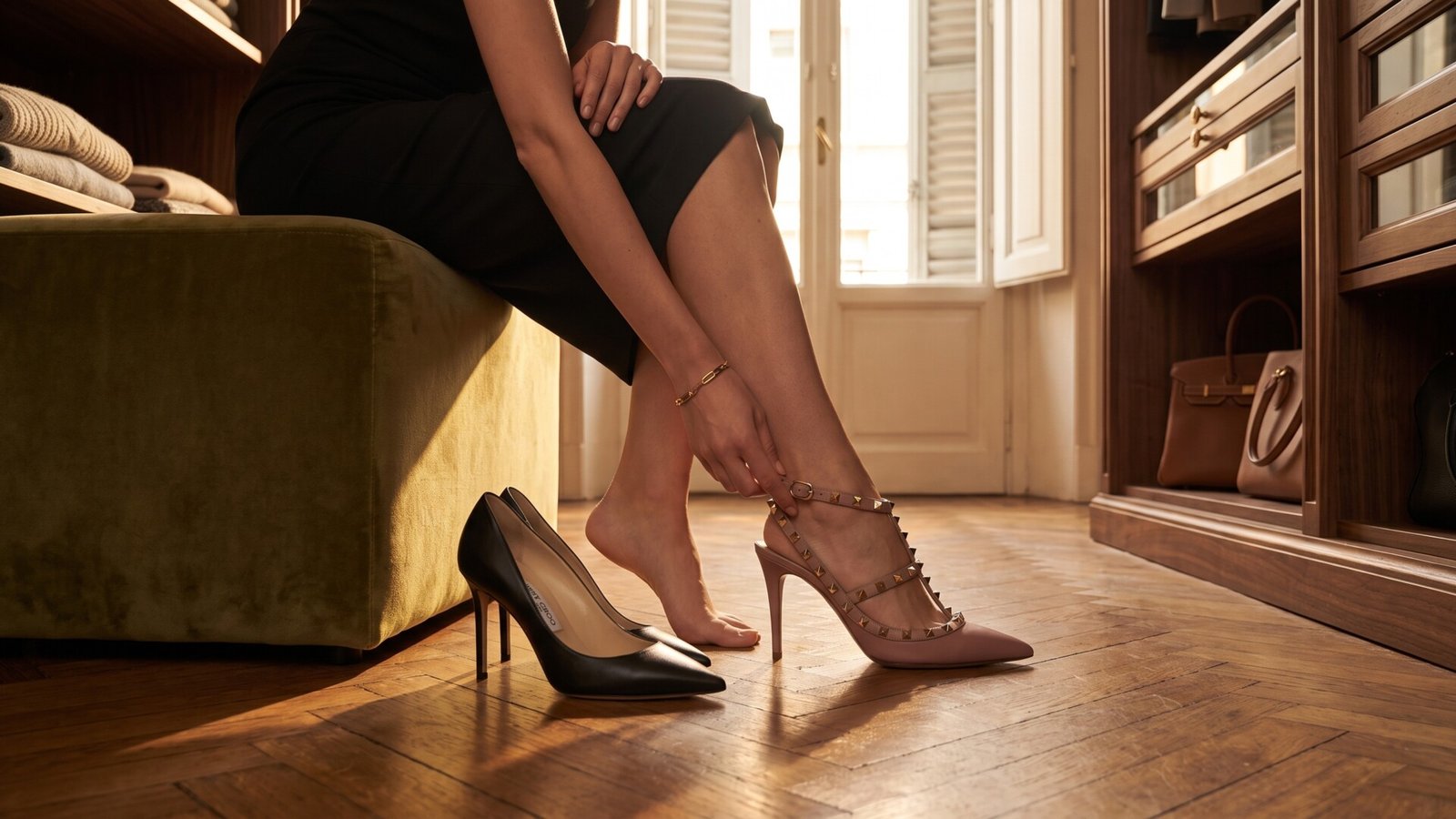
Valentino Rockstud Heels vs Jimmy Choo: Sizing, Comfort, and Value Comparison
If you’ve ever shopped high-end designer heels, you know the struggle: sizing isn’t always intuitive, comfort is relative, and the price tag can make you second-guess every purchase. Among the most recognizable luxury pumps, the Valentino Garavani Rockstud and Jimmy Choo’s classic pumps (the Romy, the Anouk and their siblings) turn up on a lot of wishlists. Both are made in Italy, both use Italian sizing, and both cost roughly $875 to $1,400 for a standard pump in the US, but they feel and wear differently. This guide compares them on sizing, extended-wear comfort, materials and value, and ends with a clear answer to “Valentino or Jimmy Choo for heels?”
Note on sources: specifications and prices below come from the brands’ own US product pages and authorized US retailers (Mytheresa US, Net-a-Porter US), checked in November 2026. Prices are full retail, not sale prices. Fit and comfort observations are general buyer-reported patterns, not results of our own wear-testing, and individual feet vary.
Quick Verdict: Valentino or Jimmy Choo?
- Choose the Valentino Rockstud if you want a design people recognize from across a room, you’re happy to wear an ankle strap, and you’re prepared to size carefully. The pyramid studs are the point of the shoe.
- Choose Jimmy Choo if you want a cleaner, strapless line (the Romy 85 is a pointed-toe stiletto with no straps), a lower entry price, and fewer hardware details to maintain.
- If walking matters most, look at the lower heel options in each range: Valentino offers Rockstud pumps in 65mm and 40mm, and Jimmy Choo names its pumps by heel height, such as the Scarlett 50.
Overview of the Brands and Iconic Styles
Valentino Rockstud Heels
Valentino’s Rockstud line is instantly recognizable thanks to its signature pyramid studs. The stud first appeared in Valentino’s Fall/Winter 2010 collection, designed by Maria Grazia Chiuri and Pierpaolo Piccioli (a few sources date it to 2011), and has stayed in production since. The pump comes as an ankle-strap or caged style, plus other variations, blending edgy glamour with sophisticated construction.
- Materials: Valentino’s US site lists the 100mm Rockstud ankle-strap pump with a calfskin upper and tone-on-tone lacquered studs; other versions are offered in patent leather, suede, kidskin, metallic leather and crystal-embellished finishes.
- Heel heights: 100mm (about 4 inches) is the classic. Current pumps also come in 65mm (for example the caged pump) and 40mm (kidskin pump). The earlier version of this article quoted 85–100mm, which doesn’t match the current range.
- Signature feature: Pyramid studs along the straps and edges, creating a mix of elegance and rebellious style. The ankle strap on the main pump is adjustable.
- Origin: The 100mm ankle-strap pump is listed by Valentino as made in Italy. Made in Italy is a per-product label, so check the page for the exact style you buy.
Valentino’s house story and full product range are covered in our complete Valentino guide. In ownership terms, Mayhoola holds the majority of the house and Kering owns a 30% stake; under a September 2025 amendment, Mayhoola’s options to sell the rest to Kering move to 2028 and 2029, and Kering’s option to buy it moves to 2029. Alessandro Michele has been creative director since 2024, following Pierpaolo Piccioli.
Jimmy Choo Heels
Jimmy Choo was founded in London in 1996 by Malaysian-born shoemaker Jimmy Choo Yeang Keat and Tamara Mellon, then an accessories editor at British Vogue; Jimmy Choo himself left the company in 2001. Ownership has changed several times since: Labelux acquired the brand in 2011, and Michael Kors Holdings (now Capri Holdings, which also owns Michael Kors) completed its purchase in November 2017. Sandra Choi has led creative direction since 2013. Popular pumps include the Romy, the Anouk, the Scarlett and the Stevie, plus embellished sandals.
- Materials: The Romy 85 on Jimmy Choo’s US site is a navy suede pump with a leather lining and leather sole, and the brand says the leather comes from tanneries certified Gold or Silver by the Leather Working Group. Other seasons use kid leather, satin, raffia, lace and crystal.
- Heel heights: Jimmy Choo names pumps by heel height in millimetres. The Romy 85 has an 85mm (3.3 inch) stiletto heel, the Scarlett 50 sits at 50mm and the Stevie 100 at 100mm. Retailers list the Anouk at 120mm.
- Signature feature: A sleek, elongated pointed toe with no hardware, which suits both tailoring and evening wear.
- Origin: The Romy 85 is listed as made in Italy, and Capri Holdings has acquired several Italian shoe factories since buying the brand in 2017.
One point worth being clear about on a site focused on Italian design: Jimmy Choo is a British brand that manufactures in Italy, while Valentino is a Roman house. For a wider look at how national shoemaking traditions differ, see our Italian vs. French luxury shoe brands comparison.
Price Snapshot (USD, November 2026)
Luxury prices change by season, color and market. The figures below are US full prices checked in November 2026, with the source named for each.
| Style | Heel | Material | Approx. US price |
|---|---|---|---|
| Valentino Rockstud ankle-strap pump | 100mm | Calfskin | $1,190 in core colors; special finishes about $1,390–$1,400 (Valentino US) |
| Valentino Rockstud caged pump | 65mm | Leather | $1,320 full price (Net-a-Porter US); often marked down at season end |
| Jimmy Choo Romy 85 | 85mm | Suede, kid, other | $875 in black suede (Jimmy Choo US) |
| Jimmy Choo Scarlett 50 | 50mm | Leather | $1,095 full price in leather (Mytheresa US) |
| Jimmy Choo Stevie 100 | 100mm | Leather; crystal versions | Crystal-embellished satin $3,095 (Jimmy Choo US); plain leather price not verified |
| Jimmy Choo Anouk | 120mm (per retailers) | Patent calfskin, leather | Not verified; check the brand page |
The takeaway: the Romy 85 is usually the cheaper route into Jimmy Choo, while Valentino’s Rockstud pump costs more because of the studs and strap construction. Net-a-Porter also lists seasonal markdowns on both houses, so a UK or EU price may look very different once converted.
Design and Fit Profile
The Rockstud’s character comes from the studs, which sit on the strap and edge of the shoe and add an edgier note to a classic pump shape. The Romy is deliberately plain: Jimmy Choo describes the current Romy 85 as a classic pointy-toe pump with a slightly softer point and a new stiletto heel. The Anouk is the taller, narrower pump of the three and reads as the most formal.
These design choices affect fit in practical ways. A narrower, more pointed toe leaves less room for the forefoot than a rounded one. A higher heel moves more body weight onto the ball of the foot. And a strap with metal studs, as on the Rockstud, adds fixed points that do not stretch, so they matter more where the strap meets your ankle or the top of the foot. You are choosing a fit profile as much as a look.
Sizing: Valentino vs Jimmy Choo
Both houses use Italian sizing. Jimmy Choo states this on its product pages (“Jimmy Choo shoes are in Italian sizing”, with a size chart running IT 34 to 43), and Valentino’s pumps are sold in Italian sizes with US equivalents from 4 to 12 including half sizes. Neither brand publishes a “runs small” or “runs large” rule, so the notes below reflect general buyer experience and should be confirmed against each brand’s size chart.
Standard Sizing Guidance
| Brand | Commonly reported fit | Size system | Width |
|---|---|---|---|
| Valentino Rockstud | True to size for narrow to medium feet; many wider-footed buyers go up half a size | Italian (IT), US 4–12 with half sizes | One standard width |
| Jimmy Choo | Generally true to size, with a pointed toe that can feel snug in some styles | Italian (IT 34–43 on the Romy) | The US site shows a width selector, but no details are published, so ask customer service |
Key takeaway: If your feet are medium or narrow, your regular size is a reasonable starting point in either brand. If you’re between sizes or have a wider forefoot, size up half a size in the Rockstud and check the return policy before ordering both.
That matches published guidance: Purseblog’s Rockstud guide says narrow feet generally run true to size, while wider feet are advised to order a half size up. The reasoning is structural. A firm pump with fixed studs cannot stretch the way plain leather can. For the Jimmy Choo pumps we could not confirm an official sizing recommendation, so compare your foot length in centimetres against the brand’s chart, leave a small allowance at the toe, and read recent reviews for the exact style. Our guide on how Italian designer shoes should fit covers the general principles.
Toe Box and Strap Considerations
- Valentino: The pointed toe combined with thin ankle straps can cause discomfort if feet are swollen or wide. The straps are adjustable, which helps with ankle and instep fit.
- Jimmy Choo: The Romy’s toe is also sharply pointed, so it isn’t automatically roomier. The advantage is the absence of straps and studs, so there are fewer pressure points over the instep.
Comfort for Extended Wear
Comfort is subjective, and no pump with a 85–100mm stiletto is a walking shoe. These are the factors worth comparing:
- Heel height and balance
- Valentino: The 100mm pump is the classic, but 65mm and 40mm versions exist, which changes the comfort equation completely.
- Jimmy Choo: The heel height is in the name (Scarlett 50, Romy 85, Stevie 100), which makes comparing easy.
- Ankle strap vs no strap
- Valentino: An ankle strap holds the heel in place, which makes long evenings easier than a strapless stiletto that slips at the back.
- Jimmy Choo: The Romy has no strap, so fit at the heel and toe has to do all the work. This is the reason to try it on with the socks or inserts you actually plan to use.
- Break-in
- Both: Leather pumps with a narrow toe generally need a few short wears to soften, and suede tends to give a little faster than patent. Brands don’t publish break-in times, so expect it to vary.
- Surface rubbing
- Valentino: Studs sit on the straps and may press on the skin until the leather conforms.
- Jimmy Choo: A plain upper means no decorative hardware to rub.
Soles and footbed: The Romy 85 product page lists a leather lining and a leather sole. A leather sole is smooth and flexible but offers little shock absorption or grip on slick floors, which is typical for dress pumps. We could not verify footbed padding or last construction for either brand, so we have not described them.
What reviewers report: Reviewers broadly agree that heel height and fit matter more than the label. In the comments on Purseblog’s Rockstud guide, one owner described the heels as comfortable for six to eight hours, while finding the Rockstud flats uncomfortable and slow to break in. That kind of spread is normal: a shoe that suits one foot shape may not suit another.
Conclusion on comfort: For short, dressy evenings the 100mm Rockstud ankle-strap pump is secure and stable. For long days, the choice that matters most is heel height: a 65mm Rockstud or a 50mm Jimmy Choo Scarlett will be easier than any 100mm stiletto from either brand.
Heel Height and Walkability
- Valentino Rockstud pumps: 100mm, 65mm and 40mm are all currently sold, so you can choose how formal and how walkable you want the shoe to be.
- Jimmy Choo pumps: heights range from 50mm (Scarlett 50) through 85mm (Romy 85) to 100mm (Stevie 100), with the number in the name. The Anouk goes higher still, at 120mm.
Pro tip: For long events or travel, consider the lower Rockstud heights (65mm or 40mm) before you consider a sandal. They keep the signature studs with a lot less strain on the ball of the foot.
Which Model Should You Buy?
Valentino Rockstud: which heel?
- 100mm ankle-strap pump: The original and the most recognized. Best for weddings, dinners and events where you’ll mostly sit and stand.
- 65mm caged pump: A lower heel with the same studded look, and the sensible choice for anyone who commutes or walks between venues.
- 40mm kidskin pump: The softest, quietest version, closer to a flat in how it wears.
If you’re debating whether to buy now or wait, our notes on Alessandro Michele’s first Valentino collection show where the house is heading under its current creative director.
Jimmy Choo: Romy, Anouk and the rest
- Romy 85: The pointed-toe stiletto that most people picture when they think of a Jimmy Choo pump. It comes in suede, kid leather, raffia, lace and other finishes.
- Scarlett 50: The lower-heel option, useful for work wear and walking.
- Stevie 100: A taller, more formal pump, available in plain leather and in crystal versions priced far higher.
- Anouk: A frequent search alongside the Romy. Retailers list it as a 120mm pointed pump in patent calfskin and leather, which makes it the tallest and most formal of these styles. We couldn’t confirm current Anouk specs and pricing from Jimmy Choo’s own site, so check the brand page before comparing it directly with the Romy.
Styling and Occasions
The Rockstud works as the focal point of an outfit. Tailored black trousers, a slip dress, or cropped jeans with a blazer let the studs add edge without competing with embellished clothing. The Romy is the more neutral choice: its clean line goes with suits, midi dresses and tailored trousers, and it does not fight with patterns. The taller Anouk reads as more formal and is best kept for evening wear.
- Weddings and long events: choose the lower heel in either brand, such as the 65mm Rockstud or the Romy 85 (or the Scarlett 50), and avoid the 120mm Anouk if you will stand for hours.
- Office to dinner: the 65mm Rockstud or the Romy 85 both work. The studs make the Rockstud read as more fashion-led, and the Romy is the more classic.
- Formal evenings with mostly seated time: the 100mm Rockstud or the Anouk are the most dramatic choices.
- Travel: studs can catch on fabric and scratch other items in a suitcase, so pack Rockstud pumps in their dust bags or a separate shoe bag. Pointed toes also take more space.
For a broader set of options, our guide to Italian designer heels and the list of best Italian designer heels for comfortable all-day wear are good next reads.
Material and Longevity
Valentino Rockstud Leather
- Pros: The core pump uses a calfskin upper, and the lacquered studs on the tone-on-tone version are color-matched, so tiny chips are less obvious than on contrasting metal.
- Cons: Pointed toes can crease over time, and studs can scratch if shoes are stored touching each other.
Jimmy Choo Leather and Suede
- Pros: Leather lining and leather sole on the Romy 85, and a plain upper with little to snag.
- Cons: Suede marks easily in rain and from oils, and patent finishes can show scuffs. Our guides to suede cleaners and to DIY versus professional cobbler work cover the options.
Durability verdict: Neither house publishes wear data, so durability depends on how you use the shoe. In general, a strappy design has more stress points (buckles, straps, studs) than a plain pump, but the strap also takes some load off the heel counter. The best protection for either is a rubber heel tip and sole guard fitted by a cobbler before the first outing.
Care Routine for Both
Leather soles wear faster outdoors than rubber, so a thin rubber sole protector added before the first wear helps with grip and slows wear. Replace heel tips as soon as they wear down, since a tip worn to the metal can damage the heel itself. Store both pairs in dust bags with shoe trees or tissue in the toe, and clean smooth leather with a soft cloth. Our guide to how to care for Italian leather shoes covers the main principles, and for suede Romy colors, the method in waterproofing Italian suede applies.
Studs need their own care. They can chip or snag over time and mark other leather goods if stored against them. If a stud loosens, take the shoe to the brand or a specialist cobbler rather than gluing it yourself.
Price vs. Prestige
Valentino Rockstud
- You pay for the stud, which is the house’s best-known signature and works as a logo without a logo.
- The pump is made in Italy, according to Valentino’s product page, and the studs are an extra construction step compared with a plain pump.
- Rockstud pumps are widely resold, but resale prices depend on size, condition and season, and no value is guaranteed.
Jimmy Choo Pumps
- A plain silhouette is easier to wear with most outfits and costs less at entry level (Romy 85 at $875 on Jimmy Choo’s US site in November 2026).
- You pay for the shape and the brand’s London-founded heritage, with Italian production.
- Resale is possible for classic styles, but again, no guarantee.
Cost per wear: This is a simple calculation rather than a forecast. A $1,190 Rockstud worn 40 times costs about $30 per wear; an $875 Romy worn 40 times costs about $22 per wear. If one of them fits better and so gets worn twice as often, it is the cheaper shoe in practice, whatever the label says. For a wider look at value in this category, see whether luxury Italian shoes are worth the money.
Takeaway: If a recognizable design is the main reason you’re buying, the Rockstud justifies its price. If you want the lower entry cost and a plainer silhouette that works with more outfits, the Romy is the more practical choice. For a broader look at the house, see our guide to Italy’s most influential fashion houses.
Sizing Tips and Tricks
- Measure feet accurately: Trace your foot on paper and measure length and width in centimetres, using the larger foot. Compare to the brand’s Italian size chart rather than your US or UK size.
- Consider half sizes: Valentino’s pumps come in half sizes. If you’re between sizes or have a wide forefoot, the larger size is usually the safer choice in a pointed toe.
- Try on in the afternoon: Feet swell during the day, so a pair that fits at 9am may pinch by evening.
- Test with the right socks or inserts: Thin cushioning pads at the ball of the foot reduce pressure in a narrow toe box.
- Check heel grip and instep: A narrow heel can slip in a strap-based pump, which is where studs or edges rub, and a high instep needs the Rockstud strap to adjust far enough.
- Break in slowly: Wear indoors on carpet for short periods first and keep the soles clean, so you can still return them if they don’t work.
Choosing by Foot Type
These are general principles for pumps rather than brand-specific claims, so use them to narrow your shortlist and then confirm with the size chart and a return policy.
- Wide forefoot or bunions: a pointed toe puts pressure on the sides of the foot. A lower heel reduces how far the foot slides forward, and a half size up is the common advice for the Rockstud. If both shoes pinch, look at roomier shapes in our comfortable all-day heels guide.
- Narrow heel: strap-based pumps like the Rockstud can slip. Heel grips or a cushioned insert reduce movement, and a closed-back pump such as the Romy often holds the heel better.
- High instep: the Rockstud ankle strap has little give, so check how far it adjusts and try it on rather than ordering blind.
- Flat or low arches: a steep 100mm heel puts more load on the ball of the foot. A 65mm or 85mm heel is more forgiving.
- Active evenings: if you expect to dance or walk between venues, pick the lowest heel in the range and carry foldable flats.
Extended Wear Comparison
| Feature | Valentino Rockstud | Jimmy Choo |
|---|---|---|
| Heel height options | 100mm, 65mm, 40mm | 50mm to 120mm (named by height) |
| Straps | Adjustable ankle strap or cage, with studs | Mostly strapless pumps |
| Size system | Italian (US 4–12 with half sizes) | Italian (IT 34–43 on Romy) |
| Hardware to maintain | Studs and buckle | Minimal |
| Typical US price | $1,190–$1,400 (100mm); $1,320 (65mm caged) | $875 (Romy 85) to $1,095 (Scarlett 50); crystal styles about $3,100 |
| Made in | Italy (per product page) | Italy (per product page) |
| Brand origin | Rome | London |
| Best for | Recognizable design, evenings | Versatile, lower entry price |
Common Fit Problems and How to Avoid Them
The most common complaint with strap-based pumps is heel slip, where the foot moves in the shoe and the strap or studs rub the back of the ankle. Heel grips or cushioned inserts can help, though they take up room. The most common complaint with narrow pointed pumps is toe pressure, which usually means the length or width is wrong for your foot and cannot always be fixed by stretching. If a pair pinches within the first few minutes at home, return it rather than hoping it will break in.
Buying Checklist
- Check the product page for the exact heel height and country of manufacture of the style you’re buying.
- Buy from the brand, an authorized department store or a reputable resale platform with an authentication policy. No photo checklist can prove authenticity on its own.
- If buying pre-owned, ask for photos of the insole, the studs and the sole, and treat a large discount on a current style from an unknown seller as a warning sign.
- Confirm the return window before you order two sizes, including whether returns are free and whether marked soles void a return. Sale pairs are often final sale.
- Plan for a cobbler visit: a rubber top lift and sole protector add a modest cost and protect the leather sole and heel tip from the first wear.
If neither house fits, Italian makers such as Gianvito Rossi, Sergio Rossi and Aquazzura also make pointed-toe pumps in a similar price band, though we haven’t compared them here. Our guide to Italian stiletto brands worth knowing covers the wider field.
Conclusion
- Valentino Rockstud: Recognizable and edgy. The ankle strap secures the shoe, and the range includes 100mm, 65mm and 40mm heels. Size carefully and expect a short break-in. Best for those who want the stud.
- Jimmy Choo: A cleaner line with a lower entry price on the Romy 85, a range of heights, and no hardware to maintain. Best for those who prioritize a versatile, plain pump. The taller Anouk suits formal, mostly seated evenings.
Bottom line: Both houses produce Italian-made pumps in the same general price band. Your choice should hinge on foot width, heel height and whether you want a signature detail or a plain silhouette. To keep exploring, start with our Valentino guide or, for investment-minded buyers, the Valentino V-Logo tote.
Frequently Asked Questions About Valentino Rockstud Vs Jimmy Choo Heels
Should I buy Valentino or Jimmy Choo heels?
Buy Valentino if the studs are what you want and you accept a more carefully sized ankle-strap shoe. Buy Jimmy Choo if you want a cleaner, strapless pump at a lower entry price. Neither is clearly better for everyone.
Which Valentino heels should I buy first?
For a first pair, many buyers choose the 100mm Rockstud ankle-strap pump in a neutral color for the signature look, or the 65mm version if they expect to walk. Our Rockstud history explains how the design evolved.
Should I size up or down for Valentino Rockstud shoes?
Published shoe guides say narrow feet generally run true to size and wider feet should order a half size up. The structure and fixed studs leave little room to stretch, so check Valentino’s size chart and buy from a retailer with a return policy.
Do Valentino and Jimmy Choo use the same sizing?
Both sell in Italian sizes, so a pair labeled 38 should be in the same system. The fit still varies by last (shoe shape), so always check each brand’s size chart.
Is the Jimmy Choo Romy comfortable?
The Romy 85 is a pointed-toe stiletto with no strap, so comfort depends on getting the length right. If the heel slips or the toe pinches, consider the lower Scarlett 50.
What is the Jimmy Choo Anouk?
A taller pointed-toe pump that retailers list at 120mm, in patent calfskin and leather. It is more formal than the Romy 85 and best for evenings where you will mostly be seated.
Is Jimmy Choo an Italian brand?
No. Jimmy Choo was founded in London in 1996 by Jimmy Choo and Tamara Mellon. The Romy 85 product page states the shoe is made in Italy, but the brand is British.
Are Jimmy Choo shoes made in Italy?
The Romy 85 is listed as made in Italy, but the label applies per product, so check the page for the exact style.
How do I care for patent leather and suede heels?
Wipe patent with a soft damp cloth and store with tissue so it doesn’t crease; brush suede and protect it before the first wear. See our guides to suede cleaners and when to see a cobbler. Test any product on an inconspicuous area first.
Can I return luxury shoes if the sizing is wrong?
It depends on the retailer. Check the return window and conditions before you buy, try the shoes on carpet, and keep the soles clean and the packaging until you are sure of the fit.