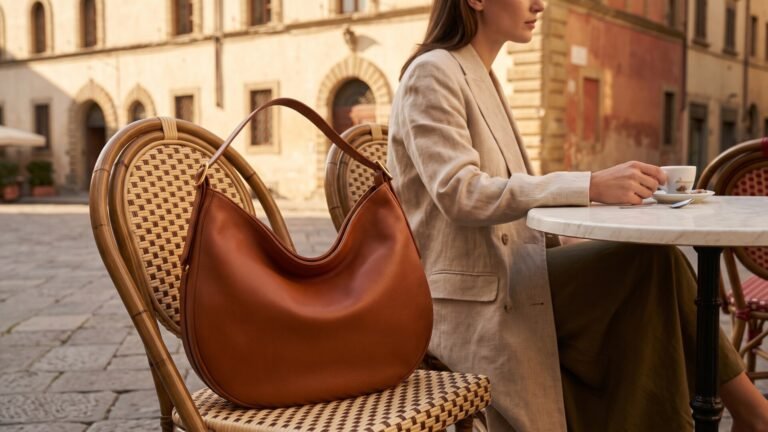
Italian Leather Hobo Bags Worth Buying
A customer picks up a hobo off the shelf, runs a thumb across the leather, and says the same thing almost every time: “It’s so soft.” That is the moment I start worrying. Soft is the easiest thing to sell and one of the harder things to live with. Soft leather with no reinforcement behind it will slump into a puddle by month eight, and the strap will start to pull at the seam where it meets the body. The hobo is a shape that depends entirely on how it is built, because there is almost nothing to it – no structure, no frame, no hardware doing the work. So the honest answer is this: an Italian leather hobo bag is worth buying when the leather, the strap, and the capacity match the way you actually carry things, and it is a waste of money when you buy it for the label and hope the rest sorts itself out.
What Makes an Italian Leather Hobo Bag Worth Buying
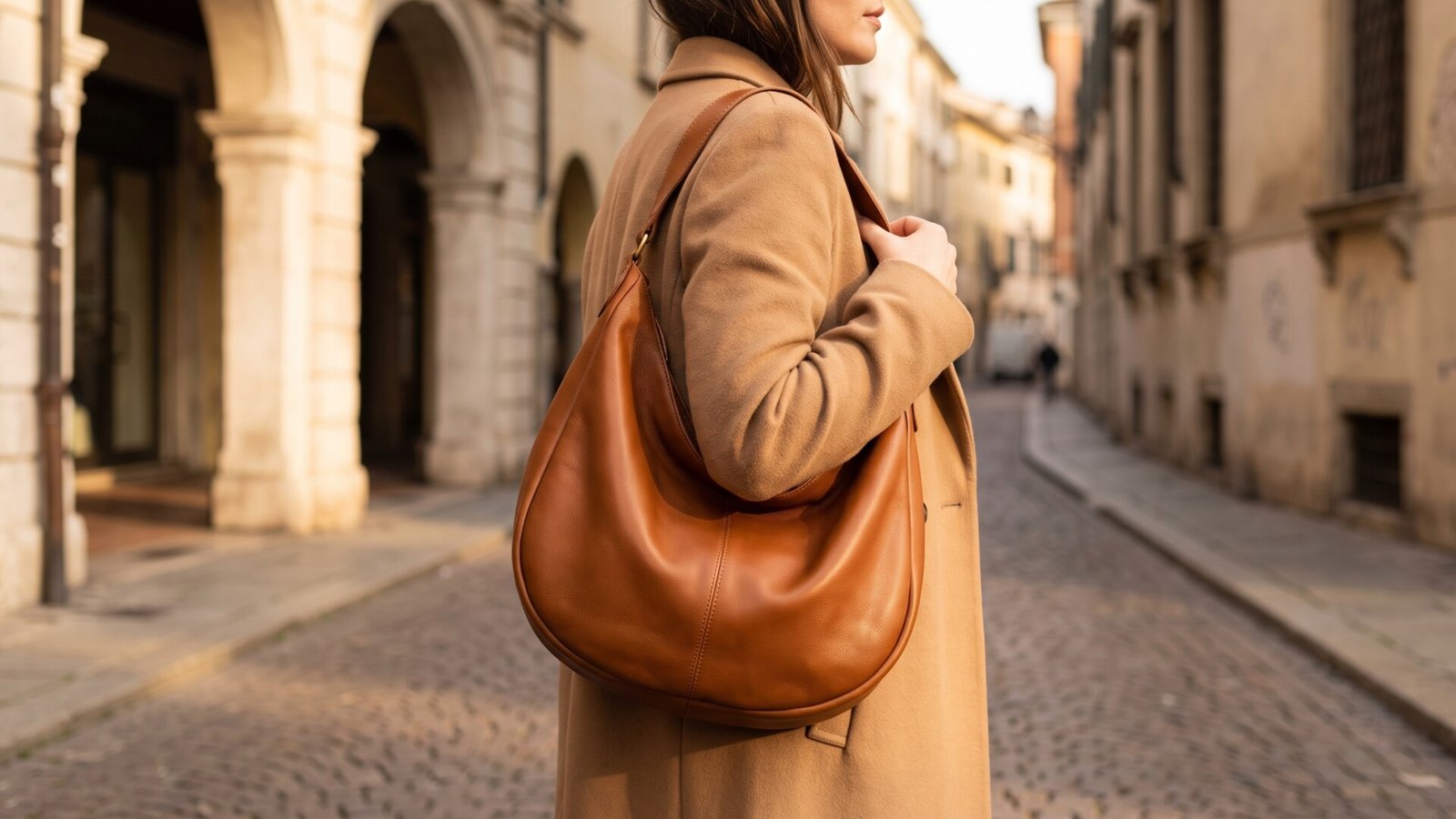
Start with what a hobo actually is, because the category is looser than the marketing suggests. A hobo is a single-strap shoulder bag with a soft, curved body that folds against the ribs. No rigid frame, no feet, no structural gusset holding it open. The tomaia – the outer body of the bag – carries the whole shape. That is why the leather choice matters more here than on almost any other silhouette. On a structured tote, a mediocre hide is hidden behind a stiffener. On a hobo, the hide is the bag.
So the qualities that separate a worthwhile hobo from an expensive slouchy handbag come down to five things, and none of them are visible in a product photo.
Useful capacity without collapse. The bag should hold a phone, a wallet, keys, sunglasses, a small pouch, and a folded scarf without the base sagging into a cone. That means a reinforced base panel or a double layer of leather at the bottom.
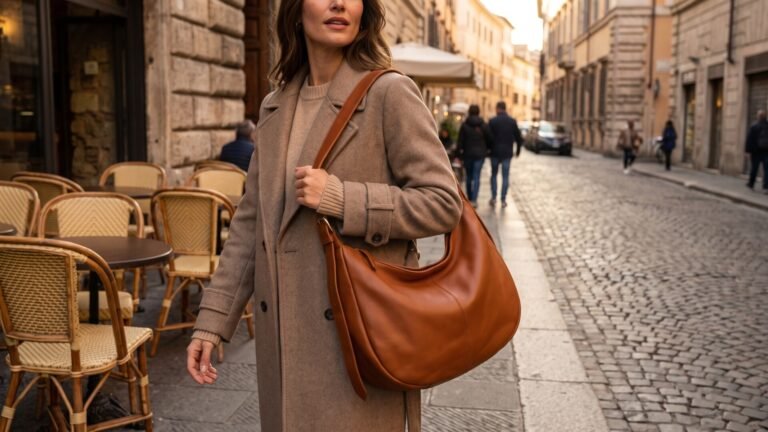
Comfortable shoulder carry. The strap drop – the distance from the top of the strap to the top of the bag – decides whether this works over a coat or slips off a bare shoulder. Most hobos land between 8 and 11 inches, which suits a light jacket. Over a heavy winter coat, you want closer to 12.
A closure you trust. An open top is fine for a car and a desk. It is not fine for a train. A well-set magnetic closure or a zip changes how you use the bag all day.
Balanced weight. Thick leather and solid hardware feel wonderful empty and punishing full. A large hobo in heavy cuoio – the Italian word for leather, from the Latin for hide – can run past two pounds before you put anything in it.
Leather that improves. Full-grain hides, which keep the outermost layer of the skin intact, develop a surface sheen and deepen in color. Corrected-grain leather, where the top layer is sanded and stamped to hide flaws, tends to look the same in year three as in week one, or worse.
Why construction beats the label
“Made in Italy” tells you where the final assembly happened. It does not tell you how the edges were finished, whether the lining is glued or stitched, or whether the handle attachments are reinforced. Those three things decide how the bag ages.
Look at the edge of the strap. If it is painted with a smooth, even sealant, that is a bordo finish – quick, clean, and prone to cracking at the flex point after a couple of years. If the edge is folded over and burnished – rubbed with wax and heat until it darkens and seals – it will outlast the paint by a wide margin. Run your thumbnail along the edge of the strap where it bends. If the paint lifts or feels plastic, you know what is coming.
Then turn the bag over and find the seam where the strap meets the body. On a good hobo, there is a reinforcement – a leather patch, a rivet, or a bar-tack stitch – spreading the load. On a cheap one, the strap is sewn straight into a single layer and the stitching does all the work. That is the first thing to fail.
The leather types, and what each one does to your life
- Full-grain, smooth finish. Keeps the whole hide. Scratches show but buff out with warmth from your hand. Develops the deepest patina. Wants occasional conditioning.
- Grained leather. The grain is embossed or the hide is tumbled for a pebbled surface. Hides scratches and water marks well. The most forgiving daily choice.
- Vegetable-tanned. Tanned with plant extracts rather than chromium salts. Stiff at first, then molds to you. Shows water marks readily. Ages the most dramatically.
- Suede and nubuck. Buffed surfaces, soft to the touch. Beautiful, and the least tolerant of rain, grease, and friction.
- Intentionally distressed. A factory finish that mimics age. Convenient, but it does not change further, so you are buying the look rather than growing it.
A decision framework, then, in the order that matters: leather and construction for longevity, strap design for comfort, closure for security, proportion for how many outfits it will actually work with. Everything else is taste.
The Best Italian Leather Hobo Bags to Consider
The shortlist below covers different budgets, different routines, and different design personalities. It is not ranked by brand prestige, because prestige is the least useful thing to pay for. Each entry says who the bag suits and where it falls short.
Best luxury choice: Bottega Veneta Jodie
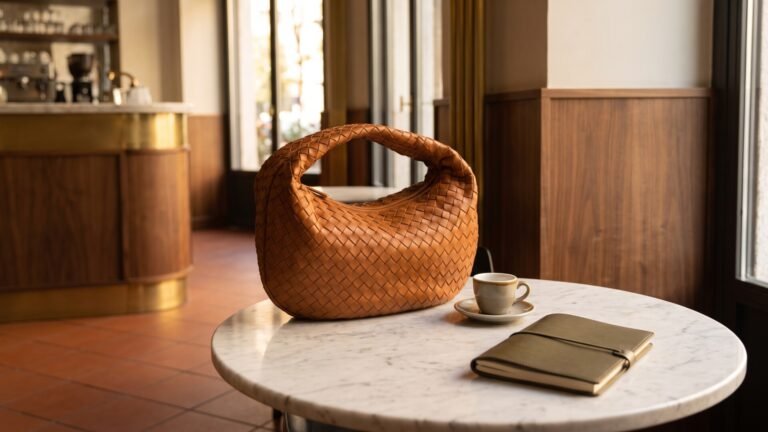
The Jodie is the hobo that most people picture when they hear the phrase. Its signature is the intrecciato – the woven leather technique Bottega has used since the late 1960s – gathered and knotted into a rounded, compact shape with a single short handle. The construction is genuinely good: the weave is tight, the leather supple, and the shape holds because the weave itself provides structure rather than a stiffener.
What you are buying is design identity. The Jodie reads instantly to anyone who knows bags, and it moves from a workday lunch to dinner without changing anything about your outfit. That versatility is real.
What you are not buying is capacity. Even the larger sizes organize poorly – there are no dividers, and small items migrate to the bottom of the curve. If you carry a laptop, a water bottle, or a notebook, this is the wrong bag. You are also paying a substantial premium for house codes rather than materials alone. That is a legitimate purchase, as long as you know that is what it is.
See our Bottega Veneta hobo bag hub for the full range and how the sizes compare. [Affiliate: Browse the Bottega Veneta handbag collection] to check current leathers and dimensions.
Best understated luxury choice: The Row soft leather hobo designs
The Row built its reputation on restraint – minimal hardware, clean lines, leather chosen for hand feel rather than logo display. The soft leather shoulder bags in the line change name and proportion from season to season, so verify the current model and its exact construction before you commit to anything.
The appeal is straightforward. No visible branding means the bag works with a tailored coat, a plain knit, and a pair of flat boots without competing with any of them. The leather is usually excellent and the hardware deliberately quiet. For a wardrobe built on neutrals, this is the bag that disappears into the outfit in the best way.
The trade-offs are price and predictability. You are paying ultra-luxury money for a bag with no recognizable signature, which means resale demand is thinner than for a logo-driven model. Availability also shifts. If you want something you can walk in and buy in three colors, this is frustrating. If you want the right bag and will wait for it, it rewards patience.
Best Italian-made mid-range choice: Furla Flow or comparable hobo silhouettes
Furla sits in the sweet spot that most buyers should be looking at. It is an Italian house with real leather production, a broad retail footprint, and prices that land in the several-hundred-dollar range rather than the several-thousand. The hobo silhouettes in the line – the Flow among them, though names shift by season – are designed for actual daily use rather than display.
That shows up in the details. Bases are usually reinforced enough to sit upright when half empty. Straps are cut wide enough not to dig in. Closures are magnetic or zipped rather than open. The leather is generally a grained or lightly finished type that tolerates being set on a cafe floor.
The compromise is collectibility. A Furla will not appreciate, and it will not carry the same signal as a luxury-house piece. What it will do is get used four or five days a week for years, which is where cost per wear actually gets won.
Inspect the specific version you are considering. Check whether the lining is stitched or glued at the top edge, whether the strap is adjustable, and whether the base holds its shape when you press down on it with the bag empty. [Affiliate: Browse the Furla handbag collection].
Best artisan-led option: Il Bisonte leather hobo bags
Il Bisonte has been working vegetable-tanned leather in Tuscany since 1970, and the bags look it. The leather starts firm and matte and turns honeyed and glossy over a couple of years of handling. Brass hardware, visible stitching, a slightly rustic finish that is deliberate rather than careless.
This is the bag for someone who wants the leather to record where it has been. A mark from a doorframe, a darker patch where your hand rests on the strap, a slight unevenness in color across the body – all of that is the point. If you have ever looked at a ten-year-old leather satchel and thought it looked better than new, this is your hobo.
The trade-off is that vegetable-tanned leather is thirsty and reactive. Rain will leave a mark, though it usually fades as the leather darkens. Grease from hands is fine; grease from a dropped chip is not. You will want a neutral conditioner approved for vegetable-tanned finishes, and you will want to use it sparingly – twice a year is plenty for most people.
[Internal: See our guide to Italian leather care] for how to treat this type of hide. [Affiliate: Browse the Il Bisonte leather bag collection].
Best value-conscious option: Coccinelle leather hobo bags
Coccinelle is the practical answer for a lot of readers. Italian design and leather construction at accessible-to-mid pricing, with styling that leans wearable rather than statement. The hobo shapes tend to be medium-to-large with soft but not floppy bodies, which is exactly the brief for a bag you carry every day.
Where value varies is inside the model, not across the brand. Two Coccinelle hobos at similar prices can differ meaningfully in lining quality, hardware weight, strap padding, and closure design. Check the zip pull – a solid metal pull with a smooth action tells you more than the logo on the front. Check whether the strap is stitched and riveted or stitched only. Check the lining corners, which is where glued linings lift first.
For a buyer who wants the look and the leather without the luxury premium, and who will genuinely wear the bag into the ground, this is often the highest cost-per-wear purchase on this list. [Affiliate: Browse the Coccinelle handbag collection].
Comparison Table: Italian Leather Hobo Bags Worth Buying
| Bag or brand | Approximate price position | Best for | Main strength | Main compromise | Long-term value |
|---|---|---|---|---|---|
| Bottega Veneta Jodie | Luxury | Design-led everyday and evening use | Distinctive silhouette and strong recognition | Limited capacity and high price | Strong design appeal, but condition matters |
| The Row soft leather designs | Ultra-luxury | Quiet luxury wardrobes | Minimal styling and refined leather | Very high price and variable availability | Strong styling longevity, less logo-driven resale demand |
| Furla Flow or comparable hobo | Mid-range | Polished daily use | Balance of quality, price, and practicality | Less collectible than top luxury houses | Good cost per wear when used frequently |
| Il Bisonte hobo bags | Mid-range to premium | Patina lovers and casual wardrobes | Characterful leather and artisan identity | Requires more tolerance for marks and change | Personal patina adds appeal but resale is selective |
| Coccinelle leather hobo bags | Accessible to mid-range | Value-conscious daily buyers | Practical Italian leather design | Model quality can vary | Best value is usually achieved through regular wear |
Prices, availability, materials, and model names shift with each collection. Verify the current leather type, dimensions, and price on the brand’s own collection page before you buy.
What Most Buyers Get Wrong About Soft Leather Hobos
The softness assumption is the big one. Softness is a hand-feel property, not a quality grade. A hide can be softened by tumbling, by a heavy finish, by splitting the leather thinner, or by chemical treatment – and some of those routes shorten the bag’s useful life. What you actually want is a leather with enough temper to hold a curve and enough suppleness to fold against your side. Those are different things, and the second one is what you feel in the shop.
Then there is the difference between slouch and collapse. A good hobo slouches – it drapes where it is not supported and holds where it is. A bad one collapses into a heap the moment you set it down, and every time you reach in you are fishing. The difference lives in three places: the base panel, the leather temper, and where the seams sit. A base with a reinforced panel or a doubled layer will hold a curve for years. A single-layer base in soft leather will not.
Seam placement matters more than people expect. If the side seams run down the middle of the bag’s profile, the leather has somewhere to fold. If the seams sit at the very bottom corners, the bag fights its own shape and wears through at those points first.
Capacity claims mislead in a specific way. A wide opening looks generous in a photo and creates a bag with no organization. Everything settles into the bottom curve. You end up with a bag that technically holds a lot and practically holds less than a small tote, because you cannot find anything without emptying it. Worse, the weight of an unstructured load pulls straight down through the base and stretches it.
And visible branding is not a shortcut to quality. A quiet bag with a tight stitch count, a burnished edge, a reinforced strap, and a solid brass clasp will outlast a louder bag with a glued lining and painted edges, whatever the front of it says. The brand tells you about the marketing budget. The stitching tells you about the bag.
How to Choose the Right Italian Leather Hobo for Real Life
Buy for the routine you have, not the one you imagine. Here is how the choice changes by situation.
For everyday commuting and work
You want a medium or large hobo with a reinforced base, a secure closure, a strap drop that clears a jacket, and enough body to keep a phone and a cardholder from sliding around. Grained leather is the sensible pick here – it hides the scuffs that come with train seats and desk edges.
A hobo can work for a tablet or a slim laptop if the bag has a reinforced base and the strap is wide enough to distribute the weight. It is the wrong choice for a full-size laptop plus a charger plus a lunch. That load belongs in a structured tote with a padded sleeve. Test the weight before you load it: pick the bag up empty, then imagine adding four pounds. A hobo in thick leather with heavy hardware can become a shoulder ache by mid-afternoon.
For travel and frequent movement
Prioritize a zip or a well-designed magnetic closure, a strap that stays put, and leather that does not need protecting. A very soft, open hobo is lovely at a restaurant and a liability in an airport – things fall out when you bend to lift a case, and you cannot see into it while it is on your shoulder in a crowd.
Access while seated matters too. A hobo with a short handle is awkward on a plane because you cannot get into it without lifting it off your lap. A longer strap that lets the bag sit beside you is easier. And consider whether the bag can hang on the back of a chair or sit on a luggage handle without sliding.
For evening use and occasion dressing
Compact curved silhouettes win here – a smaller hobo with refined hardware and a polished leather finish reads closer to an evening bag than a tote ever will. This is where something like the Jodie earns its price, because it crosses from a daytime meeting to dinner without looking like it is trying too hard.
Color decides how often you reach for it. Black, dark brown, and muted neutrals – taupe, greige, deep navy – will work with nearly everything you own. A seasonal shade brings personality and reduces the number of outfits it suits. That is not a reason to avoid it, but it is a reason to think about it as an accent rather than a workhorse.
For buyers who want visible patina
Go vegetable-tanned, and go with a maker who builds around it – Il Bisonte is the obvious example, though several smaller Tuscan workshops work the same way. Accept from the start that water marks, scratches, and uneven color are part of the outcome rather than damage. Keep the bag out of prolonged damp, store it away from radiators and direct sun, and condition it lightly twice a year with a product approved for the specific finish. Follow the maker’s own guidance where it differs.
The Hidden Cost of Choosing the Wrong Hobo Bag
The purchase price is the smallest number in this calculation. The real cost is everything that happens after.
A bag that digs into your shoulder gets carried less. A bag with no organization gets emptied onto a table every time you need a card. A bag that only works with two outfits stays in the dust bag. Each of those turns a $900 purchase into a $300-per-wear mistake, and the number on the receipt told you nothing about it.
Cost per wear is the honest measure. A $500 bag worn three times a week for three years works out to roughly $1 per wear. A $2,000 bag worn twice a month for the same period is closer to $28. The cheaper bag is the better purchase by a factor of twenty-eight, and it is not close.
Overpacking is the quiet accelerant. When a bag has a wide opening and no dividers, you fill it. The extra weight pulls on the handle attachments, stretches the base, and distorts the shape. A hobo loaded past what its construction supports will not recover – the leather takes a set and the bag stays that way.
Resale punishes the same things. Heavy corner wear, a collapsed body, a stained lining, missing dust bag, and any lingering odor will put buyers off faster than moderate surface scratches on the exterior. Scratches read as character. A collapsed base reads as neglect.
There is also the cost of the fix. Replacing a strap that has torn at the attachment point is a leatherworker’s job, and a good one will charge accordingly. Restitching a lining, replacing a broken zip pull, re-painting edges that have cracked – these are real expenses, and on a mid-range bag they can approach the value of the bag itself. Which is an argument for buying the better-constructed option in the first place.
Which Italian Leather Hobo Still Makes Sense in Three Years?
Run every candidate through five questions: will the design still look current, will the leather have aged well or badly, can it be repaired, does it work with the wardrobe you actually own, and will you still want to carry it?
The Jodie passes on design longevity and repairability. The silhouette has been in the line long enough to have proven it is not a seasonal experiment, and Bottega’s after-sales service can handle repairs. It fails the capacity test for anyone who carries more than the essentials. If your daily load is light, it is the strongest choice here for a buyer who wants a recognizable design that also works in the evening.
Furla and Coccinelle pass on cost per wear and continued usefulness. They are the rational choice for frequent daily wear, and they are the bags most likely to still be in rotation in three years because nothing about them is precious enough to make you hesitate before using them. The leather will show wear. That is fine.
Il Bisonte passes on material aging more convincingly than anything else on this list, provided you want what it does. In three years, a vegetable-tanned hobo will look markedly better than the day you bought it – darker, softer, more yours. If you want a uniform finish, it fails immediately and permanently.
The Row and other quiet designs pass on wardrobe integration and styling longevity. They will still look right in five years. What is less predictable is resale demand, because a bag with no visible signature depends on a smaller pool of buyers who already know what they are looking at.
Care, Durability, and Resale Considerations
The maintenance plan is short and mostly about habits rather than products. Empty the bag regularly – weekly is plenty – so crumbs, receipts, and loose coins do not grind into the lining. Keep cosmetics in a pouch, because a single leaked foundation bottle can end a lining. Do not carry more than the construction supports. Store the bag upright, stuffed lightly with tissue or the maker’s own inserts, in its dust bag, away from heat and direct sun.
Care splits by leather type. Finished grained leather tolerates daily handling and needs little beyond a wipe with a soft cloth and an occasional conditioner. Smooth full-grain wants conditioning a couple of times a year and will reward you with a deepening sheen. Vegetable-tanned needs the same but reacts to water, so keep it out of the rain where you can. Suede needs a brush, a protector spray, and a realistic acceptance that it will never look new again.
What fails first, in rough order: the handle attachment points, the edge paint at the strap’s flex point, the zip pull, the magnetic closure, the lining corners, and the base shape. Most of these are preventable or at least postponable with the checks described earlier.
For resale, keep the dust bag, the box if you have the space, and any authenticity cards or receipts. Do not have the bag altered – no added holes in the strap, no replaced hardware unless the maker did it. Photograph the condition honestly when the time comes, including the flaws. Buyers forgive scratches. They do not forgive surprises.
Buying Verdict: Which Italian Leather Hobo Should You Choose?
Choose the Bottega Veneta Jodie if design identity, house recognition, and day-to-evening versatility matter more than maximum capacity. See our Bottega Veneta hobo bag guide for sizing.
Choose an Il Bisonte hobo if the pleasure of natural leather and visible patina is central to why you are buying, and your wardrobe is relaxed rather than formal.
Choose Furla or Coccinelle if practical daily use, approachable pricing, and cost per wear matter more than collectibility. For most readers, this is where the money is best spent.
Choose a quiet luxury option such as The Row’s soft leather designs if minimal branding and long-term wardrobe integration justify the premium to you, and you are comfortable with thinner resale demand.
Skip the category entirely if you need a highly organized laptop bag, hands-free security, a lightweight technical material, or a rigid structure that will not change with use. A hobo is none of those things, and no amount of spending will make it one.
Frequently Asked Questions About Italian Leather Hobo Bags
Are Italian leather hobo bags worth the money?
Value depends on leather quality, construction, how often you carry it, comfort, repairability, and how many outfits it works with – not on the country of manufacture alone. A mid-range Italian hobo worn four days a week for three years will beat a luxury model worn twice a month on cost per wear by a wide margin. Pay for materials and construction first, and for the label only if the label itself is what you want.
Which Italian leather hobo bag is best for everyday use?
For most people, a Furla or Coccinelle hobo in grained leather with a reinforced base and a secure closure. It will take daily handling without anxiety and the leather hides scuffs. A compact luxury option like the Jodie works every day if your load is light, but the capacity and organization limits show up fast if you carry more than essentials.
Do Italian leather hobo bags hold their value?
It varies enormously. Recognizable designs from major houses tend to hold stronger demand, but condition, color, size, provenance, and whatever is currently fashionable all move the number. Quiet, unbranded bags can be harder to resell because fewer buyers know what they are looking at. Treat resale as a partial offset, never as a reason to buy.
Is soft Italian leather durable?
Softness describes hand feel and flexibility, not durability. What decides how long a soft bag lasts is the finish, the thickness, the seam construction, whether the base and strap attachments are reinforced, and whether you overload it. A soft, well-reinforced hobo can last a decade. A soft, unreinforced one can lose its shape in a season.
Are hobo bags practical for work?
They work for light office loads – a tablet, a notebook, a pouch, a phone. They are the wrong choice for a full-size laptop plus accessories, because the weight pulls through an unstructured base and the strap digs in. If you carry a computer daily, a structured tote with a padded sleeve is the safer buy, and a hobo becomes your second bag.
How should an Italian leather hobo bag be stored?
Empty it, stuff it lightly to hold the shape, and put it in its dust bag. Keep it out of direct sunlight and away from radiators, which dry leather out and cause cracking. Do not stack anything on top of it. Follow the maker’s guidance for the specific leather, since suede and vegetable-tanned hides have different needs.
Which leather is best for a hobo bag?
There is no universal winner. Grained leather is the most forgiving for daily use. Smooth full-grain develops the best patina but shows scratches. Vegetable-tanned ages most dramatically and reacts to water. Suede is the most beautiful and the most demanding.
Match the leather to how much maintenance you will genuinely do, not to how it feels in the shop. The bag that ends up worth the money is rarely the one that felt softest on the shelf. It is the one whose base still holds a curve after two winters, whose strap has not started to fray where it meets the body, and whose leather has darkened in the places your hand rests.
Work out what you carry on an ordinary Tuesday, find a hobo that takes that load without strain, and check the edge of the strap before you pay. Read our complete guide to Italian hobo bags for how the silhouettes compare, and the best Italian hobo bags for everyday wear if daily use is the priority.