Italian Shoe Sizes vs US and UK Sizes
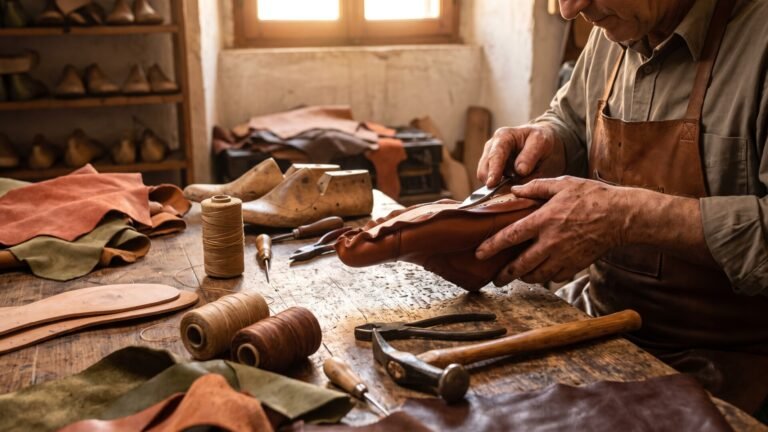
Two shoes marked Italian 38 can be built on very different lasts – the wooden or plastic foot forms a shoe is built over. One may be long and narrow, another short and wide, a third deep through the toe box. That is the real problem with Italian shoe sizes versus US and UK sizes: the number tells you which last-size the factory used, not whether that last suits your foot. A conversion chart is a useful first filter and a poor final answer.
Below you will find a conversion table for women’s and men’s sizes, an explanation of how Italian sizing actually works, a way to measure your foot, and a decision rule for when the chart and the shoe disagree.
The Quick Reference: Italian to US and UK Sizes
Treat every figure as approximate. The women’s US and UK columns follow the Italian women’s chart used by Gucci; the men’s columns follow the common retail conversion, with UK numbered one size below US. Other retailers’ charts can differ by half a size, and the brand’s own chart for the style you are buying always wins.
| Italian / EU size | US women’s | UK women’s | US men’s | UK men’s | Foot length (cm) |
|---|---|---|---|---|---|
| 35 | 5 | 2 | – | – | approx. 21 |
| 36 | 6 | 3 | – | – | approx. 22 |
| 37 | 7 | 4 | – | – | approx. 22.5 |
| 38 | 8 | 5 | 5 | 4 | approx. 23.5 |
| 39 | 9 | 6 | 6 | 5 | approx. 24.5 |
| 40 | 10 | 7 | 7 | 6 | approx. 25 |
| 41 | 11 | 8 | 8 | 7 | approx. 25.5 |
| 42 | 12 | 9 | 9 | 8 | approx. 26 |
| 43 | – | – | 10 | 9 | approx. 27 |
| 44 | – | – | 11 | 10 | approx. 28 |
| 45 | – | – | 12 | 11 | approx. 29 |
Italian and EU sizing usually runs in whole sizes, so you will see 38 and 39 but rarely 38.5. Some brands do cut half sizes, but their fit conventions vary. The more important point is that the women’s and men’s US scales have different zero points. Women’s US is roughly the Italian size minus 30; men’s US is roughly the Italian size minus 33. Apply the women’s rule to a men’s shoe and an Italian 40 becomes a US 10 instead of a US 7. It is a common error on retailer listings, and it puts you three sizes out before you have tried anything on.
The foot-length column is the one to trust most, because it is a measurement rather than a label. A foot of about 23.5 cm points to an Italian 38. Closed shoes need a little room beyond your longest toe, roughly 0.5-1 cm, with loafers and pumps at the snug end of that range, so compare your measurement to the brand’s chart rather than reading across the table.
How Italian Shoe Sizes Differ From US and UK Sizes
Italian footwear does not use a separate scale. It uses the European Paris point system, where each size step is two-thirds of a centimeter, and brands call it Italian because that is where the shoe was made. A product page that says Italian size 40 almost always means EU 40. Almost always.
The distinction that matters is between a size conversion and a fit conversion. Your Italian 39 really can be a US women’s 9, and the shoe can still be too narrow, too short in the toe or too shallow across the instep (the top of the foot where it meets the ankle). The chart converts the label. It cannot convert the last.
UK men’s sizing sits one size below US men’s, so a US 9 is a UK 8. Italian men’s sizes follow the same UK-led numbering: Gucci’s men’s chart, for example, pairs Italian 40 with UK 6. Women’s conversions need separate treatment, because UK women’s sizing does not run parallel to UK men’s.
Listing errors are more common on luxury retail sites than most buyers expect:
- EU shown as Italian. A retailer lists IT 40 when the brand’s own chart says EU 40. Usually identical, not always.
- Retailer-supplied US conversions. The US size on the listing is often calculated by the retailer, not the brand, and can be wrong.
- Men’s and women’s scales mixed. A unisex sneaker given a women’s conversion that was derived from the men’s scale.
When the brand’s chart conflicts with a general table, the brand wins.
What Most Buyers Get Wrong About Italian Shoe Sizing
The most common mistake is assuming that going up a size fixes a tight Italian shoe. Length and width are different problems. A larger size adds length; it does not add width or deepen the toe box. If the shoe presses across the forefoot – the widest part of the foot, just behind the toes – a bigger size slides your foot forward into a longer, still-narrow shoe, and now your heel slips as well.
A pointed toe compounds this. In a sharply pointed pump the longest toe sits further back from the tip than in a round-toe shoe, and the taper squeezes the smaller toes together. A woman who takes a 38 in a round-toe flat may genuinely need a 38.5 or 39 in a pointed heel. Her foot has not grown; the shoe’s interior geometry has changed.
Soft leather is the other trap. It relaxes with wear, but it will not rescue a shoe that is too short. Firmness at the heel counter and across the instep is normal in a new pair and usually eases. Sharp, localized pressure on a toe joint or the outside of the little toe is a shape problem, and it does not go away. If the fit is merely firm, our guide on how to break in Italian leather shoes covers how to ease a new pair in safely.
Measuring your foot properly
Measure at the end of the day, when your feet are largest, in the socks or hosiery you plan to wear with the shoe.
- Stand on a sheet of paper with your heel against a wall. Standing, not sitting: your foot spreads under load, and a seated measurement undersizes you.
- Mark the tip of your longest toe and the back of your heel, then measure the distance.
- Measure across the widest part of the forefoot, from the big-toe joint to the little-toe joint.
- Repeat for both feet and use the larger one.
Compare the numbers with the specific brand’s chart, not a general table, especially when you are spending real money.
Why the Last Matters More Than the Number
A last’s proportions – length, width, toe shape, instep height, heel curve – decide how the finished shoe fits far more than the size number does. A narrow, elongated last feels smaller than a rounder one in the same marked size, because there is less room inside it. Materials shift the first wear too: stiff patent leather barely gives, suede relaxes more readily, unlined leather molds to the foot, and a structured toe box will not stretch for a wide forefoot.
Even inside one house the men’s and women’s lines can behave differently. Resale specialist Fashionphile’s Gucci sizing guide describes the women’s shoes as mostly true to size with a narrower cut, and the men’s shoes as running wider. The same Italian number can therefore feel different depending on which line it comes from.
Other brands show how far lasts vary. Ferragamo’s lasts differ across its range, so check sizing style by style; our Ferragamo shoes guide has the detail. For a comparison of two houses with very different comfort profiles, see our Rockstud vs Jimmy Choo sizing comparison. Tod’s loafers are cut for a close fit, which is not the same as a painful one – our piece on why the Tod’s Gommino is so popular explains why that last works for so many feet. And in casual footwear volume and sock choice matter as much as the marked size, as our Zegna Triple Stitch sneaker review shows.
Choosing the Right Size by Shoe Category
The chart is most reliable in forgiving round-toe, soft-leather styles and least reliable in narrow, structured, pointed ones. Here is how each category behaves.
Heels. The toe box is the constraint, so fit is decided at the front, not by length. Do not size up so far that your heel lifts out with every step. If the length is right but the toe pinches, the answer is usually a different toe shape, not a bigger size. Our guide to Italian designer heels walks through the silhouettes.
Loafers. Expect a close fit at the instep and heel. Unstructured driving shoes are soft and forgiving; a structured penny loafer is not. Read the Tod’s Gommino vs driving shoe comparison, then see how the lasts of individual makers compare in our best Italian penny loafers for men, best Italian designer loafers for women and best Italian driving shoes. For the full range, start with our Italian loafers guide.
Dress shoes. Oxfords and other lace-ups have the most adjustment, so they tolerate a slightly snug size better than slip-ons. See our Italian dress shoes guide and the best Italian Oxford shoes for men.
Sneakers. Allow for socks and the movement of walking, but a larger size does not fix a narrow last: if the shoe is tight through the waist, sizing up only makes it longer and still narrow. Compare materials in our Italian leather vs suede sneakers guide, or browse the Italian designer sneakers guide.
Boots. Account for socks, ankle volume and whether the style is meant to fit close or to layer. A close-fitting leather ankle boot in your true size is often right; a structured riding boot may need more room. See our complete guide to Italian designer boots and the best Italian designer boots for women.
Flats and sandals. In sandals, length can look correct while the shoe is unstable, so check that the straps hold your foot over the footbed and your heel sits within the sole; our Italian designer sandals guide explains the strap constructions. Ballet flats and other slip-ons rely entirely on heel grip, which is covered in our Italian designer flats guide.
For broader principles, start with how Italian designer shoes should fit. If width is your main concern, our guide to Italian designer shoes for wide feet goes deeper, and if you plan long days on your feet, see the best Italian shoes for walking all day.
Between Sizes: A Decision Rule
Most guides stop at the chart. The harder cases are the ones where it cannot decide for you: your measurement falls between two sizes, the silhouette is narrow or pointed, the shoe is final sale, or you have wide feet, a high instep, bunions or one foot noticeably larger than the other. Use this rule instead:
- Buy your converted size when your measurements match the brand’s chart and the style is forgiving: round or almond toe, soft leather, adjustable fastening.
- Between sizes in laced shoes or strapped sandals: take the smaller size. Laces and straps can be tightened; length you do not need cannot be removed.
- Between sizes in slip-ons and pumps: there is nothing to adjust, so choose the size where the heel holds, even if the length is slightly generous, and add a heel grip if needed.
- Length right but forefoot or instep compressed: a half size up helps marginally. A wider fitting, where offered, is the real fix.
- The last conflicts with your foot shape: choose a different style or brand. This is the honest answer more often than people want to hear.
Customer reviews help if you read them properly. Look for repeated comments about length, width, heel slip and toe pressure, from reviewers describing the same style and sizing system you are. One person saying runs small tells you nothing; fifteen saying narrow through the forefoot tells you something real.
Three Worked Examples
A woman with a 25 cm foot buying pointed pumps. The table points to Italian 40, US 10, UK 7. Because the toe is sharply tapered, check the brand’s chart for that exact style, expect to need 40.5 or 41 if the toes touch the tip, and consider a rounder toe shape if they still pinch.
A man with a 25 cm foot buying Oxfords. The same measurement is a men’s Italian 40, which is US 7 and UK 6, not US 10. Laces give room to adjust, so if he measures 25.2 cm and the brand chart puts him between 40 and 41, the 40 is the better start, provided the forefoot is not compressed.
A man with a 25.5 cm foot buying slip-on loafers. The table says Italian 41, US 8, UK 7. A slip-on has no laces to take up slack, so the test is heel hold: if the heel lifts at 41, a heel grip is the fix, not a smaller size that cramps the toes.
Buying Italian Shoes Online Without a Costly Mistake
- Confirm whether the displayed size is Italian, EU, US or UK, and whether it is men’s or women’s.
- Find the brand’s own conversion chart and use it over the retailer’s.
- Measure both feet, standing, at the end of the day.
- Check material and construction: stiff patent and structured toe boxes are the least forgiving.
- Confirm return shipping, restocking fees, exchange rules and final-sale status.
Category pages are safer starting points than a single listing, because they usually carry the brand’s size guidance and let you compare styles. Start from our Italian designer shoes hub.
Sizing accuracy is part of what you pay for. International returns carry postage, and duties are rarely refunded. Professional stretching mainly adds width, rarely length, and a shoe forced out of shape resells for less. A pair that fits gets worn for years; a pair that pinches stays in the closet, and a $700 pair worn twice is not a bargain at any discount. Keep a record of the brand, model, size and width of every pair you own and how it felt after a month. That personal chart will be more accurate than any table.
The Buying Verdict
Convert the size, then measure your foot, then read the brand’s own chart, then check the return terms, in that order. The brand’s chart and your measurement are the final authority; the conversion table is only the first filter.
- Best for confident online buyers: clear measurements, generous return policies and a forgiving round or almond toe.
- Extra caution: pointed heels, rigid leather, narrow loafers, structured boots and anything final sale.
- Consider skipping: when the seller cannot confirm the sizing system, the shoe is known to run narrow for your foot, or returns are unavailable.
Sizing up may add length, but it cannot reliably create width or correct an incompatible last.
Frequently Asked Questions About Italian Shoe Sizes Vs US And UK Sizes
Are Italian shoe sizes the same as EU shoe sizes?
Mostly, yes. Italian footwear uses the European Paris point system, so an Italian 40 is usually an EU 40. Brand charts and internal fit still vary, so confirm how the retailer labels the size before you convert.
What is an Italian size 38 in US women's sizes?
Approximately a US women’s 8 and a UK 5, for a foot of around 23.5 cm. The brand’s chart, your measured foot and the toe shape can shift the practical fit, so treat the conversion as a starting point.
What is an Italian size 40 in US men's sizes?
Approximately a US men’s 7 and a UK 6. Do not apply the women’s conversion, which would give a US 10. A sneaker, a loafer and a dress shoe can also fit differently at the same marked size.
Do Italian designer shoes run small?
Not consistently. The real variables are last shape, width, toe box and construction. Some styles run narrow, some true to size and some generous, so check reviews and the brand chart for the specific style.
Should I size up in Italian leather shoes?
Only when the length is genuinely short and the style is forgiving. Sizing up will not fix width and can cause heel slip. If the forefoot is tight, look for a wider fitting or a different last, and confirm the return policy first.
Do Italian shoes come in half sizes?
Some brands cut them, but many sell whole sizes only. If you fall between two, choose by closure: the smaller size for laces and straps, the size that holds your heel for slip-ons and pumps.