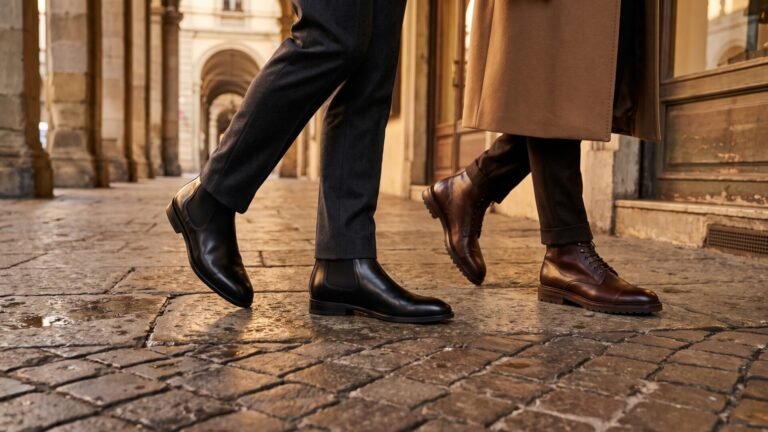
Best Italian Leather Ankle Boots
The best Italian leather ankle boots are the ones whose sole you can replace, whose shaft sits against your ankle instead of gaping away from it, and whose heel you can walk on for an hour without thinking about it. That combination has surprisingly little to do with price or with how loudly the brand announces itself. What separates a pair you still reach for in five years from one that lives in the closet is decided before you put them on: the leather, the last (the wooden form the boot is shaped over), the way the sole is attached and the lining. Get those right and a well-made $500 boot can outperform a $1,300 one. Get them wrong and the logo will not save you.
What Makes an Italian Leather Ankle Boot Worth Buying?
“Made in Italy” is a country of origin, not a quality grade. A boot can be designed in Milan, cut and closed in a factory elsewhere in Italy and finished from imported components, and still carry the label legitimately. That is not a scandal, since Italian factories are genuinely good at this, but it means the label tells you where the work happened, not how well. What you want to know is whether the boot comes from a house that actually makes shoes or one that licenses its name. The tells are in the details: a named tannery, a described construction method, a stated last, a repair policy.
Leather grade. Full-grain keeps the outer surface of the hide intact, with the tightest fiber structure and the best long-term aging. Corrected-grain is sanded and stamped to remove imperfections, so it looks uniform on day one and ages less interestingly.
Stress points. The heel counter (the stiffened cup at the back) and the toe puff should hold their shape when you press them. If they collapse under a thumb, the boot will slump within a season.
Heel and sole attachment. A heel should be attached with screws, pegs or a properly lasted and stitched construction, not just glued. Rock the boot on a flat surface; a wobble is a warning. A stitched or welted sole can be replaced by a cobbler. A cemented sole is lighter and cheaper to make and can still be resoled in some cases, but the process is more limited.
Shaft fit. This is where ankle boots fail more than any other category. The shaft, the part that rises above the ankle bone, has to sit close enough to hold the boot steady and loose enough to let your ankle flex. A shaft that gapes will rub; one that grips will restrict. Because the ankle is a joint in motion, the instep also has to accommodate the flex of walking without pressing, and the way the sole rolls as you step decides whether a two-mile walk is fine or miserable. None of this shows up in a photograph.
Cost per wear. A $500 pair worn three times a week for two years is roughly $1.60 a wear before maintenance, while a $1,200 pair worn twice a month for the same period is $25 a wear. The expensive boot is the cheap one only if you actually wear it, and you will only wear it if it fits and suits your life.
The Best Italian Leather Ankle Boots by Buyer Type
The recommendations are organized by what you need the boot to do. Prices are typical US retail ranges for current-collection leather ankle boots and move with season, model and retailer.
Best for a timeless investment: Santoni leather ankle boots
Santoni suits a buyer who wants a polished, restrained boot that will still look right in a decade. Prices run about $1,100-$1,700. The house is known for hand-finished leathers: one listed Santoni ankle boot is cut from uncoated, unpigmented full-grain calfskin with a graded Velatura finish, a leather sole and Goodyear welt construction, which is the construction that lets a cobbler resole it. A dark brown or black Santoni with a moderate heel works for a meeting, a dinner and a wedding, and nobody asks the brand because it simply looks right.
The trade-off is the sole. Some Santoni ankle boots have leather soles, which are lovely on carpet and slippery on wet pavement; others, like the Saint Moritz lace-up listed with a rubber anti-slip sole, are built for weather. Check the model, and add a thin rubber topy (an oversole fitted by a cobbler) if you plan to wear a leather-soled pair hard. Read our Santoni shoes review for the fuller picture, and Tod’s vs. Santoni if you are weighing the two directly.
Best for understated everyday luxury: Tod’s ankle boots
Tod’s makes the case for a softer, quieter luxury. The house built its name on driving shoes and the Gommino, and that flexible, cushioned philosophy carries into boots with pebbled rubber outsoles that pair with denim as readily as with trousers. Expect about $900-$1,400. Some retailers advise sizing down half a size because the leather is so flexible, and construction varies by model, so check what you are buying.
The limitation: Tod’s is not a weather brand. Some models are designed for polished casual wear rather than serious mileage, and suede from any house will not enjoy a wet winter. The value case is strong if you wear them often, because this boot earns its keep through frequency rather than resale. See our Italian designer boots guide for where these sit in the category, and why the Tod’s Gommino is so popular for the comfort philosophy.
Best for a fashion-forward wardrobe: Prada leather ankle boots
Prada is the choice when the boot has to do design work. The house is good at proportion, with a slightly chunky sole, an elongated toe or a lugged tread, and those choices make a plain outfit look considered. Expect about $1,250-$1,800, with the signature brushed leather (spazzolato) among the options. The caveat is versatility and time: a bolder sole or a very pointed toe reads as current, and current has a shelf life, so buy it second, after a dependable neutral boot. Comfort also varies enormously between a lugged rubber platform and a slender heeled boot, so try before you commit. For more on this trade-off, see our guide to the best Italian designer boots for women.
Best for a recognizable luxury statement: Gucci ankle boots
Gucci ankle boots are for the buyer who wants the boot to anchor an outfit and does not mind it being read as Gucci. The horsebit, often on a loafer-inspired ankle boot, does visible work, and prices run about $1,000-$1,500. The distinction worth making is between a versatile leather boot and a decorative one: a classic, restrained equestrian-influenced style will age well, while a heavily embellished or strongly seasonal one will not and is harder to resell. Branding is no substitute for fit or sole quality; a beautiful Gucci that pinches is still a boot that pinches. Choose the plainer end of the range for long-term relevance.
Best for elegant everyday dressing: Ferragamo leather ankle boots
Ferragamo is the practical middle ground: a long shoemaking history, a controlled aesthetic and heel heights that read as elegant without being punishing. Expect about $1,000-$1,500. A Ferragamo ankle boot with a modest block or stacked heel is a genuine work-to-evening option, polished enough for a client meeting and comfortable enough for the walk between. Fit is where to focus: check the toe box if your feet are wide or you plan to wear thicker socks, try the boot at the end of the day when your feet are largest, and walk on a hard surface rather than carpet. Our Ferragamo shoes guide covers sizing detail, and how Italian designer shoes should fit is the general framework.
Best for sleek minimalism: Gianvito Rossi ankle boots
Gianvito Rossi does clean lines better than almost anyone: no visible branding, an elegant heel and a narrow, refined profile, typically about $900-$1,500. For tailoring, dresses and evening wear it is close to perfect. The trade-off is that a narrow profile leaves less room for thick socks or a wider foot, and the dressier the boot, the less it wants to be walked in for miles. This is a boot for the office, dinner and the city, not the airport trek. If your feet are wide, size carefully; our guide to Italian designer shoes for wide feet will help, and our Italian designer heels guide covers the house’s pumps.
Best for handmade value and classic construction: Italian-made artisan ankle boots
This is the recommendation most roundups skip, and it is often the best one. Italy has many small workshops, in the Marche, in Tuscany and near Vicenza, making boots to a standard the big houses once did and now often subcontract. You will not get a recognizable logo. You will often get a stitched sole, a leather lining, a named tannery and a boot a cobbler can repair. Prices vary widely by maker, so check them rather than assuming a bargain.
Before you buy, verify the country of manufacture (stated specifically, not just “Italian design”), the construction method (stitched, welted or cemented, and whether the maker will resole), the lining material (leather breathes and lasts; synthetic is a cost signal), the sole and whether it is replaceable, and the return policy, because you are often buying fit sight unseen. Buy through established Italian footwear retailers or verified artisan collections rather than unknown marketplace sellers. For craft context, see the art of Italian shoe making and our explainer on handmade Italian shoes.
Comparison Table: Best Italian Leather Ankle Boots
| Brand | Typical US price | Best for | Watch for |
|---|---|---|---|
| Santoni | $1,100-$1,700 | Polished, traditional wardrobes | Leather soles on some models |
| Tod’s | $900-$1,400 | Everyday luxury, casual styling | Not a weather boot |
| Prada | $1,250-$1,800 | Fashion-led wardrobes | Comfort varies by sole and heel |
| Gucci | $1,000-$1,500 | Recognizable statement boots | Embellished styles date faster |
| Ferragamo | $1,000-$1,500 | Work-to-evening versatility | Toe box width |
| Gianvito Rossi | $900-$1,500 | Minimalist elegance | Narrow profile, dressy use |
| Italian artisan | Varies by maker | Construction and repairability | Verify materials and returns |
Leather, Construction, and Sole Choices That Change the Decision
The leather decides how the boot ages and how much you have to look after it. Smooth calfskin is the default: it takes a polish, holds shape and ages into a patina with care. Pebbled leather hides scuffs and water marks and is more forgiving in bad weather, at the cost of a slightly less refined look. Suede is the most comfortable out of the box and the most demanding to maintain; it needs protection before first wear and does not enjoy rain. Patent is high-shine and formal and can crack at flex points if it dries out. Factory-treated, grained leathers are the most weather-tolerant and the least interesting to own.
Construction matters most when the sole wears through, which it will. A stitched or welted sole, where stitching runs through to the upper often via a welt strip, can be replaced by a cobbler, sometimes more than once, which is the difference between a boot that lasts five years and one that lasts fifteen. Sole material is a separate choice. Leather soles are traditional, breathable and elegant, and slippery when new and unhappy in the wet. Rubber soles grip, tolerate weather and cushion more. Hybrids, leather with a rubber insert or a rubber topy, are the practical compromise most city wearers should choose. Our comparison of leather soles vs. rubber soles goes deeper.
What most buyers do not know is that the upper is rarely what fails first. The heel tip wears down and, if ignored, the heel itself starts to go. The sole edge abrades, the lining at the heel counter wears through, a zipper pulls out, an elastic panel loses tension, and an unsupported shaft sags. Check those points on any boot you consider, and budget for heel tips every year or two: they are cheap to replace and expensive to ignore.
What Most Buyers Get Wrong About Italian Ankle Boots
A higher heel is not more elegant. It is more fragile to walk on and more likely to be left in the closet. Heel stability, pitch (the angle the heel sets your foot at) and the surface you walk on decide whether a heeled boot is wearable. A well-balanced 60mm block heel beats a beautiful 90mm stiletto you cannot walk in.
Softer leather is not automatically better. Very supple leather feels wonderful immediately and then creases heavily, loses structure around the ankle and supports less over a long day. A little firmness at first often marks a boot that will hold its shape.
A pointed toe is sophisticated and unforgiving. It lengthens the leg and sharpens a silhouette, and it also squeezes wider feet, rules out thick socks and tires you on long walks. If your feet are wide, prioritize a rounder or almond toe.
“Made in Italy” should start a conversation, not end one. Ask what was made, where, by whom and how the boot can be repaired. A maker who can answer is usually worth buying from.
Fit, Comfort, and Real-World Wear
The hand test for an ankle boot, in order:
- Heel slip. Walk a few steps. Your heel should lift a few millimeters and settle back. If it slides freely, the boot is too long or the shaft too loose; if it does not lift at all, it may be too tight across the instep.
- Instep pressure. Press over the top of your foot. You want contact, not pressure. If the leather digs in when you flex, choose a different last.
- Toe clearance. You should feel a small gap at the front, roughly a thumb’s width, and be able to wiggle your toes.
- Shaft contact. The shaft should touch your ankle lightly all around without gripping. If the lining bunches or a seam is proud inside the back, that is a rub point waiting to happen.
- Forward slide. Walk on a slight decline. If your foot slides forward and your toes jam, the boot is too long or the heel pitch is wrong for you.
Profile matters as much as size. Chelsea boots (elastic side panels, no laces) are the most versatile and the easiest to put on; the elastic eventually relaxes, so buy them snug. For men, our guide to Italian designer Chelsea boots covers the classic makers. Zip boots give a cleaner line and more shaft control, and lace-ups offer the most adjustable fit across the instep, which suits a high instep or narrow ankle. Heeled and block-heeled boots suit tailoring and evening; flat boots suit walking and travel. For other long-day options, see the best Italian shoes for walking all day.
Break-in should be gradual, not heroic. Stiff leather, a firm counter and a leather sole soften over a few weeks of short wears, but a sharp pain at the heel or a pinch at the toe is a fit problem that wearing will not fix. See how to break in Italian leather shoes.
Which Italian Leather Ankle Boots Still Make Sense in Three Years?
The test is frequency, not taste: ask how many times a month you will realistically wear the boot, then buy for that number.
- Maximum cost per wear: a classic black or dark brown Chelsea or low-heeled boot with a rubber or hybrid sole.
- Tailored wardrobe: a polished heeled boot in black or brown, built for trousers, midi skirts and structured coats.
- Daily commuting or a damp climate: a rubber-soled boot, ideally in pebbled leather or a treated finish.
- Fashion-forward: a Prada or Gucci statement boot, but only once you own a dependable neutral pair.
Resale is selective, not guaranteed: classic black leather in excellent condition with complete packaging resells most easily, so treat it as a bonus, not a plan.
Styling and Wardrobe Integration
A dark neutral ankle boot is the most useful shoe in a cold-weather wardrobe because it works across four settings. For a tailored office, pick a polished boot with a moderate heel and keep the shaft close to the ankle so it disappears under a trouser hem; see Italian designer shoes for business casual outfits. For a casual city look, a softer boot in smooth or pebbled leather works with denim and knitwear, which is where Tod’s and a good artisan boot shine. For evening, a sleek minimal boot in Gianvito Rossi territory reads more formal the cleaner its line. For travel and transitional weather, a rubber or hybrid sole matters more than polish.
Shaft height, toe shape and heel profile change the proportion of everything above them: a higher shaft crops the leg and a lower one lengthens it, an almond toe is softer and a pointed one sharper. For a small wardrobe, buy a dark neutral everyday boot first, brown or burgundy second and a statement or seasonal style last. More ideas are in how to style Italian shoes for every occasion and how to style Italian shoes for fall.
Care, Durability, and Long-Term Value
A simple routine keeps a good boot good for years: brush off dirt after wear, condition smooth leather a few times a season, and protect suede before first wear (see waterproofing Italian suede without darkening it). Use cedar shoe trees if the lining is leather, and let boots dry naturally away from radiators and direct sun, which crack leather. Rotation is the cheapest durability upgrade there is: two pairs worn alternately outlast one worn daily by a wide margin.
The real savings are in professional maintenance: replace heel tips before they wear into the heel block, add a topy to leather soles if you walk in the city, resole when the sole thins, and repair zippers early. Our guide on how to care for Italian leather shoes has the full routine, the right way to clean patent leather Italian heels covers high-shine finishes, and how to store luxury boots covers the off-season.
Buying Verdict: Which Pair Should You Choose?
- Best overall for most buyers: a restrained leather ankle boot with a moderate heel or flat profile, dark neutral color, almond or round toe and a durable rubber or hybrid sole.
- Best premium choice: Santoni for polish and welted construction, Ferragamo for work-to-evening balance, or Tod’s for softer everyday wear.
- Best fashion choice: Prada or Gucci, once you own a dependable neutral boot.
- Best value choice: a verified Italian artisan boot with repairable construction and transparent materials information.
- Skip the purchase if you need a dedicated rain boot, hope break-in will solve an unresolved fit issue, or are considering a highly seasonal style as your only ankle boot.
For the wider picture, start at our Italian designer shoes hub.
Frequently Asked Questions About Italian Leather Ankle Boots
What is the difference between an ankle boot and a Chelsea boot?
A Chelsea boot is a type of ankle boot with elastic side panels and usually a pull tab, and no laces or zip. Other ankle boots close with a zip or laces. The category is the same height; the closure changes how the boot fits, how it looks and how it ages.
Are Italian ankle boots true to size?
It varies by house and last. Italian (EU) sizing applies, and retailer advice differs: some suggest sizing up in pointed or structured styles, while Tod’s ankle boots are often listed a half size down. Read the fit note on the product page and try them on with your real socks.
How do I check an ankle boot's shaft measurements?
Look for shaft height, circumference and heel height on the product page. One listed Santoni women’s ankle boot shows a 34 cm circumference, 20 cm height and 3 cm heel, for example. Compare the circumference with the widest part of your ankle and calf opening, and allow room for the trousers you will wear over it.
Are leather ankle boots warm enough for winter?
Leather breathes, so warmth depends on the lining, the sole and your socks more than the upper. An unlined or thinly lined boot is a cool-weather choice, while shearling- or fur-lined styles exist from several houses for real cold. Add a rubber sole and a protective treatment for snow and salt.
How do I stop my heel slipping in ankle boots?
First check the length: a heel that slides freely usually means the boot is too long or the shaft too loose, and no pad fully fixes that. For minor slip, try a heel grip or a slightly thicker sock, and let the boot settle over a few short wears before deciding.