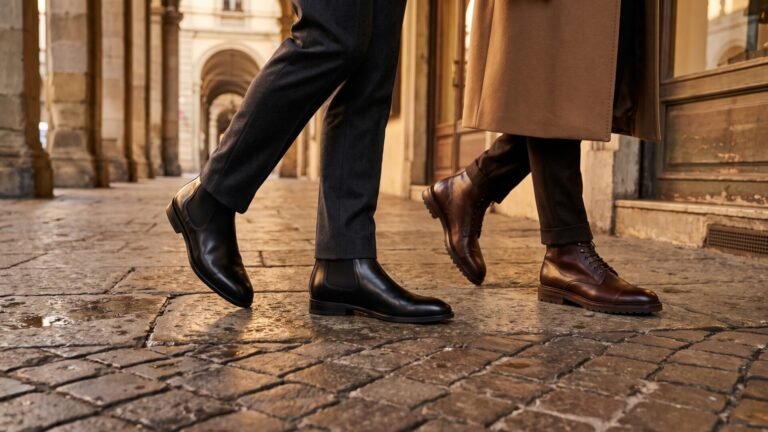
Best Italian Designer Boots for Women
Most women buying their first pair of Italian designer boots reason like this: it is Italian, it is leather, it costs a great deal, therefore it must be a good boot. None of those three things guarantees the fourth. A famous house can put a beautiful calfskin upper on a sole you will wear through in a year, cut the shaft for a calf that is not yours, and finish the toe in a shape that limits the boot to one outfit.
The best pair is the one whose leather, sole, shaft and heel match the way you actually live, not the way the product photograph suggests you might. Get those right and a boot earns its price over hundreds of wears.
What Makes an Italian Designer Boot Worth Its Price?
A boot asks more of its materials than a pump or a loafer. The upper flexes with every step, the shaft has to hold its shape up the leg, and the sole meets wet pavement and grit. Judge it on five things.
Leather. Full-grain leaves the outer surface of the hide intact, so it takes polish and ages into a patina. Top-grain is lightly corrected: more uniform, slightly less durable. Corrected-grain is sanded and stamped, often to imitate a grain it does not have, which is fine for a work boot and a compromise at this price. Run your thumb across it: good leather feels cool and slightly tacky, not slick like plastic, and when pressed it creases in fine lines and springs back.
Sole. A leather sole is breathable and elegant, slippery when new, and wears faster on pavement. Rubber grips better and lasts longer in wet weather, and a lug sole adds real traction. What matters most is whether the sole is stitched or glued. Goodyear welted means a strip of leather is stitched through the upper and insole and then to the sole, so a cobbler can replace the sole repeatedly. Blake stitched is lighter and more flexible and can also be resoled, though fewer times. Glued soles are the cheapest to make and the hardest to repair.
Heel. A stacked heel, built from layers of leather, can be repaired and rebalanced. A molded heel, plastic or resin in one piece, is usually replaceable only as a unit. Turn the boot over and look.
Lining. A leather lining stitched into the upper breathes and molds to the foot; a glued-in synthetic one traps heat. If the lining shifts under your fingers inside the shaft, it is not properly secured.
Provenance. “Made in Italy” is real and worth something, but it is not a quality certificate. It tells you where a boot was made, not how good the leather or the sole is, so the specific model tells you more than the country. For how these workshops operate, see the art of Italian shoe making and our explainer on handmade Italian shoes.
The Best Italian Designer Boots for Women
These are recommendations by buyer type, not a ranking. A boot that is perfect for a Milanese commute can be wrong for a wet English winter. Prices are typical US retail ranges for the styles named and move with model and retailer.
Best overall: Ferragamo women’s leather boots
Ferragamo is the most balanced recommendation, for a boring reason: Salvatore Ferragamo built his reputation on fit and anatomical lasts before he built it on glamour, and the boots still lean that way. Look for plain ankle boots and moderate block heels, typically about $1,000-$1,500. Polished calfskin holds a shine, the proportions are refined without being trend-specific, and the heels are pitched for walking. A block-heel ankle boot in black or dark brown goes to work under trousers, to dinner under a dress and through an airport.
Hand test: press the vamp, the part over the top of the foot. It should give slightly but not collapse; a vamp that folds like cloth creases hard across the toe within weeks. Embellished, runway-adjacent pieces are a different purchase with a worse cost per wear. See our Ferragamo shoes guide, and if your forefoot is wide, read our guide to Italian designer shoes for wide feet before ordering.
[Affiliate: View the current Ferragamo boot collection]
Best investment boot: Gucci leather riding or knee-high boots
For a tall boot with an unmistakable identity, start with Gucci’s equestrian lineage: horsebit hardware and riding references without a logo stamped across the shaft. Knee-high styles typically run about $2,000-$2,500. A restrained leather knee-high in a classic color works over trousers, under a midi skirt and with a coat. A logo-heavy or embellished version narrows the outfits it suits and dates faster.
Tall boots live or die on shaft fit. Measure your calf at its widest point and compare it with the shaft circumference on the product page; one retailer lists 16.5 inches for a pull-on Gucci knee-high with no zip to adjust. Then try the boot with the socks and trousers you will actually wear, and prefer a full-length back zip to a half zip. The shaft should not dig into the back of your knee on stairs. Classic Gucci silhouettes in good condition draw resale interest, but that will not rescue a gaping shaft. See our Gucci brand guide.
[Affiliate: View the current Gucci boot collection]
Best for understated luxury: Brunello Cucinelli leather ankle boots
Brunello Cucinelli is the Italian answer to the quiet-luxury instinct. The boots carry almost no visible branding and are built around neutral color and clean line, typically about $1,700-$2,400 for ankle boots. They suit a restrained wardrobe of cashmere, good wool and muted tones, and they move between work, travel and evening without a change of outfit.
Quiet luxury is a style direction, not proof of superior construction. A plain Cucinelli boot is not automatically better made than a plain boot from a lesser-known workshop; judge the leather, the sole and the fit as you would anything else. Hand test: look at the edge where the sole meets the upper. A clean, tight bond with even stitching suggests care; a visible glue line suggests speed.
[Affiliate: View the current Brunello Cucinelli boot collection]
Best for statement dressing: Valentino Garavani Rockstud boots
The Rockstud is the boot you buy once you already own the practical pairs, typically about $1,200-$1,600 for ankle boots. The pyramid studs give a recognizable silhouette that moves easily from a city day into an evening. The honest accounting: studs add weight and catch on tights, hems and coat linings; patent and high-shine finishes show scuffs and need specific care (see the right way to clean patent leather Italian heels); and pointed toes and higher heels limit how long you can stay in them.
These are occasion and rotation boots, not the pair for a wet commute. That is fine if you buy them knowing it: a Rockstud boot that leaves the closet eight times a year is a different financial decision from one worn twice a week. For fit and value context, see our Valentino Rockstud vs Jimmy Choo comparison.
[Affiliate: View the current Valentino Garavani boot collection]
Best for sleek fashion versatility: Prada leather ankle boots
Prada does the clean, modern ankle boot that works with trousers, denim, a skirt or tailoring, typically about $1,250-$1,800. The finish decides the ownership experience. Smooth leather is the most versatile and the easiest to live with. Prada’s signature brushed leather (spazzolato) has its own finish, so follow Prada’s care guidance for the exact pair. Patent is the most fragile in rain, and technical-fabric styles are lighter and more weather-tolerant but age differently from leather. If you want one boot to do the most work, choose smooth black leather.
Heel height is the other decision: a lower or block heel almost always makes a better long-term purchase than the most dramatic runway proportion, because you will wear it more. Hand test: flex the boot at the ball of the foot. It should bend where your foot bends, not stiffly across the middle.
[Affiliate: View the current Prada boot collection]
Best for comfort-led luxury: Tod’s leather ankle boots
Tod’s is the strongest choice when softness comes first, typically about $900-$1,400 for ankle boots. The house built its name on the Gommino driving shoe and its pebbled rubber sole, and the boots feel broken-in sooner than most; some retailers advise sizing down half a size because the leather is so flexible. Be precise about what that means, though. Comfort still depends on the last, the heel height and the width across the forefoot, so a supple boot on a narrow last will pinch a wide foot. A driving-style sole is built for flexibility and grip on dry ground, not a wet winter pavement.
What Tod’s does well is the transition: a restrained ankle boot moves from a casual weekend to a polished weekday without looking out of place in either. For the house’s background, see why the Tod’s Gommino is so popular, and for a head-to-head with another Italian maker, Tod’s vs. Santoni.
[Affiliate: View the current Tod’s boot collection]
Best premium alternative: Gianvito Rossi boots
Gianvito Rossi, a label founded in 2006 by the son of designer Sergio Rossi, makes polished, feminine boots with a refined heel and a sleek line, typically about $900-$1,500 for ankle boots. If your wardrobe leans dressy and you want elegance over utility, this is a strong option. The caution is the same across the brand: narrow toes and high heels are beautiful and limiting. A stiletto ankle boot is an occasion piece, while a block-heel style from the same house keeps the line and is wearable for a full day. For the house’s pumps and stilettos, see our Italian designer heels guide.
Hand test: look at the heel from behind. It should sit centered under your own heel, not offset. An offset heel throws your weight forward and turns a beautiful boot painful by mid-afternoon.
[Affiliate: View the current Gianvito Rossi boot collection]
Best sculptural or fashion-forward choice: Bottega Veneta boots
Bottega Veneta is for the reader who wants shape: an unusual sole, a modern leather or technical-rubber treatment, a toe or shaft with real presence. Ankle boots typically run about $1,450-$1,800. For the material story behind the rubber-led styles, see our piece on Bottega Veneta’s Atomic boots.
The trade-off is versatility. An oversized sole, exaggerated shaft or distinctive toe narrows the outfits a boot will suit and shortens the years it looks current. That is a reason to buy it as a second or third pair, once you already own the plain black ankle boot that does the daily work.
[Affiliate: View the current Bottega Veneta boot collection]
Comparison Table: The Best Italian Designer Boots for Women
| Brand | Typical US price | Best for | Watch for |
|---|---|---|---|
| Ferragamo | $1,000-$1,500 | All-round first pair | Embellished styles narrow use |
| Gucci (knee-high) | $2,000-$2,500 | Tall boot with identity | Shaft circumference |
| Brunello Cucinelli | $1,700-$2,400 | Quiet, neutral wardrobes | Premium buys style, not proof of build |
| Valentino Rockstud | $1,200-$1,600 | Statement rotation piece | Studs snag; patent needs care |
| Prada | $1,250-$1,800 | Modern, adaptable city boots | Finish decides care |
| Tod’s | $900-$1,400 | Comfort-led everyday wear | Last width; sole not for wet |
| Gianvito Rossi | $900-$1,500 | Dressy, polished wardrobes | Stiletto heels limit wear |
| Bottega Veneta | $1,450-$1,800 | Distinctive second pair | Least versatile |
What Most Buyers Get Wrong About Italian Designer Boots
Assuming the softest leather is the most durable. Soft leather creases beautifully and molds to the foot, and it also stretches, abrades at the heel and toe and marks in rain more readily than a firmer hide. For daily wear, a little initial firmness is a feature.
Believing a high price guarantees comfort. Comfort comes from the last (the form the boot is built around), toe room, shaft pressure, heel pitch, lining and sole flex. A $1,500 boot on a last that does not match your foot is less comfortable than a $400 boot that does.
Buying the most distinctive boot first. The plain black ankle boot looks boring in a photograph and earns its keep fifty times over. The statement boot looks thrilling and gets worn to one dinner.
Expecting leather boots to hurt during break-in. A firm fit can settle into comfort. Crushing pressure across the instep, numb toes, a heel that slips with every step or a toe that touches the front will not resolve with time; they mean the wrong size or the wrong last. See how Italian designer shoes should fit and how to break in Italian leather shoes.
Choosing the Right Boot by Lifestyle, Fit, and Climate
For city wear, commuting and work
Prioritize a stable block heel or flat sole, a secure shaft, a rubber or protective outsole and leather that tolerates ordinary friction. Delicate suede, thin leather soles, stilettos and exposed hardware are poor choices for a commute with stairs, pavement and unpredictable weather. For professional wardrobes, black, dark brown, burgundy and deep taupe do the most work. A pointed toe reads sharp and formal, an almond toe is the most versatile, and a rounded toe is the most forgiving of a wider forefoot. A boot that works with both trousers and skirts doubles its value. Our guide to the best Italian leather ankle boots covers the most practical everyday styles.
For travel and frequent walking
Choose lower heels, secure closures, flexible but protective soles and enough room for your feet to swell over a long day. Do not buy your first luxury boots for a major trip and expect day-one comfort; allow time for the fit to settle. Confirm your size against our Italian shoe size conversion guide, and see the best Italian shoes for walking all day.
For wet or changeable weather
Untreated leather, suede, fabric panels, leather soles and light finishes all struggle in rain. Do not assume a designer boot is waterproof unless the maker says so, and check its care guidance before the first wet day. A rubber oversole added by a cobbler protects a leather sole and is the best single investment for a boot you plan to wear through a real winter. See leather soles vs. rubber soles and how to care for Italian leather shoes.
For occasional and evening wear
A sculpted heel, patent leather, crystals, studs or a narrow toe can all be justified if your wardrobe has the occasions. Run the cost-per-wear math honestly: a $1,200 boot worn six times a year costs $200 a wear, while a $900 boot worn sixty times costs $15. For styling across occasions, see how to style Italian shoes for every occasion.
Leather, Construction, and Care: What Determines Ownership Value
Match the finish to the wear. Smooth calfskin is the most versatile, takes polish and shows scuffs that can usually be buffed out, so it is the default for a first pair. Grained leather hides scratches because the natural grain breaks up the surface. Suede is soft and beautiful and wants protection before its first outing; it is not a wet-weather material. Patent is striking and fragile, scuffing and sometimes cracking at flex points. Technical and rubberized materials tolerate weather and wipe clean, and they age in a modern rather than patinated way.
The sole and heel decide repairability. A stitched sole can be replaced and a glued one usually cannot; a stacked leather heel can be rebalanced and a molded one is replaced as a unit. In a well-made boot the first thing to fail is usually the heel tip, the small cap at the bottom of the heel. It is cheap to replace and expensive to ignore, because once it wears through the heel itself starts to go. The other likely failure points are outsole wear at the heel strike and ball of the foot, zipper stress from pulling a tight shaft closed, shaft creasing behind the knee on a boot that is slightly too tall, sole separation after repeated wetting and drying, lining abrasion at the heel counter, and hardware damage from studs and buckles catching.
A realistic routine keeps a good boot alive for years: rotate pairs so leather can dry between wears, use breathable boot trees to hold the shaft, let damp leather dry naturally and away from direct heat, clean according to the finish, and see a reputable repair specialist at the first sign of heel-tip wear rather than the last.
Which Boots Still Make Sense in Three Years?
The test is how often you reach for the boot in year three. Build the decision around five things: how often you will wear it, your climate, how many outfits it suits, how much maintenance you will realistically do, and whether it can be repaired. An illustrative calculation with round numbers: a $1,100 boot worn 150 times a year for three years costs about $2.44 a wear, while a $1,600 statement boot worn 12 times a year costs about $44. Same category, wildly different value.
On resale, recognizable classic silhouettes in excellent condition and classic colors can hold value better than obscure ones, but demand shifts with fashion and no brand guarantees a profitable resale. Treat it as a possible partial recovery, never an investment return.
Buying Verdict: Which Boots Should You Choose?
- Best overall: Ferragamo, for Italian heritage, polished design and versatility in one purchase. Start with a plain ankle boot or a moderate heel.
- Best investment-minded choice: classic Gucci riding or knee-high boots, once you have confirmed the shaft circumference.
- Best comfort-led choice: Tod’s, provided you check the exact last and outsole rather than trusting the brand.
- Best understated choice: Brunello Cucinelli, for a refined neutral wardrobe.
- Best statement and fashion choices: Valentino Rockstud, Prada or Bottega Veneta, for readers who already own practical boots. The most directional styles have the lowest versatility.
- Who should skip them: buyers who need genuinely waterproof work boots or heavy outdoor traction, and anyone who cannot confirm the fit of a tall shaft. A designer leather boot is not that product, whatever it costs.
The rule that decides it: buy the boot you will wear several times a month across more than one outfit, not the one that looks most impressive in a photograph. For the wider picture, start with our complete guide to Italian designer boots, the Italian designer shoes hub and our guide to the best Italian luxury shoe brands.
Frequently Asked Questions About Italian Designer Boots For Women
Do Italian leather boots stretch?
Leather relaxes and conforms modestly, especially across the instep and at flex points. It will not fix severe tightness, crushing pressure or a shaft that is genuinely too narrow. If a boot is painful in the shop, do not buy it hoping it will stretch into comfort.
Should I size up or down in Italian designer boots?
It varies by house and last. Italian (EU) sizing applies, and retailers’ advice differs: some suggest sizing up in pointed or structured styles, while Tod’s ankle boots are often listed a half size down. Read the fit note on the specific product and try on with your real socks.
How should I store luxury boots over summer?
Clean them, let them dry fully, and keep the shaft upright with boot shapers or rolled paper. Store them in breathable dust bags in a cool, dry place away from heat and direct sun. Our guide on how to store luxury boots covers the details.
Can I waterproof Italian designer boots with a spray?
A protective spray can add some resistance, but it does not make a boot waterproof, and some treatments darken leather or flatten suede. Check the maker’s care guidance, test on a hidden spot first, and apply thin coats to clean, dry leather.
What heel height is easiest for everyday boots?
A block heel of around two inches or lower is the easiest to walk in all day, because it spreads your weight and stays stable on pavement. Stilettos and very high heels are best kept for evenings and short wear, however well the boot is made.