Italian Leather Sneakers vs. Suede Sneakers
Italian leather sneakers are the safer long-term purchase for most people, and Italian suede sneakers are the more beautiful one. That tension is why the choice is harder than it looks. Two pairs from the same house, at the same price, can behave nothing alike after a winter of real wear. The upper decides how often you reach for the shoe and how much of a wet Tuesday it can take. It does not decide whether the shoe is well made: hide grade, lining, sole construction and finishing matter at least as much as whether the surface has a nap.
The short decision rule: buy leather if this is your only luxury sneaker or your climate is unpredictable. Buy suede as a second pair if you live somewhere mostly dry and don’t mind a little shoe care. The rest of this guide explains why, and how to judge the whole shoe rather than just its surface.
What Leather and Suede Actually Change in Ownership
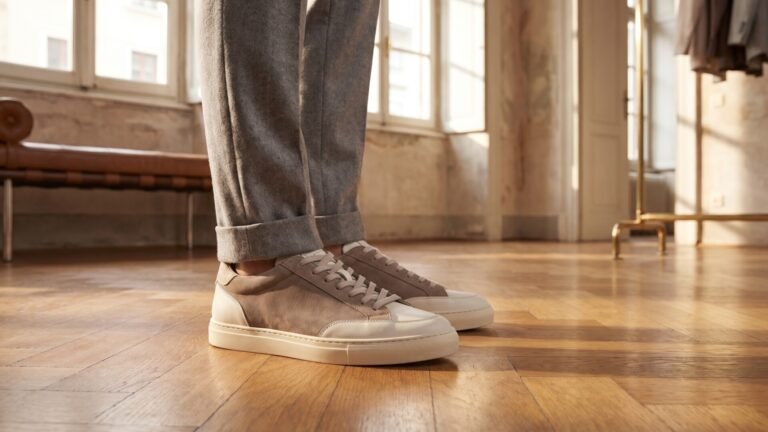
Suede is leather. Many buyers treat it as a lesser, fabric-like cousin that dissolves in a drizzle, and it is not. Suede is a hide sanded or split on the flesh side to raise a nap of fine fibers. The material is not weaker than smooth leather, but its exposed fibers respond to moisture, friction and oil in ways a sealed surface does not.
A smooth upper has a finish (aniline, semi-aniline or pigment coating) that you can wipe. Suede gives you something to brush: a brass-bristle brush, some patience and prompt treatment of any mark. Nubuck sits between the two. It is the outer grain side of the hide, lightly sanded, so it has a velvet nap on a denser surface than suede, and it generally wears better. If a model is offered in both, nubuck is worth a look as a compromise.
The upper is one component among many, and the ones underneath decide how long the pair lasts:
- Hide quality. Full-grain leather, the outermost layer with the grain intact, creases rather than cracks. Corrected-grain leather, sanded flat and embossed with a printed grain, looks uniform on day one and shows its nature within a year. Good suede is dense and tight-napped; poor suede is powdery and goes bald at the flex point.
- Lining. Leather lining holds shape and manages moisture. A fabric lining feels lighter and gives out sooner.
- Stitching and panel count. Fewer panels mean fewer seams to stress. Check the heel counter seam first, because that is where a cheap shoe splits.
- Sole construction. A cupsole is a pre-formed rubber unit stitched or cemented to the upper; a vulcanized sole is fused to the upper under heat. Both can be excellent. What matters is whether the sole is stitched on (repairable) or glued only (usually not).
- Rubber compound. Soft rubber feels wonderful and wears fast. Hard rubber lasts but can feel like a brick. Most good Italian sneakers land sensibly in between.
So the honest comparison is this: a well-made suede sneaker from a serious Italian workshop will outlast a cheap coated-leather one. Coated leather, a split hide with a sprayed-on polyurethane surface, resists water at first and then tends to crack across the vamp at the flex point, because the coating and the hide beneath it move differently. For the deeper version, read our piece on the art of Italian shoe making and our explainer on handmade Italian shoes before you spend four figures on a word on the label.
Leather vs. Suede: The Ownership Tradeoffs That Matter
| Factor | Leather | Suede | Better choice |
|---|---|---|---|
| Everyday versatility | Denim, tailoring, travel, smart-casual | Relaxed tailoring, denim, knitwear | Leather |
| Weather tolerance | Better when treated, not waterproof | Vulnerable to rain, salt, stains | Leather |
| Initial softness | May need a short break-in | Often supple immediately | Suede |
| Aging | Creases that can age attractively | Compressed nap, shine at friction points | Depends on quality |
| Cleaning | Wipe and condition | Brush and treat carefully | Leather |
| Dressing up | Easier | Textural, inherently casual | Leather |
| Resale | Broader demand, condition easy to judge | Condition-sensitive, niche | Leather |
| Best for | One-pair wardrobes, commuting, travel | Dry climates, texture-led wardrobes | Depends on buyer |
Two corrections to the received wisdom. First, leather is not waterproof. Untreated smooth leather absorbs water, stains at the toe and takes salt damage in winter that shows as a white tide mark along the welt, the strip where upper meets sole. Second, suede is not destroyed by a single shower. Protected suede can be brushed back after light rain. What kills it is repeated soaking, road salt worked into the nap and oil: a splash of dressing at the salad bar is a professional cleaning job, not a brush job.
Buyers also conflate softness with comfort. Suede often feels softer on the first wear, which tells you almost nothing about hour eight. What carries you through a long day is fit, heel hold, cushioning and how the sole flexes at the ball. A firm leather sneaker on a well-shaped last beats a buttery suede shoe with a sloppy heel. If a leather pair feels firm at first, our guide on how to break in Italian leather shoes explains what will soften and what will not.
What Most Buyers Get Wrong About Italian Luxury Sneakers
The most expensive leather sneaker is not automatically the most durable. Price in this category buys finishing, silhouette, brand positioning and the cost of doing business in Italy. It does not reliably buy a thicker hide or a longer-wearing sole. The price tells you what the market will bear; the construction tells you what you are getting.
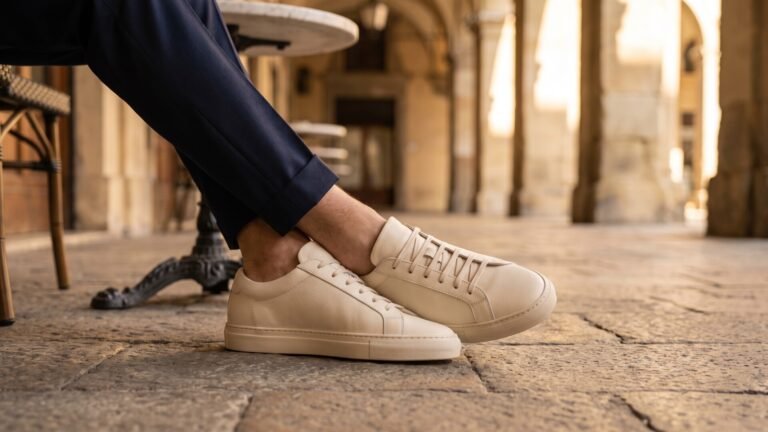
Then there is the white minimalist sneaker, the category’s sacred cow. A smooth white leather upper is a blank surface that records every scuff and crease in high contrast. The clean look is a maintenance commitment disguised as a neutral. A darker leather or a textured finish hides far more.
Suede, meanwhile, gets judged too fast, usually after one bad day. Most surface marks lift with a suede brush and a little steam held near, not on, the nap, and a suede eraser handles dry scuffs. What does not come back easily is a saturated oil stain or a salt ring that has dried in. Suede forgives the small stuff and punishes the big stuff. Leather is the reverse: it shrugs off a soaking but wears its small scars in public.
The psychology decides wear frequency more than any spec. Leather says you thought about it; suede says you own more than one pair and know which to reach for. If you buy suede for the look and leave it in the box whenever the sky darkens, you have bought a display object. Buy the material whose look will actually get the shoes out the door. For broader guidance on what you are paying for, read whether luxury Italian shoes are worth the money, and see our Italian designer sneakers guide for the category end to end.
Which Material Fits Your Wardrobe and Daily Routine?
Choose leather if you need one versatile pair
If this is your only serious sneaker, buy leather. Smooth or lightly textured leather in white, off-white, black, navy or deep brown carries you from office-casual to travel to a relaxed dinner, and it handles the move from denim to chinos to soft tailoring that suede works harder to make. For office wear specifically, see our guide to Italian designer shoes for business casual outfits.
The practical advantage shows at the end of the day: surface dirt wipes off, and a toe scuff can often be conditioned back toward invisibility in thirty seconds. The shoe you can make presentable quickly is the one you wear on a rushed Tuesday. The tradeoff is that a pristine minimalist pair demands visible upkeep. For lower maintenance within leather, go darker or textured.
Choose suede if texture and softness matter most
Suede earns its place as a second pair. If you already own a dependable leather sneaker, suede adds texture: it reads softer and less corporate, and it pairs beautifully with flannel, brushed cotton, knitwear, denim, corduroy and unstructured tailoring.
The ownership conditions matter. Suede wants a mostly dry climate, moderate-distance use and a willingness to brush and protect it. Give it those and it can look better than leather at the same age, because it ages by deepening and softening rather than creasing into hard lines. Withhold them, with daily commuting through wet winters or long walks on gritty pavements, and the nap flattens and the toe darkens before the shoe is worn out.
Choose based on climate and travel
Neither material is weatherproof, so the question is which forgives your local conditions. Treated leather copes with a wet commute and recovers. Protected suede copes with a light shower and then needs attention. For travel, leather wins on logistics: you cannot control the weather, you may not have room for a brush and protector, and one shoe that looks right in several settings saves packing. Suede is the better travel shoe only if the climate is dry and you are not walking far in uncertain conditions.
Comfort, Durability, and Maintenance After Six Months
Six months in, the two materials tell different stories. Leather develops creases across the vamp, the panel over the top of the foot, and they either settle into a patina or crack, depending on the hide and your care. Suede’s nap compresses where the shoe flexes, the toe may darken, and high-friction zones like the inner heel can go shiny or, in poor suede, bald. Good suede wears this gracefully; cheap suede looks threadbare.
But what breaks first in a luxury sneaker is rarely the upper:
- Heel lining. It wears through where your heel rubs, which is annoying because the shoe still looks fine outside.
- Insole compression. The footbed flattens under heel and ball and the cushioning goes.
- Outsole wear. Heel strike and the outer forefoot go first, and soft rubber disappears fastest.
- Edge separation. The bond between upper and sole fails at toe or heel, especially on cemented soles.
- Stitching stress. Seams at the heel counter and the eyestay, the panel the laces pass through, take load every step.
Upper material is one line item among several. A suede sneaker with a stitched sole and leather lining will outlast a leather sneaker with a glued sole and fabric lining, and it is not close.
For leather: wipe after wear with a soft damp cloth, dry it naturally away from heat, and condition sparingly, since a thick coat softens and darkens leather and attracts dirt. Use shoe trees to hold shape and draw moisture, and protect before the first wear.
For suede: brush regularly in one direction with a brass-bristle brush, and apply a compatible protector before first wear. Treat stains early: a suede eraser for dry scuffs, a damp cloth and gentle steam for surface marks. Never soak it, scrub hard, or dry it near a radiator or with a hairdryer; air-dry at room temperature, stuffed with paper. Our guides to the best suede cleaners that actually work and how to waterproof Italian suede without darkening it cover products, and how to care for Italian leather shoes covers the leather side. If walking distance is your main concern, our round-up of Italian luxury sneakers for everyday walking is the better companion.
Comparing Real Italian Sneaker Options
Material plays out differently across the models people actually consider. Compare within a brand’s range where you can, because a suede version of a design may have a different lining, sole or panel construction than the leather one. Prices below are typical US retail ranges and move with colorway and retailer.
Common Projects Achilles Low (about $450-$570). The reference point for minimalist leather sneakers: a clean silhouette, a gold-foil style code at the heel and nothing else. It comes in whole sizes only, and the smooth, pale upper shows creasing and scuffing plainly, so it rewards the owner who enjoys upkeep. [Affiliate: Browse the Common Projects collection]
Zegna Triple Stitch (about $1,000-$1,300). A comfort-led, polished casual shoe, made in Italy and offered in suede, leather and deerskin at similar prices, which makes it a rare like-for-like material comparison. Zegna recommends going down half a size to a full size from your usual fit. It sits closer to tailoring than the Achilles. Our Zegna Triple Stitch sneaker review covers fit and feel, and Zegna Triple Stitch vs. Common Projects Achilles Low is the direct comparison. [Affiliate: See the Zegna Triple Stitch collection]
Brunello Cucinelli sneakers (about $850-$1,200). Soft suede and leather in a refined casual shape, with a premium that buys finish and brand positioning as much as raw durability. If you want the texture-led look with real material quality, start here; our Brunello Cucinelli sneakers review has the detail. [Affiliate: Explore Brunello Cucinelli sneakers]
Golden Goose Super-Star (about $550-$700). The intentionally distressed option, in leather with suede details, for buyers who do not want a pristine sneaker. Pre-distressing means the first scuff does not ruin the look, though it does not remove concerns about sole wear or fit. Read our Golden Goose Super-Star review, our piece on the Super-Star’s bio-based leather, and whether Golden Goose sneakers are comfortable for all-day wear. [Affiliate: Shop Golden Goose Super-Star]
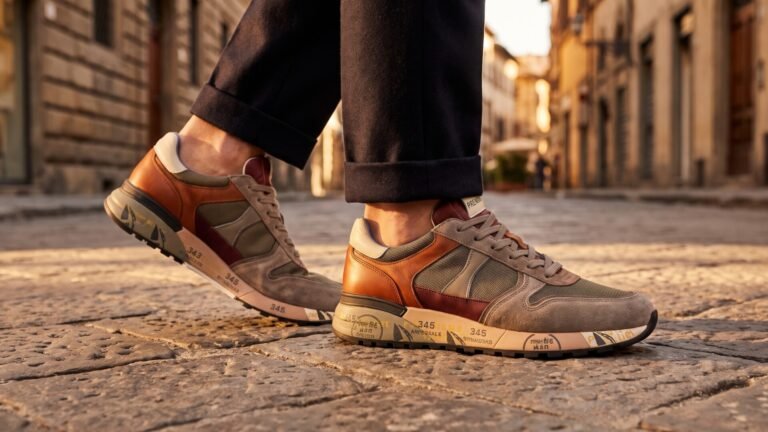
Premiata sneakers (Lucy about $230-$330). A design-forward Italian brand that uses material contrast, typically suede panels with technical fabric, as part of the look, at a far lower price than the others here. Our Premiata sneakers review explains where it fits. [Affiliate: Browse Premiata sneakers]
Across all five, material is one variable and the brand name is another. Judge the pair in your hand against the checklist above, not against the price tag. If sourcing matters to you, see our list of Italian designer sneakers made with recycled materials.
The Hidden Cost of Choosing the Wrong Material
Run the cost-per-wear test before you buy. A $700 sneaker worn three times a week for three years works out to under $2 a wear. A $350 pair that stays in the closet because you are scared of the rain costs far more per wear, because you never get the value out of it. The expensive shoe that suits your life is the cheap one; the bargain that does not is the expensive one.
Consider opportunity cost too. The same budget might buy one highly branded sneaker, two strong Italian casual pairs, or a leather sneaker plus a specialist shoe for bad weather. Two good pairs you actually wear usually beat one precious pair you protect.
On resale, leather generally has broader secondhand demand and is easier for a buyer to assess, because creasing and surface condition are legible in photos. Suede loses value faster when the nap is flattened, stained or uneven. Classic colors and recognizable models hold up best in either material, but treat resale as a bonus, not a plan. After several years, the better shoe is almost always the one that was worn regularly, kept out of prolonged wet and maintained before small problems became permanent. Material sets the difficulty level; care decides the outcome.
Comparison Verdict: Who Should Buy Leather and Who Should Buy Suede?
| Buyer profile | Recommended material | Why |
|---|---|---|
| First luxury sneaker | Leather | Broadest styling range, easier upkeep |
| Wet or changeable climate | Leather | More forgiving when treated |
| Polished casual wardrobe | Leather | Moves into smart-casual easily |
| Frequent traveler, limited luggage | Leather | Easier to clean and style across settings |
| Already owns a white leather pair | Suede | Adds texture and variety |
| Dry climate | Suede | Lower weather risk, manageable care |
| Wants immediate softness | Suede | Often supple from the first wear |
| Building a varied rotation | Both | They play different roles |
The verdict is straightforward. Choose leather for maximum utility and suede for a deliberate second-pair purchase. Two practical cautions: avoid pale suede as a first or only luxury sneaker unless you accept the maintenance, since it shows dust, darkens at the toe and punishes every puddle; and within suede, favor dark brown, taupe, navy or charcoal for better wardrobe integration and less visible grime.
If comfort is your deciding factor, our top 7 Italian luxury sneakers that are actually comfortable is the follow-up read. The same leather-versus-suede logic carries over to Italian loafers and Italian designer boots, and our Italian designer shoes hub covers the wider category.
Frequently Asked Questions About Italian Leather Vs. Suede Sneakers
What is nubuck, and is it a good middle ground?
Nubuck is leather sanded on the outer grain side, which gives a fine velvet nap on a denser surface than suede. It generally holds up better to wear than suede while still needing a brush and a protector. It suits buyers who like the texture but want something less fragile.
Are suede sneakers too warm for summer?
Not necessarily. Breathability depends on the lining, the thickness of the hide and any perforation more than on the surface. Thin-lined suede feels light in dry heat, while heavily coated leather can feel hot. Light colors reflect heat but show dirt, so a mid-tone suede is the practical summer choice.
Can I wear suede sneakers to the office?
In a smart-casual office, yes: dark brown, navy or charcoal suede works with chinos and unstructured tailoring. In a stricter dress code, smooth leather in a plain colorway is the safer choice, and it is easier to keep looking sharp across a working week.
Does protector spray change how suede looks?
It can. Some sprays darken suede slightly or flatten the nap, so test on a hidden spot such as the inside of the tongue first. Apply thin coats to a clean, dry, brushed pair, and let the treatment cure fully before you wear them outside.
How often should I brush suede sneakers?
A quick brush after every few wears is a sensible habit. Work in one direction to lift the nap and clear dust, and treat marks as soon as you notice them, because a fresh scuff lifts far more easily than one that has been walked on for weeks.