Golden Goose Super-Star Review: Are They Worth the Price?
Most people assume the Golden Goose Super-Star costs what it does because of how it is made. The leather, the stitching, the Italian workshop – that is the story the price tag tells. It is not quite the truth. The Super-Star is expensive because of how it looks, and specifically because of a finish that has been applied deliberately, by hand, to make a new shoe look like a shoe you have already owned for three years.
That is not a criticism. It is the whole proposition, and once you understand it the buying decision gets much simpler. You are not paying for a sneaker that will outlast everything else in your closet. You are paying for a finished aesthetic – one that develops further as you wear it – and for a silhouette people recognise from across a room. Whether that is worth the money depends entirely on whether you want that aesthetic in the first place.
Here is who benefits, who should walk away, and what the alternatives actually give you.
What the Golden Goose Super-Star Actually Offers
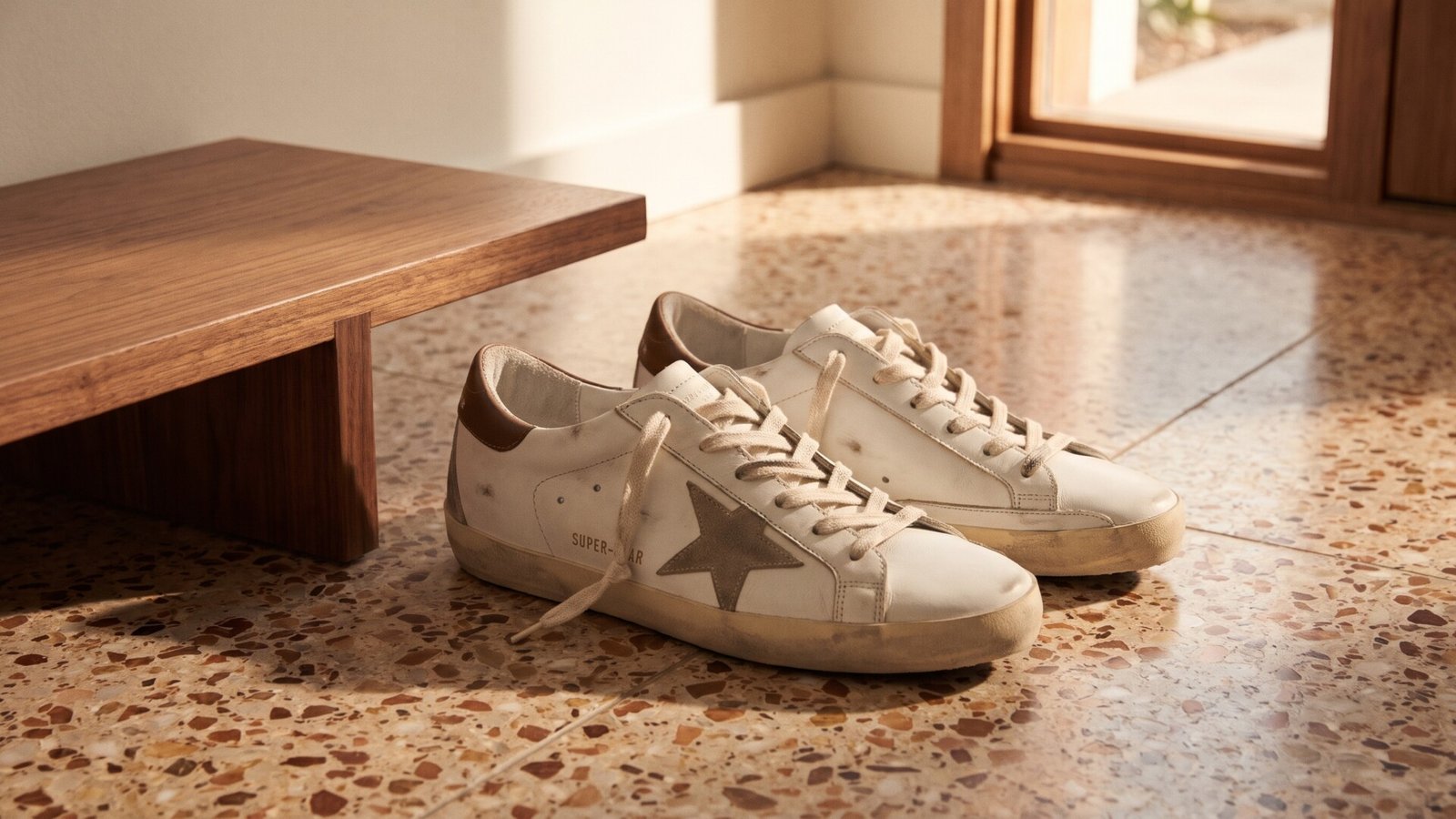
Strip away the branding for a moment and you have a low-top sneaker in the shape of a 1970s basketball shoe. Leather upper – the tomaia, the assembled upper of the shoe – a flat rubber cupsole, a perforated toe box, a side star, and a contrasting heel tab. That is the physical object. It is a simple thing, made well, in a shape that has been around for half a century.
What separates it from every other low-top in the category is the finish. Each pair is distressed before it leaves the workshop: scuffs along the toe, creasing across the vamp, a slightly yellowed midsole, laces that look like they have been through a washing machine. This is design language, not damage. A new Super-Star is supposed to look like a second-hand Super-Star.
The model sits at the centre of Golden Goose’s range, and it is worth knowing how it differs from its closest sibling. Our Golden Goose Ball Star review covers that shoe in detail, but the short version: the Super-Star is the cleaner, more streamlined silhouette, closer to a classic tennis or court shoe. The Ball Star leans harder into the retro basketball profile – chunkier, more padded, more overtly sporty. If you want the shoe that disappears into a wardrobe, the Super-Star is the one. If you want it to be the loudest thing you are wearing, look at the Ball Star.
The reason people buy it is not complicated. It arrives already lived-in, which removes the anxiety of the pristine white sneaker – the pair you are afraid to wear because the first scuff will ruin them. With a Super-Star, the first scuff is just another scuff. That psychological ease is a real part of the value, and it is the thing most reviews skip over.
Where the Super-Star Comes From
Golden Goose was founded in 2000 in Marghera, near Venice, by Alessandro Gallo and Francesca Rinaldo, and moved its headquarters to Milan in 2021. The Super-Star dates from 2007 and carries a star whose points are deliberately uneven. The company has changed hands several times: Carlyle acquired it in 2017 and Permira bought it from Carlyle in 2020, and a further majority stake sale was reported in December 2025, so check the current ownership if that matters to you. For the wider brand, see our complete guide to Golden Goose, and for a related take on the same model, our piece on the Golden Goose Super-Star and its bio-based leather.
Construction, Materials, and Durability
Where the premium is visible
Hold a Super-Star and the first thing you notice is the leather. It is soft, with a slightly matte hand – not the plasticky shine of a corrected-grain hide, but something finished to look worn rather than polished. Golden Goose’s US product pages list cowhide leather uppers, a lining of cow leather and cotton, and a 100% rubber sole, and describe the pairs as handcrafted in Italy, though they do not specify the grade of leather. Run your thumb across the vamp and it gives slightly. That give is what allows the shoe to crease naturally rather than crack.
Look at the stitching around the toe box and the heel counter. On a well-made pair it is even, tight, and consistent – with no skipped or uneven spacing. Sloppy spacing, loose threads, or stitching that wanders off the edge line is a finishing fault, and it is one of the few things on this shoe you can judge objectively.
The outsole is rubber, cup-sole construction, which means the sole is moulded and bonded to the upper rather than stitched through. This is normal for sneakers and not a flaw – but it does mean the sole is not replaceable the way a Goodyear-welted dress shoe sole is. When the rubber wears through, the shoe is finished. That is the single most important durability fact about any sneaker, and it applies here as much as anywhere.
The footbed is cushioned but not removable on most versions, and the lining is leather or a leather-textile mix depending on the model. Check the heel lining specifically – it is the first place a sneaker wears out, and a thin lining will rub through within a couple of years of daily wear.
What tends to age well and what does not
The pre-distressed finish is genuinely forgiving. A crease across the toe that would annoy you on a pristine Common Projects reads as intentional on a Super-Star. Light marks on the midsole blend into the existing treatment. In that narrow sense, the shoe is lower-maintenance than a clean white sneaker.
But looking aged is not the same as resisting wear, and this is where buyers get confused. The distressing is cosmetic. It does nothing to strengthen the leather, protect the sole, or reinforce the heel lining. The structural clock is ticking exactly as it would on any other sneaker.
What to watch, in rough order of when it tends to appear:
- Heel lining – rubs through first, usually within two to four years of regular wear
- Insole compression – the cushioning flattens, especially under the heel
- Outsole wear – the heel edge and the ball of the foot go first
- Leather creasing – normal, and visually absorbed by the finish
- Decorative elements – the star, heel tab, and any applied details take friction
How long a pair lasts depends almost entirely on rotation. One pair worn for a daily commute will look tired in eighteen months. The same shoe rotated across three or four pairs, worn a couple of times a week, can look good for five years or more. That is true of every sneaker ever made, and it is the honest answer to the durability question.
Fit, Comfort, and Everyday Wear
Sizing is where most online reviews do you a disservice by offering a universal rule. There isn’t one. Golden Goose sizing has shifted across seasons and models, and the Super-Star and Ball Star do not necessarily fit identically. The only reliable approach is to check the specific retailer’s size conversion chart for the model you are buying, and to buy from somewhere with a workable return policy.
What matters more than the number on the box:
- Toe-box shape – if you have a wide forefoot, check the retailer’s fit notes and customer feedback for width before you simply size up in length
- Heel hold – a sneaker that slips at the heel will rub, and the lining will fail faster
- Foot width – narrow feet may find the standard fit roomy; wide feet may need to go up
- Sock thickness – thin socks versus thick socks changes the fit by most of a half size
- Preferred fit – a close fashion fit versus room for walking are different purchases
On comfort, be realistic. The Super-Star is a fashion sneaker with a flat cupsole and modest cushioning. For city wear, errands, a day at the office, a dinner – it is perfectly pleasant. For a ten-mile walking day, a theme park, or a trip where you are on your feet from morning to night, it is not the tool for the job. It is not a performance trainer and it was never designed to be one.
Break-in is short. The soft leather and the pre-flexed finish mean most buyers find them comfortable within a few wears. The pressure points to watch are the heel counter, if the fit is slightly large, and the top of the toe box if you have a high instep.
If extended walking is your main concern, our article Are Golden Goose sneakers comfortable for all-day wear goes deeper into that specific question. And the practical advice applies here too: alternate pairs. A luxury sneaker worn every single day will compress, stretch, and wear in a way that a rotated pair never does.
What Most Buyers Get Wrong About the Golden Goose Super-Star
The first misconception is that a distressed shoe is a durable shoe. It is not. The finish is applied to make the leather look worn – it says nothing about the quality of the sole, the strength of the stitching, or how the lining will hold up. A Super-Star will wear out on roughly the same schedule as a well-made sneaker at half the price. What you are paying for is how it looks while it does so.
The second is that price correlates with comfort. It does not, and in this category it barely correlates at all. A $400 sneaker can be less comfortable for walking than a $120 one, because comfort is a function of last shape, cushioning, and fit – not brand positioning. The Super-Star is comfortable enough for ordinary life. It is not more comfortable than a dedicated walking shoe, and it is not trying to be.
The third is that the distressing makes the shoe maintenance-free. It hides some marks. It does not protect against deep stains, water damage, or the salt that gets into leather over a winter. You still need to brush off surface dirt, keep them dry, and store them properly.
And the fourth, the one that actually explains the price: the Super-Star sells a complete visual identity. The leather and rubber and labour are a fraction of what you pay. The rest buys you a recognisable silhouette, a specific attitude, and the social signal that comes with it. That is not a con – it is how fashion works – but you should know you are buying it. If you want the identity, the price can be rational. If you want materials per dollar, it never will be.
Golden Goose Super-Star Compared With the Alternatives
The most useful comparison is within the family. The Golden Goose Ball Star is the chunkier, more retro option – a fuller profile, more padding, a silhouette that reads more strongly as a statement. Choose the Super-Star if you want versatility and a cleaner line. Choose the Ball Star if you want the shoe to be the focal point of the outfit and you like a roomier-looking shape.
Against the [Affiliate: Common Projects Achilles Low], the logic flips entirely. Common Projects is the minimalist’s luxury sneaker: no visible branding beyond a gold serial number on the heel, a clean leather upper, a sleek profile. It is the shoe for someone who wants quality without a logo. The trade-off is that it shows every mark – a scuff on a pristine white Achilles is a problem, where the same scuff on a Super-Star is invisible. If you want a timeless, understated sneaker and you are prepared to look after it, Common Projects is the stronger long-term choice. If you want a shoe that forgives you, the Super-Star wins.
The [Affiliate: Autry Medalist] sits at a lower price point and offers a genuinely appealing retro sneaker with a similar court-shoe shape. It does not carry the same luxury positioning, the finishing is a step down, and resale appeal is more limited – but for everyday wear it is a sensible, well-made option that gets you most of the look for less.
The [Affiliate: Veja V-10] is the material-conscious choice. It is not trying to be a luxury sneaker; it is a practical everyday shoe with a sustainability story. If that story matters to you and you want a simple white sneaker, it is a reasonable buy. It is not a substitute for the Super-Star’s aesthetic, and it is not meant to be.
| Shoe | Approximate price position | Best for | Comfort and walking | Long-term value |
|---|---|---|---|---|
| Golden Goose Super-Star | Premium luxury | Buyers who want intentional distressing and recognisable branding | Moderate everyday wear; not a technical walking shoe | Strong style recognition; resale depends on condition and colourway |
| Golden Goose Ball Star | Premium luxury | Buyers who prefer a chunkier retro basketball shape | Moderate everyday wear; fit may feel more substantial | Good brand recognition, with a more trend-sensitive silhouette |
| Common Projects Achilles Low | Premium luxury | Minimalist wardrobes and discreet branding | Clean, simple everyday comfort; less forgiving visually | Strong timeless appeal, though pristine condition matters |
| Autry Medalist | Mid-range designer | Retro styling at a lower entry price | Generally practical for casual wear | Lower luxury positioning and more limited resale appeal |
| Veja V-10 | Mid-range designer | Buyers prioritising a simpler everyday sneaker and material-conscious positioning | Practical casual comfort, subject to individual fit | Good wardrobe utility, but not comparable luxury resale appeal |
Styling and Real-World Ownership
Where the Super-Star works best
This is a sneaker that wants to be worn with relaxed clothing. Straight-leg denim, a slightly cropped trouser, a midi skirt, a simple dress, a travel outfit of linen and cotton – the distressed finish sits naturally with all of it. The whole point of the pre-worn look is that it lowers the formality of whatever you pair it with.
Colourway matters more than most buyers expect. White and neutral combinations – white with a grey star, white with a black heel tab – integrate into almost any wardrobe and stay versatile for years. Metallics, bright heel tabs, and high-contrast details turn the shoe into a statement piece, which is fine if that is what you want, but it narrows what you can wear it with. If this is your only pair, buy the neutral.
The styling rule that follows from the finish: the shoe suits casual clothing better than formal clothing. Worn with a suit it reads as deliberate contrast, and that can work – but it is a choice, not a default. For most people, the Super-Star belongs with the relaxed half of the wardrobe.
For broader outfit guidance, our guide on how to style Italian shoes for fall is worth reading if you are planning to wear them through the colder months.
Where it becomes a poor choice
The Super-Star is not the right shoe for formal business dress, for a trip where you will walk ten miles a day, for wet conditions, or for anyone who wants a completely clean and understated sneaker. It is also a poor choice if you already own a distressed white sneaker – a second pair adds branding, not function.
Care is straightforward but not optional:
- Brush off surface dirt with a soft brush after wearing
- Use a leather cleaner sparingly, on a cloth, and test on a hidden area first
- Never soak the shoe
- Air-dry away from direct heat – no radiators, no hairdryers
- Follow the material instructions for the specific finish on your pair
What the Super-Star Costs
As of November 2026, women’s leather Super-Star styles on Golden Goose’s US site were listed in roughly the $585 to $700 range: a white leather pair with a grey suede star at $585 and a leopard-print leather pair at $695, both excluding sales tax. Metallic, glitter and special-edition finishes can cost more, and discounted pairs sometimes appear at multi-brand retailers with limited sizes. For comparison, the Common Projects Original Achilles Low has a regular price of roughly $450 at US boutiques, so the Super-Star sits meaningfully above it. Prices change by season and market, so confirm on the product page before you buy.
Is the Golden Goose Super-Star Worth the Price?
Break the price into four parts and the answer gets clearer.
Materials and construction. Good leather, consistent stitching, a rubber cupsole. Solid, but not exceptional for the money. You can find comparable construction for less.
Design originality. This is where the Super-Star earns its premium. The pre-distressed finish is distinctive, recognisable, and hard to replicate convincingly. You are paying for a design idea, and it is a good one.
Comfort and use. Adequate for everyday city wear. Not a reason to buy, not a reason to avoid.
Brand and resale appeal. The Golden Goose name carries weight, and a well-kept pair in a popular colourway and size will hold some value on the resale market. But do not assume appreciation. Condition, colourway, size demand, and timing all matter, and a worn pair is a worn pair.
Cost per wear is the honest way to think about it. Worn twice a week for three years, the price per wear lands in the low single digits – reasonable for a shoe you love. Worn a handful of times a season, it never justifies itself.
The hidden costs are real: professional cleaning if they get badly marked, replacement insoles as the cushioning flattens, and the fact that you will want a second pair for bad weather. And there is one more, rarely mentioned: some buyers discover after a month that they do not actually like the distressed finish as much as they thought. That is an expensive discovery.
The contrarian conclusion: if you want the longest-lasting, most versatile neutral luxury sneaker, a cleaner design will serve you better. If you specifically want the Golden Goose aesthetic, the Super-Star will satisfy you more than a technically superior but visually generic alternative. The shoe is not overpriced for what it is. It is overpriced for what some people think it is.
Buying Verdict: Who Should Buy the Super-Star?
Buy it if you genuinely like the distressed finish, you want a recognisable everyday luxury sneaker, you will rotate it with other shoes, and you value styling identity over maximum cushioning. [Affiliate: Browse the Golden Goose Super-Star collection] once you have confirmed your size against the retailer’s chart.
Choose the Golden Goose Ball Star instead if you prefer a roomier, more assertive retro basketball silhouette and want the shoe to be the focal point of your outfit. Our Golden Goose Ball Star review covers fit and styling in full.
Choose Common Projects Achilles Low instead if you want discreet branding, cleaner design, and a more timeless minimalist investment.
Choose an accessible alternative such as the Autry Medalist or Veja V-10 instead if budget, frequent walking, or practical value matters more than Golden Goose’s finishing and brand language.
Three buyer types, three answers:
- The style-led luxury buyer – buy the Super-Star. It does what you want it to do, and the price is part of the appeal.
- The high-mileage practical buyer – skip it. Buy a comfort-focused sneaker and a separate pair for style.
- The minimalist value-conscious buyer – buy Common Projects or Autry. You will get more shoe per dollar and less regret.
The Super-Star is a good shoe with a clear point of view, and that point of view is what you are paying for. If you want the distressed look, the recognisable star, and a sneaker that gets better-looking as you wear it, it earns its place in a rotation. If you want a clean minimalist sneaker, maximum walking comfort, or the best materials per dollar, it is the wrong purchase. Our guide to the best Italian luxury sneakers for everyday walking has better answers for comfort, and the wider Italian designer brands guide shows where Golden Goose sits among Italian houses.
Frequently Asked Questions About Golden Goose Super-Star
How much do Golden Goose Super-Star sneakers cost?
As of November 2026, women’s leather Super-Star styles on Golden Goose’s US site were listed at roughly $585 to $700 before tax. Special finishes can cost more, and prices vary by season and retailer.
Where are Golden Goose Super-Star sneakers made?
Golden Goose’s US product pages for the Super-Star list Italy as the place of manufacture and describe the pairs as handcrafted. Check the product page for your specific style, since labelling applies per product.
Are Golden Goose Super-Star sneakers worth the price?
They can be, for buyers who want the distinctive design, the recognisable branding, and a sneaker they will wear often in casual settings. They are not worth it if you expect athletic-level comfort or proportionally better materials for every dollar. The value is in the aesthetic, not the specification.
Do Golden Goose Super-Star sneakers run true to size?
Fit varies by foot shape, material, and season, so there is no universal rule. Check the specific retailer’s size conversion chart for the model you are buying, and buy from somewhere with a return policy you can live with.
Are Golden Goose Super-Star sneakers comfortable for walking?
They are generally fine for casual city wear and moderate walking. If you need extended walking comfort, compare cushioning, support, and fit against dedicated comfort sneakers – the Super-Star is a fashion shoe, not a walking shoe.
Can Golden Goose Super-Star sneakers get wet?
Do not treat them as waterproof. Leather and mixed-material sneakers should not be soaked, and prolonged exposure to rain or snow will damage the finish and the leather. Follow the care instructions for your specific material.
Do Golden Goose Super-Star sneakers last?
Lifespan depends on rotation, walking volume, climate, maintenance, and fit. Expect a few years of regular wear, longer with rotation. The finish may disguise cosmetic wear, but soles, heel lining, and stitching determine how long they actually last.
Are Golden Goose Super-Star sneakers still in style?
The model has a strong established identity rather than relying on a short trend cycle, though specific colours and embellishments are more fashion-sensitive than the core low-top shape. A neutral colourway is the safer long-term buy.
Which is better, Golden Goose Super-Star or Ball Star?
The Super-Star is sleeker and more versatile; the Ball Star is chunkier and more of a statement. Choose based on whether you want the shoe to blend into your wardrobe or stand out within it.