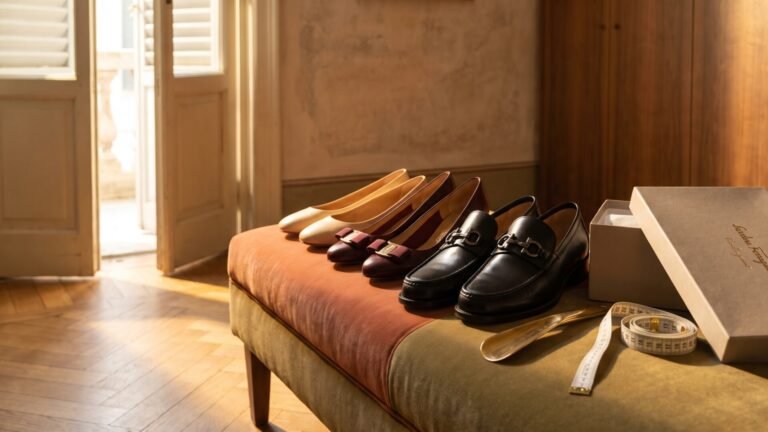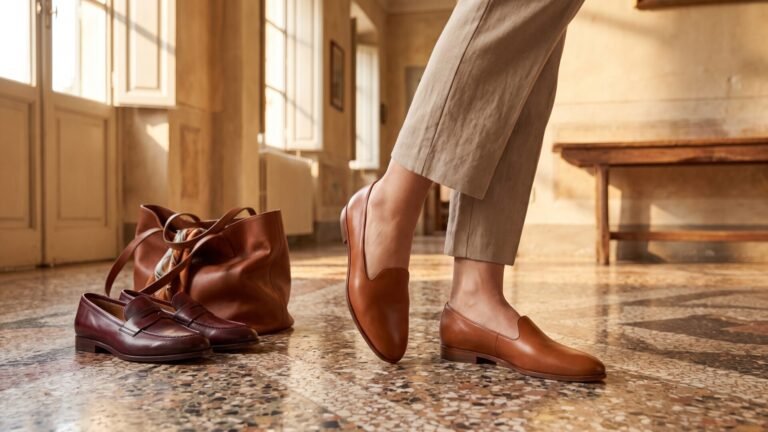
Best Italian Designer Loafers for Women
The best Italian designer loafers for women are not the most famous pair, and usually not the most expensive one. They are the pair whose construction matches how you actually spend your week – the sole that suits your pavement, the last that suits your foot, the leather that survives your weather. Most loafers on a luxury shelf are well made. That is not the problem. The problem is that a beautiful shoe built for a Milanese showroom can be a miserable shoe for a wet Tuesday commute, and a soft driving-style loafer that feels like a slipper in the shop can be the one you reach for every single morning for three years.
So this is a shortlist built around use, not prestige. Six houses. Six different jobs.
The Italian Loafers Worth Considering
Not every luxury loafer deserves a place on a list like this. Plenty are perfectly nice shoes that solve no particular problem. The six below each do one thing genuinely well, and the differences between them are differences you can feel in your hand before you ever put them on.
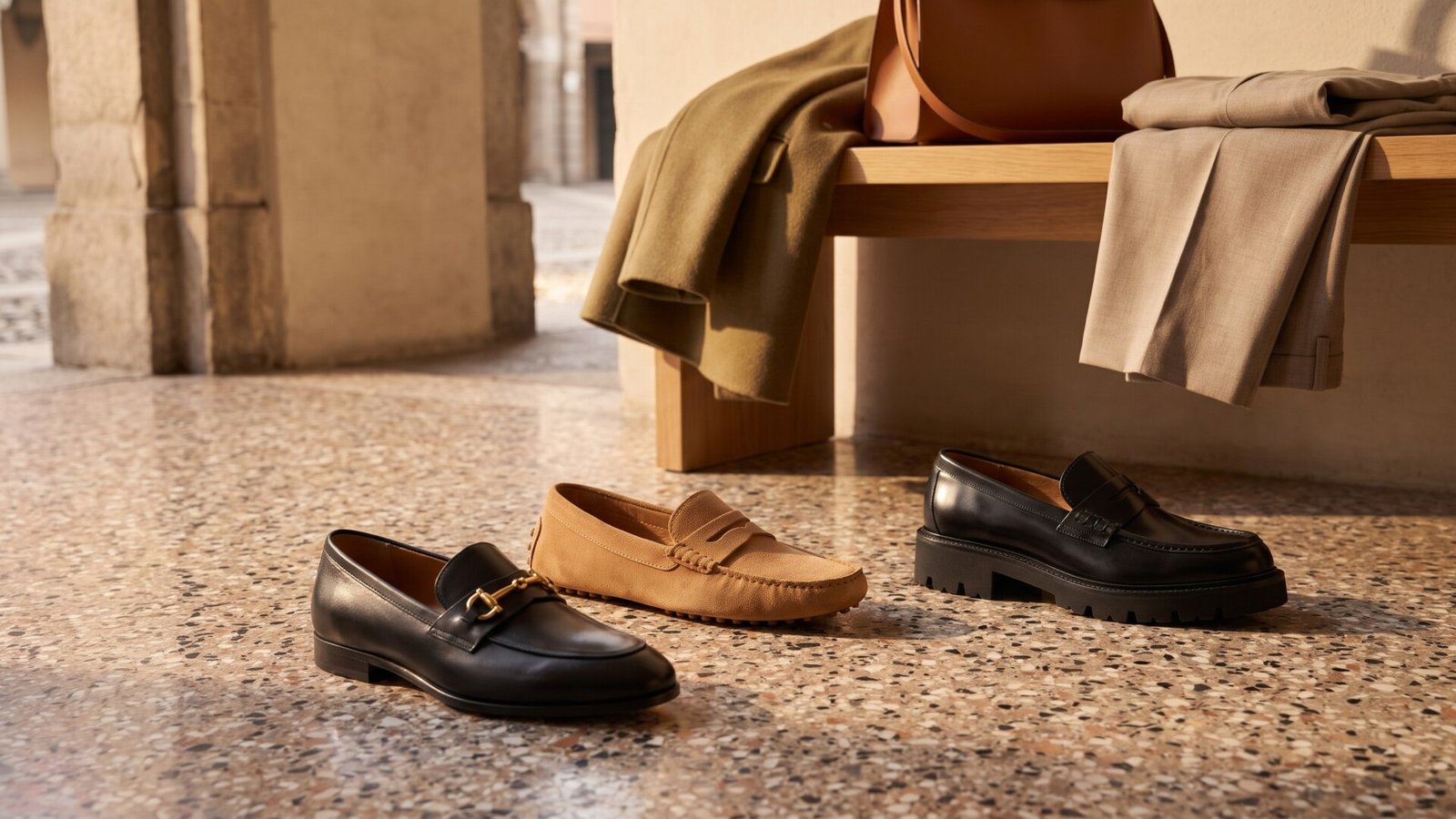
Tod’s Gommino. The gommino – the rubber pebble sole, those little nubs you see on the bottom – started as a driving shoe and became a loafer. What you get is a soft, flexible, unlined-feeling shoe that pairs with denim and knitwear and long-haul flights. The pebbles give grip on smooth surfaces and almost nothing on rough ones. More on that below.
Gucci Horsebit 1953. The morsetto – the metal bar across the vamp, borrowed from horse tack – has been on this shoe since the fifties. It is the most recognizable loafer in the world and, more usefully, one of the most stylistically flexible. Polished leather, a clean almond toe, and hardware that reads as heritage rather than logo.
Ferragamo Gancini. The gancino – the small hooked clasp – sits on a more structured shoe than either of the above. This is the office loafer. Firm heel counter, defined shape, leather that holds a crease rather than collapsing into one.
Prada brushed leather loafers. Brushed leather is calfskin finished with a light abrasion so it takes on a soft, slightly matte sheen that scuffs less visibly than a high polish. The silhouette is sharper and heavier than a classic penny, often with a lugged or chunky sole. Directional, and it changes the proportion of everything you wear it with.
Santoni. A shoe town brand – Santoni comes out of the Marche region, the same cluster of hills that produces a huge share of Italy’s better footwear. Traditional finishing, hand-colored patinas on many models, a dressier last. This is the pair for someone who wants to see the shoemaking.
Brunello Cucinelli. Quiet, soft, minimal. Often suede, often a slightly relaxed shape, always in the neutral range – camel, taupe, dark brown, off-white. No hardware worth mentioning. The luxury is in the leather and the restraint.
Here is the quick framework before the detail:
- Everyday casual and travel: Tod’s Gommino
- Heritage and smart-casual identity: Gucci Horsebit 1953
- Business and business casual: Ferragamo Gancini
- Modern, directional polish: Prada brushed leather
- Traditional craftsmanship: Santoni
- Quiet luxury: Brunello Cucinelli
If you want the wider category context first, the [Internal: Italian Loafers hub] covers the history and the construction vocabulary in more depth, and the [Internal: Italian Designer Shoes hub] maps the whole footwear landscape.
Comparison Table: Best Italian Designer Loafers for Women
| Loafer | Best for | Design character | Practical strengths | Main trade-off |
|---|---|---|---|---|
| Tod’s Gommino | Casual daily wear and travel | Relaxed, driving-inspired | Soft feel, flexible construction, easy styling | Less formal, limited weather protection |
| Gucci Horsebit 1953 | Heritage appeal and polished outfits | Iconic, refined, recognizable | Strong styling versatility, enduring design | Some versions feel firm during break-in |
| Ferragamo Gancini | Work and business casual | Structured, elegant, understated | Easy to dress up, strong office compatibility | Less relaxed than softer loafers |
| Prada brushed leather | Modern city dressing | Sharp, architectural, fashion-led | Distinctive silhouette, strong visual impact | Heavier or more rigid in some builds |
| Santoni leather | Traditional craftsmanship | Refined, artisanal, dressier | High-quality finishing, formal versatility | Needs more care and deliberate styling |
| Brunello Cucinelli | Quiet luxury and relaxed tailoring | Minimal, soft, understated | Works with elevated casual wardrobes | Hard to justify if your wardrobe is trend-led |
Prices move with material, sole type, season, and retailer, so treat any figure you see as a snapshot rather than a rule. Most of these sit somewhere between roughly $700 and $1,200 at full price, with Cucinelli and some Santoni models pushing higher and Tod’s occasionally dipping lower on classic colorways. The table is a starting point. It cannot tell you whether the last suits your instep, and that is the thing that decides whether you wear them.
What Separates a Good Italian Loafer From an Expensive One
"Made in Italy" is a manufacturing origin, not a quality grade. It tells you where the final assembly happened. It does not tell you where the leather was tanned, how the upper was cut, or whether the sole is stitched or glued. Plenty of expensive Italian loafers are glued. Plenty of mid-priced ones are stitched. You have to look.
Start with the leather. Press your thumb into the vamp – the top surface across the front of the foot – and release. Good calfskin springs back with fine, tight grain. Cheap corrected-grain leather, which is leather that has been sanded and coated to hide flaws, dents and stays dented, and the surface feels plasticky under the pad of your finger. Creasing is the real test over time: a good upper creases in fine lines across the flex point. A poor one creases in one deep fold that eventually cracks.
Then the edge. Run your thumb along the inside edge of the topline – the opening where your foot goes in. If it catches, it was finished in a hurry. A properly finished edge is either folded and burnished or neatly painted with no ragged transition. Then turn the shoe over and find the seam where the upper meets the sole. Stitching means the sole can be replaced. A smooth, seamless junction means it was glued, and when that sole wears through, the shoe is generally finished.
The lining matters more than people think. A leather lining – usually calf or kid – breathes and molds to the foot. A synthetic or fabric lining is cheaper and traps heat. Turn the shoe and look inside the heel: leather there is a good sign, because that is where the lining wears through first.
Sole choice decides more than any other single factor. A leather sole is elegant, breathes, and is the traditional choice for a dress loafer. It is also slippery when new and poor in rain. A rubber sole – whether the Gommino’s pebbles, a thin micro sole, or a lugged city sole – gives grip and weather resistance at the cost of some formality. Neither is better. One suits your commute and one does not. The [Internal: Leather Soles vs. Rubber Soles guide] goes deeper on this when you need it.
One workshop aside worth carrying with you. A finisher I spent an afternoon with outside Fermo, in the Marche, showed me two uppers from the same tannery hide. One had been cut from the back, one from the belly. Same leather, same color, same price on the shelf. The belly one would wrinkle within a month. "You cannot see it in the shop," he said. "You see it in the mirror in October." That is the gap between expensive and good, and no label closes it for you.
For the full construction picture, [Internal: The Art of Italian Shoe Making] and [Internal: Handmade Italian Shoes Explained] are the places to go next.
The Best Loafer for Each Woman’s Wardrobe
For daily city wear and travel
The Gommino is the most immediately comfortable shoe on this list, and that is both its case and its limit. The soft upper, the flexible pebble sole, the absence of structure – it feels broken in from the first wear. Pair it with straight-leg denim, a knit dress, relaxed tailoring, and it never looks like you tried. For travel it packs flat and forgives swollen feet on a long flight.
The limit is the sole. Those rubber pebbles are designed for the pedals of a car, not for cobblestones, wet pavement, or a nine-mile museum day. They wear relatively quickly under sustained hard use, and they offer very little underfoot protection. If your daily reality is a city with uneven sidewalks and frequent rain, a more substantial rubber-soled loafer will serve you better, even if it feels stiffer in the shop. The [Internal: Why is Tod’s Gommino So Popular?] piece explains how a driving shoe became a wardrobe staple, and the [Internal: Tod’s Gommino vs Driving Shoe difference explained] article is worth reading if you are unsure which version you are actually looking at.
For work and business casual dressing
The Ferragamo Gancini is the safest workwear purchase on this list. Its value is not excitement – it is repetition. A moderate, structured silhouette in black or dark brown pairs with tailored trousers, midi skirts, suits, and simple dresses, and it looks intentional every time without drawing attention. That is what makes cost per wear work: a restrained shoe you wear three times a week beats a beautiful statement shoe you wear four times a year, by a wide margin.
The Gucci Horsebit works here too, and it is the better choice if you want a bit more identity in a smart-casual office. But be honest about the room. In a conservative workplace, visible hardware is a talking point, and not everyone wants their shoes to start conversations. The [Internal: Best Italian Designer Shoes for Business Casual Outfits] article covers the wider workwear wardrobe, and the [Internal: Italian Designer Flats guide] is the natural comparison if you are deciding between a loafer and a flat for the same role.
For quiet luxury
Brunello Cucinelli makes the loafer for the woman whose wardrobe is already built – the camel coat, the wide-leg wool trouser, the fine-gauge knit in oatmeal. The shoe is soft, minimally detailed, and almost always in a neutral that disappears into the outfit rather than sitting on top of it. It is genuinely lovely leather, and it ages into something softer and better.
The cost-per-wear problem is real, though. This loafer only earns its price if the rest of your closet supports elevated casual dressing. Buy it to wear with jeans and a blazer and you will get your money back in wear. Buy it hoping it will elevate a wardrobe of prints and fast fashion and it will sit in the box. Understated is not the same as minimal branding – a quiet loafer still needs to fit, finish well, and work with at least three outfits you already own.
Santoni is the alternative if you want to see the craft rather than feel it quietly. More visible finishing, more patina, more of a dress shoe. The [Internal: Santoni Shoes Review] will go deeper when it publishes.
For a modern, fashion-forward wardrobe
Prada’s brushed leather loafer is the one that changes how you dress, not just what you wear. The heavier sole and sharper toe give a loafer presence, which means it balances wide-leg trousers, long skirts, and oversized coats in a way a delicate classic loafer cannot. It also means it can overwhelm a slim cropped trouser or a fine summer dress. Proportion is the whole game with this shoe.
Brushed leather, as mentioned, is calfskin lightly abraded for a soft matte finish. It hides scuffs better than a high polish, which makes it more livable than it looks. But the silhouette itself is a fashion decision, and fashion decisions date. If you want this loafer to last beyond one cycle, choose a restrained color – black, dark brown, a deep neutral – and let the shape do the talking. The [Internal: How to remove scuff marks from high-shine Prada loafers] article is the care reference if you go for a shinier finish instead.
For traditional Italian craftsmanship
Santoni is for the reader who wants a dressier loafer and is willing to look after it. The finishing is the point: hand-colored leathers, careful edge work, a refined last. This is a shoe that rewards rotation, cedar shoe trees, and a proper brush-down after wear. Neglect it and you have paid for craft you never see.
One honest caveat. A highly finished, traditionally constructed loafer is not automatically more comfortable on day one than a soft casual design. Structured shoes need break-in. The leather has to warm and mold, the sole has to flex. Give it two or three short wears around the house and to the office before you judge it. If it still pinches after that, it is the wrong last for your foot, not a shoe that needs more time.
What Most Buyers Get Wrong About Luxury Loafers
The most common mistake is buying the most recognizable loafer and assuming recognizability equals investment. It does not. The horsebit is a wonderful piece of design and it has stayed relevant for seventy years, which is a genuine argument for it. But hardware does not fix a last that pinches your instep or a sole that suits nothing in your week. Buy the shoe that fits and works, then enjoy the heritage as a bonus.
The second mistake is confusing softness with comfort. A very soft upper feels wonderful in the shop. It also offers less support, holds its shape less well over years, and protects your foot less from the ground. Comfort over a full day is a function of fit, underfoot support, and sole, not of how squishy the leather feels in the first thirty seconds.
The third is buying loafers only for formal outfits. The strongest purchase on this list is almost always the one that covers several wardrobe roles – denim through tailoring – because that is the shoe that gets worn. A loafer reserved for occasions is a loafer with a terrible cost per wear, however beautiful.
The fourth is judging the sole by tradition rather than by life. A leather sole is the classic choice and looks superb with tailoring. It is also genuinely poor in rain and slick on polished stone when new. If you commute on foot through a wet city, a rubber sole is the more sensible buy, and no amount of tradition changes that. Judge the sole by your pavement, not by the rulebook.
Fit, Comfort, and Practical Ownership
Fit decides everything, so here is the framework to use in the shop.
The heel should be secure. A little slip in the first week is normal in a leather-lined loafer as the lining compresses, but if your heel lifts more than a few millimeters with each step, the shoe is too long or too wide in the heel and it will not fix itself.
The widest part of your foot – the ball, just behind the toes – should sit at the widest part of the shoe. If it sits forward of that point, the shoe is too short and the vamp will press across the top of your foot.
Your toes must not be compressed. A narrow, almond-shaped last looks elegant and excludes a lot of feet. If your toes touch the front or the sides, size up or choose a different last. Elegance you cannot walk in is not elegance.
Try shoes late in the day, when feet are at their largest, and wear the hosiery you actually intend to wear with them. A loafer that fits over a thin sock may not fit over a thicker one, and a loafer worn barefoot needs a slightly different fit than one worn with socks.
Common problems, and what they mean:
- Heel slip during break-in. Usually resolves as the lining compresses. If it persists after two weeks of wear, the fit is wrong.
- Pressure across the vamp. Often a sign the shoe is too short or the instep is too high for the last. It rarely improves much.
- Rigid uppers that soften slowly. Normal in structured loafers. Give them time, but not indefinitely.
- Narrow lasts. A beautiful shape that simply will not accommodate a wider foot. No break-in fixes this.
Comfort by construction, rather than by brand: Gommino-style soft loafers for immediate flexibility, structured leather loafers for support and shape retention, chunkier rubber-soled loafers for protection and visual weight. Match the construction to the job.
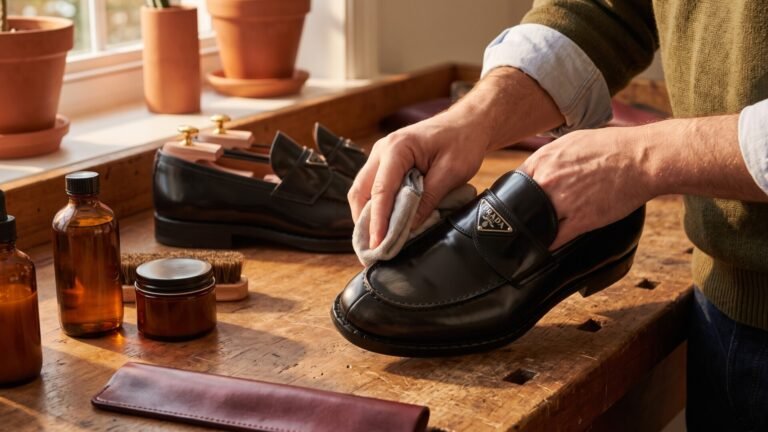
Care expectations, realistically. Rotate your loafers – never wear the same pair two days running, because leather needs a day to dry out from the inside. Use cedar shoe trees where the construction allows; they absorb moisture and hold shape. Protect suede before the first wear and reapply through the season. Treat smooth leather according to the maker’s guidance rather than a generic rule. Replace heel tips before they wear into the heel block, which is a cheap repair that prevents an expensive one. The [Internal: How to Care for Italian Leather Shoes] article is the full routine.
Which Loafer Still Makes Sense in Three Years?
Judge long-term value by how often you will wear the shoe, not by what it might resell for. A $900 loafer worn twice a week for three years is a bargain. A $1,200 loafer worn six times a year is not, however good the leather.
What tends to fail first, in order: the heel tip, the sole at the ball of the foot, the lining at the heel counter, and the leather at the vamp flex point. Moisture damage – from rain, from sweat, from being put away damp – accelerates all of it. Repairability depends on construction. A stitched sole can be resoled by a good cobbler or through the brand’s aftercare. A glued sole generally cannot, which is the single strongest argument for checking that seam before you buy.
On design relevance over three years: the restrained classics hold. The Gucci Horsebit, the Ferragamo Gancini, and a clean Santoni silhouette will look current because they have looked current for decades. The Gommino stays useful for relaxed dressing but will not stretch to formal wardrobes. Prada’s heavier silhouette will remain relevant for a modern wardrobe but is less universally adaptable. Highly seasonal embellishment is the thing to avoid if longevity is the goal.
The three-year framework, plainly:
- Frequent casual wear and travel: Tod’s Gommino
- Work-heavy wardrobe: Ferragamo Gancini
- Heritage identity and repeated smart-casual use: Gucci Horsebit
- Craftsmanship and understated dressing at the center of your wardrobe: Santoni or Brunello Cucinelli
Resale value varies by condition, size, color, model, and market demand. No loafer here is a financial instrument, and none should be bought as one.
Styling Italian Designer Loafers Without Making Them Look Dated
The loafers that date fastest are the ones worn with the outfit they were photographed in. The ones that last are worn with the clothes you actually own.
Versatile pairings that work across all six: straight-leg denim with a knit blazer; tailored trousers with a fine-gauge sweater; a midi skirt with bare ankles in summer and fine socks in winter; relaxed suiting with a long coat. None of these are trends. All of them let the shoe do its job.
Proportion is the rule that matters most. Slim loafers – the Gucci, the Ferragamo, the Santoni – work with cropped or softly tailored trousers and anything with a defined line. Chunkier loafers – the Prada, some Gommino builds – balance wide-leg trousers, long skirts, and oversized outerwear. Put a heavy loafer under a delicate cropped trouser and the outfit looks bottom-heavy. Put a slim loafer under a wide trouser and it can disappear.
Finish changes formality. Highly polished leather reads dressier than suede or brushed leather, which reads softer and more casual. Choose the finish to match the role you need the shoe to play most often.
Color guidance: black for maximum formality and office use, and the safest single pair. Dark brown or burgundy as a softer alternative that works with navy, camel, and denim. Tan or suede for relaxed wardrobes, with more attention to weather and maintenance. The [Internal: How to Style Italian Shoes for Every Occasion] article covers the wider styling picture.
Buying Verdict: Which Italian Designer Loafers Should You Buy?
Best overall for the widest range of casual wardrobes: Tod’s Gommino, if you want flexibility and can live with limited weather protection and lower formality. [Affiliate: Browse Tod’s Gommino collection]
Best for a polished heritage wardrobe: Gucci Horsebit 1953, for buyers who value a recognizable design that stays easy to style. [Affiliate: Browse Gucci Horsebit loafers]
Best for work and business casual: Ferragamo Gancini, because structured elegance gives the strongest repeat-wear potential. [Affiliate: Browse Ferragamo Gancini loafers]
Best for a contemporary statement: Prada brushed leather loafers, for buyers comfortable with a heavier, more directional silhouette. [Affiliate: Browse Prada women’s loafers]
Best for traditional Italian finishing: Santoni, for buyers willing to invest in care, rotation, and a dressier shoe wardrobe. [Affiliate: Browse Santoni women’s loafers]
Best for quiet luxury: Brunello Cucinelli, when the relaxed tailoring and neutral separates are already in place. [Affiliate: Browse Brunello Cucinelli loafers]
Skip the purchase if the loafer pinches anywhere, slips badly at the heel, cannot work with at least three outfits you already own, or is being bought because the hardware signals something. Buy the loafer that matches your real weekly wardrobe, not the one you imagine for a life you do not quite lead.
Frequently Asked Questions About Italian Designer Loafers For Women
Are Italian designer loafers worth the money?
They can be, when the fit, construction, and wardrobe compatibility support frequent wear. The price buys you better leather, better finishing, and often a repairable sole – but only if you actually wear the shoe. A well-made loafer worn twice a week for years is good value. A famous one worn four times a year is not, whatever the label says.
Which Italian designer loafers are most comfortable for women?
Soft Gommino-style loafers feel easiest immediately. Structured Ferragamo, Gucci, Prada, and Santoni loafers need break-in but offer more support and hold their shape better over time. Comfort depends far more on the last matching your foot shape and the sole matching your daily surfaces than on the brand.
Are Tod's Gommino loafers suitable for walking all day?
They are flexible and comfortable for many casual situations, but the pebble sole is not designed for long-distance city walking, wet weather, or rough terrain. For a full day on your feet, a more substantial rubber sole will serve you better.
Which Italian loafers are best for work?
Ferragamo Gancini is the safest workwear choice, with restrained Gucci and Santoni styles close behind for polished business casual wardrobes. Check your workplace dress code – hardware and shine read differently in a conservative office than a creative one.
Do Italian designer loafers run small?
Sizing varies by brand, last, material, and model, so there is no single answer. Check the brand’s own sizing guidance and consider width and instep, not just length. A loafer that is the right length but too narrow across the ball will never be comfortable.
Are Gucci Horsebit loafers still in style?
The horsebit design has genuine heritage relevance and has stayed current for decades. Style it with modern proportions – straight-leg trousers, relaxed tailoring – so the outfit does not tip into costume. The shoe is not the risk; the styling around it is.
How long should Italian leather loafers last?
With rotation, proper care, and timely repairs, quality leather loafers can last years. Heavy daily wear, wet weather exposure, and skipped maintenance shorten that considerably. The heel tip and sole are the first things to need attention, and replacing them early is what keeps the shoe alive. There is one condition attached to everything above. These recommendations assume you will rotate the pair, keep shoe trees in them, and resist wearing one loafer every day through a wet winter. If that is not realistic for you – if you want a single pair to absorb everything – then buy at the lower end of this list, accept a shorter lifespan, and put the savings toward the second pair that lets the first one rest. The shoe is only as good as the rotation it lives in. Start with the [Internal: Italian Loafers hub] to see the full category, then decide which job you actually need filled.