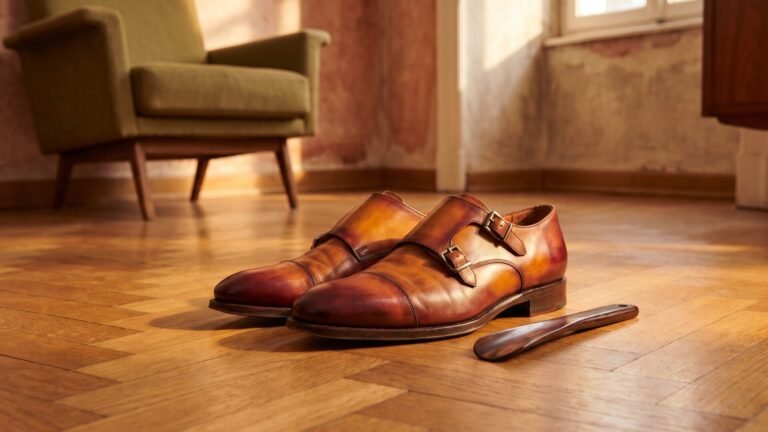
Best Italian Oxford Shoes for Men
The best Italian Oxford for a man is not the most ornate or the most expensive one. It is the one whose last, construction, sole and level of formality line up with the wardrobe and the feet he actually has. Italian makers shape the Oxford more sharply than English ones do, with a slimmer waist, a longer toe and a hand-finished leather, and that sculpting is exactly where the fit problems live. The range of quality under the Italian banner is also enormous.
This shortlist separates the investment-grade handmade pairs from the polished business options and the more accessible Italian-made shoes. One framing recommendation first: a conservative black or dark brown cap-toe is the safest first purchase. Wholecuts and patina-heavy styles are wonderful, but they ask more of your wardrobe and your maintenance habits, and they are the wrong place to begin.
What Makes an Italian Oxford Different
An Oxford has closed lacing: the quarters are stitched under the vamp, so the laces pull the two sides together and the top of the foot presents one clean line. In a Derby the quarters sit over the vamp and the lacing is open. That is why the Oxford reads as more formal, and also why it offers less adjustment across the instep.
The classic English Oxford is built on a rounded last (forma, the wooden block a shoe is shaped over) with a generous toe and a sturdy waist. The Italian tradition pushes the other way: elongated, almond-shaped lasts, a slimmer waist and a toe that tapers. Italian makers also lean harder on hand-applied patina and burnishing. A sleek last looks superb under a tapered trouser, but if your foot is wide across the ball or high on the instep, the same last will pinch. The shape is a design choice, not a quality signal.
Formality inside the Oxford family is a ladder, and it is a common point of confusion. A plain black wholecut or cap-toe sits at the top. A semi-brogue (a cap-toe with perforations along the toe cap) is a step down, and a full brogue or wingtip is the most casual Oxford, closer in formality to a Derby than to a black cap-toe. A closed-laced shoe is not automatically the formal one: the decoration matters as much as the lacing.
Construction decides what happens when the sole wears through:
- Blake stitching sews the upper through to the outsole. It is light and flexible, but resoling reuses the same line of stitching, so it can be done only a limited number of times.
- Blake Rapid adds a second stitch and a midsole for more structure and a cleaner resole path.
- Goodyear welting stitches the upper to a welt and the welt to the outsole. It is heavier and stiffer, and the most repairable.
- Cemented construction glues the sole to the upper. It is the cheapest and lightest, and effectively unrepairable once the bond fails.
If you want a shoe you will resole several times over fifteen years, look for Goodyear or Blake Rapid. A glued sole means a disposable shoe, however good the leather looks. Our piece on the art of Italian shoe making shows how these methods differ on the workshop floor.
The Best Italian Oxford Shoes for Men
Each entry says who the shoe is for, how formal it reads, what to watch on fit and where the money goes. Prices are US dollars from brand sites checked in November 2026 and move with season and retailer; where a current price could not be confirmed, none is given.
Santoni Classic Cap-Toe Oxford
Santoni, founded in Corridonia in 1975, is the strongest all-around choice for a man who wants recognizable Italian finishing without an aggressively fashion-forward shape. The house is known for hand-finished, patinated leather, according to the brand, and its classic cap-toe carries that character in a silhouette conservative enough for a boardroom. Oxfords have been listed at about $950 to $2,350 at full price on Santoni’s US site.
The tradeoff is upkeep: a high-shine, hand-finished leather shows scuffs and water marks more readily than a matte one. Buy the restrained colorway for work, since a deep brown or near-black espresso will out-earn a dramatic patina in a formal wardrobe. Santoni runs more than one last and the lines use different constructions, so confirm whether you are looking at a Blake, Blake Rapid or Goodyear model before buying. Our Santoni shoes review has the brand-level detail, and Tod’s vs. Santoni is the comparison if you are weighing the two.
Salvatore Ferragamo Oxford Shoes
Ferragamo is the practical luxury option: a house with real heritage, a formal shoe that reads correctly in almost any setting, and a more approachable entry into Italian designer footwear than the specialist shoemakers. Its Tramezza line is the best-known dress-shoe family, and the plain black and dark brown cap-toes are the ones to look at.
Ferragamo also makes more decorative dress shoes. A shoe with a prominent buckle, contrast stitching or an exaggerated toe is a styling statement, not a formal shoe, and it will date faster than the plain cap-toe beside it. Fit is style-specific because the house uses several lasts, so try the exact model rather than assuming your size carries across. Check the construction of the pair you are buying, since the brand spans several build methods. Our Ferragamo shoes guide covers the range with US price ranges, and how Italian designer shoes should fit is the fitting primer.
Giorgio Armani Formal Oxfords
Armani suits the man who wants a sleek, understated dress shoe that supports a tailored wardrobe without visible ornament. Its patent leather Oxford, a tuxedo shoe with grosgrain piping and a rubber-injected leather outsole, is listed at $1,295 on Armani’s US site and is made in Italy. That is evening tailoring rather than daily office wear.
Armani is styling-led luxury: the value is in the silhouette, the brand coherence and the finish, not necessarily in repair-oriented construction. A specialist shoemaker will often give you a more rebuildable shoe at a similar price, while Armani gives you a more resolved design. Ask whether the sole can be replaced, and by whom, before you commit.
Velasca Oxford Shoes
Velasca is the accessible Italian option. The brand describes its shoes as artisanally handcrafted in Italy, and its Oxford range offers a choice of leather or Vibram rubber soles. The Polentatt, a Goodyear-welted semi-brogue Oxford, is listed at $660 on Velasca’s US site, and the Medich in black cordovan at $1,220, so the range spans a wide gap. For a man building a first formal rotation, or wearing Oxfords to the office several days a week, that entry price is the appeal.
The value case is simple: at that price you can afford two pairs, and two rotated pairs outlast one expensive pair worn daily. Check each model’s leather, sole construction, width options and return policy, because a cheap shoe with a glued sole is still a disposable shoe.
Enzo Bonafè Oxfords
Enzo Bonafè is the craftsmanship-led choice for a reader who prioritizes handwork and repairability over logo recognition. Enzo Bonafè founded the family-run factory outside Bologna in 1963, and its shoes are hand-welted and partially hand-lasted, according to a factory visit by the menswear site Permanent Style. The same visit found the designs somewhat old-fashioned, with the focus on quality and process. The shoes are sold mainly through specialist retailers.
An expertly made shoe is still a poor purchase if the fit is wrong, and Bonafè offers a range of lasts, so match the last to your foot or buy from a retailer who can advise. Our explainer on handmade Italian shoes covers what that handwork buys you.
Stefano Branchini Oxfords
Stefano Branchini is the pick for a man drawn to dramatic patina and a visibly artisanal Italian identity. These shoes have a point of view, which makes them wrong for a conservative interview or legal wardrobe and a better second or third Oxford than a first. Patina and high-shine finishes demand careful storage, brushing and cautious conditioning, and a salt-stained patina shoe is a sad object. Our piece on whether luxury Italian shoes are worth the money is worth reading before you spend at this level.
Also Worth Knowing
Three more Italian names are worth a look. Stefano Bemer in Florence sells bespoke, made-to-order and ready-to-wear shoes. Bontoni in Sant’Elpidio a Mare is a small family maker. Scarosso, which is headquartered in Berlin and makes its shoes in Montegranaro, is an online-only option with lower prices. Below the premium tier, prioritize a clean cap-toe, full-grain leather, a replaceable sole and a reliable return policy over decoration. Ornate broguing at a low price is usually there to distract from lesser leather.
Comparison Table: Which Italian Oxford Is Right for You?
| Brand | Best for | Formality | Build note | Price (USD) |
|---|---|---|---|---|
| Santoni | Versatile Italian luxury | High | Hand-finished leather; construction varies by line | About $950-$2,350 |
| Ferragamo | Office and formal versatility | High | Several lasts; verify model construction | Varies by model |
| Armani | Minimalist tailoring, evening | High | Styling-led; verify repairability | $1,295 (patent) |
| Velasca | Accessible first Italian pair | High | Goodyear-welted on the Polentatt | $660-$1,220 |
| Enzo Bonafè | Long-term enthusiast ownership | High | Hand-welted, partially hand-lasted | Varies by retailer |
| Stefano Branchini | Statement patina | Medium-high | Demanding maintenance | Varies by model |
The picks below are based on construction, design restraint, fit potential, maintenance burden and long-term usefulness, not logo prestige. Best overall: a well-constructed Santoni or comparable classic cap-toe. Best value: a Velasca-style cap-toe, because regular wear is where value lives. Best for conservative business dress: Ferragamo, in black or dark brown. Best for collectors: Enzo Bonafè. Best for a first-time buyer: the restrained cap-toe from whichever of these houses fits your foot.
What Most Buyers Get Wrong About Italian Oxfords
Reading a hand-painted patina as proof of quality. Patina is a finish, and a finish can be applied to a mediocre upper. What decides whether a shoe lasts is the leather underneath, the lasting, the stitching, the edge finishing and the repair options. A beautifully patinated shoe on a glued sole is a decorated disposable.
Assuming the slimmest, longest Oxford is the most elegant. A shoe should complement the trouser and the foot. A very long toe on a short man reads as a costume, and a razor-thin waist on a wide foot reads as a squeeze. Elegance is proportion, and proportion is relative to the wearer.
Buying black for everything. A dark brown or espresso Oxford gets more wear in a business wardrobe than black, because it works with navy, grey and earth tones alike. Burgundy is the quiet third option that lifts a dark suit. Black is for the most formal occasions and evening.
Judging comfort from softness. A heavily padded shoe feels lovely in the shop and supports poorly over a day, while a structured leather shoe feels firm at first and molds to the foot. Fit and support are comfort, not softness.
Choosing the Right Oxford for Work, Weddings and a Capsule Wardrobe
Business and daily office wear. Choose a black or dark espresso cap-toe with restrained finishing, a moderate toe length and a sole that tolerates regular walking. A leather sole is traditional but slippery on wet pavement and quick to wear under daily commuting. A rubber or combination sole is the sensible choice for sidewalks; see our leather soles vs. rubber soles comparison. Buy a second pair in dark brown or burgundy as soon as you can, because leather needs a day between wears to dry. If your office has gone business casual, Italian designer shoes for business casual outfits covers what replaces the Oxford, and our guide to the best Italian penny loafers for men is the natural next step.
Weddings and evening tailoring. Match the shoe to the dress code. A black cap-toe covers formal daywear and black-tie-adjacent events, a wholecut in black or dark brown is the sleeker evening choice, and a subtle medallion toe adds interest without noise. Bright leather and ornate broguing compete with formal tailoring. For an outdoor ceremony on grass, a thin leather sole with no traction is the wrong choice; our guide to Italian designer wedding shoes for an outdoor ceremony goes further.
A capsule wardrobe. Three pairs cover almost everything: a black cap-toe, a dark brown Oxford and a more expressive burgundy or wholecut pair, bought in that order. If your formal wear is occasional, one good dark brown cap-toe will out-earn the rest. Our guides on how to style Italian shoes for every occasion and Italian dress shoes place the shoe in a wider wardrobe, and the best Italian dress shoes guide widens the shortlist.
Fit, Construction and Ownership Costs
Run the fitting checks in this order. Your heel should sit locked without slipping, because a loose heel rubs and a tight one blisters. Allow about a thumb’s width beyond the longest toe, with enough height in the toe box that it does not press on the tops of your toes. Check for instep pressure, then width at the ball. Finally, flex your foot: the shoe should crease across the vamp at the natural bend of the foot, not behind it or across the toe cap.
Because you cannot loosen an Oxford across the instep the way you can a Derby, sizing accuracy matters more. Try both sizes if you are between, and try them late in the day when the foot is at its largest. Our guide to Italian shoe sizes vs US and UK sizes covers the conversion, which does not map cleanly onto US or UK numbers.
Maintenance is the ownership cost nobody quotes at the till. Use cedar shoe trees after every wear to hold the shape and draw out moisture, and give the shoe thirty seconds with a horsehair brush. Condition sparingly, because over-conditioning softens leather and dulls the finish. Rotate pairs, keep them out of the rain where you can, and dry them at room temperature, never on a radiator. Use a specialist for resoling rather than a cobbler who has never seen a welted waist. Our guides to caring for Italian leather shoes and breaking in Italian leather shoes are the practical references.
Which Italian Oxford Still Makes Sense in Three Years?
Four things predict satisfaction better than any brand name: how often you will wear the shoe, whether you will maintain it, how formal your workplace actually is, and whether your size or dress code is likely to change.
The arithmetic makes the point. A $660 pair worn twice a week for three years is roughly 300 wears, or about $2.20 per wear before any resole. A $1,500 pair worn a dozen times a year is 36 wears over three years, about $42 per wear. The expensive shoe is the worse buy if it lives in a box.
Premium construction justifies its price when four conditions hold: you wear the shoe often, you have access to a competent repairer, the fit is genuinely right, and you will maintain it. Remove any one and the math weakens. So the best value is often a restrained mid-range cap-toe that gets worn regularly, not the most artisanal Oxford kept for weddings.
Buying Verdict: The Best Italian Oxford for Each Buyer
- Best overall: a well-constructed Santoni or comparable Italian cap-toe, for versatility and formal credibility.
- Best for craftsmanship: Enzo Bonafè, for the enthusiast prepared to pay for construction and repairability.
- Best for expressive style: Stefano Branchini, for a buyer who specifically wants patina rather than a uniform shoe.
- Best for value: a Velasca-style cap-toe, when regular wear and a manageable entry price matter most.
Who should skip Italian Oxfords: readers who need extra width, maximum all-day walking comfort or a casual shoe. An Oxford is a formal shoe on a sculpted last. Start with the wide-feet guide, the best Italian shoes for walking all day, Italian loafers or Italian luxury sneakers instead, and come back to the Oxford when the role fits. For the full category, browse our Italian designer shoes hub.
Frequently Asked Questions About Italian Oxford Shoes For Men
Are Italian Oxford shoes good for everyday wear?
Yes, if the pair is built for it: a restrained cap-toe on a sole that tolerates pavement, rotated with a second pair. The mistake is wearing one thin-soled, high-shine formal shoe daily and expecting it to hold up.
Is Blake stitching better than Goodyear welting?
Neither is better in the abstract. Blake is lighter and more flexible but can be resoled fewer times. Goodyear is heavier and stiffer but rebuildable repeatedly. Choose by how often you will wear the shoe and whether you plan to resole it for years.
How much should I spend on Italian Oxfords?
Spend according to wear frequency. Velasca lists Oxfords from about $660, and Santoni’s range runs from about $950 to $2,350. Above that you are paying for handwork and character, which is fine if you will wear and maintain the shoes.
Are patina Oxfords appropriate for a wedding?
At a less formal wedding a subtle patina can work well. For black-tie-adjacent or highly formal ceremonies, plain black or dark brown is safer. Let the dress code and the venue decide.
Do Italian dress shoes hold their value?
Less reliably than handbags. Classic, restrained models from recognized houses resell better than expressive patina styles, and condition matters enormously. Buy for wear, not resale, and treat any residual value as a bonus.
Are Italian Oxford shoes worth the money?
They are when the fit is right, the construction can be resoled and you wear them often. They are not worth it as a boxed collectible worn twice a year. A modest shoe that fits beats a perfectly made one on the wrong last.