Tod’s Gommino vs. City Gommino: What’s the Difference?
Most people assume the City Gommino is the Gommino, upgraded. Dressier leather, smarter name, a bit more money, therefore better. That is not how the shoes are built, and it is not how they wear. The classic Gommino is a soft, low-slung moccasin designed around flexibility – the whole point is that the upper and the pebble sole move with your foot. The City Gommino tightens that same idea up: a cleaner silhouette, more structure through the heel and waist, a shoe meant to hold its shape on pavement and under a trouser. You are not buying the same shoe twice at different prices. You are buying two different compromises, and which one is right depends almost entirely on where you will actually wear them.
The rest of this is about telling those compromises apart with the shoe in your hand.
What the Names Actually Mean
Start with the family, because the naming confuses people more than the construction does. The Gommino is Tod’s signature moccasin – a slip-on built on a rubber sole studded with small raised nubs, which the house calls the gommino, literally "little rubber" in Italian. The sole carries 133 of these rubber pebbles, and Tod’s says the shoe takes more than a hundred phases of manual assembly. According to the brand’s history page, Diego Della Valle conceived the driving loafer in the 1970s after seeing a similar shoe on a trip to the United States. The nubs are the signature. They are also the thing that shapes how the shoe feels underfoot, and we will come back to that.
Tod’s does not use these names with the precision of a technical catalogue. A Gommino in suede with a soft unlined upper and a Gommino in polished calf with a structured heel are related, not identical, and the naming can shift with the season, the leather, the sole treatment, and the market. So the useful move is not to memorize a definition. It is to read the specific product page – the leather, the lining, the sole, the heel – and compare that, because a seasonal release can materially change what you are getting.
The distinction worth holding onto is one of intent rather than category. The classic Gommino is positioned as relaxed, driving-shoe-inspired casual footwear. The City Gommino is positioned as the same DNA cleaned up for urban and business-casual wear. They are not two different shoe types. They are two answers to the same question – how much structure do you want in a soft moccasin? – and the answers diverge.
If you are still working out where the Gommino sits against a true driving shoe, that is a separate and useful question, and our guide to the best Italian driving shoes and the piece on Tod’s Gommino loafers and their bubble-sole versions cover it. This piece stays inside the family: classic against City.
Classic Gommino vs. City Gommino: The Key Differences
Silhouette and visual presence
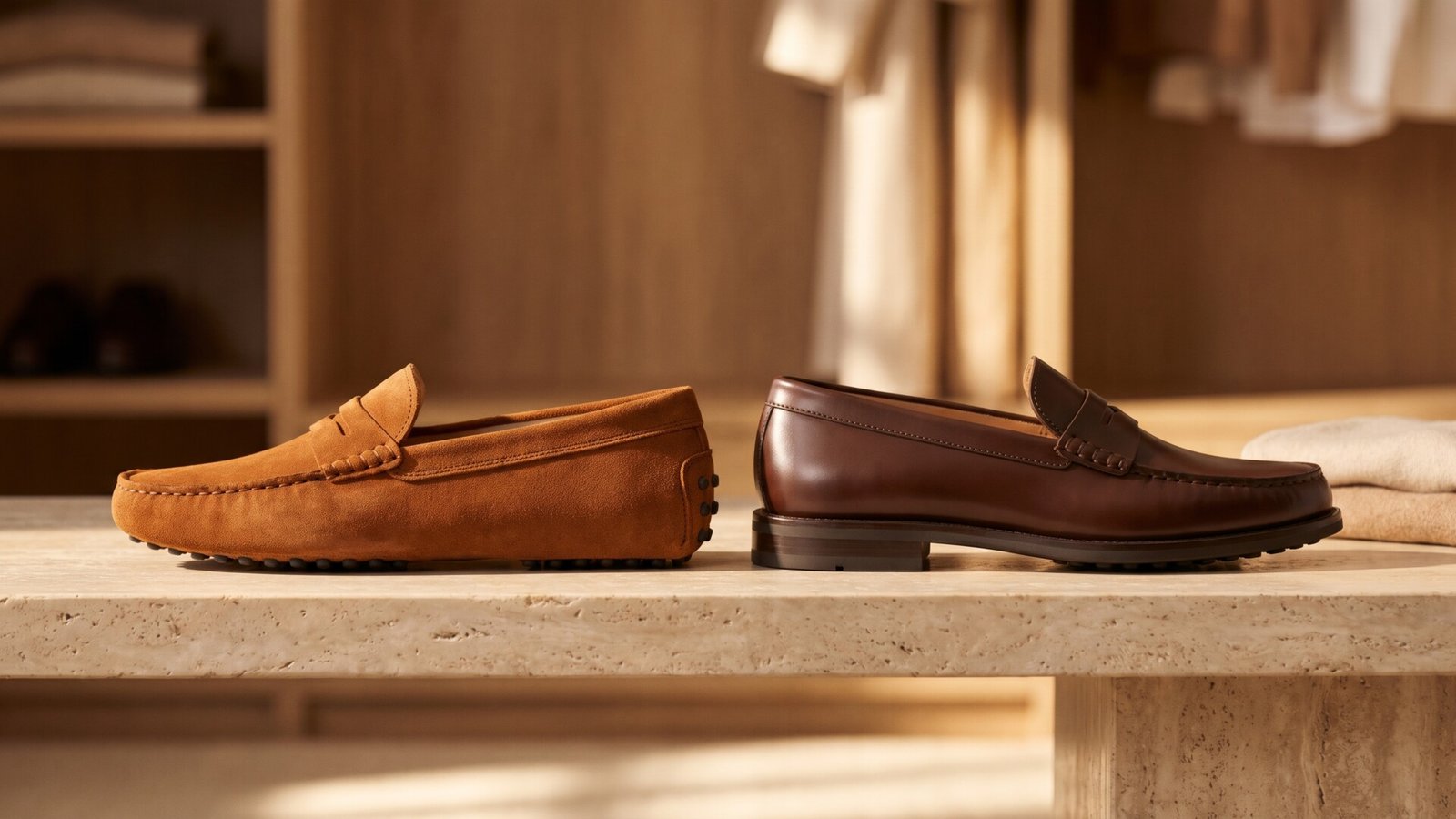
Put the two side by side and the difference reads before you touch them. The classic Gommino has a rounded, low, moccasin-like profile – the apron stitching across the toe is prominent, the vamp sits close to the foot, the whole thing looks like it wants to be worn without socks on a boat. The City Gommino typically reads cleaner: a slightly more defined waist, a tidier heel, a vamp that holds a line rather than slumping.
Why does that matter to a buyer? Because silhouette decides what the shoe can sit under. The classic looks most natural with relaxed tailoring, linen trousers, resort clothing, denim. Put it under a sharply pressed trouser and it can look like you forgot to change out of your weekend shoes. The City version crosses that line more gracefully – it can go from chinos to a soft jacket without announcing itself as casual footwear.
The variables that shift this impression across seasons are worth knowing: apron stitching (the raised seam around the toe), vamp shape, heel profile, hardware such as a bit or a metal trim, and leather finish. A polished calf City Gommino and a suede classic are further apart than the names suggest. Judge the specific pair, not the label.
Sole and underfoot feel
The rubber pebble sole is the heart of the matter, so define it properly. It is a thin rubber outsole covered in small raised nubs, and its job is grip and flexibility – it lets you feel the pedals through the sole, which is exactly why it exists on a driving shoe. It is not a cushioning system. It is not a walking-shoe midsole. It is a flexible, low-profile layer with traction molded into it.
The classic Gommino leans fully into that: thin, pliable, close to the ground. The City construction usually adds a little more substance underfoot and a firmer platform, which makes pavement less jarring and helps the shoe feel more planted in an urban setting. Tod’s describes the City Gommino as having a thick, sturdy rubber sole, but the exact sole depends on the model, so check.
Here is the thing most buyers get wrong. A pebble sole is not a walking sneaker outsole. It gives you flexibility and grip, not cushioning or arch support. You can wear a Gommino for errands and short outings comfortably. Wear it for a full day of sightseeing on hard pavement and the lack of underfoot cushioning will find you by mid-afternoon. Neither version escapes that, though the City version manages it a little better.
Structure and support
This is where the two shoes genuinely part company, and where the hidden trade-off lives. The City Gommino generally gives you more structure: a firmer heel counter (the stiffened panel at the back that holds your heel in place), a more defined waist, an upper that resists collapsing. That structure is what keeps the shoe looking sharp after a season and what makes it feel secure when you are walking on a city street rather than stepping out of a car.
The classic Gommino trades that away for softness. It feels slipper-like, which is the appeal, and which is also the risk. A very soft upper with a soft heel hold can start to move on your foot after the leather relaxes, and a slip-on that shifts at the heel is uncomfortable in a way that is hard to fix.
Fit is the warning here. The same nominal size can feel different depending on the leather and the last (the shaped form the shoe is built around). If you have a high instep, a wide forefoot, or a narrow heel, try the specific pair – the slip-on design gives you no laces to adjust, so the fit is the fit. A structured City Gommino may hold a narrow heel better; a soft classic may accommodate a high instep more forgivingly. Neither is universally kinder.
Formality and wardrobe range
Be precise about what these shoes are, because the marketing blurs it. The classic Gommino is refined casual footwear. It is not a dress loafer, and it will look wrong with a suit. The City Gommino is polished casual to business casual – it can carry an unstructured jacket and tailored trousers, and it looks at home in a relaxed office. It is still not a formal loafer.
That distinction matters because a lot of buyers arrive hoping the City Gommino will replace a proper penny loafer or a leather-soled dress shoe. It will not. When you need a sharper silhouette – a real dress shoe, a formal Italian loafer – neither Gommino is the answer, and you should be looking at our guides to the best Italian penny loafers for men and the best Italian designer loafers for women instead. The Gommino is the shoe you reach for when the dress code is "smart but human."
A Short History of the Gommino
Tod’s traces its roots to a cobbler’s workshop opened in the Marche region by Filippo Della Valle in the early 1900s, which his son Dorino later turned into a small company in Sant’Elpidio a Mare. Dorino’s son Diego joined the family business in 1975 and went on to lead the brand with his brother Andrea. The brand was registered as J.P. Tod’s in 1984 and took the name Tod’s in 1997, and it remains led by the Della Valle family.
The Gommino followed from Diego Della Valle’s idea of a driving loafer, and Tod’s describes the shoe as made with the sole and sides cut from a single piece of leather in a tubular construction. Wallpaper reports the shoes are made by hand in Tod’s Italian factories in Casette d’Ete, in the Marche. The design later influenced other Tod’s products: the D Bag, introduced in 1997, echoes the Gommino’s pebble detail. For the wider house, see our complete guide to Tod’s.
Comparison Table: Tod’s Gommino vs. City Gommino
| Feature | Classic Tod’s Gommino | Tod’s City Gommino |
|---|---|---|
| Overall character | Soft, relaxed, driving-shoe inspired | Cleaner, more structured, city-oriented |
| Best use | Casual weekends, travel, resort dressing | Business casual, urban wear, polished everyday outfits |
| Comfort profile | Flexible and slipper-like | More supportive but potentially less soft |
| Walking suitability | Good for light-to-moderate wear; limited as an all-day walking shoe | Better suited to city use, depending on sole and fit |
| Formality | Casual luxury | Smart casual to business casual |
| Main strength | Easy comfort and iconic Tod’s identity | Greater wardrobe versatility and visual structure |
| Main drawback | Can look too relaxed and wear less evenly under heavy walking | May lose some of the classic Gommino’s softness and simplicity |
Read that table as typical positioning, not gospel. Seasonal variations in leather, sole, and lining can move any row. Before you buy, confirm the current material, the sole type, the lining, and the return policy on the specific pair – because those four things decide your actual ownership experience more than the model name does.
Craftsmanship, Materials, and Long-Term Ownership
Now the part that separates a considered purchase from an expensive one. What you are paying for in either Gommino is leather quality, hand-finishing, moccasin construction, and the Tod’s name – not a replaceable-sole construction. That last point deserves emphasis, because it is where expectations go wrong.
A traditional welted dress shoe (Goodyear welted, meaning the upper is stitched to a welt that is in turn stitched to the sole) can be resoled repeatedly by a cobbler. The Gommino is not built that way. It is a flexible moccasin with a rubber pebble sole bonded and finished to the upper, and when that sole wears through, it is not the routine cobbler resole a welted shoe allows. Ask Tod’s or a specialist whether sole replacement is possible for your pair before you count on it. This is not a flaw – it is the construction that makes the shoe feel the way it does. But you should buy it knowing it.
Run your thumb along the inside edge of the opening. If it catches, the edge was finished in a hurry. On a well-made pair the edge is clean and burnished, the stitching around the apron is even and tight, and the lining is stitched rather than glued down. Those details are what you are paying the premium for, and they are visible if you look.
The pebble sole is both signature and maintenance issue. Those individual nubs give you flexibility and the distinctive look, but under frequent pavement use they wear unevenly – the outer edge of the heel and the ball of the foot go first. The upper can still look beautiful while the sole has quietly lost grip and shape. That is the split you have to watch: upper longevity and sole longevity are two different clocks.
Aging patterns differ too. The classic’s softer upper develops attractive creasing but can lose shape faster if you wear it day after day without rest. A more structured City Gommino holds its outline better but may show pressure points and finish wear more visibly where it creases. Practical habits help both: use a shoe tree where the shape allows, let the leather rest a day between wears, keep them out of rain, and follow Tod’s care guidance for the specific material – suede, smooth calf, and specialty finishes each want different treatment.
What most buyers misunderstand about durability
An expensive moccasin is not automatically a high-mileage shoe. Durability here depends on how closely you respect the shoe’s intended use. Wear a Gommino as a walking shoe and it will wear like one – fast, and in the wrong places. Wear it as the refined casual slip-on it is, rotate it, and it will last years.
The mistake is assuming the price buys you construction that shrugs off abuse. It does not. It buys design, hand-finishing, comfort, and identity. If you want a shoe built to be resoled and beaten up for a decade, that is a different purchase entirely.
Which Version Works Better in Real Life?
For driving and short casual trips
If pedal sensitivity and a soft, flexible slip-on feel are the point, the classic Gommino is the more honest choice. It is lower, softer, and closer to the driving-shoe idea the whole family descends from. The City Gommino can still work behind the wheel, but if driving is your primary use, paying for extra structure you do not need is money spent on the wrong thing. For the broader field, see our best Italian driving shoes: luxury brands, models and buying advice.
For city walking and travel
The City Gommino is the stronger travel shoe – provided the fit is secure. It handles polished travel outfits and short urban walks with more composure, and it looks right stepping into a restaurant after a day of moving around. But be clear-eyed: neither version is the obvious choice for airport days, sightseeing, or extended pavement walking. If all-day walking is the priority, a supportive luxury sneaker beats both, and our guide to the best Italian luxury sneakers for everyday walking is where to look.
For work and business casual
For an office with a relaxed dress code, the City Gommino earns its place – with tailored trousers, chinos, knit polos, unstructured jackets. The classic Gommino can look too informal against conservative suiting or sharply pressed trousers, and no amount of good leather fixes a shoe that reads wrong for the room. When the business-casual wardrobe is the goal, our best Italian designer flats for work and the Tod’s vs. Santoni comparison will map the wider options.
For women and men building a small luxury shoe wardrobe
Here is a truth that cuts across the model debate: color and material usually matter more than the name on the box. A restrained leather shade – black, dark brown, navy, medium tan – in whichever version suits your wardrobe will out-earn a statement color in the "better" model every time. Before you buy, ask whether the Gommino adds something distinct or duplicates a loafer, ballet flat, sneaker, or driving shoe you already own. If it duplicates, spend the money elsewhere.
What Most Buyers Get Wrong About the Gommino Decision
A few recurring errors are worth naming plainly, because each one costs real money.
Treating the City Gommino as a formal loafer. It is more polished than the classic, not formal. It will not stand in for a dress shoe, and buying it hoping it will is a common and expensive disappointment.
Buying the softest fit possible. Softness feels wonderful in the shop. But leather relaxes, and a slip-on that was already loose becomes a shoe that moves at the heel – comfortable for five minutes, irritating for a day. Buy the fit that is secure now, not the one that is softest now.
Judging comfort while standing in a store. Standing still tells you almost nothing. What matters is heel security, forefoot pressure, and how the shoe behaves after several hours. Walk the length of the shop, go up and down stairs if you can, and pay attention to whether your heel lifts.
Choosing the most recognizable color over the most useful one. The iconic shade is not always the one you will wear. Cost per wear rewards the color that goes with what you actually own.
Assuming the pebble sole suits every walking situation. Flexible traction is not cushioning or support. The nubs grip; they do not absorb. Confusing the two is why people end up with sore feet and blame the shoe.
What Each Version Costs
Prices vary by leather, season and market, so treat these as ranges in US dollars as of November 2026. A classic leather Gommino has been listed at a regular price of about $595 at a US retailer, and current prices commonly fall in roughly the $550 to $650 range for smooth leather. The City Gommino sits a little higher, at roughly $650 to $750 at US retailers; Mr Porter, for example, listed a black smooth-leather City Gommino at $695. Suede, exotic leathers and special editions can cost more. These figures come from single retailer listings rather than a full market survey, so confirm the current price and size availability on the product page, and note that discounted pairs often have limited sizes.
Value, Cost Per Wear, and Which One Makes More Sense in Three Years
Frame both as wardrobe investments, not financial ones. Neither shoe is bought to appreciate, and you should ignore anyone who suggests otherwise.
Cost per wear is the honest measure, and it favors the shoe you actually reach for. A pair worn twice a week for years beats a more expensive pair that sits in the closet because it never quite fits your life. So the question is not which shoe costs less at retail – it is which one your wardrobe and habits will keep in rotation.
The classic Gommino tends to win on value for a specific buyer: someone whose wardrobe is genuinely casual, who drives often, who wants the most recognizable expression of the Tod’s driving-shoe idea and will wear it for relaxed weekends, light driving, and short outings. For that person, the classic is the shoe, and the City version is paying for structure they do not need.
The City Gommino tends to win for a different buyer: someone who needs one refined casual shoe to cover office, travel, dinners, and weekends – who wants a single pair to do more. For them, the extra structure and cleaner silhouette earn their keep across more outfits, and the cost per wear falls accordingly.
Resale deserves a careful word. A recognizable Tod’s design in a neutral color, in excellent condition with original packaging and minimal sole wear, can hold some demand. But used footwear resale is sensitive to hygiene, fit, and visible wear, and the pebble sole shows its mileage. Do not buy either shoe as an asset. Buy it to wear.
Buying Verdict: Which Gommino Should You Choose?
Choose the classic Gommino if your wardrobe is casual, you prioritize flexibility, you want the most recognizable driving-shoe expression, and you will use it for light driving, relaxed travel, and short outings.
Choose the City Gommino if you want a cleaner profile, need more visual structure, dress business casual, and expect the shoe to move between urban and weekend settings.
Skip both if you need all-day walking support, a formal office shoe, a replaceable-sole construction, or a shoe for wet and harsh conditions. None of those is what a Gommino is for.
For most buyers seeking a single versatile pair, the City Gommino is the better purchase – it covers more of real life. For buyers who specifically want the relaxed Tod’s driving-shoe experience, the classic is the more distinctive and honest choice. Either way, compare the current leather, sole, lining, color, and return terms before you commit, because seasonal versions change the ownership experience more than the model name suggests.
When you are ready to look at current pairs, start with the collections rather than a single listing: [Affiliate: Browse the Tod’s Gommino collection] and [Affiliate: Browse the Tod’s City Gommino collection].
The One Thing to Remember
If you take a single line into the shop, make it this: the Gommino you should buy is the one that matches where you actually walk, not the one with the more sophisticated name. The classic is softer and more distinctive; the City is cleaner and more versatile. Everything else – the leather, the color, the sole – is detail you can judge with your hands once you know which compromise you are choosing. From there, the complete guide to Tod’s and the Tod’s shoes guide will fill in the wider picture. If you are still deciding whether a Gommino belongs in your wardrobe at all, compare it against the alternatives in Zegna vs. Tod’s, and browse the wider Italian designer brands guide for other houses.
Frequently Asked Questions About Tod's Gommino Vs. City Gommino
Is the City Gommino more comfortable than the classic Gommino?
Comfort depends on your foot shape and how you will use the shoe. The classic usually feels softer and more flexible; the City may feel more secure and supportive for urban wear. Neither is universally more comfortable – a soft shoe that slips at the heel is less comfortable than a structured one that fits.
Is the Tod's City Gommino a formal loafer?
No. It is best described as polished casual or business casual. It should not be treated as a substitute for a traditional dress loafer or a formal Italian shoe.
Can you walk all day in Tod's Gommino shoes?
They handle light-to-moderate walking for many wearers, but the flexible pebble sole does not provide the cushioning and support you would expect from an all-day walking shoe. For long days on hard pavement, a supportive sneaker is the better tool.
Do Tod's Gommino shoes run true to size?
Fit varies with the specific last and material. Leather stretch, heel width, instep height, and the slip-on design can make the same nominal size feel different across versions. Try the specific pair, and if you cannot, buy from a retailer with a clear return policy.
Which Tod's Gommino is better for driving?
The classic Gommino, when driving performance and a soft, flexible feel are the priority. The City Gommino can suit buyers who want one shoe for both driving and city dressing, but it is a compromise behind the wheel.
Are Tod's Gommino shoes worth the price?
For buyers who value Tod’s design, Italian hand-finishing, flexibility, and frequent wear, yes. They are poor value for buyers expecting athletic support, formal welted construction, or heavy-duty walking durability.
How much do Tod's Gommino and City Gommino cost?
As of November 2026, a classic leather Gommino generally falls around $550 to $650 at US retailers and the City Gommino around $650 to $750. For example, Mr Porter listed a black leather City Gommino at $695. Prices vary by leather, season and retailer, so check the current listing.
What is the sole difference between the Gommino and the City Gommino?
Both use Tod’s rubber pebble sole, which carries 133 pebbles on the classic Gommino. Tod’s describes the City Gommino as having a thick, sturdy rubber sole, giving more structure underfoot than the thin, flexible classic.
How long do Tod's Gommino shoes last?
There is no fixed lifespan. Rotation, surface type, care, fit, and whether you drive or walk in them matter more than price. The rubber pebble sole usually shows wear before the upper becomes unusable.