Valentino Rockstud vs Jimmy Choo sizing and comfort review
Choosing between a Valentino Rockstud and a Jimmy Choo pump is mostly a question of fit and use, not just looks. The Rockstud is a studded, fashion-led pump from a Roman house; the Jimmy Choo Romy and Anouk are sleek pointed-toe pumps from a London brand that manufactures in Italy. This guide compares heel heights, toe shapes, materials, sizing guidance, comfort expectations and price, so you can decide which shoe suits the way you actually plan to wear it.
How this comparison was put together: it draws on the brands’ own product pages, retailer listings and published shoe guides, not hands-on testing or a personal shoe collection. Sizing and comfort vary from foot to foot, so treat the guidance below as a framework and use each brand’s size chart and return policy. Prices are US dollar ranges as of November 2026.
Quick Comparison
| Feature | Valentino Garavani Rockstud | Jimmy Choo Romy 85 | Jimmy Choo Anouk |
|---|---|---|---|
| Brand origin | Rome, Italy | London, UK (made in Italy per product page) | London, UK |
| Heel height | 100 mm and 65 mm pumps; 7 mm flats | 85 mm stiletto | Retailers list a 120 mm version |
| Toe shape | Pointed with a rounded profile | Pointed, described by the brand as a slightly softer point | Pointed |
| Typical materials | Calfskin, patent, nappa and other finishes | Suede, kid and nappa leather; leather lining and sole | Patent calfskin and leather |
| Signature feature | Pyramid studs | Clean, unadorned line | Taller, narrower profile |
| Approx. US price | From roughly $1,000 | $850 for the navy suede pair | Not verified |
| Best for | Statement looks and evenings | Day-to-evening wear | Formal evenings |
The Two Houses
Valentino is a Roman fashion house, and Valentino Garavani is the accessories label under which the Rockstud is sold. The Rockstud debuted around 2010 to 2011 under the house’s then co-creative directors Maria Grazia Chiuri and Pierpaolo Piccioli, and has since been produced in different heel heights, materials and colours. The Rockstud’s metal pyramid studs outlining the shoe made it one of the better-known designer pumps of the decade, and the house has continued to build on it, including under current creative director Alessandro Michele; see our article on Alessandro Michele at Valentino for the wider direction of the house. The shoe’s own story is covered in the history of the Valentino Rockstud, and the house overview sits in our complete guide to Valentino.
Jimmy Choo was founded in London in 1996 by shoemaker Jimmy Choo and former Vogue accessories editor Tamara Mellon. Ownership has changed several times since then: Labelux acquired it in 2011, Michael Kors Holdings (now Capri Holdings) completed a purchase in November 2017, and Capri was the owner at the time of the latest information we checked, so confirm current ownership if that matters to you. This is a point worth noting for a site focused on Italian design: Jimmy Choo is a British brand, although the Romy 85 product page states it is made in Italy. For a wider look at the differences between national fashion traditions, see our Italian vs. French luxury shoe brands comparison.
Design and Fit Profile
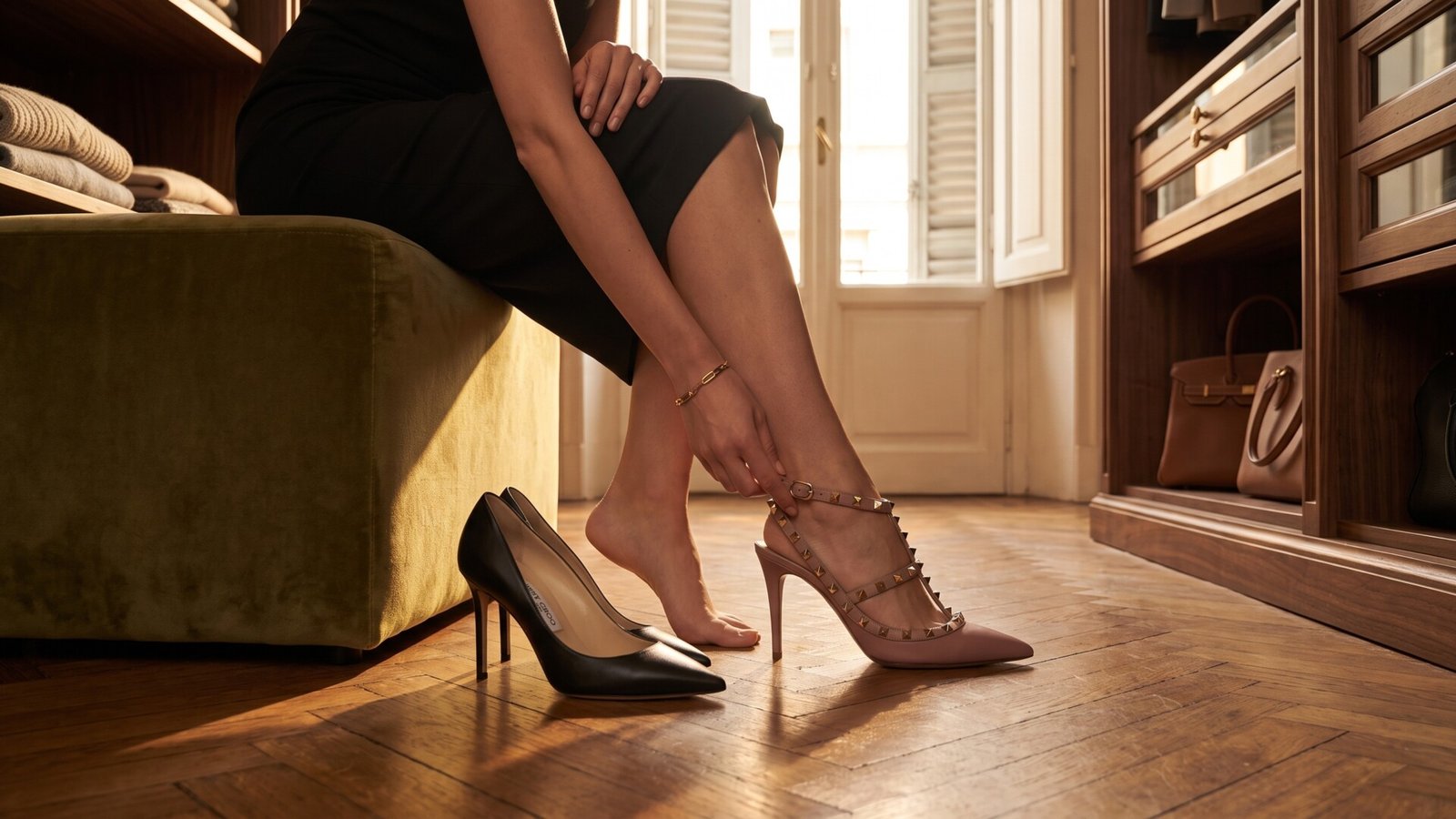
The Rockstud’s character comes from the studs, which sit on the strap and edge of the shoe and add an edgier note to a classic pump shape. The Romy is deliberately plain: a pointed-toe stiletto with no embellishment, intended to lengthen the leg. Jimmy Choo describes the current Romy 85 as a classic pointy-toe pump with a slightly softer point and a new stiletto heel. The Anouk is a taller pointed pump, which retailers list in a 120 mm height.
The design choices affect fit in practical ways. A narrower, more pointed toe leaves less room for the forefoot than a rounded one. A higher heel moves more body weight onto the ball of the foot. And a strap with metal studs, as on the Rockstud, adds fixed points that do not stretch, so they matter more where the strap meets your ankle or the top of the foot. You are choosing a fit profile as much as a look.
Sizing Guidance
Brand sizing differs, and neither house publishes a universal conversion that works for every style, so the safest approach is to use each brand’s own size chart and buy from a retailer with a clear return policy. Published shoe guides give a useful starting point for the Rockstud: Purseblog’s Rockstud guide says narrow feet generally run true to size, while wider feet are advised to order a half size up. That advice reflects a shoe with a firm structure and fixed studs, which cannot stretch the way plain leather can.
For the Jimmy Choo pumps we could not confirm an official sizing recommendation, so we have not given one. In general, pointed-toe pumps leave less toe room than almond or rounded-toe styles, so people with wider forefeet often need more length or a different shape. Compare your foot length in centimetres against the brand’s size chart, leave a small allowance at the toe, and read recent customer reviews for the exact style you are buying.
A Practical Fit Checklist
- Measure both feet in the evening, when they are largest, and use the larger foot.
- Compare the length in centimetres with the brand’s own chart rather than assuming a conversion from another brand.
- Check the toe shape: a pointed toe needs more length than a rounded one for the same toe room.
- If you have a high instep or a wide forefoot, look for reviews from people with similar feet.
- Check heel grip: a narrow heel can slip in a strap-based pump, which is where studs or edges can rub.
- Try the shoes on carpet at home and keep the soles clean until you are sure you are keeping them.
For a wider view of how designer shoes should fit, see our guide on how Italian designer shoes should fit.
Comfort Expectations
Heel Height and Pitch
Heel height is the single biggest comfort factor. The classic Rockstud pump comes in 100 mm (about 4 inches) and 65 mm (about 2.5 inches), with 7 mm flats in the line. The Romy 85 is 85 mm (about 3.3 inches). Fifteen millimetres is a noticeable difference in a stiletto because it changes how steeply the foot is pitched and how much weight sits on the ball. If you plan to stand or walk for long periods, a lower heel such as the 65 mm Rockstud or the Romy 85 will be easier than a 100 mm or 120 mm pump.
Materials and Construction
The Romy 85 product page lists a leather lining and a leather sole, with a suede or kid upper depending on colour. A leather sole is smooth and flexible but offers little shock absorption or grip on slick floors, which is typical for dress pumps. Rockstud pumps are made in calfskin, patent, nappa and other finishes according to published guides. We could not verify the footbed padding, last construction or sole details for any of these styles, so we have not described them.
What Reviewers Say
Shoe reviewers tend to agree that comfort depends on heel height and fit more than the label. In Purseblog’s Rockstud guide, one commenter reported the heels were very comfortable for six to eight hours, while the flats were uncomfortable and took a year to break in. That kind of range is common: a shoe that suits one foot shape may not suit another. If you plan to wear the shoes for a long event, choose the lower heel, test them indoors and bring a backup plan.
Styling
The Rockstud works as the focal point of an outfit. Tailored black trousers, a slip dress, or cropped jeans with a blazer let the studs add edge without competing with embellished clothing. It suits evening events and dressier occasions, and it can lift a simple work outfit.
The Romy is the more neutral choice. Its clean line goes with suits, midi dresses and tailored trousers, and it does not fight with patterns. The taller Anouk reads as more formal and is best kept for evening wear, such as floor-length dresses or sleek jumpsuits. For a broader set of options, our guide to Italian designer heels and the list of best Italian designer heels for comfortable all-day wear are good next reads.
Which Occasion Suits Which Shoe
Weddings and long events: choose the lower heel in either brand, the 65 mm Rockstud or the Romy 85, and avoid the 120 mm Anouk if you will stand for hours.
Office to dinner: the Rockstud 65 mm or the Romy 85 both work. The studs make the Rockstud read as more fashion-led, and the Romy is the more classic.
Formal evenings with mostly seated time: the Rockstud 100 mm or the Anouk are the most dramatic choices.
Travel: studs can catch on fabric and scratch other items in a suitcase, so pack Rockstud pumps in their dust bags or a separate shoe bag. Pointed toes also take more space, so plan for it.
Price and Value
As of November 2026, Jimmy Choo’s US site listed a navy suede Romy 85 at $850, and other Jimmy Choo pumps on the same page ranged from about $850 to above $1,000 depending on material and design. Valentino Garavani Rockstud pumps start at roughly $1,000 for the 100 mm ankle-strap pump according to Purseblog’s guide, with prices rising for special materials and finishes. Because we could not retrieve Valentino’s own price list and the guide may not be current, treat the Rockstud range as approximate and check the product page. Discounted pairs occasionally appear at multi-brand retailers, with limited sizes.
Cost Per Wear
Cost per wear is a more useful measure than the sticker price. As an illustration, a $1,000 pair worn twenty times a year for five years is 100 wears, or $10 each. An $850 pair worn once a week for three years is about 156 wears, or roughly $5.50 each. The cheaper-per-wear shoe is the one that fits your life, which is usually the more comfortable one. Resale values for both brands vary with condition, size and demand, and we could not verify percentages, so we have not quoted any. For a wider look at value in this category, see our guide on whether luxury Italian shoes are worth the money.
Care and Longevity
Both pumps have leather soles, which wear faster outdoors than rubber. A cobbler can add a thin rubber sole protector to a new pair before first wear to add grip and slow wear, which is a common recommendation for leather-soled dress shoes. Replace worn heel tips promptly, since a heel worn down to the metal can damage the heel itself. Store the shoes in dust bags with shoe trees or tissue in the toe, and clean smooth leather with a soft cloth. Suede, as on some Romy colours, is more vulnerable to water and marks. Our guide to how to care for Italian leather shoes covers the main principles, and the suede guidance in our waterproofing Italian suede article applies to suede pairs.
Studs are a separate consideration. Metal studs may chip or snag over time, and they can mark other leather goods if stored against them. If a stud loosens, take the shoe to the brand or a specialist cobbler rather than gluing it yourself.
Choosing by Foot Type and Lifestyle
Foot shape is as important as brand. The notes below are general principles for pumps rather than brand-specific claims, so use them to narrow your shortlist and then confirm with the size chart and a return policy.
- Wide forefoot or bunions: a pointed toe puts pressure on the sides of the foot. A lower heel reduces how far the foot slides forward, which helps, and ordering a half size up is the common advice for the Rockstud. Look at roomier shapes in our comfortable all-day heels guide if both shoes pinch.
- Narrow heel: strap-based pumps like the Rockstud can slip. Heel grips or a cushioned insert reduce movement, and a closed-back pump such as the Romy usually holds the heel better.
- High instep: the ankle strap on a Rockstud has little give, so check strap adjustability and try it on rather than ordering blind.
- Flat or low arches: a steep 100 mm heel puts more load on the ball of the foot. A 65 mm or 85 mm heel is more forgiving.
- Active evenings: if you expect to dance or walk between venues, pick the lowest heel in the range and carry foldable flats.
Buying Safely: Authenticity, Returns and Timing
Both brands are widely counterfeited, and no checklist can prove a pair is genuine on its own. The safest routes are the brands’ own boutiques and websites, authorised department stores and established multi-brand retailers. If you buy pre-owned, choose a reseller that authenticates items and offers a return window, and ask for photographs of the insole, the studs and the sole. A large discount on a current style from an unknown seller is a warning sign.
Before you pay, check the return window, whether returns are free, and whether worn soles void a return. Try pumps on a carpeted surface at home and keep the soles unmarked. Sale pairs are often final sale or limited in sizes, so factor that in if you are unsure of your size. When two sizes are possible, ordering both from a retailer that accepts returns and sending one back is often safer than guessing.
Common Problems and How to Avoid Them
The most common complaint with strap-based pumps is heel slip, where the foot moves in the shoe and the strap or studs rub the back of the ankle. Heel grips or cushioned inserts can help, though they take up room. The most common complaint with narrow pointed pumps is toe pressure, which is usually a sign the length or width is wrong for your foot and cannot always be fixed by stretching. If a pair pinches within the first few minutes at home, return it rather than hoping it will break in.
Buying Verdict
Choose the Valentino Rockstud if you want a recognisable statement shoe for dressier occasions and you are comfortable with the cost and a firmer fit. Consider the 65 mm version if comfort matters.
Choose the Jimmy Choo Romy 85 if you want a classic, understated pump that works with more outfits and a lower heel than most evening pumps.
Choose the Anouk if you want a taller, more formal pointed pump and expect to be seated for much of the event.
Check each brand’s size chart, buy from a retailer with a clear return policy, and try the shoes indoors before committing. [Affiliate: Shop the Valentino Rockstud Collection] and [Affiliate: Shop the Jimmy Choo Romy Collection]. If you are looking for the Anouk, [Affiliate: check the latest prices here].
For a second, similar comparison, see our earlier article Valentino Rockstud heels vs Jimmy Choo: sizing, comfort and value. If you are still deciding between Italian houses, our Italian stiletto brands worth knowing and Italian designer brands guides cover the wider field, and our look at the Valentino V-Logo tote shows another side of the house.
Frequently Asked Questions About Valentino Rockstud Vs Jimmy Choo Sizing
Should I size up or down for Valentino Rockstud shoes?
Published shoe guides say narrow feet generally run true to size and wider feet are advised to order a half size up. The structure and fixed studs leave little room to stretch, so check Valentino’s size chart and choose a retailer with a return policy.
Do Jimmy Choo shoes run true to size?
We could not confirm an official recommendation. Pointed-toe pumps leave less toe room than rounded styles, so compare your foot length with Jimmy Choo’s size chart, read recent reviews for the exact style and buy from a retailer that accepts returns.
Which is more comfortable, the Rockstud or the Romy?
Heel height and fit matter more than brand. The Romy 85 has an 85 mm heel, while the classic Rockstud pump is 100 mm and a 65 mm Rockstud is also available. A lower heel is generally easier to wear for long periods.
What are Valentino Rockstud shoes made of?
Published guides list patent leather, calfskin, nappa and other finishes, with metal pyramid studs. Check the product page for the exact materials of the style you are buying.
Is Jimmy Choo an Italian brand?
No. Jimmy Choo was founded in London in 1996. The Romy 85 product page states the shoe is made in Italy, but the brand is British.
How much do Valentino Rockstud and Jimmy Choo Romy pumps cost?
As of November 2026, a navy suede Jimmy Choo Romy 85 was $850 on Jimmy Choo’s US site. Rockstud pumps start at roughly $1,000, though prices vary by material and retailer, so check the current listing.
How do I care for leather-soled pumps?
Consider adding a thin rubber sole protector before first wear, replace worn heel tips promptly, store the shoes in dust bags with tissue or shoe trees, and use a specialist for studs or suede that need repair.
Can I return luxury shoes if the sizing is wrong?
It depends on the retailer. Check the return window and conditions before you buy, and keep the soles clean and the packaging until you are sure of the fit.