Brunello Cucinelli Solomeo: The 2026 Guide to ‘Humanistic’ Luxury Investment
Brunello Cucinelli sweaters cost well over a thousand dollars, carry almost no visible logo, and come from a restored medieval village in Umbria. That mix is why searches for Brunello Cucinelli Solomeo usually hide a money question: is the premium paying for something real, or just for a story? This guide separates the two, using the company’s published figures, retailer listings and independent reporting, and labelling the house’s own claims as the house’s own claims.
It is a companion to our full Brunello Cucinelli brand guide, and it focuses on one question: does the “humanistic” model translate into a purchase that makes financial sense? The answer comes down to arithmetic about how often you will wear a piece, and we show that arithmetic below. Everything here is based on research rather than wear-testing, and prices are dated because they move.
Brunello Cucinelli and Solomeo at a Glance
| Fact | Detail (as of November 2026) |
|---|---|
| Founded | 1978, by Brunello Cucinelli (born 1953 in Castel Rigone, Umbria), starting with colored cashmere sweaters |
| Home base | Solomeo, a hilltop hamlet in Umbria; the company moved there in 1982 and the founder bought the castle in 1985 |
| Stock market | Listed on Borsa Italiana (Milan) since 2012; the founder’s family holds roughly half the shares |
| 2025 revenue | About 1.41 billion euros (roughly $1.6 billion), up 11.5% at constant exchange rates, per the January 2026 results |
| Biggest region | The Americas, about 520 million euros, or roughly 37% of sales |
| Signature categories | Cashmere knitwear, soft tailoring, casualwear, shoes, bags |
The Solomeo Story: A Brand Built Around One Village
Cucinelli began in the late 1970s with a small workshop dyeing cashmere in colors that were unusual for knitwear at the time, and formally founded his company in 1978. In 1982 the business moved to Solomeo, then a small and partly dilapidated village. Three years later, in 1985, he bought the village’s castle and began a restoration that continued for decades.
Over time the project grew well beyond a headquarters. Solomeo now has a library, a theatre of roughly 240 seats and a school of crafts that teaches trades such as tailoring and masonry. The house describes the village as the spiritual home of the brand. It is also the registered base of a listed company that reported 1.41 billion euros of sales last year, and both descriptions are true at once. For a buyer, the useful point is that Solomeo is part of the product: the story told in the boutique is a story about this place.
What “Humanistic Capitalism” Means in Practice
Humanistic capitalism is Cucinelli’s own term for running a business so that profit does not come at the expense of the dignity of the people who produce it. Reporting that has covered the company, including Monocle and The Local, describes several concrete features:
- Above-market pay – staff in Solomeo are reported to earn roughly 20 percent more than industry norms. This is the company’s own figure as relayed by outside reporting, not an audited number.
- Protected working hours – a working day that ends at 5:30 pm, with a 90-minute lunch break.
- Craft training – the school in Solomeo exists to pass manual skills to a new generation of workers.
- Cultural investment – restored buildings, a library and a theatre that serve the local community.
These points are a real reason many buyers feel comfortable with the company. They are not a guarantee about any single garment. A sweater’s quality depends on its yarn, gauge and finishing, and its price reflects brand positioning and boutique rent as well as wages and materials. A sensible way to treat the philosophy is as a reason to be at ease with the purchase, not as proof that a particular price is fair.
How the Clothes Are Actually Made
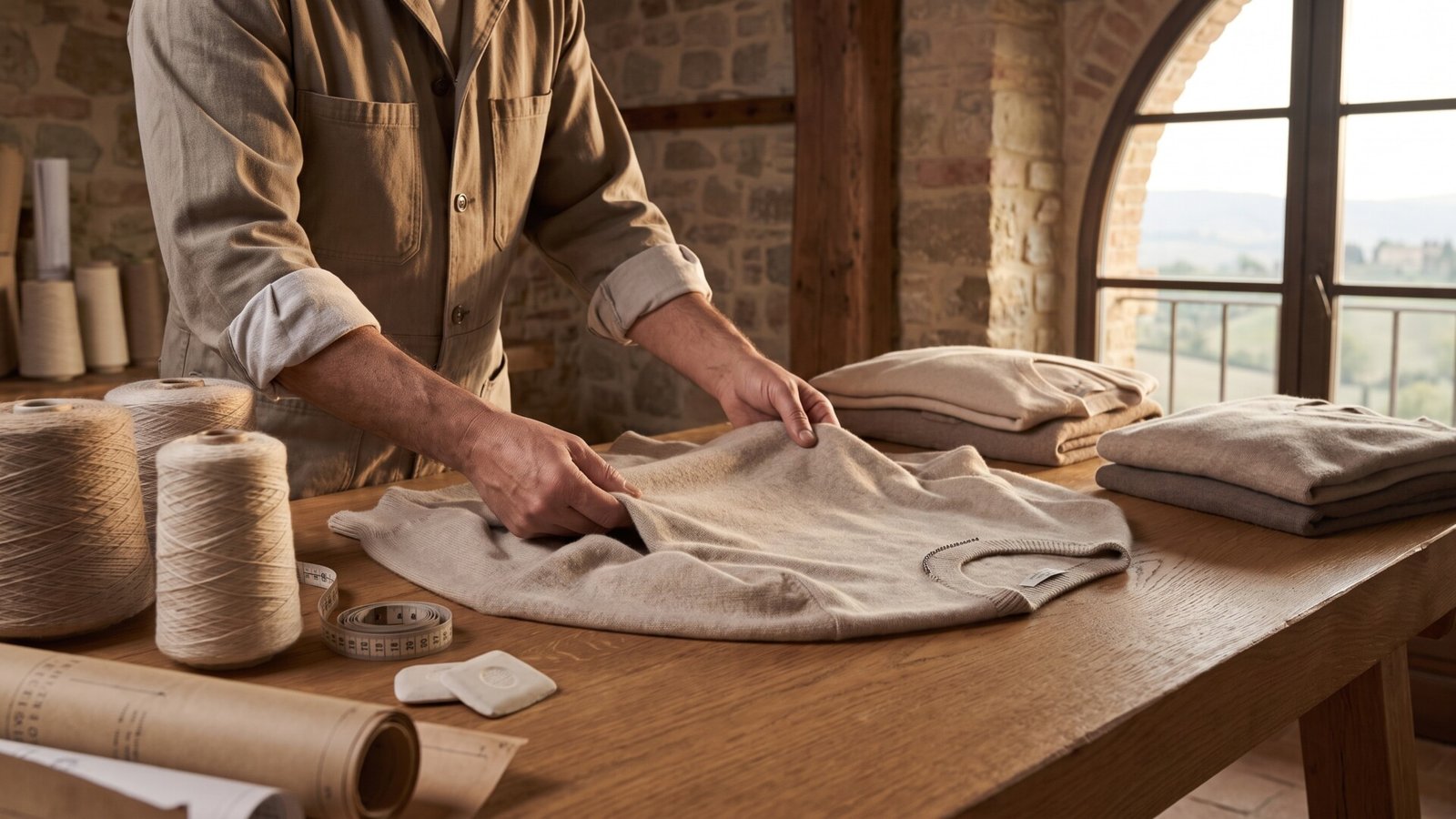
It is often repeated that everything is made by hand in Solomeo. The company’s investor information gives a more precise picture. The house says its products are made in Italy by about 400 artisan workshops that it selects for their skills in specific stages of production, with roughly 70 percent of them in Umbria and the rest in industrial districts elsewhere in Italy. Manual work is described as accounting for about 60 percent of the collections.
Two practical points follow. First, Solomeo is the headquarters, design center and training ground, but most manufacturing happens in partner workshops rather than one factory. Second, the company has been pulling some production closer: in 2024 it acquired the Sartoria Eugubina sewing workshop in Gubbio, Umbria. “Made in Italy” is a labelling claim that applies product by product, so the label on the garment in your hand is the thing to read.
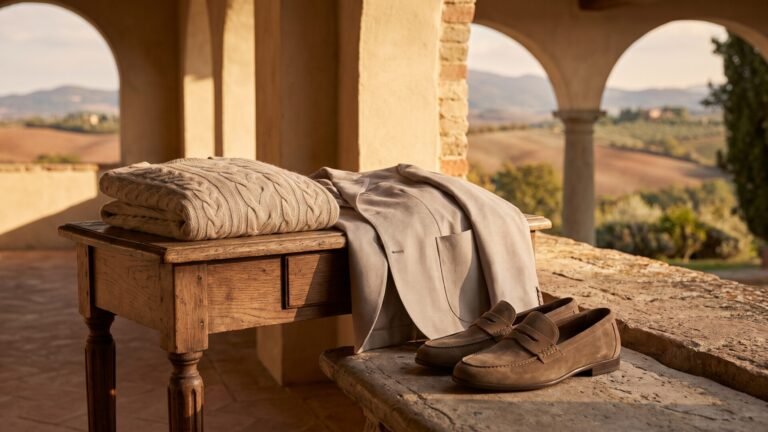
The design language is consistent enough to describe in a sentence: neutral tones such as oatmeal, taupe, grey and navy; soft shoulders and relaxed trousers; very little branding; and a bead-chain trim called Monili as the one recognizable decorative signature. Because the look changes slowly from season to season, a piece bought now is less likely to look dated in five years than a trend-driven one, which matters for the cost-per-wear math below. For the full design breakdown, see our complete Brunello Cucinelli guide.
What You Pay: Verified 2026 Price Ranges
Price is where the investment question starts. The ranges below come from retailer listings and retail tags seen in 2026, and euro prices are converted loosely to dollars. Treat them as a snapshot and confirm on the brand or retailer site before buying.
| Category | Approximate range (USD) | Basis |
|---|---|---|
| Cashmere sweaters | $1,350 to about $2,200+ | Retailer listings and retail tags, 2026 |
| Cashmere tailoring | Up to about $11,000 | One cashmere blazer at Mytheresa; wool and linen jackets cost less |
| Sneakers | About $900 to $1,100 | Retail and multi-brand listings |
| Boots | About $1,300 to $1,900 | Converted from European retailer listings |
| Totes and shoulder bags | About $2,000 to $4,500 | Converted from European retailer listings |
We have not listed a single price for suits or loafers because we could not confirm current US prices from the brand’s own store. If you are comparing, our guides to Italian suits and Brunello Cucinelli sneakers put these figures in a wider context.
The Cost-Per-Wear Math That Decides It
Cost-per-wear is the price divided by the number of times you wear the piece. It is the most useful way to test the “investment” label, because it replaces a vague feeling about quality with a number you control. The table below shows the cost per wear for three real price points at three levels of use.
| Piece and price | 50 wears | 100 wears | 200 wears |
|---|---|---|---|
| Entry cashmere sweater, $1,350 | $27.00 | $13.50 | $6.75 |
| Heavier or embellished sweater, $2,200 | $44.00 | $22.00 | $11.00 |
| Suede sneakers, $1,100 | $22.00 | $11.00 | $5.50 |
The break-even test. Suppose a good $300 sweater lasts 30 wears before it pills or loses shape. That is $10 per wear. To match that figure, a $1,350 sweater has to be worn 135 times, and a $2,200 sweater 220 times. At 40 wears a year, which is roughly twice a week through a cold season, the entry-level sweater reaches break-even in a little over three years and the $2,200 one in about five and a half.
That is the angle most “is it worth it” articles skip: the premium is only justified if the piece survives and stays wearable for that many wears, and it is the wearing frequency, not the logo or the village, that decides whether you come out ahead. A sweater that sits in a drawer for eight months of the year needs far longer to pay off. The practical rule that follows is to buy the piece you would reach for weekly, in a color you already wear, and to skip the seasonal color you would wear five times.
Maintenance belongs in the equation too. Add professional cleaning, a comb and storage supplies, and the real cost of ownership rises by a modest amount each year. The calculation also assumes the garment lasts, which depends on the knit and your care rather than on the brand name, so it is worth checking the gauge, ply and fiber content on the label before paying a premium.
Which Pieces Fit the Investment Logic
Cashmere crewnecks and half-zips. The company started with cashmere, and a plain sweater in a neutral color is the easiest piece to wear often, which is exactly what the math rewards. For background on yarn grades and how Italian knitters differ, see our guide to Italian cashmere.
Soft tailoring. Cucinelli’s blazers are deliberately unstructured, closer to a cardigan than a formal suit. They work for people who wear tailoring several days a week. For harder-edged alternatives, compare Kiton and Brioni, and for a more modern, structured approach, Ermenegildo Zegna.
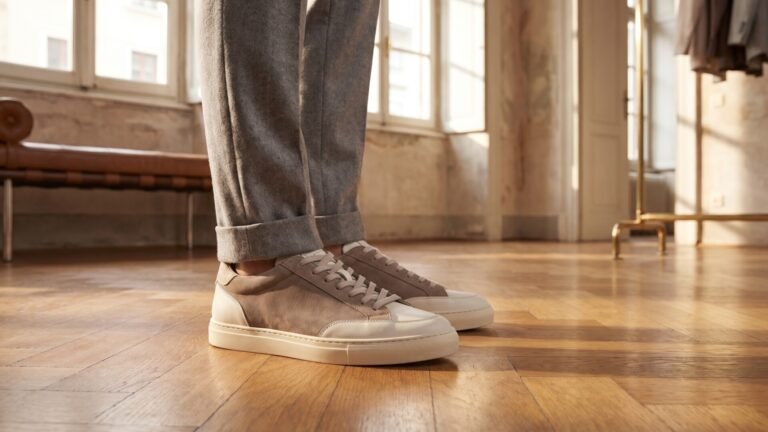
Shoes. Minimal leather and suede sneakers are the most accessible shoe category and work in many outfits, which helps the wear count. For dress-shoe construction, such as hand finishing, compare specialists like Santoni and Tod’s before paying a brand premium.
Bags. Totes and shoulder bags carry the highest prices in the table above. A bag is worn often when it is a true daily carry, but the same money buys a lot of choice elsewhere, so compare against other restrained leather houses before deciding.
The Resale Reality
Many “investment” articles quote resale percentages as if they were published facts. We could not find a reliable public data set for Cucinelli resale values, so we do not give percentages here. What can be said is more modest and still useful.
- Asking price is not sale price. Resale platforms show what sellers hope to receive. Look for items marked as sold, or compare several similar listings over a few weeks.
- Soft goods resell for less than hard goods. Worn knitwear has a thin secondhand market for hygiene and fit reasons, while shoes and bags in good condition tend to be easier to move.
- Condition and color decide a lot. Neutral colors and classic shapes are the safer bets; seasonal colors date faster.
- Authentication matters. Buy only from platforms that authenticate items, and check measurements and fiber content against the label photos.
The honest framing is depreciation avoidance, not appreciation. A well-chosen piece may lose value more slowly than a trend piece, but no luxury garment is guaranteed to hold its price, and the cost-per-wear math above is the safer foundation for the decision than any resale hope. The platforms where pre-owned pieces appear include The RealReal and Vestiaire Collective.
What Most Buyers Get Wrong
Buying the story instead of the piece. Solomeo, the theatre and the wage policy are real, but they are the same for every item in the store. They cannot tell you whether this sweater, in this size, is the right one. Try it on and read the label.
Choosing a color for the season. The brand’s value case rests on the wear count, and neutrals get worn most. A bright color may thrill you for a month and sit unused after that.
Treating it as a status purchase. The house is known for restraint. If recognition is the goal, a logo-led brand does that job better; if you want to be comfortable and understated, this is the point of the brand. Our guide to Loro Piana versus Brunello Cucinelli compares the two leading quiet luxury cashmere names directly, and our overview of Italian designer brands places both among their peers.
Ignoring cheaper routes to a similar look. Makers such as Luca Faloni and Falconeri sell Italian cashmere at far lower prices. The cut, yarn and finishing are not identical, so compare gauge and fiber before assuming equivalence, but the gap can change the break-even point dramatically.
The 2026 Outlook
The company’s results show a brand growing steadily rather than chasing scale. Revenue reached about 1.41 billion euros in 2025, up 11.5% at constant exchange rates. The Americas were the largest region at roughly 520 million euros, Europe followed at about 495 million, and Asia reached about 393 million euros, growing 15.3%. Management has pointed to growth of around 10% for 2026 and a longer-term target of 1.8 billion euros by 2028.
For buyers, two things follow. The quiet luxury aesthetic that Cucinelli helped define remains in demand, and the company is large enough that its pieces are sold through wholesale partners as well as its own boutiques, so you will find them outside Solomeo’s orbit. Whether prices keep rising is something we cannot predict, which is one more reason to buy for wear and not for speculation.
Care Essentials That Protect the Investment
Always follow the care label first. As general practice, wash cashmere gently in cold water with a wool detergent or have it professionally cleaned, dry it flat and fold it rather than hanging it. Use a cashmere comb for pilling, which is normal on soft knits and does not by itself signal poor quality. Brush suede, protect it from moisture with a spray tested on a hidden area, and store leather and suede in dust bags away from heat and sunlight. Consistent care is the cheapest way to extend the number of wears, which is the variable that drives the whole calculation.
The Investment Verdict
Brunello Cucinelli is not a financial asset, and nothing in the company’s results or the resale market suggests you should expect your purchase to appreciate. It is a durable-goods decision: the premium makes sense if you will wear a neutral, well-made piece often enough to bring its cost per wear toward the price of a cheaper alternative, and if you are comfortable with the company’s story. If you want fashion novelty, visible status or the lowest price per wear, other brands do those jobs better.
The lowest-risk way to find out is to buy one plain piece, try it in person against a cheaper alternative, and count the wears for a season before buying a second.
Explore More
For the full brand overview, start with our Brunello Cucinelli guide, then see the guide to Italian designer brands and our comparison with Loro Piana. For specific product recommendations, [Affiliate: browse the latest Brunello Cucinelli collection on Farfetch] or [Affiliate: explore the selection at MatchesFashion].
Frequently Asked Questions About Brunello Cucinelli And Solomeo
Is Brunello Cucinelli worth the money?
It can be if you wear a piece often. A $1,350 sweater needs about 135 wears to match the cost per wear of a $300 sweater that lasts 30 wears. It is a durable-goods decision rather than a financial investment, and no garment is guaranteed to hold resale value, so wearing frequency is what decides it.
What is Solomeo and why does it matter to the brand?
Solomeo is the Umbrian hamlet where the company is based. The founder moved the business there in 1982, bought the castle in 1985 and funded restoration of a library, a theatre and a craft school. It anchors the brand’s story, but most manufacturing is done by partner workshops across Italy.
Where is Brunello Cucinelli made?
The company says its products are made in Italy by about 400 artisan workshops, roughly 70 percent of them in Umbria. Solomeo is the headquarters and training center rather than a single factory. Origin is a product-level claim, so check the label on each item before buying.
How much does a Brunello Cucinelli sweater cost?
Retailer listings seen in 2026 put plain cashmere sweaters from about $1,350 to roughly $2,200, with heavier or embellished styles higher still. Prices change by season, market and exchange rate, so confirm on the brand or retailer site before you buy.
Does Brunello Cucinelli hold its resale value?
We could not find reliable public data, so we give no percentages. Knitwear generally has a thin secondhand market, while shoes and bags in good condition are easier to sell. Compare sold listings on authenticated platforms rather than asking prices, and do not buy expecting to profit.
Are there cheaper alternatives to Brunello Cucinelli cashmere?
Yes. Italian makers such as Luca Faloni and Falconeri sell cashmere at far lower prices, and Loro Piana sits at a similar price tier to Cucinelli. The cut, yarn and finishing differ, so compare gauge, ply and fiber content rather than assuming the look is equivalent.