Etro ‘Ornamenta’ Paisley: Is the 2026 Velvet Collection Too Bold or Just Right?
Searches for Etro Ornamenta usually come from one of two places: a shopper who has seen the name attached to a bold paisley velvet collection, or a reader curious whether Etro’s 2026 paisley is too much to wear. The first thing worth knowing is that Ornamenta is the name of Etro Home Interiors’ 2026 collection, shown at Salone del Mobile in Milan, and it is furniture and decor rather than a velvet wardrobe. Etro’s clothing for the season uses paisley in other ways, and the right question is how to buy paisley, and paisley velvet in particular, without regret.
This guide sorts out what Ornamenta actually is, where Etro’s paisley clothing and accessories fit, what changed at the company in the past year, how to judge a velvet piece, and the cost-per-wear arithmetic that decides whether a loud, seasonal garment makes sense. Everything is based on published reporting and general textile practice rather than wear-testing, and we have left out prices we could not verify.
Etro Ornamenta at a Glance
| Question | Answer (as of November 2026) |
|---|---|
| What is Ornamenta? | Etro Home Interiors’ collection, presented at the 64th Salone del Mobile, Milan, 21-26 April 2026 |
| What style? | Art Deco influences reinterpreted through Etro’s floral and graphic language |
| Is it clothing? | No. It covers seating, tables, a dressing table and patterned textiles |
| Is Etro paisley sold as clothing? | Yes, across the house’s women’s, men’s and accessories lines, with paisley returning in the 2026-27 shows |
| Founded | 1968 in Milan, by Gerolamo “Gimmo” Etro, as a textile design business |
| Controlling owner | L Catterton, with roughly 51% after a late-2025 reshuffle |
Etro and Paisley: How the Motif Became the House Signature
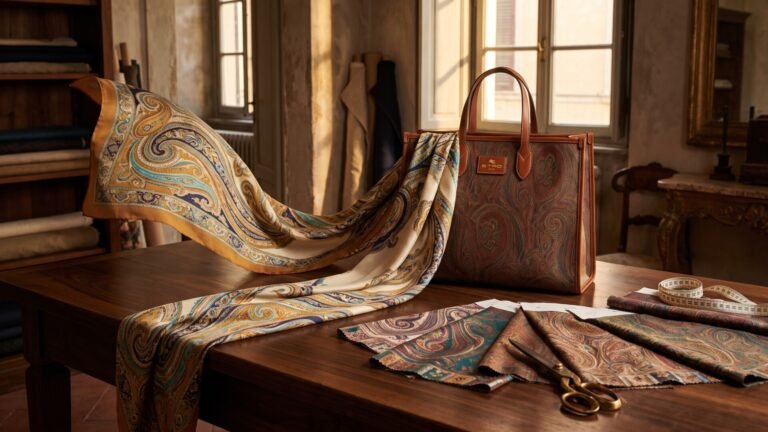
Gimmo Etro founded the company in Milan in 1968 as a textile design business, and he and his wife Roberta assembled a collection of about 300 antique shawls. That archive is the root of the house’s paisley. The motif itself is far older than Etro: the teardrop shape traces back to Persian and Indian boteh designs and later to Kashmir shawls, and it reached Europe over centuries. What Etro did was make one interpretation of it unmistakably its own. For the full lineage, our guide to the history of Etro’s paisley print traces it from Persia to the present.
The business widened in steps. After a trip to India, Etro launched a furnishing textiles line in 1981, added leather goods in 1984 and a home collection in 1985, introduced a fragrance line in 1989, and staged its first fashion show at Milan Fashion Week in 1996. That timeline matters here, because it explains why the same paisley appears on a sofa, a scarf and a jacket: the house began with fabric for interiors and dress and has kept both in its range ever since.
What Etro Ornamenta Actually Is
Ornamenta was unveiled by Etro Home Interiors at the 64th Salone del Mobile in Milan, which ran from 21 to 26 April 2026. Press coverage describes it as a reinterpretation of Art Deco, combining geometric structure and ornament with the floral and graphic motifs the house already uses. The pieces reported include:
- Caresse seating – sofas and armchairs with layered upholstery.
- Opus seating – more defined volumes, bolster cushions and braided finishes; both seating lines revisit the capitonne (button-tufted) technique.
- Samarcanda Duo tables – an extension of an existing series with dual-material marble surfaces.
- Vantus dressing table – translates the paisley motif into a sculptural form with storage lined in branded textiles.
The materials named in coverage are stone, metals, wood and patterned textiles. We found no published pricing or retail availability for the collection, and no source describing it as a velvet apparel line, so we do not quote either. If you saw Ornamenta described as clothing, treat that description with caution and check the retailer’s product page, which will state the category and fabric.
Where Etro’s Paisley Shows Up in Clothing This Season
The runway collections tell a different story from Ornamenta and are the better guide to what Etro clothing looks like now. The Fall/Winter 2026-27 show was reported as a mix of bohemian ease and British influence, with paisley described as larger and more strongly graphic, charged with sequins, alongside feathers, softened tartan checks and sculptural knits. The Resort 2027 collection returned to paisley and the Arnica motif, with reversible jacquard capes, suede jackets with 1970s details, ruffled boho silhouettes and, for men, Mediterranean preppy knits with silk prints. Neither report names velvet as a defining fabric.
Putting the pieces together, the paisley you can realistically buy from the house comes in several forms, and the fabric changes how you wear it:
Etro paisley by product type
- Silk and cotton prints: the lightest and most versatile way into the motif, suited to scarves, shirts and dresses
- Jacquard: the pattern woven into the cloth, which gives a denser, more tactile surface than a print
- Sequins and embellishment: the louder, evening-leaning versions reported for Fall/Winter 2026-27
- Suede and leather: paisley as an accent on outerwear and accessories
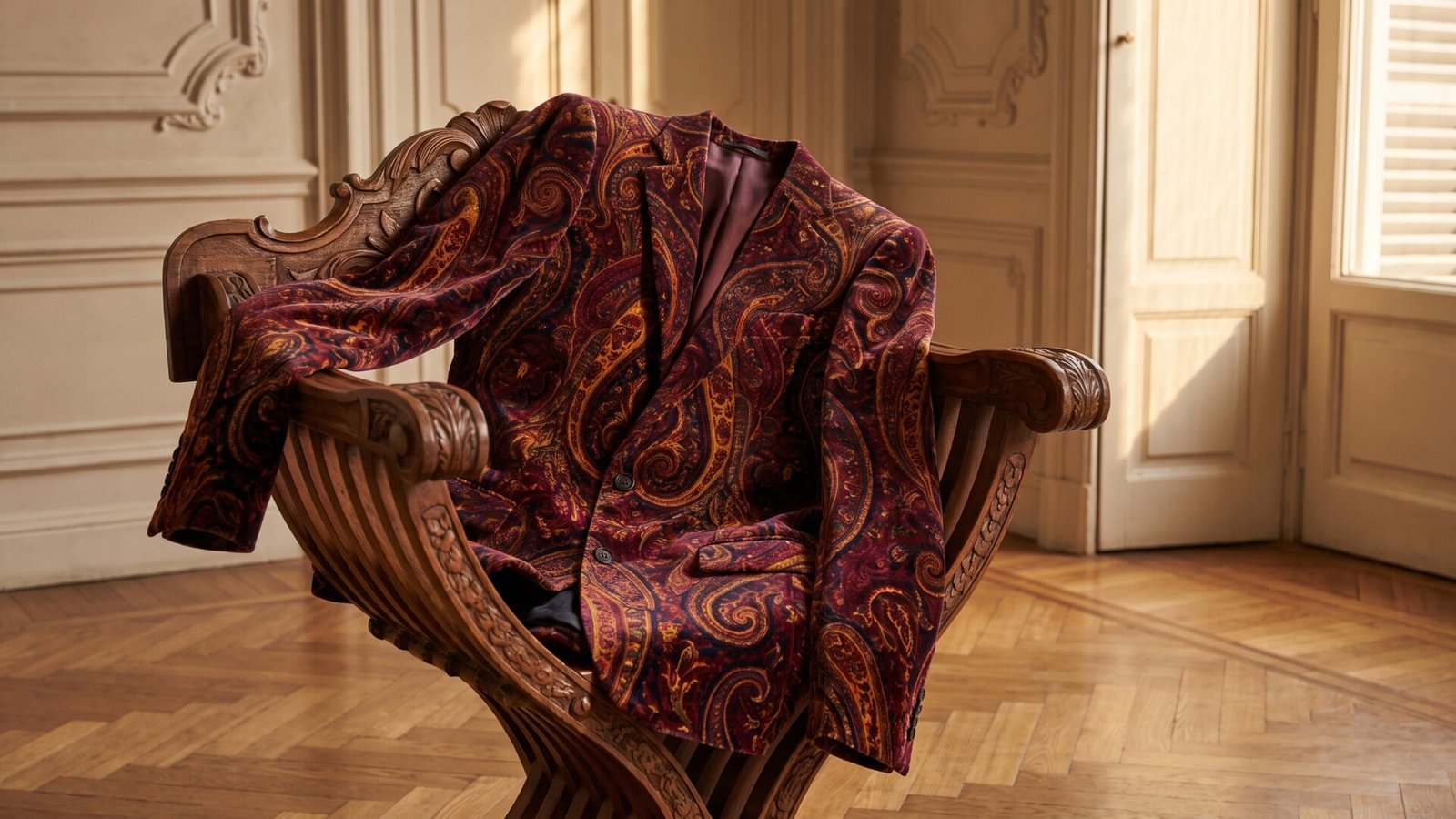
- Velvet: available from the house in some seasons and categories, but not confirmed as the defining fabric of this year’s shows
Etro in Transition: Ownership and Creative Direction
Two recent changes affect how you should think about buying anything from the house as a keepsake. In 2021 private equity firm L Catterton acquired a 60% stake in Etro, valuing the company at about 500 million euros. In 2022 Marco De Vincenzo became creative director for women’s, men’s and home, the first designer from outside the Etro family to hold that role. On 19 December 2025 the founding family sold its remaining minority stake, with new investors including Rams Global, Swinger International and SRI Group coming in and L Catterton keeping control at roughly 51%. In March 2026 Etro and De Vincenzo parted ways by mutual agreement as the house entered what it called a new strategic phase.
The practical takeaway is modest. Claims that a particular season’s pieces will become “collector’s items” are speculation at any time, and more so when ownership and creative leadership have just changed. The paisley motif is the house’s most stable asset, but the way it is cut, scaled and colored can shift with whoever designs the next collections. Buy because you will wear the piece, not because you expect it to appreciate.
How to Judge a Paisley Velvet Piece
If you are shopping for velvet paisley, whether from Etro or elsewhere, the label tells you more than the marketing. These are the points worth checking in person or in the product description:
- Fiber content. Silk velvet and silk-viscose blends have the deepest sheen and drape; cotton velvet is sturdier and matte; polyester velvet is the most crush-resistant but can look flat. None is automatically better, but the label should match the price.
- Pile density. Run a hand across it: a dense, even pile feels plush and springs back, while a sparse pile shows the backing and wears shiny at the elbows and seat.
- Pattern placement. On a jacket, check that the paisley matches across the front, at the pockets and at the sleeve seams. Print or woven motifs that break at seams are a sign of cost-cutting.
- Lining and seams. A full lining and clean, flat seam finishes protect the pile from friction and help the garment hang correctly.
- Care label. Many velvets are dry-clean only. Confirm that before you commit, since it adds an ongoing cost.
The Cost-Per-Wear Reality of Seasonal Velvet
Most advice on statement pieces stops at “only buy what you love.” The numbers are more useful. Velvet is a cold-weather fabric, so the number of days it can realistically be worn is capped by climate in a way a silk scarf or a cashmere sweater is not. If you can wear a velvet jacket on 10 to 20 occasions a year, five seasons gives you 50 to 100 wears in total. The table below shows what that does to cost per wear at three illustrative price points. These are examples to show the arithmetic, not Etro prices.
| Example price | 25 wears | 50 wears | 100 wears |
|---|---|---|---|
| $1,000 | $40 | $20 | $10 |
| $2,000 | $80 | $40 | $20 |
| $4,000 | $160 | $80 | $40 |
The insight is that a seasonal statement piece reaches a respectable cost per wear only if you plan its use up front. A jacket worn for a handful of winter dinners, a holiday party and a few weekday outfits can reach 20 wears a year, which puts a $2,000 piece near $20 per wear over five years. The same jacket worn twice a year costs far more per wear. Before buying, write down the specific occasions you would wear it, and if you cannot name ten a year, a scarf or a pair of velvet loafers delivers the paisley at a lower stake.
Add upkeep to the sum. Dry cleaning a velvet jacket once or twice a year, plus a padded hanger and garment bag, is a small recurring cost, but over five seasons it narrows the gap between a garment bought on sale and one bought at full price. Climate belongs in the sum too: the same jacket is a very different purchase in a city with five cold months than in one with two.
A Quick Decision Guide: Which Etro Paisley Fits You
| If you want | Best fit | Why |
|---|---|---|
| To try the motif cheaply | Scarf | Easy to style, little care, year-round use |
| Paisley on an ordinary outfit | Loafers or small leather goods | Small surface, many wears |
| One statement layer | Jacket in jacquard, suede or velvet | Wears with plain basics; plan 10+ occasions a year |
| An evening look | Dress or embellished piece | Fewer wears, highest impact |
| The Ornamenta look at home | Etro Home Interiors | The collection is furniture and decor |
How to Wear Bold Paisley Without Overdoing It
Dense paisley already carries a lot of visual information, so the simplest approach is to let it be the only loud element. Pair a paisley jacket with plain trousers and a solid knit in a color the pattern already contains; the darkest tone in the print is usually the safest match. Keep metals and jewelry minimal, and stay within one family of shoes and bag.
For evening, a velvet piece can stand alone with very little else, and the fabric’s sheen does much of the work. For daytime, small doses help: a scarf, a pocket square or a loafer lets the motif show without taking over the outfit. If you want to combine prints, vary the scale (a large paisley with a fine stripe, say) and keep the colors in the same narrow range. The aim is a pattern that looks chosen, not a costume.
If you like the maximalist end of Italian fashion more broadly, houses such as Missoni, Dolce & Gabbana and Versace approach bold pattern and color in their own ways, and our overview of Italian designer brands places Etro among them.
Caring for Velvet and Paisley Pieces
Always follow the care label first. As general practice for velvet: have it dry cleaned by a cleaner experienced with pile fabrics, and do not do so more often than needed, since repeated cleaning can wear the fibers. Between cleanings, brush gently in the direction of the pile with a soft brush to lift dust. Remove light creases by hanging the garment in a steamy bathroom or using a steamer held a short distance from the fabric, never pressing an iron onto the pile. Store on a padded hanger with space around it, away from direct sun, and avoid folding it tightly in a suitcase, which can leave pressure marks. Water spots and stains are best left to a professional.
Who Should Buy Etro Paisley, and Who Should Skip It
Buy if you already own a base of solid, well-fitting basics and want one piece with personality; if you enjoy being noticed; if you can name enough occasions to wear it; and if you live where velvet is practical for several months of the year.
Skip or start smaller if you are building a first wardrobe and need versatile staples; if you want clothing that disappears into a crowd; if you rarely dress up; or if you want a purchase that holds value for resale. For a calmer approach to Italian dressing, our guides to Brunello Cucinelli and Loro Piana show the opposite end of the spectrum.
Where to Find Etro Paisley
The full current range, with colorways and categories, is on [Affiliate: Etro’s official website]. Luxury retailers such as [Affiliate: luxury department stores like Net-a-Porter and Mytheresa] often carry a curated selection of the house’s women’s, men’s and accessories lines. Availability, shipping terms and return policies differ by retailer, so check them before ordering.
Entry points by category, from lowest to highest commitment:
- [Affiliate: Etro Velvet Paisley Scarf] – the lowest-stakes way to wear the motif.
- [Affiliate: Etro Velvet Loafers] – paisley on an everyday outfit; see also our guide to Italian designer shoes.
- [Affiliate: Etro Velvet Paisley Jacket] – the statement piece that most rewards planning its use.
- [Affiliate: Etro Paisley Velvet Dress] – an evening piece for specific occasions.
The Final Verdict
Etro Ornamenta is not a velvet wardrobe: it is the house’s 2026 home collection, and the clothing that carries Etro’s paisley this season is described in different terms, with sequins, jacquard, suede and feathers more prominent than velvet. If your goal is a bold paisley piece, the decision comes down to how often you will wear it, the fabric’s care demands and the climate you live in. A scarf or loafer gives you the motif at a low stake, and a jacket or dress rewards you only if you plan its use.
[Affiliate: Shop the Etro 2026 Velvet Collection] to see what is currently available, and read our guide to the history of Etro’s paisley print and our overview of Italian designer brands for more context.
Frequently Asked Questions About Etro Ornamenta And Etro Paisley
What is Etro Ornamenta?
Ornamenta is Etro Home Interiors’ collection, presented at Salone del Mobile in Milan in April 2026. It reinterprets Art Deco through Etro’s floral and graphic motifs, with seating, marble-topped tables and a paisley dressing table. It is furniture and decor, not a clothing line, and we found no published pricing.
Is the Etro paisley design timeless or just a trend?
The paisley motif is centuries old and has been central to Etro since the house began as a textile business in 1968. Specific scales, colors and fabrics change by season, so the pattern is lasting while a particular cut or colorway may look of its moment. Buy for wear, not appreciation.
Is velvet durable?
Good velvet with a dense pile can last many years, but it is more sensitive than flat fabrics. Pile can crush or mat with friction, pressure and poor storage, and many velvets are dry-clean only. Store on a padded hanger with space around it and brush gently in the direction of the pile.
Can I wear Etro paisley to the office?
Often yes, in small doses. A scarf, loafer or one paisley jacket over plain trousers and a solid knit suits creative or relaxed workplaces. In conservative offices, keep the pattern to an accessory. Dense, sequined or evening-leaning pieces are better saved for after work.
How do I care for velvet paisley garments?
Follow the care label first. In general, dry clean sparingly, brush gently with the pile, steam creases from a distance instead of ironing, and store on a padded hanger away from sun. Avoid tight folding in luggage, and leave water marks and stains to a professional cleaner.
Are there more subtle Etro alternatives?
Yes. The house prints paisley on silk and cotton as well, which reads lighter than dense velvet or sequins, and scarves, loafers and small leather goods give the motif at lower commitment. Our guide to the history of Etro’s paisley print explains how the pattern is used across the range.