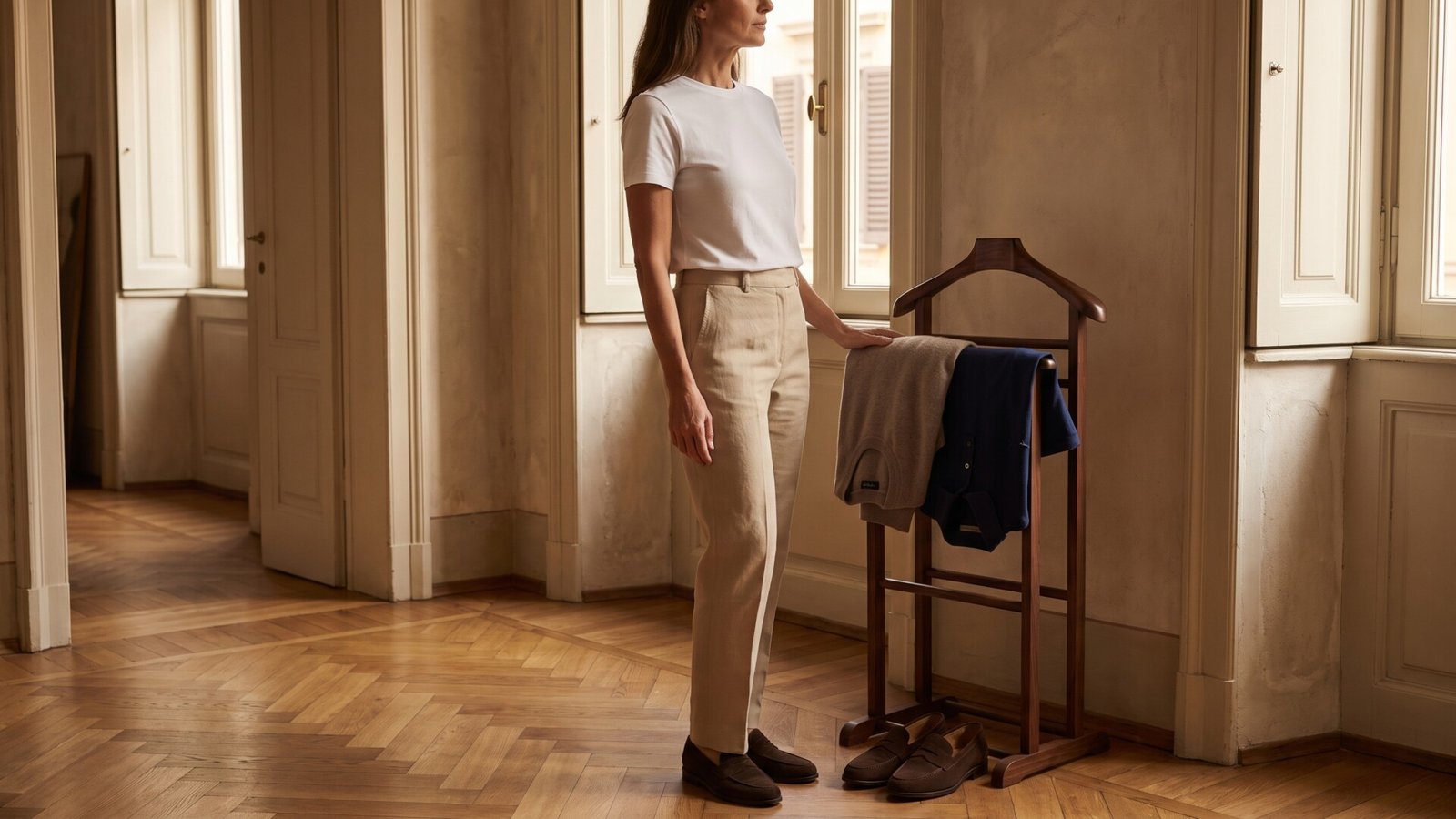
Italian Luxury Basics: The Foundation of a Timeless Italian Wardrobe
Most luxury budgets go to the pieces people notice: the leather jacket, the bag, the statement coat. The garments worn most often, such as the t‑shirt, polo, fine knit and plain trouser, usually get whatever is cheapest. Yet these are the pieces that sit against your skin, show every flaw in fit and fabric, and decide how everything layered on top looks. Italian makers have long treated them as serious work, and this guide explains what separates an Italian luxury basic from an ordinary one, which brands are worth knowing, and how to build a small, durable wardrobe from the inside out.
You will find the materials and construction details to look for, a garment‑by‑garment buying guide, profiles of the main brands, a capsule wardrobe plan, care advice and answers to common questions. This article is part of our larger Italian Designer Clothing guide; the sections below link to deeper pages on Italian knitwear, Italian cashmere, Italian suits, Italian leather jackets and Italian outerwear.
What Defines Italian Luxury Basics?
The Philosophy of Italian Minimalism
Italian luxury basics generally avoid logos, flashy hardware and trend‑driven details. The design is restrained: clean lines, neutral colours and proportions that flatter the body without drawing attention. If the fabric and fit are right, the garment does not need ornament. This is the same idea behind the quiet luxury movement; for brands that follow it, see our guide to Italian quiet luxury brands.
Material Excellence in Everyday Wear
The materials worth paying attention to:
- Long‑staple cotton: Longer fibres, such as Egyptian Giza or American Pima/Supima, spin into smoother, stronger yarn that pills less. Check the label, because “premium cotton” on its own means little.
- Fine merino wool: Very fine merino (roughly 17 to 19 microns) is soft against the skin, breathable and more durable than most cashmere, which makes it a practical choice for polos and lightweight sweaters.
- Cashmere and cashmere blends: Pure cashmere is the softest; a blend with silk, cotton or wool adds durability at a lower price. See our Italian cashmere guide for how to judge quality.
- Technical blends: Some Italian makers use stretch or wrinkle‑resistant blends that suit travel and commuting, though they feel different from natural fibres.
Construction Standards
The difference between a basic t‑shirt and a luxury one is rarely the label. Look for dense, even stitching, flat seams that do not chafe, ribbed collars that keep their shape, and fabric that has been pre‑shrunk or finished (for example mercerised) so it does not twist after washing. These details are hard to see on a hanger and obvious after a season of wear.
Reading the “Made in Italy” Label
“Made in Italy” is a labelling claim that applies to each garment, not necessarily to a whole brand or line, so check the care label of the exact piece. Italian knitwear and shirting often come from specialised workshops in regions such as Umbria, Piedmont and Lombardy, but a brand’s website or label is the reliable source for where a particular garment was made. Other signs of quality are the fibre content printed on the label, buttons sewn with a reinforced shank, and fabric that recovers its shape when you stretch it.
Why Basics Are Hard to Get Right
A t‑shirt has nowhere to hide. A poorly cut collar, a sagging hem or thin fabric shows immediately, which is why a simple garment is often the best test of a maker’s skill.
The Role of Basics in a Luxury Wardrobe
Wardrobe Foundation
Think of statement pieces, such as designer bags and coats, as the visible layer and basics as the structure beneath. A good t‑shirt makes an average jacket look better; a worn, thin one weakens an expensive coat.
Cost‑Per‑Wear
Basics are your highest‑frequency garments, so their cost per wear falls quickly. As an illustration, a $250 shirt worn 50 times a year for five years costs $1 per wear, whereas a $250 statement piece worn 10 times a year costs $5 per wear. The figures are illustrative, not quotes for any brand, and they only hold if the garment actually lasts, which is why construction and fibre matter.
Layering and Dress Codes
A fine‑gauge merino crewneck works under a blazer, over a t‑shirt or alone with jeans. A navy merino polo with chinos is casual; with tailored trousers and loafers it is business casual. That ability to move between dress codes is what makes a basic worth buying well.
The Essential Categories of Italian Luxury Basics
T‑Shirts
- Fabric: Long‑staple cotton jersey with a dense, even surface; a fabric that is too thin will go see‑through when white.
- Construction: A close collar rib that resists stretching and clean, flat seams.
- Fit: The shoulder seam sits on your natural shoulder, the sleeve ends around mid‑bicep and the hem falls near the hip bone.
Brands to look at: Brunello Cucinelli, Zegna, Loro Piana and Prada. Prices vary widely by season and fabric, so compare current listings.
Polo Shirts
A luxury polo sits between a t‑shirt and a dress shirt. Fine merino suits cooler weather; mercerised cotton or cotton‑silk blends suit summer. The collar should hold its shape rather than curl, and the hem should be long enough to stay tucked or short enough to wear loose. Zegna, Cucinelli and Prada all offer polos with different personalities, from tailored to relaxed to minimalist.
Casual Shirts
- Linen and cotton‑linen: For summer; expect creasing as part of the look.
- Oxford cloth: A substantial cotton with a soft collar roll, the easiest shirt to wear untucked or with a blazer.
- Soft, unlined collars: A hallmark of Italian casual shirting; mother‑of‑pearl buttons are a common detail.
Knit Basics
Fine‑gauge crewnecks, V‑necks and turtlenecks in merino or cashmere blends do the most work in a cooler‑weather wardrobe. Navy, charcoal and beige cover most needs. For a deeper buying guide and care advice see Italian knitwear, best Italian cashmere sweaters for men, and the brand guides to Malo and Fedeli.
Trousers and Chinos
Look for fine cotton twill, wool‑cotton blends or stretch fabrics with a soft hand and natural drape. A straight or slightly tapered leg and a mid‑rise waist work for most men and women; details to check include a lined waistband, reinforced pocket bags and a hem that breaks cleanly over the shoe. Tailoring alterations are worth the cost. For suiting, see Italian suits.
Luxury Denim
Italian‑made denim tends towards lighter, softer fabric and a tailored cut compared with heavyweight raw denim. A dark, clean wash and a slim‑straight leg are the quiet‑luxury default; heavy distressing and logo patches usually are not.
The Best Italian Luxury Basics Brands
Zegna
Zegna is a good first stop for versatile basics: tailored but not tight fits and a strong focus on fabric innovation, including technical and wrinkle‑resistant materials. It also runs the Oasi Cashmere programme for sourcing cashmere. Best for: professionals and first‑time luxury buyers.
Brunello Cucinelli
Founded in 1978, Brunello Cucinelli began with dyed cashmere sweaters and is known for relaxed, soft garments in earthy colours. Best for: buyers who put comfort and texture first.
Loro Piana
Founded in 1924 in Quarona, Piedmont, and part of LVMH since 2013, Loro Piana is the top end of the category in price and material, particularly for cashmere and fine wool. Best for: buyers who want top‑tier materials and accept the price.
Prada
Prada brings a minimalist, slightly edgy approach, with technical fabrics and architectural details. Best for: modern minimalists. Note that many Prada pieces carry the triangle logo, so choose unbranded pieces if you want a quiet look.
Gucci
Gucci mixes logo basics, such as the GG t‑shirt, with simpler staples. For a quiet wardrobe, stick to the unbranded cotton tees, knits and trousers. Best for: buyers who want a mix of subtle and statement pieces.
Armani
Giorgio Armani’s house is built on soft, understated tailoring, and its basics follow the same relaxed silhouette. Best for: those who like classic Italian elegance.
We do not quote per‑brand price tables here because prices vary by season, fabric and market; use the brand websites for current figures.
Italian Luxury Basics Categories at a Glance
| Category | Versatility | Comfort | Formality | Cost‑Per‑Wear |
|---|---|---|---|---|
| T‑Shirts | Very High | Very High | Low | Very High |
| Polo Shirts | High | High | Medium | Very High |
| Shirts | High | Medium | High | High |
| Knit Basics | Very High | Very High | Medium | Very High |
| Trousers | Very High | High | Medium | Very High |
| Denim | High | High | Low–Medium | Very High |
The ratings are editorial judgments, not measurements.
Why Most People Build Wardrobes Backwards
Many buyers spend on the visible items and economise on the rest. A thin t‑shirt whose collar sags or hem twists undermines a good jacket. A better approach is to allocate budget to what you wear most, then add statement pieces slowly. In basics, fit is everything: the shoulder seam, sleeve circumference and hem length are visible in a way that a heavily designed garment can hide.
A related point: a large‑logo t‑shirt is a statement piece, not a basic. A plain tee from a brand known for fabric will usually age better than a logo piece that dates quickly.
How to Build an Italian Luxury Basics Wardrobe
Step 1: Foundation Layer
Three t‑shirts (white, black, heather grey) and two polos (navy, white). Choose Zegna for versatility, Cucinelli for texture or Loro Piana for top‑end materials.
Step 2: Mid Layer
Add two fine‑gauge crewneck sweaters (navy and charcoal), one cardigan and two casual shirts (a white Oxford and a blue linen).
Step 3: Lower Half
Two pairs of tailored chinos (beige and navy) and one pair of dark, straight‑leg jeans that work with both casual and tailored jackets.
Step 4: Seasonal Adjustments
- Summer: Lightweight cotton trousers, linen shirts and short‑sleeve polos.
- Winter: Flannel trousers, merino turtlenecks and cashmere knitwear, with an overcoat from our Italian outerwear guide.
Capsule Checklist
3 t‑shirts, 2 polos, 2 crewneck sweaters, 1 cardigan, 2 casual shirts, 2 pairs of chinos and 1 pair of jeans: 13 pieces that combine into many outfits. Add a blazer from our suit and tailoring guide, a leather jacket and an overcoat and the wardrobe is complete.
Styling Italian Luxury Basics
Casual
- White t‑shirt, dark jeans, brown leather loafers.
- Navy polo, beige chinos, white leather sneakers.
- Grey crewneck sweater, black jeans, Chelsea boots.
Smart Casual
- White t‑shirt under a navy blazer, grey chinos, suede loafers.
- Merino polo, charcoal trousers, leather derbies.
- Turtleneck under a field jacket, dark jeans, chukka boots.
Travel
A white t‑shirt, navy polo, grey crewneck and two pairs of chinos combine with each other and can be dressed up with a blazer or down with sneakers, enough for a week in a carry‑on.
Are Italian Luxury Basics Worth It?
Where they pay off: frequent wear, better fit and fabrics that hold their shape. Where they do not: resale, since few people buy used t‑shirts, and when the money would be better spent on a fit adjustment or a single well‑made garment. Longevity depends on care and on fibre: a good merino sweater can last many years, while a cotton tee will eventually fade or thin even if well made.
Care and Maintenance
- Cotton basics: Follow the care label; cold wash inside out and avoid bleach and high heat.
- Merino and cashmere: Hand wash or use a wool cycle with wool detergent, or dry clean if the label says so. Dry flat.
- Denim: Wash inside out in cold water and less often than other garments.
- Storage: Fold knits rather than hang them; use breathable garment bags and cedar blocks for off‑season items.
- Repairs: Have a tailor deal with loose buttons, pulled threads and small holes before they spread.
Always follow the garment’s own care label, which overrides general advice.
The Future of Italian Luxury Basics
Demand for unbranded, high‑quality basics has grown with the quiet luxury trend. Sustainability is also reshaping the category, with initiatives such as Zegna’s Oasi Cashmere programme, and technical fabrics are becoming more common in luxury basics. Expect more attention on traceability, but check any claim against the brand’s own documentation.
Frequently Asked Questions About Italian Luxury Basics
What are luxury basics?
High-quality foundational garments such as t-shirts, polos, casual shirts, knitwear, trousers and denim, made from premium fibres with careful construction and minimal branding.
Which Italian brand makes the best basics?
It depends on what you value. Zegna is strong for versatile, tailored basics; Brunello Cucinelli for relaxed comfort and texture; Loro Piana for top-end materials; Prada for a minimalist edge.
Where can I shop for a full wardrobe of Made in Italy luxury pieces?
Start with the brand websites and boutiques of houses such as Zegna, Brunello Cucinelli and Loro Piana, and check the care label of each piece, because Made in Italy applies per garment. Our Italian Designer Clothing guide links to category pages.
What are the hallmarks of authentic Italian-made luxury clothing?
A Made in Italy care label, clear fibre content, dense even stitching, flat seams, a collar that keeps its shape and fabric that recovers after stretching. No single sign proves origin, so buy from the brand or an authorised retailer.
Are luxury basics worth the price?
They can be if you wear them often and they last, because cost per wear falls quickly. They are less compelling if you rarely wear the category or the fit is wrong.
What should I buy first: basics or statement pieces?
Basics, because they are the garments you wear most and the ones that make everything else look better.
Do Italian luxury garments need special care?
Often yes: natural fibres such as cashmere, merino and fine cotton last longer with gentle washing, flat drying and folded storage. Always follow the care label.
How many basics do I need?
A capsule of about 13 pieces covers most needs: 3 t-shirts, 2 polos, 2 sweaters, 1 cardigan, 2 casual shirts, 2 chinos and 1 pair of jeans. Adjust for climate and lifestyle.
Conclusion
Luxury basics are the garments you wear most and notice least, which is exactly why quality and fit matter in them. Start with the best t‑shirts, polos and knitwear you can afford, choose neutral colours, check labels for fibre content and origin, add statement pieces slowly, and care for everything properly.
Explore more Italian luxury: Italian Knitwear | Italian Cashmere | Italian Suits | Italian Leather Jackets | Italian Outerwear | Italian Designer Clothing | Malo | Fedeli | Zegna | Brunello Cucinelli | Loro Piana | Prada