Rifugio: The Complete Guide to Italy’s Handmade Leather Jacket Specialist
Rifugio is a family-run leather and suede outerwear maker based in Naples. It is well known among menswear writers and retailers, and barely known outside them. The label is small, the branding is discreet, and the jackets are soft and light rather than built like motorcycle armour. This guide pulls together what is documented about the brand: who runs it, how the jackets are made, which leathers it uses, what they cost in US dollars, and how Rifugio compares with other Italian leather specialists such as Stewart and Valstar.
Rifugio sits inside our wider coverage of Italian designer brands. If you are still deciding what kind of jacket you want, start with our overview of Italian leather jackets and come back here for the detail on this maker.
Rifugio at a Glance
| Detail | What is documented |
|---|---|
| Base | Naples, Italy (an Art Deco villa houses the cutting room, sewing room and showroom, according to a 2023 Permanent Style visit) |
| People | Alfredo Rifugio, the master tailor, and his son Alfonso, who runs the brand side |
| Team size | Around 15 tailors in 2019; about 25 employees in 2023, five of them family members |
| Core products | Suede and leather jackets, bombers, blazers, shearling, deerskin, safari and field jackets |
| Materials | Lamb, calf, goat, deerskin, shearling, and exotic skins for special orders |
| Made-to-order | Made-to-measure and made-to-order options, usually arranged through retailer trunk shows |
| Typical price range (USD) | Roughly $900 to $3,500+, depending on leather, lining and handwork (see pricing section) |
The History of Rifugio
Origins as a Leather Specialist
Rifugio’s story is tied to Alfredo Rifugio, a Neapolitan tailor who began sewing at the age of thirteen and later opened his own tailoring business. Naples has a long tradition of tailoring, and Alfredo applied it to leather and suede rather than wool. Published profiles describe him as having tailored leather jackets in the city for more than fifty years. We could not confirm an exact founding year for the company from independent sources, so this guide does not give one.
For much of its history the workshop worked behind other names. Menswear press has reported that Alfredo’s atelier produced jackets for other labels, including Loro Piana, before the family launched Rifugio as its own brand in the late 2010s. White-label work is now a very small share of the business.
The White Jewel
The story most often repeated about Alfredo Rifugio, and told in The Rake, is the commission from Pope John Paul II. On the suggestion of the Pope’s personal pilot, Alfredo made a white leather jacket for the Pope to wear while skiing and hiking. The piece became known as the “White Jewel”. It is a brand anecdote, so read it as the house’s own account, but it appears consistently in press coverage.
Rifugio Today
Rifugio remains family-run. Alfredo leads the tailoring, and his son Alfonso has driven the move from contract manufacturing to a retail-facing brand, including experiments with technical and synthetic materials. The team has grown from a handful of tailors to a workforce of roughly two dozen, and the jackets are sold through independent menswear retailers in Europe, the US and Asia rather than through a network of flagship stores. Staffing and range change from year to year, so check the brand’s current information before relying on these figures.
What Makes Rifugio Different?
Tailoring Applied to Leather
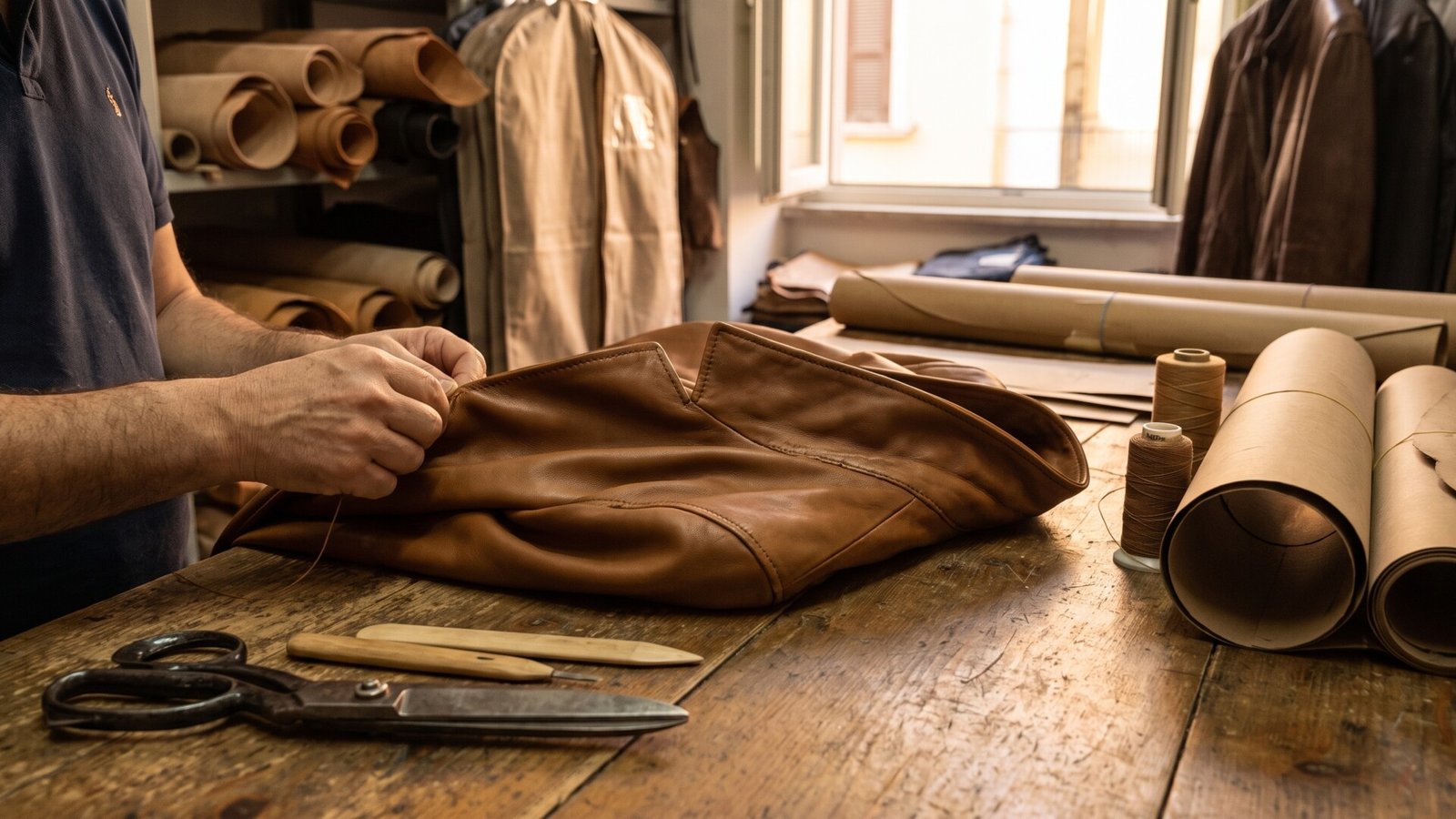
Rifugio jackets are cut and sewn like tailored garments. A visit to the Naples villa described by Permanent Style found separate cutting and sewing rooms, with the sewing room the largest and holding about a dozen workstations. Hand work is concentrated in specific operations, such as setting the sleeves and sewing the armhole and cuff linings. The company is open about the fact that more of the range is machine-sewn than before the brand launched, so “handmade” is better understood as hand-finished and hand-assembled in key places than as sewn entirely by hand.
Light and Soft Rather Than Rugged
The signature is a lightweight, supple hide that drapes like cloth. Winter pieces usually carry the most handwork because unlined jackets expose the back of the stitching. Deerskin is treated on the inside so it is smooth enough to wear unlined. The trade-off is that these jackets are made for comfort and elegance, not for hard abrasion, so they suit city and travel wear better than motorcycle use.
Small-Scale Production
Output is limited compared with a large fashion house, and several models are offered made-to-order. We have seen the figure of “eighty hours per jacket” and “ten craftsmen” repeated online, but we could not trace it to a primary source, so we do not treat it as established. What can be said is that a single jacket passes through several specialised stations (cutting, sewing, lining, finishing) rather than one assembly line.
The Leathers Behind Rifugio Jackets
Tanneries supply the hides, which range from calf to crocodile. The leathers named in published coverage and retailer listings include:
- Lambskin (nappa and wild nappa): very soft and light, used for drapey bombers, blazers and racers.
- Calfskin: firmer and more structured, a better choice for everyday wear.
- Deerskin: distinctive grain and strong for its weight. Rifugio made a single-breasted deerskin jacket for The Rake.
- Goatskin: elastic and breathable.
- Suede (lamb and goat): the core of the range, used in bombers, safari jackets and suede blazers.
- Shearling and exotics: shearling bombers and, on request, crocodile or alligator.
We could not verify which tanning method is used across the range, so treat claims about vegetable tanning or “full-grain” hides with caution. Soft nappa and suede finishes are typically produced with chrome or combination tanning and are valued for hand-feel rather than for the deep patina associated with vegetable-tanned saddle leather. If tannage matters to you, ask the retailer for the specifics of the exact jacket. For background on the leather families themselves, see our guides to Italian leather brands known for durability.
Construction Details to Look For
Pattern and Fit
Patterns prioritise movement: relatively high armholes, shaped shoulders and a lightweight body so the jacket sits close without restricting the arm. Sizing runs on European numbers (for example EU 48 to 56), and fit varies by model, with slim and regular cuts sold under separate listings. Try the exact model if you can, because a suede bomber and a blazer in the same size fit differently.
Stitching and Finishing
A Rake profile reports that a jacket can contain more than 1,800 stitches, including functioning sleeve buttonholes. On unlined jackets the inside seams are visible, so look for even stitch length, clean seam allowances and no loose threads. Linings range from breathable cotton to wool and cashmere on warmer models.
Hardware and Components
Hardware varies by model. Horn or metal snaps, knit or cashmere cuffs and two-way zips appear on many listings. Check that zips run smoothly and that snaps close firmly, because hardware is the first thing a local tailor will be asked to replace after several years.
Rifugio’s Main Jacket Styles
Racer Jackets
Minimal jackets with a straight zip front and band collar, usually in calfskin or lamb nappa. They work with jeans, chinos and trousers, and are the easiest style to wear all year in mild climates.
Bomber Jackets
The suede bomber is the model most often associated with the brand. It is offered unlined, wool-lined or with shearling or fur-style linings in colours from beige and tan to navy and dark brown, including cargo-pocket variations.
Flight Jackets
Aviation-inspired cuts in suede and smooth leather with collars, pockets and cuffs borrowed from military patterns. Compared with an authentic heavy flight jacket, these are far lighter and more tailored.
Safari Jackets and Overshirts
Lightweight suede safari jackets with four patch pockets suit spring and summer. The suede overshirt, covered by Permanent Style, is the entry point for buyers who want the look without a full jacket.
Suede Blazers
Single- and double-breasted suede blazers, unlined or wool-lined, are the most tailoring-led pieces. They pair with knitwear and trousers in the way a sport coat would, which is one reason menswear retailers favour them.
Shearling and Long Coats
Shearling bombers and longer field jackets and coats cover the cold-weather end of the range. They sit at the top of the price scale.
Made-to-Measure and Made-to-Order
Permanent Style reported in 2019 that made-to-measure carried a 30% surcharge and made-to-order a 10% surcharge over ready-to-wear, with no fully bespoke service, and that made-to-measure was arranged through retailer trunk shows. A 2023 visit reported made-to-measure jackets starting around 2,800 euros, which is roughly $3,000 at recent exchange rates. Terms change, so confirm lead times and surcharges with the retailer before ordering.
Rifugio vs Other Italian Leather Specialists
| Brand | Specialty | Character | Best For |
|---|---|---|---|
| Rifugio | Soft suede and leather jackets, blazers | Light, tailored, Neapolitan | Smart-casual wardrobes, collectors of menswear |
| Stewart | Luxury leather jackets | Rugged, everyday | Daily wear, colder climates |
| Valstar | Suede outerwear (G-9 style) | Classic, casual | Smart casual wardrobes |
| Giorgio Brato | Hand-treated leather | Artisan, treated finishes | Buyers who want a distinctive finish |
| Herno | Technical outerwear | Lightweight, performance | Modern luxury, rain and cold |
| Moncler | Down and performance wear | Fashion-led | Fashion-conscious buyers |
For other Italian makers known for softness and leather handling, also see Guidi, and for a tailoring-first approach to menswear see Brioni and Kiton.
What You Are Paying For
Many fashion-house leather jackets cost $3,000 to $5,000 or more, and a good share of that price is branding and retail overhead. Rifugio sells with little visible branding, through independent retailers, so more of the price goes into the hide, the tailoring and the finishing. That does not make every Rifugio jacket a bargain, but it does make the comparison with logo-led jackets worth running.
Is Rifugio Worth the Price?
Price Ranges in USD
Retailer pricing varies by market, season and sale status. At the time of writing, ready-to-wear suede jackets from stockists have appeared at roughly $800 to $1,000 on sale, with full-price suede and lambskin jackets typically in the $1,500 to $2,500 range. Deerskin, shearling and heavily hand-finished models sit higher, in the region of $2,500 to $3,500 and above. Made-to-measure starts higher again (see above). Treat these as indicative ranges, not quotes, and check the retailer’s current listing.
Longevity and Cost per Wear
The brand does not publish a lifespan, so any number is an estimate. Soft suede and lambskin are more delicate than thick calf, but a well-cared-for jacket kept out of rain and heat can last many years, and proper storage matters as much as cleaning. As a simple illustration, a $2,000 jacket worn 40 times a year for ten years works out to $5 per wear, against $12.50 per wear for a $500 jacket replaced after one season of 40 wears. The maths favours the better jacket only if you keep wearing it, so buy the cut and colour you will actually reach for.
Buying Tips and Authenticity
- Buy from established stockists. Rifugio is sold through independent menswear retailers, and resale listings on marketplaces include many second-hand and discounted jackets.
- Check the size system. Sizes are European and the same size can fit differently across models.
- Ask about lining and weight. Unlined, wool-lined and shearling versions suit very different temperatures.
- Be cautious with second-hand deals. Ask for clear photos of labels, stitching and the inside seams, and for the seller’s return policy. General guidance cannot prove authenticity, so use a reputable seller or authentication service for expensive pieces.
How to Style Rifugio Jackets
Casual
A suede bomber with dark jeans, a white tee and brown boots. The suede adds texture without bulk.
Smart Casual
A suede or lambskin blazer over a merino turtleneck, tailored chinos and loafers. For knitwear to pair with it, see Luca Faloni and Falconeri.
Rugged Elegance
A flight jacket with black jeans, a crewneck and Chelsea boots. The aviation cut gives an edge that fine knitwear softens.
Capsule Wardrobe
One bomber or racer in a neutral shade (black, dark brown, beige) can anchor a cold-weather wardrobe with jeans, chinos or tailored trousers. Browse more options in Italian designer clothing.
Care and Maintenance Guide
Care advice here is general and conservative. Always follow the care label and the retailer’s instructions, test any product on an inconspicuous area first, and take valuable or stained jackets to a professional leather and suede cleaner.
Smooth Leather
Wipe with a dry or barely damp soft cloth and condition occasionally with a product suited to fine, soft leather. The brand has offered its own cleaning kit; use it or a leather specialist’s recommendation instead of household cleaners.
Suede
Apply a suede protector before first wear, brush gently with a suede brush to lift the nap, and keep the jacket away from rain. If it gets wet, let it dry naturally, away from radiators and hairdryers.
Storage
- Hang: use a wide, padded hanger to hold the shoulder shape.
- Breathe: store in a cotton garment bag, not plastic, which can trap moisture.
- Climate: keep in a cool, dry closet away from sunlight and heat.
Repair
A skilled leather tailor can replace zips, re-stitch seams and patch linings. Repair is usually preferable to replacement for a jacket of this quality.
Rifugio vs Stewart: Which Suits You?
Stewart is the comparison readers raise most often, since both are Italian and both specialise in leather outerwear. The differences are in weight, cut and intent rather than in a clear quality gap.
Weight and feel: Rifugio leans toward light, supple hides and unlined or lightly lined construction. Stewart leans toward sturdier calf and lamb jackets meant for daily wear and colder weather.
Range: Rifugio covers suede blazers, safari jackets, overshirts, shearling and deerskin as well as bombers and racers. Stewart’s core is the classic leather jacket in biker, racer and bomber shapes.
Dress code: A Rifugio suede blazer can stand in for a sport coat. A Stewart jacket is more likely to replace a casual outer layer. If you want something between the two for suede specifically, Valstar is worth a look.
Who each suits: Choose Rifugio if you want a softer, more tailored jacket for smart-casual wear and mild climates. Choose Stewart if you want a tougher everyday leather jacket. Neither brand’s longevity is guaranteed by a published figure, so care and storage will matter more than the label.
Fit and Sizing Guide
Leather and suede do not stretch like cloth, and soft hides give a little only across the shoulders and elbows after wear. Use these checks when trying a jacket on:
- Shoulders: the shoulder seam should sit at the edge of your shoulder bone. A seam that droops will not fix itself with wear.
- Chest: you should be able to wear a thin knit underneath and still zip or button without pulling. Allow for a heavier knit if you plan to wear the jacket in winter.
- Sleeves: with arms relaxed, cuffs should end at the wrist bone. Sleeve shortening in leather is a specialist job and not always possible.
- Length: bombers and racers end at the waistband, safari jackets and blazers at the hip. Blazer cuts are longer and slimmer than bombers.
Retail listings show both slim and regular cuts under the same brand, so compare the stated measurements rather than the size number alone, and check the return policy before buying online.
Choosing by Season and Climate
| Season | Suitable styles | Notes |
|---|---|---|
| Spring and summer | Unlined suede safari jackets, overshirts, light blazers | Light hides and no lining keep weight low; suede still dislikes rain |
| Autumn | Suede or lambskin bombers, racers, blazers | The most versatile weight for the brand’s soft hides |
| Winter | Wool- or cashmere-lined jackets, shearling bombers, longer coats | Lining and shearling add warmth; these are the highest-priced pieces |
Because suede marks easily in wet weather, a lambskin or calfskin racer is the more practical choice for rainy cities. Pair any of them with trousers and shoes from our Italian designer brand guides to build a coherent outfit.
Where Rifugio Fits Today
Interest in understated clothing, covered in our guides to quiet-luxury makers like Brunello Cucinelli and Loro Piana, has helped small tailoring-led labels like Rifugio. The pitch is simple: soft hides, light construction and little branding. Whether that justifies the price depends on how you dress, and on whether a lighter suede jacket suits your climate better than a heavier calfskin one.
Frequently Asked Questions About Rifugio
Is Rifugio a luxury brand?
Yes. Rifugio is an Italian maker of luxury leather and suede outerwear, sold through independent menswear retailers and known for soft hides and tailored construction.
Where are Rifugio jackets made?
Rifugio is based in Naples, Italy, where the family’s atelier is located. Made in Italy is a per-product labelling claim, so check the label on the specific jacket you are buying.
Are Rifugio jackets handmade?
They are tailored and finished by hand in key stages, such as setting sleeves and sewing linings, but the company has said more of the range is now machine-sewn than before the brand launched. Hand-finished is a fairer description than entirely handmade.
How much does a Rifugio jacket cost in USD?
Retail prices vary by market and sale status. Suede jackets have been listed from roughly $800 on sale up to about $2,500 at full price, while deerskin, shearling and heavily hand-finished models run higher, around $2,500 to $3,500 and above. Made-to-measure starts at about $3,000.
Who was Alfredo Rifugio?
Alfredo Rifugio is the Neapolitan master tailor behind the brand. He began sewing at thirteen, and press profiles say he made a white leather jacket for Pope John Paul II. His son Alfonso runs the brand side of the business.
Is Rifugio better than Stewart?
They suit different buyers. Rifugio makes lighter, softer, more tailored suede and leather jackets, including blazers and safari styles. Stewart leans toward rugged, everyday leather jackets. Choose by fit, weight and how you plan to wear the jacket.
What leather does Rifugio use?
Published coverage and retailer listings mention lambskin, calfskin, goatskin, deerskin, suede, shearling and, for special orders, exotic skins such as crocodile.
Which Rifugio jacket should I buy first?
A suede bomber or a racer in a neutral colour such as beige, tan, dark brown or navy is the most versatile starting point. Choose lined or unlined according to your climate.
How do I care for a Rifugio suede jacket?
Use a suede protector before first wear, brush gently to lift the nap, keep it dry, store it on a padded hanger in a cotton garment bag, and take stains to a professional suede cleaner.
Conclusion
Rifugio is a small Neapolitan atelier that applies tailoring methods to suede and leather, with light, soft jackets and little branding. The documented strengths are the range of hides, the tailored patterns and the made-to-measure option. The claims to treat with care are the exact founding date, the hours per jacket and how much is done by hand. Compare it with Stewart, Valstar and the others above, try the exact model if you can, and buy from a retailer you trust.
Explore more Italian luxury: Italian Designer Brands | Italian Leather Jackets | Italian Designer Clothing | Stewart | Valstar | Italian Leather Brands Known for Durability