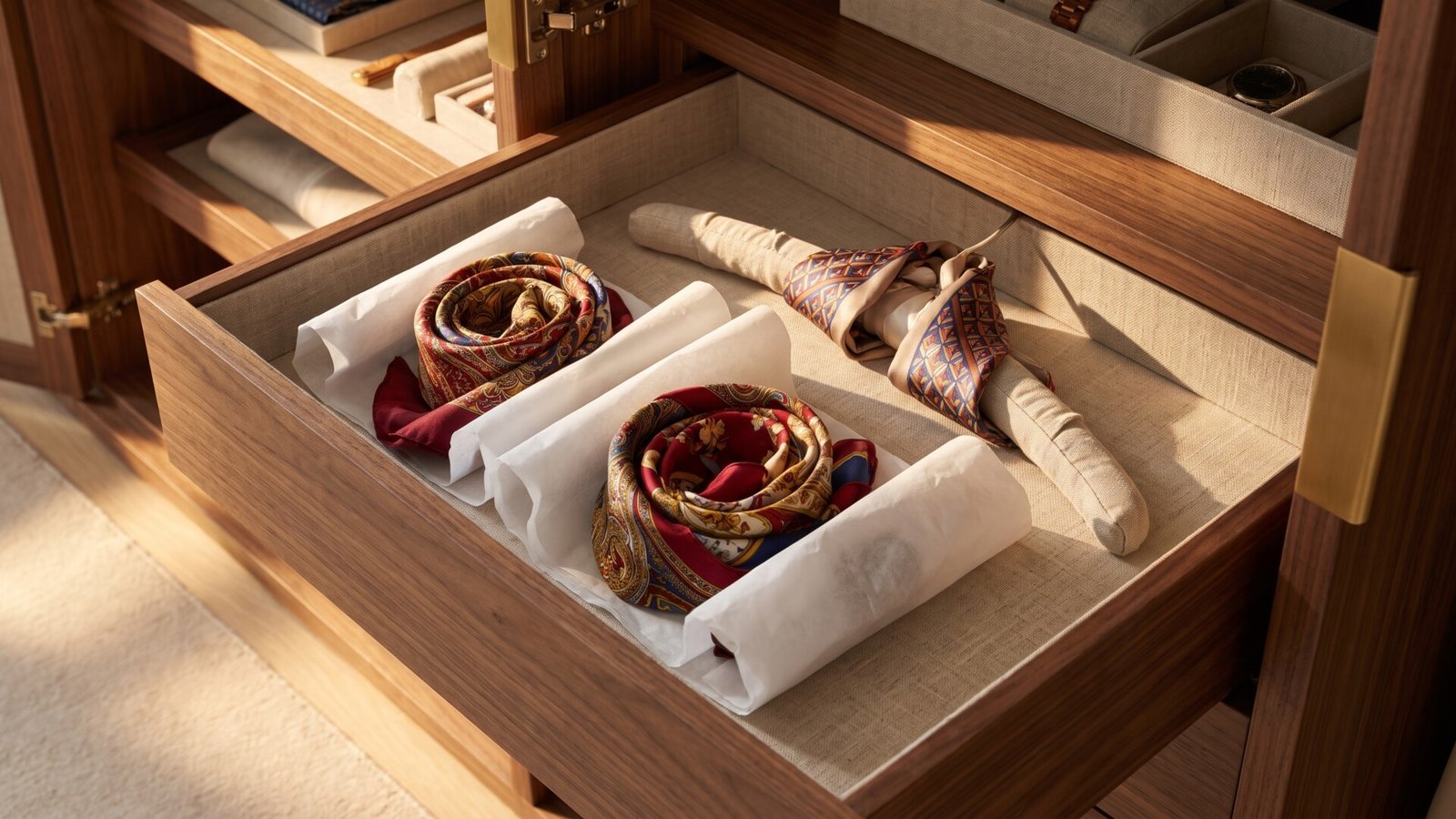
Proper storage for silk Italian scarves (to prevent creasing)
For years, I treated my silk scarves like I treated my t-shirts. I folded them into neat little squares, stacked them in a drawer, and wondered why the ones I loved most started to look tired. The colors were still vibrant, but the fabric had a permanent map of creases that no amount of steam could fully erase. The crisp, liquid drape that made an Italian silk scarf so special was gone.
I learned this the hard way, and it cost me the pristine finish of a few beautiful pieces. The creases weren’t just a cosmetic issue. They were a sign that the delicate silk fibers had been stressed and weakened. The scarf was no longer the same. It was a hard lesson in the fact that owning a luxury item means caring for it with the same intention you used when choosing it.
This article is about saving you from that mistake. We are going to talk about the right way to store your silk Italian scarves, not just to keep them looking good, but to protect the investment you made in them. We will cover the best hanging methods, the correct folding techniques, the ideal environment, and the tools that make it all easier. Let me save you the years of trial and error.
The Art and Legacy of the Italian Silk Scarf
Before we get into the nitty-gritty of storage, it’s worth pausing to remember what we are actually protecting. An Italian silk scarf is not just a piece of fabric; it is a portable piece of art. The history is deep, with the craft being perfected in places like Como, a town in Northern Italy that has been synonymous with silk production since the 15th century.
The best Italian scarves are often made from seta, a specific type of mulberry silk known for its exceptional length, strength, and natural luster. The printing process itself is a feat of engineering and artistry. Many houses still use traditional techniques like cadrage, a method of screen-printing that requires each color to be applied separately, with painstaking precision. When you hold one of these scarves, you are holding the result of hundreds of hours of skilled labor, passed down through generations.
This is why proper storage matters so much. You aren’t just preserving a fashion accessory; you are preserving a piece of heritage. The way you store it is a direct reflection of your respect for that craftsmanship. A well-cared-for scarf can be passed down, its colors as rich as the day it was made. A poorly stored one loses its value, both monetary and sentimental, in a few short years.
Understanding the Nature of Silk
To store silk correctly, you have to understand what you are dealing with. Silk is a protein fiber, similar to human hair. This is the key to everything. It is not a synthetic polymer like polyester, which is essentially plastic and can be treated with a certain amount of brute force.
Silk is composed of fibroin, a protein that gives it its strength, and sericin, a gum-like substance that holds the fibers together. This structure makes silk incredibly strong for its weight, but it also makes it inherently sensitive. It is hygroscopic, meaning it absorbs and releases moisture from the air easily. That is why it feels so cool in summer and warm in winter. But it also means it reacts to its environment.
The fibers are also prone to what is called fibrillation, where the tiny micro-fibers on the surface can become roughed up and dull. This happens when the fabric is rubbed, twisted, or crushed. Creasing is a form of this damage. When you fold a silk scarf and leave it under a heavy stack of clothes, you are literally breaking the bonds between the fibers at that stress point. The crease is not just a wrinkle; it is a sign of structural damage. This is why you need to store it in a way that avoids sharp, prolonged pressure on the fabric.
The Storage Mistakes That Ruin Silk
We have all been guilty of these at some point. Let’s look at the three biggest culprits that damage silk scarves, so you can recognize them and avoid them.
The Creasing Catastrophe
This is the most common problem. It happens when you fold a scarf in half, then in half again, and then again, creating a small, dense square. The sharp folds at the edges of that square are under immense pressure. Over time, those folds become permanent. You can try to iron them out, but ironing silk is a risky endeavor that can easily burn or shine the fabric. The crease becomes a permanent part of the scarf’s landscape, catching the light differently and ruining the smooth flow of the design.
The Fading Enemy
Silk is notoriously sensitive to light, especially direct sunlight. The ultraviolet (UV) rays in sunlight are powerful enough to break down the chemical bonds in the dye molecules. This causes the colors to fade, often unevenly. I have seen scarves left on a shelf near a sunny window where one side is a beautiful, rich color and the other is a washed-out, pale version of itself. This is irreversible damage. The scarf’s beauty is literally bleached away.
The Environmental Assault
Humidity is another silent killer. A damp environment can cause the silk fibers to swell and weaken. It can also create the perfect breeding ground for mold and mildew. These are not just unsightly; they can eat into the protein of the silk, leaving behind permanent stains and a musty odor that is nearly impossible to remove. On the flip side, an environment that is too dry can make the silk brittle and prone to tearing. The goal is always a stable, moderate environment.
The Right Way to Store Your Silk Scarves
Now, for the practical advice. There are three primary methods for storing silk scarves: hanging, folding, and rolling. Each has its place, and the best choice depends on your space and the number of scarves you own.
Hanging Silk Scarves
Hanging is a great option because it prevents creases entirely. The scarf hangs at its full length, with no folds to stress the fibers. But you have to do it correctly.
The biggest mistake people make is draping a silk scarf over a standard wooden or plastic hanger. The weight of the scarf can cause it to slip, and the sharp edge of the hanger can create a permanent dent in the fabric. You need a specialized solution.
The best option is a scarf hanger. These are designed with multiple rings or slots that allow you to thread the scarf through, so it hangs gently without any sharp pressure points.
- Household Essentials Scarf Hanger: This is a classic, reliable choice. It features multiple swivel arms with smooth slots. You simply fold the scarf in half, drape it over the slot, and pull the ends through. It holds the scarf securely in place, preventing it from slipping, and the smooth plastic won’t snag the delicate silk. It can hold up to 30 scarves, making it perfect for a growing collection. [Affiliate: Check the price for the Household Essentials Scarf Hanger on Amazon]
The key is to make sure the scarf is hanging freely and not touching the floor or another garment that could rub against it.
The Art of Folding
If you prefer to keep your scarves in a drawer, folding is fine, but you have to do it in a way that minimizes pressure on the fibers.
Here is the step-by-step method I use now:
- Lay the scarf flat: Start by laying the scarf out on a clean, flat surface like a bed or a large table. Smooth out any wrinkles with your hands.
- Fold in half: Fold the scarf in half to create a long rectangle. Try to match the corners perfectly.
- Fold in half again: Fold the rectangle in half once more, so you now have a longer, thinner strip.
- Roll, don’t fold: Here is the crucial step. Instead of folding the strip into a square, gently roll it into a loose cylinder. This is the “rolling” technique mentioned in the outline, and it is the secret to keeping silk crease-free in a drawer.
- Store separately: Place the rolled scarf in its own drawer or in a compartment where it won’t be pressed under the weight of other items.
This rolling technique is superior to folding because it avoids creating sharp, high-pressure creases. The curve of the roll is gentle and does not stress the fibers.
The Rolling Alternative
As mentioned above, rolling is the best alternative to folding. It is also a fantastic space-saver. You can roll multiple scarves and stand them on end in a drawer, like files in a cabinet. This allows you to see all your options at a glance without having to dig through a pile.
To do this, you can use the same method as above, but instead of making a thin strip, you can fold the scarf in half once and then roll it from one end to the other. The result is a compact roll that is easy to store and gentle on the fabric.
Creating the Ideal Storage Environment
The method you choose is only half the battle. The environment where you store your scarves is just as important.
Temperature and Humidity
Silk prefers a cool, stable environment. The ideal temperature is between 60 and 70 degrees Fahrenheit, with a relative humidity of around 50 to 55 percent. This is the same climate that is recommended for storing fine art and antique books.
Avoid storing your scarves in an attic or a basement, where temperature and humidity can fluctuate wildly. A closet in your bedroom is usually perfect. If you live in a particularly humid climate, consider using a dehumidifier in your closet. If it is very dry, a small humidifier can help prevent the silk from becoming brittle.
Breathable Storage
This is a mistake I see all the time. People use plastic dry-cleaning bags or airtight plastic containers to “protect” their silk. This is a terrible idea. Plastic traps moisture, which can lead to mildew and yellowing.
You need breathable storage. The best options are:
- Cotton or muslin bags: These are ideal. They allow the silk to breathe while protecting it from dust and light. You can find these at most home goods stores.
- Ziploc Big Bags for Clothing: While the name says “Ziploc,” these are not the thin, airtight food storage bags. These are large, heavy-duty bags designed for clothing. They are made of a thicker, more breathable material and feature a sturdy zipper. They are excellent for storing seasonal items, like heavy silk scarves in the summer. They protect against dust and pests while still allowing some airflow. [Affiliate: Check the price for Ziploc Big Bags for Clothing on Amazon]
The key is to ensure that whatever container you use is not completely airtight. Your silk needs to breathe.
Complementary Care to Prevent Creasing
Storing your scarf correctly is the main event, but a few supporting habits will make a world of difference.
The Cleaning Ritual
You should not wash your silk scarves often. In fact, less is more. Over-washing strips the silk of its natural luster and can dull the colors. I recommend cleaning your scarves at the end of the season, before you store them for a long period.
When you do clean them, you must use a detergent specifically formulated for silk. Regular detergents contain enzymes and harsh chemicals that can damage protein fibers.
- The Laundress Delicate Wash: This is a favorite of mine. It is a pH-neutral, plant-based formula that is safe for silk and other delicate fabrics. It is gentle enough to use by hand or in the washing machine on a delicate cycle. It also contains a light, clean scent that is not overpowering. [Affiliate: Check the price for The Laundress Delicate Wash on Amazon]
Always hand-wash in cool water or use the most delicate machine cycle your washer has. Never wring or twist the scarf to remove water. Instead, gently press the water out and lay it flat on a clean, dry towel to air dry.
Avoiding the Sun
This is a non-negotiable rule. Never dry a silk scarf in direct sunlight. The UV rays will fade the colors and weaken the fibers. Always dry it in a shaded area with good air circulation. And when you are storing your scarves, make sure they are in a dark place, away from windows and direct light.
The Investment Perspective: Why Good Storage Pays
Let’s talk about the money side of this. A high-quality Italian silk scarf is not cheap. Prices can range from $200 to over $1,000, depending on the designer and the complexity of the print. You made a deliberate choice to buy it. The question is: are you making a deliberate choice to maintain it?
Think about the cost-per-wear. If you buy a $500 scarf and wear it 100 times, that is $5 per wear. That is a great value. But if you store it improperly and it becomes creased and faded after 20 wears, the cost per wear jumps to $25, and you have a scarf that you are embarrassed to wear. The math is simple.
Proper storage is the cheapest insurance you can buy for your luxury items. A $15 scarf hanger or a $20 set of storage bags can extend the life of your $500 scarf for years, if not decades. It is an investment in the longevity of your wardrobe.
This is where the “money” aspect of this article comes into play. It is not just about aesthetics; it is about protecting your assets. A well-maintained silk scarf also holds its resale value significantly better than one that has been mistreated. If you ever decide to part with a piece from your collection, you will be able to command a much higher price if it is in pristine condition.
How Proper Storage Elevates Your Style
Beyond the financial logic, there is a more personal benefit. A scarf that is stored correctly is ready to be worn. It drapes beautifully, ties perfectly, and looks like a million bucks. This transforms how you use it.
Think about the difference. You are getting ready for a dinner out. You open your drawer, and your scarves are neatly rolled. You pull out the one you want. It is smooth, vibrant, and smells fresh. You can tie it around your neck, wear it as a headband, or knot it onto your handbag. It instantly elevates a simple outfit.
Now, imagine you have to dig through a pile of folded scarves, pull one out, and find it covered in creases. You have to spend time steaming it, hoping the creases come out. The spontaneity is gone. You feel frustrated, and you might even skip the scarf altogether. The scarf becomes a burden instead of a joy.
Proper storage is not just about maintenance; it is about accessibility and inspiration. When your collection is organized and pristine, you are more likely to use it. You will find new ways to style your scarves. You will rediscover pieces you forgot you owned. It makes the entire experience of owning luxury fashion more enjoyable.
The Secret at the Heart of Silk
I learned this too late for my first silk scarves. I hope you learn it in time for yours. The secret is that the care you give a beautiful object is a reflection of the pleasure you take in it. It is a quiet, daily ritual of respect. It is the act of folding a scarf not just to put it away, but to ensure it will be there for you tomorrow, and for years to come.
The creases I created in my early scarves are a permanent reminder of my own carelessness. They are a map of my mistakes. But they also taught me the value of slowing down, of paying attention to the details, and of treating my belongings with the same intention I use in every other part of my life.
A well-stored silk scarf is more than just a garment. It is a testament to your appreciation for beauty and your commitment to preserving it. The scarf you carry in your heart, the one you store with care, is the one that will carry you through countless seasons, always ready to add a touch of elegance to your day.
[Shop Scarf Storage Solutions] [Explore More Silk Care Tips]
Frequently Asked Questions About Silk Italian Scarves Storage
How often should I clean my silk scarves?
You should clean them sparingly. I recommend once or twice a year, or at the end of the season before storing. Over-washing is more harmful than under-washing. If a scarf is only lightly worn, you can simply air it out for a few hours to refresh it before putting it back in storage.
Can I store my silk scarves in a humid environment?
It is not recommended. High humidity can cause the silk to weaken and create a breeding ground for mold and mildew. If you live in a humid climate, you should use a dehumidifier in your storage area and ensure your scarves are in breathable bags. Silica gel packets can also help absorb excess moisture.
What should I do if my silk scarf gets creased?
First, do not panic. If the crease is fresh, you can often remove it by hanging the scarf in a steamy bathroom for a few minutes. The steam will help relax the fibers. For stubborn creases, place a clean, dry pressing cloth over the scarf and use a warm (not hot) iron on the silk setting. Never iron silk directly, as it will leave a shiny mark.
Is it safe to use a clothes dryer for silk scarves?
Absolutely not. The heat and tumbling action of a dryer will damage the silk fibers, causing them to weaken and become rough. It will also set creases and cause shrinkage. Always air dry your silk scarves flat on a clean towel, away from direct sunlight.
How do I choose the right storage bag for my scarves?
You want a bag that is breathable. Look for materials like cotton, muslin, or a non-woven fabric. Avoid airtight plastic bags. The Ziploc Big Bags for Clothing are a good option because they are made of a breathable material and are large enough to hold several scarves without crushing them.
Are there special hangers designed specifically for silk scarves?
Yes. The Household Essentials Scarf Hanger is a perfect example. It has multiple smooth, slotted arms that hold the scarf gently without creating pressure points. It is a much better option than draping a scarf over a standard hanger, which can cause it to slip or create a dent.