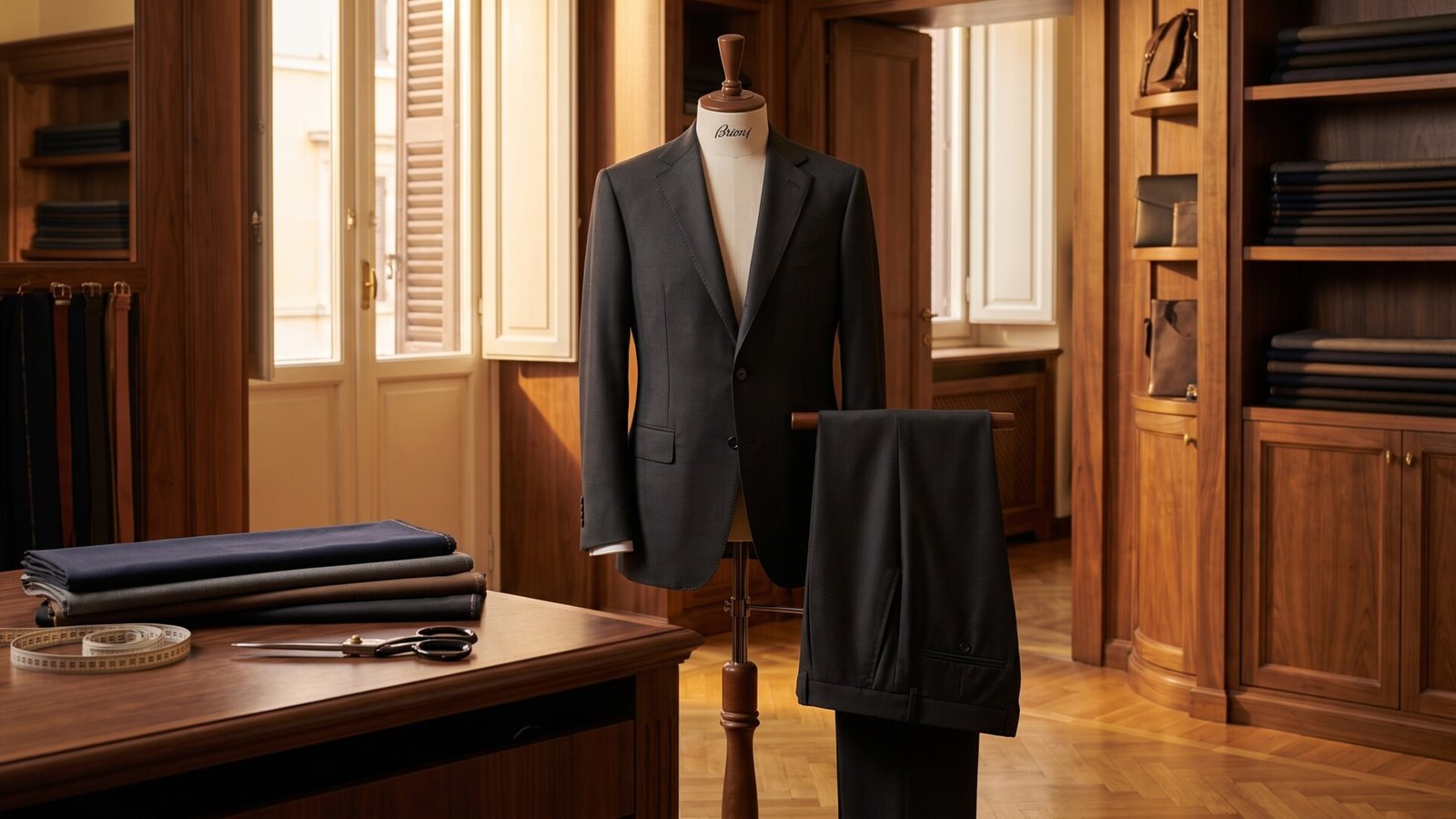
Brioni: The Definitive Guide to Roman Tailoring and Ultra-Luxury Menswear
Brioni is a Rome-founded tailoring house, established in 1945, known for structured, canvassed suits and an authoritative silhouette that sets it apart from the softer Neapolitan school. It is owned by the French group Kering and produces its tailoring largely in Penne, in Italy’s Abruzzo region. If you are asking “what is a Brioni suit?”, the short answer is a firmly shaped, full-canvas Italian suit with a clean shoulder, a defined chest and a suppressed waist, priced in the upper tier of ready-to-wear tailoring.
This guide covers the brand’s Roman heritage, how its suits are built, what each product category offers, how Brioni compares with Kiton, Canali and Zegna, what you are actually paying for, and how to look after a suit once you own one. It is part of our wider look at Italian designer brands.
Brioni Heritage and the Rise of Roman Tailoring
Founding in Rome
Brioni was founded in Rome in 1945 by Nazareno Fonticoli, a master tailor, and Gaetano Savini, who handled the business side. The first shop opened on Via Barberini in the centre of Rome. Where Neapolitan tailoring favours an unstructured, lightweight jacket, the Roman house built its reputation on a cleaner, more upright line.
The name refers to the Brioni (Brijuni) Islands off the Croatian coast, a resort archipelago that served as the summer residence of Yugoslav president Josip Broz Tito. The brand has long courted an international clientele, and in 1952 it staged what it describes as the first men’s fashion show, in the Sala Bianca of Florence’s Palazzo Pitti.
The Roman Style Identity
Roman tailoring is usually described as sitting between the soft Neapolitan school and the sharper Milanese tradition. In Brioni’s case that means a defined shoulder, a fitted chest, a suppressed waist and a balanced, slightly formal profile. A Brioni jacket is meant to hold its shape rather than drape, creating a V-shaped line from shoulder to waist.
Brioni opened its production plant in Penne, in the Abruzzo region, in 1959, which is also when the house moved into ready-to-wear. Penne remains the heart of its manufacturing today, alongside other sites in the region.
Brioni’s Role in Global Luxury Menswear
Brioni became known beyond Italy in the 1950s and 1960s. John Wayne was fitted at the Rome atelier in that period, and Clark Gable and Cary Grant are among the Hollywood names the house is reported to have dressed. In the 1990s it became a fixture of film product placement: Pierce Brosnan wore Brioni as James Bond from GoldenEye (1995), and Daniel Craig wore it in Casino Royale (2006). Earlier Bond actors, including Sean Connery, are not documented as Brioni clients, so the association belongs to the Brosnan and Craig era.
Since 2011 Brioni has been part of Kering, the group that also owns Gucci and Bottega Veneta. Creative leadership has changed often: Brendan Mullane (2012), Justin O’Shea (2016), Nina-Maria Nitsche (2017–2018) and Norbert Stumpfl, who joined in 2018 and was reported to be leaving in December 2025 after seven years, with no successor named in the reports we found. Check Brioni’s own channels for the current line-up before relying on any of this.
What Defines a Brioni Suit?
Structured Roman Tailoring Philosophy
The defining trait is structure. The shoulder carries a moderate amount of shaping for a clean, horizontal line, the chest is built over a canvas interlining that holds its form, and the waist is suppressed without being pinched. The structure is meant to support the body rather than restrict it. Independent reviewers have noted that Brioni’s interlinings are softer than those in many English or German bespoke jackets, so “structured” here does not mean stiff.
Precision Construction
Brioni combines machine and hand work. In a 2023 review, Gentleman’s Gazette examined two Brioni jackets and found them fully canvassed, with handmade buttonholes and hand pick stitching, but also a machine-attached collar and very regular machine stitching along the front. The reviewer concluded there was less handwork than at an Italian bespoke tailor at a similar price. That is a useful reference point: Brioni sells refined industrial tailoring, not bespoke in the strict sense.
The house’s own marketing cites a process of around 220 steps and more than 24 hours of work per garment. Treat that as the brand’s claim, not an independent measurement.
Fabric Selection
Brioni works with fine wool, cashmere blends, silk and linen, and its suits are generally cut from high-count worsteds. Individual cloth specifications, mills and fibre counts vary by season and collection, so check the label or ask the boutique rather than assuming a particular Super number or mill. If a specific fibre such as vicuña matters to you, ask for written confirmation.
Fit Discipline
A Brioni suit is cut close to the body without being tight. Armholes sit relatively high, which helps keep the jacket from lifting when you raise an arm, and the collar is designed to sit flush against the neck. Trousers are offered flat-front or with pleats depending on the model, and the overall effect is sculpted rather than relaxed. As with any structured jacket, fit at the shoulder and collar is the part a tailor cannot easily change later, so get those right first.
Brioni Craftsmanship and Production Standards
Tailoring as Engineering
Brioni treats tailoring as a controlled process. Components are cut to consistent patterns, and different people handle different stages. This is how the house has been able to produce at scale: Gentleman’s Gazette reports a peak of about 70,000 suits a year, with more than 1,000 people working in its tailoring facilities. The trade-off is that individual garments reflect a system rather than one tailor’s hand.
Hand-Finishing Elements
Where Brioni does use hand work, it is concentrated in details: buttonholes and pick stitching were found to be hand-done in independent review. Sleeve lining and other internal details varied between the older and newer jackets examined. If hand-finishing is a priority for you, ask which stages of the specific garment are done by hand and look at the buttonholes and lapel edges in person.
The Tailoring School in Penne
In 1985 Brioni opened its Scuola di Alta Sartoria in Penne to train new tailors. According to FashionUnited, the school, named after founder Nazareno Fonticoli, reopened in September 2024 with a two-year programme for sixteen apprentices. For a house that makes most of its tailoring in one Abruzzo town, the school is a practical answer to a shortage of skilled hands.
Made-to-Measure Heritage
Brioni’s made-to-measure service, often called Su Misura, starts from the house block and adjusts it to your measurements, with cloth, lining and details chosen from the house range. It is a made-to-measure programme rather than full bespoke, which would begin with a pattern drafted from scratch. Reviewers place made-to-measure prices at up to roughly $10,000 with premium cloths. Ask the boutique about lead times, the number of fittings and whether adjustments are included in the price.
Core Product Categories
Brioni prices change by season and country. The USD figures below come from published reviews and are indicative only. Confirm current prices on brioni.com or with a boutique before buying.
Suits (Core Identity)
The heart of the house: business suits in navy, charcoal and grey, formal and evening suits, and softer-structured suits for executives who want less formality. Single-breasted two-button jackets are the commonest silhouette, with double-breasted and three-piece options also in the range. Gentleman’s Gazette suggests suits start around $5,000 and that made-to-measure can reach roughly $10,000 with nicer cloth. Retail listings for current models fall in a similar upper-four-figure band.
Blazers and Jackets
Structured sport coats in wool, cashmere, cotton and linen, designed to be worn with tailored trousers or jeans. Brioni also makes softer, less constructed blazers that keep the Brioni shoulder but drop some of the internal structure. Ready-to-wear jackets start around $3,000 and most land between about $4,000 and $5,000-plus, based on 2023 reporting.
Shirts
Dress shirts in poplin and twill, plus casual shirting in linen and flannel. Brioni shirts are known for refined collar construction. We have not verified current shirt pricing, so check the retailer’s listing.
Knitwear
Fine-gauge merino and cashmere sweaters, cardigans and layering pieces in muted tones, designed to sit under a blazer or stand alone. For a deeper look at the category, see our guide to Italian cashmere makers such as Loro Piana and Brunello Cucinelli.
Outerwear
Tailored overcoats in wool and cashmere, plus lighter coats for spring and autumn. If you are weighing a Brioni coat against a technical option, Herno is a useful comparison for a more outerwear-focused Italian brand.
Accessories
Silk neckwear, pocket squares, leather belts and small leather goods. Ties and accessories are the lowest-cost way to buy into the brand, but we have not verified current price bands, so check the retailer’s listing.
Is Brioni a Luxury Brand?
Yes. Brioni is generally classed as ultra-luxury menswear: it is owned by a major luxury group, it sells through its own boutiques and top department stores, and its tailoring is priced well above premium-contemporary brands. Within Italian tailoring it is usually grouped with Kiton and Cesare Attolini at the top of the market, although the three differ in style and in how much hand work goes into each garment.
Why Are Brioni Suits So Expensive?
Several factors combine. First, the cloth: a suit that uses fine worsted, cashmere or silk blends costs far more per metre than standard suiting. Second, the labour: the brand cites around 220 construction steps and 24-plus hours per garment, and it keeps most production in Italy rather than moving it abroad. Third, canvas construction costs more than fused construction, because the interlining is shaped and stitched rather than glued. Finally, there is brand positioning: you are also paying for Brioni’s heritage, boutique network and marketing.
Reviewers are candid that the last item matters. Gentleman’s Gazette rated Brioni’s construction as very good but its retail value as below average, and pointed out that pre-owned jackets can be found for a fraction of retail. If you want maximum hand work per dollar, a small Neapolitan or English maker may deliver more. If you want a consistent, polished, structured suit from a major house, Brioni is a coherent choice.
Brioni vs Other Italian Tailoring Houses
Brioni vs Kiton
Kiton is the benchmark for Neapolitan softness: lightweight canvas, minimal shoulder padding and a fluid silhouette, with a reputation for extensive hand work. Brioni offers a firmer, more upright Roman cut. Kiton suits the buyer who wants to feel unencumbered; Brioni suits the buyer who wants a defined line.
Brioni vs Canali
Canali makes well-constructed suits at lower price points than Brioni, with a more modern classic cut. If you wear a suit several days a week, Canali is a practical choice; Brioni is better aligned with buyers who want a more formal, high-end piece for key occasions.
Brioni vs Zegna
Zegna is fabric-led, with a strong emphasis on its own cloth and on versatile, travel-friendly tailoring. Brioni is tailoring-led, known for shape and formality. Neither is objectively better; they suit different wardrobes.
Brioni vs Giorgio Armani
Armani popularised soft, deconstructed tailoring in the 1980s, and Armani jackets are typically more fluid than Brioni’s. Brioni is the more structured option, aimed at a traditional, formal wardrobe.
Position in the Luxury Hierarchy
Brioni sits in the top tier of Italian tailoring, usually listed alongside Kiton and Cesare Attolini. For a broader view of the category, see our overview of Italian suits.
Italian Tailoring Houses at a Glance
| Brand | Structure | Style Identity | Hand-work reputation | Best For |
|---|---|---|---|---|
| Brioni | High | Roman, formal | High (mixed machine and hand) | Executive tailoring, formal occasions |
| Kiton | Low to medium (soft) | Neapolitan, artisanal | Very high | Soft-tailoring enthusiasts |
| Canali | Medium | Modern classic | Moderate to high | Daily business wear |
| Zegna | Variable | Fabric-led, contemporary | Moderate to high | Versatile wardrobes, travel |
| Armani | Low (soft) | Fashion tailoring | Moderate | Style-focused looks |
Why Brioni Represents “Power Tailoring”
The Psychology of Structure
A strong shoulder and a suppressed waist create a V-shaped line that reads as authoritative, which is why structured tailoring has long been associated with executives and public figures. Brioni has built its identity on that language. That is an observation about styling, not a guarantee about how others will respond.
Why Brioni Is Built for Visibility
Soft tailoring can look relaxed, even rumpled. A Brioni suit is designed to look composed from a distance: crisp lapels, a clean line from shoulder to hem and a precise fit.
The Balance Between Luxury and Discipline
A well-made canvassed jacket is not stiff. The canvas gives shape, while the shoulder and sleeve are cut so that the arm moves freely. The difference between this and a fused suit is internal: one has a shaped, stitched interlining, the other has fabric glued to a stiff backing.
The Misunderstood Value of Structure
Many buyers equate structure with discomfort. In a canvassed jacket the interlining softens and moulds to the wearer over time, which is why a well-fitted jacket tends to feel more comfortable after a period of regular wear.
How to Wear Brioni in a Modern Wardrobe
Executive Formal Wear
A charcoal or navy suit with a white shirt, a navy or burgundy tie and black Oxfords. The structured shoulder carries the look without extra accessories.
Smart Luxury Dressing
A blazer over a fine merino turtleneck, grey flannel trousers and brown suede loafers. The blazer provides structure, the knit provides softness.
Evening Formality
A midnight-blue or black suit with a white shirt, black bow tie and patent or highly polished leather shoes. For a full black-tie look, confirm the dress code first, since a dinner suit (tuxedo) is a different garment from a standard suit.
Modern Adaptations
A softer, less constructed blazer over a plain T-shirt with dark denim and clean leather sneakers. The soft shoulder lets the jacket sit comfortably in a casual outfit.
Choosing a Suit for a Formal Summer Wedding
For a warm-weather formal wedding, look for a lighter-weight worsted or a wool-linen blend in mid-grey, light navy or stone. A half-lined or unlined construction is cooler, but not every model is offered that way, so ask the boutique which jackets and cloths are available in the season you are buying. Pair with a white or pale blue shirt, a knitted or silk tie, and leather lace-ups or loafers depending on the dress code. Check the invitation for “black tie optional” or “morning dress” before choosing a business suit.
Building a Formalwear Wardrobe Around Brioni
If you are building a small formal wardrobe, a sensible order is: a navy suit, a charcoal suit, a blazer in a texture such as hopsack or flannel, then evening wear. Rotate two or three suits rather than relying on one, which also helps each one last longer. For related pieces, see our guides to Italian suits and Italian designer clothing.
Investment Value: Is Brioni Worth It?
Cost-Per-Wear Logic
A $6,000 suit worn 50 times a year for 15 years costs $8 per wear. A $1,500 suit worn 50 times a year for three years costs $10 per wear. The calculation is illustrative; it assumes the cheaper suit wears out sooner, which depends on construction, rotation and care.
Longevity and Maintenance
A canvassed suit that is rotated, brushed and cleaned sparingly can last a decade or more, though the lining, trousers seat and cuffs often need repair before the jacket does. Plan for alterations and relining over time.
Resale Market Reality
Brioni pieces circulate on the resale market, but prices vary a lot by condition, size and model. Gentleman’s Gazette cited examples of used jackets selling for $100 to $300, far below retail, so treat resale as a way to buy for less, not as a way to recoup the original price. We have not verified specific resale percentages.
Wardrobe Role
Brioni works best as the suit you reserve for important occasions or for a role where formal presence matters. For ideas on how a single suit can anchor a formal wardrobe, see our guide to Brioni suits for a modern CEO.
Buying Guide: New, Made-to-Measure or Pre-Owned
- Ready-to-wear: the simplest route; budget for alterations to sleeves, hem and waist. Fit at the shoulders and collar should be right off the rack.
- Made-to-measure (Su Misura): lets you choose cloth, lining and details, and fits better if your proportions differ from the house block. Ask about fittings, lead time and alteration policy.
- Pre-owned: the best value route, particularly for jackets. Buy from sellers with clear returns and authentication, check the interior labels and lining, and remember that tailoring a structured jacket is limited at the shoulder.
- Authentication: buy from authorised boutiques, department stores or established resale platforms. No checklist can prove authenticity on its own.
Care and Maintenance Guide
Suit Rotation Strategy
Avoid wearing the same suit two days in a row. Resting it for a day or more lets the wool recover its shape and release moisture.
Dry Cleaning Guidelines
Dry clean only when needed, since repeated cleaning can dull wool and stress the canvas. Between cleanings, brush the suit and air it out. For a valuable suit, use a tailor or cleaner experienced with structured garments.
Storage Requirements
Hang suits on wide, shaped wooden hangers in breathable cotton garment bags, never plastic. Store in a cool, dry closet away from direct sunlight, and use cedar or another moth deterrent for wool.
Tailoring Maintenance
Have a skilled tailor check seams, buttons and hem once a year, and fix small issues quickly.
The Future of Brioni and Roman Tailoring
Evolving Workplace Dress Codes
As workplaces dress down, Brioni has widened its offer to include softer jackets and knit-based pieces, while keeping structured tailoring at its core.
Leadership and Ownership
Kering has owned Brioni since 2011 and has repeatedly denied press rumours of a sale. In late 2025 reports said the house’s long-serving creative lead, Norbert Stumpfl, was leaving and that Kering was reassessing priorities for its tailoring business. Brioni’s direction under new design leadership is worth watching, and we will update this guide as the house confirms changes.
Sustainability in High-End Tailoring
A suit that lasts many years reduces replacement purchases, which is the most practical sustainability argument for high-end tailoring. We have not verified specific claims about Brioni’s fabric traceability or sourcing programmes, so check the brand’s own sustainability reporting for details.
Frequently Asked Questions About Brioni
What is a Brioni suit?
A Brioni suit is a canvassed Italian suit from the Rome-founded house Brioni, known for a structured shoulder, a defined chest and a suppressed waist. Most tailoring is made in Penne, Abruzzo.
What makes Brioni different from other Italian suit brands?
Brioni is defined by structured Roman tailoring, with a defined shoulder and a clean silhouette. That sets it apart from the softer Neapolitan look of Kiton or the fabric-led approach of Zegna.
Is Brioni a luxury brand?
Yes. It is an ultra-luxury menswear house, owned by Kering since 2011, with tailoring priced in the upper four figures in USD for suits.
Why are Brioni suits so expensive?
The price reflects fine cloth, canvassed construction, a labour-intensive process the brand puts at around 220 steps, Italian production and brand positioning. Reviewers note that retail value is lower than the construction quality alone would suggest, and pre-owned pieces cost far less.
Are Brioni suits worth it?
It depends on your priorities. If you want a polished, structured suit from a major house for important occasions, many buyers find it worthwhile. If you prioritise maximum hand work per dollar, smaller makers may offer more. Pre-owned is the best value route.
Is Brioni better than Kiton?
They serve different tastes. Brioni is structured and formal; Kiton is soft and strongly hand-finished. Choose Brioni for a defined line and Kiton for a softer, more artisanal feel.
How long does a Brioni suit last?
With rotation, brushing and occasional professional care, a canvassed suit can last a decade or more. Linings, trouser seats and cuffs usually need repair before the jacket does.
Can Brioni suits be worn casually?
The softer blazers and knit pieces are designed for smart-casual wear. The classic structured suits suit formal and professional settings.
Is Brioni still handmade?
Brioni combines machine and hand work. Independent review found handmade buttonholes and hand pick stitching, with machine-attached collars and machine front stitching, so it is not fully handmade.
Did Sean Connery wear Brioni as James Bond?
There is no documented evidence of that. Pierce Brosnan wore Brioni as Bond from GoldenEye (1995), and Daniel Craig wore it in Casino Royale (2006).
Which Brioni suit is best for a summer wedding?
Look for a lightweight worsted or wool-linen blend in mid-grey, light navy or stone, and ask the boutique which cloths and lining options are available this season.
Does Brioni offer made-to-measure?
Yes. Brioni’s Su Misura service adapts the house block to your measurements. Reviewers have placed made-to-measure at up to roughly $10,000 with premium cloths, so confirm current pricing and lead times with the boutique.
Conclusion
Brioni offers structured, canvassed Roman tailoring from a major luxury house. It rewards buyers who value a defined silhouette and consistent finishing, and it is less compelling if your priority is maximum handwork per dollar. Try the shoulders and collar in person, ask which stages are done by hand, and consider made-to-measure or pre-owned if you want better value.
Explore more Italian luxury: Italian Designer Brands | Italian Suits | Italian Designer Clothing | Kiton | Canali | Zegna | Loro Piana | Brunello Cucinelli